
TL;DR
A wheelbarrow tire that repeatedly loses air usually has one of five problems: a puncture, leaking valve, damaged tube, poor bead seal, or cracked or rusted rim. Choose a tube for dependable cushioning, compatible sealant for small tread punctures, or a correctly sized flat-free wheel when puncture-free uptime matters more than ride comfort.
A flat tire can turn a two-minute mulch run into a sweaty drag across the yard. You load three bags, lift the handles, and hear that soft rubbery squirm as the wheel folds under the weight. The first instinct is to add air, but repeated inflation treats the symptom, not the leak.
This guide helps you find the failure and choose among a new inner tube, liquid tire sealant, or a flat-free wheel. You will learn what bubble patterns reveal, why a new tube sometimes dies on its first trip, and which wheel measurements matter before you spend a cent.
The tradeoff is straightforward but easy to miss. Pneumatic tires roll softly over roots and gravel, while solid or cellular wheels shrug off thorns and months in the shed. Your best choice depends on load, terrain, rim condition, and how much downtime you will tolerate—not on whichever fix sits closest to the checkout counter.
Use soapy water on the tread, valve core, stem base, beads, rim seams, and rusty areas before choosing a repair.
Fit a new tube when the casing and rim remain sound and you want better cushioning over roots, gravel, or ruts.
Reserve compatible sealant for small tread punctures; replace tires with sidewall cuts, exposed cords, failed beads, or major cracking.
Choose a load-rated flat-free wheel for thorn-heavy acreage, construction debris, long storage, or badly deteriorated tire-and-rim assemblies.
Measure axle diameter, hub length, offset, wheel clearance, bearing type, and load capacity because a universal label does not guarantee fit.
Wheelbarrow Tire Keeps Going Flat: Tubes, Sealant or Solid Swap
A repeated flat is a clue, not a diagnosis. Find where the air escapes, inspect the casing and rim, then match the repair to your terrain, load and tolerance for downtime.
Five places the air can escape
Inflate only to the pressure printed on the sidewall. Brush soapy water across the entire assembly; steadily growing bubbles reveal an active leak.
Puncture
Look for thorn tips, nails, wire and glass embedded in the rubber.
Core or stem
Test the opening, then bend the stem gently to expose cracks at its base.
Damaged tube
Pinches, folds and tears may only open when the tire carries a load.
Poor bead seal
Follow both lines where the tire meets the painted steel rim.
Cracked rim
Inspect seams, welds, dents, rust flakes and sharp metal edges.
Trace the leak before choosing the fix
Growing bubbles identify escaping air. A quick wipe and guess can miss a second leak elsewhere on the wheel.
Which option fits the job?
The tire’s condition sets the safety limit. Terrain and work pattern then determine which acceptable solution offers the best value.
| Situation | New tube | Compatible sealant | Flat-free wheel |
|---|---|---|---|
| Sound casing and rim | ✓ Excellent | ✓ Suitable | ~ Optional |
| Small tread punctures | ✓ Reliable | ✓ Best quick fix | ~ More than needed |
| Sidewall cut or exposed cords | ✗ Unsafe | ✗ Will not restore strength | ✓ Replace assembly |
| Thorn-heavy acreage | ~ Repeated risk | ✓ Handles pinholes | ✓ Maximum uptime |
| Rough roots and gravel | ✓ Softest ride | ✓ Keeps cushioning | ~ Firmer ride |
| Severely rusted rim | ✗ New tube at risk | ✗ Metal still unsafe | ✓ Complete replacement |
| Long shed storage | ~ Check pressure | ~ Product may age | ✓ Always ready |
“Universal” does not guarantee a fit
Tire diameter is only the first check. Verify the full mounting chain before buying a replacement wheel.
Some damage should never be hidden by a tube or liquid sealant
Wear eye protection, keep your face away from an old assembly and stop inflating when the tire or rim shows structural failure. Have an uncertain split-rim or multi-piece wheel handled by a tire professional.
The practical verdict
Comfort matters
The casing and rim are sound, and you want dependable cushioning over uneven ground.
The puncture is tiny
The leak is in the tread, the tire remains structurally sound and the formula matches the setup.
Downtime costs more
Thorns, debris, long storage or a deteriorated assembly make puncture-free readiness the priority.
Find the Leak Before You Spend Money
When your wheelbarrow tire keeps going flat, locate the escaping air before buying a tube, sealant, or wheel. A wheelbarrow tire that repeatedly loses air usually has one of five faults: a puncture, a leaking valve, a damaged tube, a poor bead seal, or a cracked or rusted rim.
Start by reading the sidewall and identifying the wheel design. A tube-type pneumatic tire holds air inside a separate rubber tube, while a tubeless tire seals directly against the rim. Flat-free wheels use solid rubber, cellular polyurethane, or another airless structure, and foam-filled pneumatic casings contain cured material rather than pressurized air.
Do not trust the word tubeless on the sidewall as proof of the current setup. Someone may have installed a tube years ago to bypass a leaky bead. I have opened supposedly tubeless garden wheels and found wrinkled tubes inside, rubbed chalky white where they had folded against the casing.
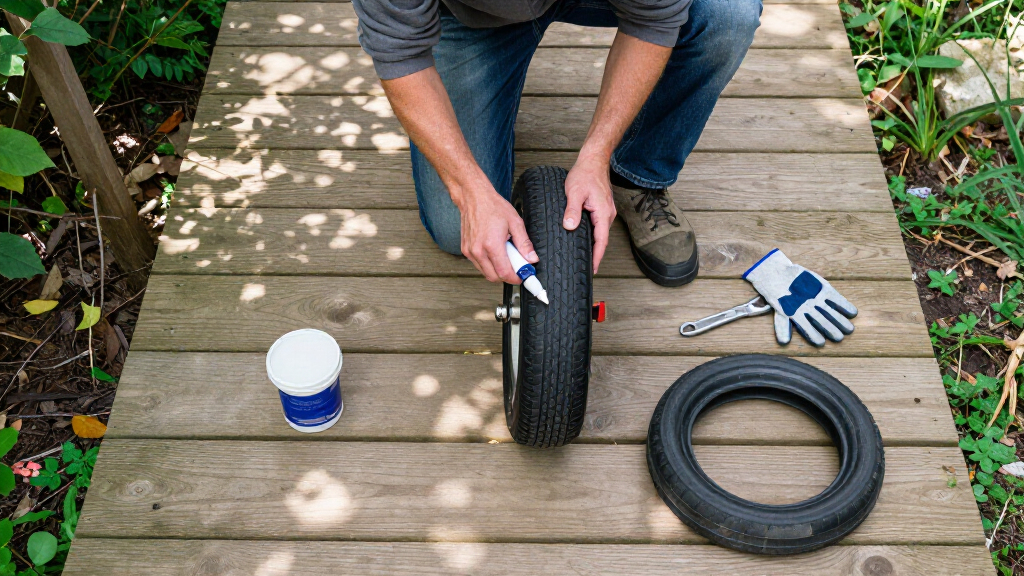
Inflate the tire only to its marked sidewall pressure, put on eye protection, and keep your face away from an old or corroded assembly. Mix water with a few drops of dish soap, then brush or spray it across the tread, sidewalls, valve core, valve-stem base, both beads, rim seams, and rusty spots. Growing bubbles point to active leakage.
- Check the tread slowly for nails, wire, glass, and thorn tips.
- Watch the valve opening for bubbles that indicate a loose or damaged core.
- Bend the valve stem gently and inspect its base for cracking.
- Follow both beads where black rubber meets painted steel.
- Inspect welds, dents, rust flakes, and sharp edges around the rim.
A tire that collapses within minutes likely has a large opening, torn tube, shifted bead, or failed stem. An overnight leak points more often to a pinhole, valve core, bead, or installation pinch. Slow pressure loss over several weeks can come from normal permeation, but you should still check the valve and bead before calling it normal.
Safety warning: Stop inflating if you see exposed cords, a bulge, deep cracking, bead damage, or severe rim corrosion. Have an uncertain split-rim or multi-piece assembly handled by a tire professional; stored air can release with frightening force.
wheelbarrow inner tube replacement
As an affiliate, we earn on qualifying purchases.
As an affiliate, we earn on qualifying purchases.
Choose a Tube When You Want the Smoothest Ride
When your wheelbarrow tire keeps going flat but its casing and rim remain sound, a correctly fitted replacement tube is usually the most dependable low-cost repair. It preserves pneumatic cushioning, rolls well over rough ground, and can bypass minor sealing trouble between a tubeless-rated tire and its rim.
A tube makes sense when the old rubber is cracked, carries several patches, or has torn around the valve. It also works when a slightly imperfect bead refuses to seal but the tire has no cuts, exposed cords, or structural distortion. Installing a tube cannot make a rotten casing safe.
The soft ride matters more than it sounds. Push a loaded pneumatic wheel over fist-sized roots, and the tire flexes around each bump like a padded work boot. With 80 pounds of wet soil in the tray, that give reduces jolts through your wrists and helps keep the load from hopping sideways.
Before fitting the tube, remove the wheel and mark the valve position on the tire. If you find a hole in the old tube, match that location to the casing and rim. A tiny brown thorn, wire sliver, sharp weld, or raised rust scale often remains inside, ready to puncture fresh rubber on the first lap around the garden.
Run a gloved hand around the casing rather than dragging bare fingertips across possible wire. Smooth minor rim burrs, clean loose rust, and replace a torn rim strip. If corrosion has eaten deep pits or weakened the metal, replace the complete wheel instead of hiding the damage beneath a new tube.
Add just enough air to give the new tube a soft, round shape before seating the second bead. That small puff keeps it from folding like an empty sandwich bag. Use rounded tire tools, take shallow bites, and never stab at the bead with a screwdriver, which can pinch the tube against the rim.
A patch is reasonable for one small, accessible puncture in supple rubber. Replace the tube when the damage reaches the valve base, the tube feels brittle, or old repairs crowd the surface. According to Outdoor Pro Masters, repeated holes in the same area usually mean an embedded object, rim burr, or damaged rim strip remains in the assembly [1].
As an affiliate, we earn on qualifying purchases.
Use Sealant for Small Punctures, Not Broken Tires
Tire sealant works best on small tread punctures in an otherwise sound tube or tubeless tire. Choose a formula labeled for low-speed lawn, garden, or utility tires and verify whether it supports tubes, tubeless assemblies, or both. Sealant cannot restore strength to damaged rubber or metal.
The liquid spreads as the wheel turns and reaches tiny escape paths from the inside. When a thorn opens a pinhole, fibers or suspended particles collect at that opening while the carrier fluid helps form a plug. On a property lined with hawthorn or locust trees, this can stop several needle-sized leaks without repeated bead removal.
Imagine clearing brush along a half-acre fence line. You pull three pale thorns from the tread, add the labeled amount of compatible sealant, inflate to the sidewall specification, and rotate the wheel. A faint wet hiss fades as the punctures close; that is the kind of damage sealant handles well.
It performs poorly on sidewall cuts, torn valve stems, large holes, split tubes, separated tread, damaged beads, and severely corroded rims. Those parts flex or move too much for a reliable liquid plug. A dark gash that opens when you squeeze the sidewall calls for tire replacement, even if sealant slows the bubbles.
- Use the quantity stated for the tire size and construction.
- Remove an embedded object only when you are ready to seal or repair the opening.
- Rotate the wheel after filling so the liquid reaches the tread.
- Set final pressure with a gauge rather than judging firmness by hand.
- Check the maker’s service interval because sealant can dry, settle, or need replenishment.
More liquid does not automatically make a stronger repair. Excess sealant adds weight, can create an off-balance lurch, and leaves a sticky puddle when someone later removes the tire. Product chemistry also varies, so follow its stated compatibility with steel or aluminum rims and disclose the sealant before professional service.
Aerosol inflate-and-seal cans suit roadside-style emergencies better than planned wheelbarrow care. They may leave the tire below its required pressure and make the permanent repair messier. Never substitute household expanding construction foam; it cures unevenly, lacks controlled tire density, and can ruin the wheel.
liquid tire sealant for wheelbarrows
As an affiliate, we earn on qualifying purchases.
As an affiliate, we earn on qualifying purchases.
Compare Tubes, Sealant, and Flat-Free Wheels at a Glance
The best repair depends on where the air escapes, how often you meet thorns, and whether you value a soft ride or zero inflation checks. A tube gives the best all-around cushioning, sealant handles small recurring punctures, and a flat-free wheel provides the most predictable uptime on hostile ground.
| Choice | Best fit | Ride and effort | Main limitation |
|---|---|---|---|
| Patch or new tube | Sound casing and rim; puncture or old tube failure | Soft over roots; usually easy rolling at correct PSI | Can suffer thorns, pinches, or installation damage |
| Compatible sealant | Small tread holes; recurring thorn exposure | Keeps the pneumatic feel with little added effort | Dries over time and will not repair structural damage |
| Flat-free wheel | Debris, nails, long storage, or badly deteriorated wheel | Firmer; some models bounce or drag under heavy loads | Less cushioning and possible compression under load |
For a suburban wheelbarrow moving compost across smooth pavers twice a month, either a sound tube or a flat-free wheel can serve well. The tube feels quieter as it crosses the joints, while the airless wheel will still be ready after winter storage. Your choice mostly comes down to whether you mind checking PSI.
For regular loads of stone across rutted ground, a quality pneumatic tire usually wins on comfort and flotation. It spreads slightly over loose soil instead of digging in like a narrow hard roller. This works well, except when sharp demolition scraps or thorn stubs create so many punctures that repair time outweighs the smoother ride.
A flat-free wheel earns its keep around barns, renovation debris, and thorn-heavy acreage. Modern cellular polyurethane designs offer more give than old solid-rubber wheels, but they still pass more vibration into the handles. Under a dense load of broken concrete, a cheaper foam wheel may feel slightly flattened and resist turning.
Flat-free does not mean wear-free. Tread can abrade, foam can deform, and hub bearings or bushings can loosen. A wheel that cannot leak may still wobble like a bent dinner plate after years of overloading, so load rating and hub construction matter as much as the tire material.
heavy-duty wheelbarrow solid wheel
As an affiliate, we earn on qualifying purchases.
As an affiliate, we earn on qualifying purchases.
Measure These Parts Before Buying a Solid Swap
If your wheelbarrow tire keeps going flat and you want a permanent airless replacement, measure the axle, hub, wheel, and frame clearance before ordering. The tire size molded into the sidewall identifies only part of the fit. A so-called universal wheel may still bind, wobble, or sit off-center.
Common markings such as 4.00-6 help identify the tire family, but they do not tell you the full axle diameter or usable hub length. Measure the shaft with calipers if possible, then measure from one outside hub face to the other. Check whether the wheel runs on sealed bearings, sleeve bearings, or plain bushings.
One owner can buy the right tire diameter and still lose an afternoon because the hub is an inch too short. Tightening the axle nut then pulls the frame ears inward, pinching the wheel until it turns like a rusty winch. Correct spacers may solve a small gap, but they cannot correct a wheel that is too wide for the frame.
- Overall diameter and width: Confirm the tire clears the tray, braces, and ground through its full rotation.
- Axle diameter: Match the bore or use only purpose-made adapter bushings supplied for the wheel.
- Hub length: Measure the space between the frame supports without bending them inward.
- Wheel offset: Check that the tire sits centrally and does not rub a brace.
- Load rating: Include the tray, cargo, impact from bumps, and the pressure you apply through the handles.
- Tread direction: Follow any arrow molded into an directional tread pattern.
A complete flat-free wheel is usually easier to fit than pressing a solid tire onto the old rim. Some solid tires need specialized tools, heat, or a shop press, and forcing one with improvised levers can damage the rim or your hands. Wear gloves and eye protection, and let a tire shop handle a fit that requires heavy pressing equipment.
Also inspect the axle bolt, washers, spacers, and frame holes while the wheel is off. A fresh airless wheel cannot cure an oval frame hole or a deeply grooved axle. If the tray carries regular heavy loads, choose a wheel with a clearly stated capacity rather than relying on appearance or the universal label.
Stop Repeat Flats With Better Pressure and Storage Habits
A wheelbarrow tire keeps losing air when pressure, storage, or rim care lets small problems grow. Use the pressure molded into the sidewall, check it before heavy hauling, keep the valve capped, and store the wheel away from sun, standing water, and sharp debris. These habits take minutes and prevent many repeat failures.
Underinflation makes the tread look broad and sluggish. It increases rolling resistance, lets the sidewall fold, encourages tube pinches, and may allow a tubeless bead to unseat. With a heaped load of damp gravel, the handles feel glued to the ground even though the tire is only several PSI below its specification.
Overinflation creates a different problem. The tire becomes hard as a drum, delivers sharper jolts, and puts extra stress on an aging casing or weak rim. The sidewall’s specified pressure, not a guess based on thumb pressure, sets the working target [2]. Use a low-pressure gauge suited to garden equipment because an automotive gauge may lack useful resolution at lower readings.
Check pressure before a major job and during seasonal storage. A valve cap costs almost nothing yet blocks grit and moisture from reaching the valve core. If bubbles appear at the valve opening, use the correct core tool to snug or replace the core rather than attacking it with pliers.
Store the wheelbarrow under cover with the tire out of pooled water. Sunlight dries and cracks rubber, while wet steel quietly develops orange scale around scratches and bead seats. A shed wall hook or dry floor space can add more useful life than another hurried shot of sealant.
Pay attention to leaks that appear only under load. They can point to a pinched tube, sidewall break, bent rim, or puncture that opens as the casing flexes. Test with a controlled load on level ground, keep your feet clear, and stop if the sidewall bulges or the rim shifts.
Do not keep adding air to a tire with deep cracks, exposed cords, a displaced bead, or a visibly weakened rim. Replace the damaged assembly or have a tire professional inspect it; low travel speed does not make stored pressure harmless.
Frequently Asked Questions
Why does my wheelbarrow tire go flat when I cannot find a hole?
The leak may sit at the valve core, stem base, bead, tube, or a corroded rim rather than in the visible tread. Inflate only to the sidewall pressure and apply soapy water to each area; slowly growing bubbles expose leaks too small to hear.
If it leaks only with cargo aboard, inspect for a pinched tube, bent rim, or sidewall damage that opens as the tire flexes. Stop using an assembly that bulges, separates, or shows exposed cords.
Can I install a tube in a tubeless wheelbarrow tire?
You can often fit the correct tube inside a tubeless-rated tire when a minor bead or rim-sealing problem persists. The casing and rim must still be structurally sound, and the tube size and valve arrangement must match the wheel.
Inspect the inside carefully before installation. A hidden thorn or rough rim edge can puncture the new tube almost at once, leaving you with the same soft tire before the first load of mulch reaches the garden.
Will tire sealant fix a sidewall leak?
Sealant does not reliably repair a cut or structurally damaged sidewall. Sidewalls flex with every rotation, so a temporary plug can reopen while you push a heavy load over a curb or root.
Replace a tire with a deep cut, bulge, exposed cord, or spreading crack. Sealant belongs in small tread punctures and only when the product label matches the tire’s tube or tubeless construction.
Are flat-free wheelbarrow tires harder to push?
Some flat-free wheels require more effort on soft ground or under dense loads because they do not flex like properly inflated pneumatic tires. Cellular polyurethane models usually cushion better than solid rubber, though construction quality and load rating make a large difference.
On concrete, packed gravel, or a thorn-filled worksite, the maintenance benefit can outweigh the firmer ride. On sand, mud, roots, or long rough hauls, a quality pneumatic wheel often rolls more comfortably and transfers fewer sharp knocks into your hands.
Why did my brand-new inner tube go flat immediately?
A new tube usually fails quickly because a thorn remained in the casing, a rim burr cut it, the tube twisted, or a tire tool pinched it during installation. Wrong sizing can also create folds that rub or split under load.
Mark the old tube’s valve position, match its puncture to the tire and rim, and remove the cause before installing another one. Give the replacement tube a small amount of air before seating the final bead so it stays rounded and away from the tools.
Conclusion
Diagnose first, then match the repair to the failure. A small tube puncture deserves a patch or new tube, several tiny thorn holes suit compatible sealant, and a rotten rim or puncture-plagued work route favors a complete flat-free wheel. No liquid or inner tube can restore a casing with torn sidewalls, exposed cords, or a damaged bead.
If you value a soft roll across roots and loose soil, keep a sound pneumatic setup at the marked PSI. If you need the wheelbarrow ready after six months in the shed or every morning on a debris-strewn jobsite, measure carefully and choose airless. The right wheel should disappear beneath the work—just a steady rumble, a balanced load, and no hiss following you across the yard.