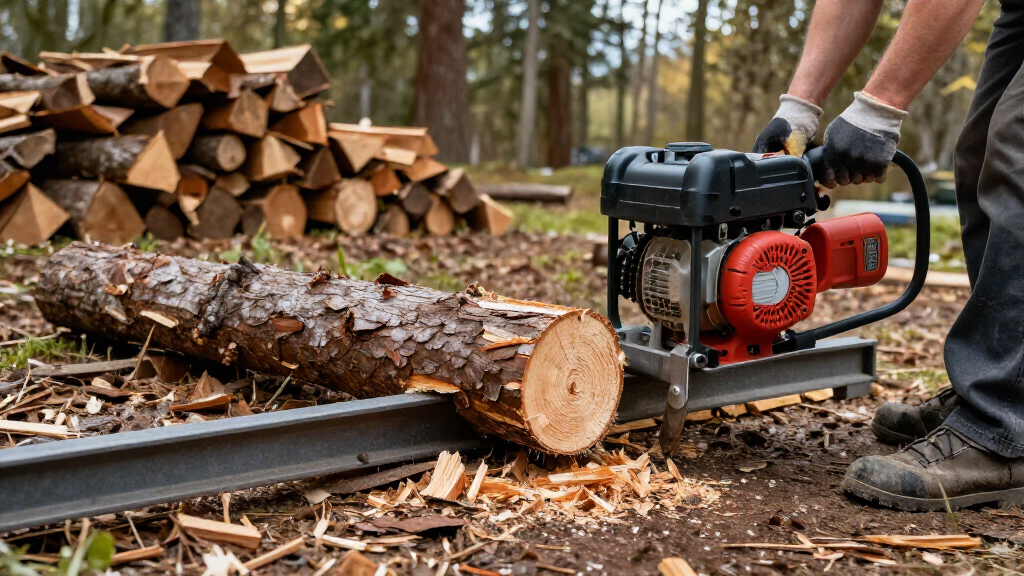

For most homeowners, I’d put the Full Boar 28-Ton Gas-Powered Log Splitter at the top of this gas-powered log splitter roundup for its middle-ground force and engine size. The Landworks Portable 20-Ton stands out for lighter-duty work and rapid auto return, while the Full Boar 35-Ton with log lift suits demanding jobs where handling heavy rounds matters. The main tradeoff is between portability and splitting capacity: higher-tonnage machines can handle tougher wood but take more space and effort to move. Cycle speed, vertical operation, and log-handling features also change how tiring a long session feels. Continue reading for the full breakdown and advice on matching a splitter to your wood, workload, and storage space.

Get business pricing on tools and workshop supplies
- Business-only prices and quantity discounts
- Tax-exempt purchasing
- Multiple users, one account, clear invoices
Complete the kit



Key Takeaways
- The roundup spans two distinct jobs: 18- to 25-ton models focus on routine firewood and easier transport, while 33- to 36-ton machines target larger rounds and heavier workloads.
- Log handling separates the heavy-duty picks. The Full Boar 35-Ton and BILT HARD 35-Ton with log lift add help with heavy rounds, a practical advantage that raw tonnage alone cannot provide.
- Portable 20-ton options are not identical. The Landworks model adds rapid auto return, while the SuperHandy portable models emphasize different capacity choices within the same general weight class.
- Several models share a 209cc, 7 HP engine class. Their real differences lie in claimed splitting force, cycle behavior, portability, and configuration—not just the engine label.
- The YARDMAX 35- and 36-ton splitters offer high-force alternatives with Briggs & Stratton CR950 engines. The 36-ton half-beam model’s two-way design sets it apart from the broader lineup.
| BILT HARD 18-Ton Gas Log Splitter, 7 HP 209cc |  | Best Lightweight Pick | Splitting force: 18 tons | Engine: 7 HP, 209cc OHV | Cycle time: 7.5 seconds | VIEW LATEST PRICE | See Our Full Breakdown |
| Ezasin 20-Ton Gas Log Splitter, 209 cc, 7 HP, 8-Second Cycle |  | Best for Hardwood Capacity | Splitting force: 20 tons | Engine: 7 HP, 209cc | Cycle time: 8 seconds | VIEW LATEST PRICE | See Our Full Breakdown |
| SuperHandy 20-Ton Portable Gas-Powered Horizontal Log Splitter |  | Best for Faster Repeated Splitting | Splitting force: 20 tons | Engine: 7 HP gas engine | Cycle time: 7.5 seconds | VIEW LATEST PRICE | See Our Full Breakdown |
| Full Boar 35-Ton Gas Log Splitter with 306cc Engine, Interchangeable 4-Way and 6-Way Wedges, and Hydraulic Log Lift |  | Best for High-Volume, Heavy Logs | Splitting force: 35 tons | Engine displacement: 306cc | Beam design: Box beam | VIEW LATEST PRICE | See Our Full Breakdown |
| BILT HARD 18-Ton Gas Log Splitter, 209cc 4-Stroke |  | Best for Quick Return Cycles | Splitting force: 18 tons | Engine: 209cc 4-stroke | Forward cycle time: 4.75 seconds | VIEW LATEST PRICE | See Our Full Breakdown |
| SuperHandy 25-Ton Portable Gas Log Splitter with 7 HP Engine |  | Best Portable Pick | Splitting force: 25 tons | Engine: 7 HP AlphaWorks gas engine | Hydraulic pump: Two-stage Bucher gear pump | VIEW LATEST PRICE | See Our Full Breakdown |
| YARDMAX 35-Ton Gas Log Splitter with Briggs & Stratton CR950 Engine |  | Best for Long Logs | Splitting force: 35 tons | Engine: Briggs & Stratton CR950 | Beam design: Full-beam, patent-pending U-beam | VIEW LATEST PRICE | See Our Full Breakdown |
| Full Boar 20-Ton Gas Log Splitter with 209cc Engine |  | Best for Faster Cycles | Splitting force: 20 tons | Engine: 209cc Full Boar, EPA-certified | Pump: 10.5 GPM two-stage | VIEW LATEST PRICE | See Our Full Breakdown |
| Full Boar 28-Ton Gas-Powered Log Splitter with 212cc Engine |  | Best for Towing to Work Sites | Splitting force: 28 tons | Engine: 212cc Full Boar OHV | Cycle time: 10.9 seconds | VIEW LATEST PRICE | See Our Full Breakdown |
| YARDMAX 36-Ton 2-Way Half-Beam Gas Log Splitter with Briggs & Stratton CR950 Engine |  | Best for Two-Sided Loading | Splitting force: 36 tons | Engine: Briggs & Stratton CR950 | Engine output: 6.5 HP; 208 cc | VIEW LATEST PRICE | See Our Full Breakdown |
| 20-Ton Gas-Powered Horizontal Log Splitter, 209cc |  | Best for Straightforward Property Use | Splitting force: 20 tons | Engine: 209cc 4-stroke, 7 HP | Pump: 2-stage gear pump | VIEW LATEST PRICE | See Our Full Breakdown |
| Landworks Portable 20-Ton Gas Log Splitter with 7 HP Engine and Rapid Auto Return |  | Best Value for Repeat Splitting | Power source: Gas | Engine: 7 HP | Splitting force: 20 tons | VIEW LATEST PRICE | See Our Full Breakdown |
| Full Boar 33-Ton Gas-Powered Log Splitter with 223cc Engine |  | Best for Towable Work-Site Capacity | Splitting force: 33 tons | Engine: 223cc Full Boar OHV | Cycle time: 14.3 seconds | VIEW LATEST PRICE | See Our Full Breakdown |
| BILT HARD 35-Ton Gas-Powered Horizontal/Vertical Log Splitter |  | Best for Heavy-Duty Versatility | Splitting force: 35 tons | Engine: 301cc, 10 HP single-cylinder OHV | Operating positions: Horizontal and vertical | VIEW LATEST PRICE | See Our Full Breakdown |
| BILT HARD 35-Ton Gas Log Splitter with Log Lift, 4-Way and 6-Way Wedges, 306cc 10 HP Engine |  | Best for High-Volume, Reduced-Lifting Work | Splitting force: 35 tons | Engine: 306cc, 10 HP | Hydraulic pump: 18 GPM, two-stage Bucher pump | VIEW LATEST PRICE | See Our Full Breakdown |
| gas-powered log splitter | Splitting force | Engine | Cycle time | Weight |
|---|---|---|---|---|
| BILT HARD 18-Ton Gas Log Split | 18 tons | 7 HP, 209cc OHV | 7.5 seconds | — |
| Ezasin 20-Ton Gas Log Splitter | 20 tons | 7 HP, 209cc | 8 seconds | — |
| SuperHandy 20-Ton Portable Gas | 20 tons | 7 HP gas engine | 7.5 seconds | — |
| Full Boar 35-Ton Gas Log Split | 35 tons | — | — | — |
| BILT HARD 18-Ton Gas Log Split | 18 tons | 209cc 4-stroke | — | — |
| SuperHandy 25-Ton Portable Gas | 25 tons | 7 HP AlphaWorks gas engine | 12 seconds | 90 pounds |
| YARDMAX 35-Ton Gas Log Splitte | 35 tons | Briggs & Stratton CR950 | — | 542.3 pounds |
| Full Boar 20-Ton Gas Log Split | 20 tons | 209cc Full Boar, EPA-certified | 8.5 seconds | 147.7 pounds |
| Full Boar 28-Ton Gas-Powered L | 28 tons | 212cc Full Boar OHV | 10.9 seconds | 431 pounds |
| YARDMAX 36-Ton 2-Way Half-Beam | 36 tons | Briggs & Stratton CR950 | — | 515 pounds |
| 20-Ton Gas-Powered Horizontal | 20 tons | 209cc 4-stroke, 7 HP | 8 seconds with automatic return | 130 pounds |
| Landworks Portable 20-Ton Gas | 20 tons | 7 HP | 7.5 seconds | — |
| Full Boar 33-Ton Gas-Powered L | 33 tons | 223cc Full Boar OHV | 14.3 seconds | 473 pounds |
| BILT HARD 35-Ton Gas-Powered H | 35 tons | 301cc, 10 HP single-cylinder OHV | — | 640 pounds |
| BILT HARD 35-Ton Gas Log Split | 35 tons | 306cc, 10 HP | 15 seconds | — |
More Details on Our Top Picks
BILT HARD 18-Ton Gas Log Splitter, 7 HP 209cc
At a listed 52 pounds, this BILT HARD is the lightest-feeling option in this group on paper, a major distinction from the 130-pound SuperHandy and 135-pound Ezasin. Its 18-ton force and 7.5-second cycle suit routine firewood work, while the 10-inch tires and full-beam steel frame support moving it around a property without relying on an outlet. The tradeoff is less splitting force than those two 20-ton models, which may matter for stubborn, knotty rounds. Log capacity reaches 20 inches long and 16 inches in diameter, but buyers need to supply both engine oil and hydraulic fluid before use. It also runs outdoors only, so it is a better fit for open-yard work than enclosed or poorly ventilated spaces.
Pros:- 18 tons of splitting force for regular firewood tasks.
- 7.5-second cycle time supports a steady pace.
- 10-inch tires and full-beam frame support transport around a property.
- Gas operation does not require access to an electrical outlet.
Cons:- Lower splitting force than the 20-ton SuperHandy and Ezasin.
- Engine oil and hydraulic fluid are not included.
- Outdoor, well-ventilated operation is required.
Best for: Property owners who want a gas splitter for routine firewood and prioritize a listed weight of 52 pounds for easier repositioning.
Not ideal for: Buyers regularly splitting knotty hardwood who would benefit from the 20-ton SuperHandy or Ezasin, or anyone needing an indoor-capable machine.
- Splitting force:18 tons
- Engine:7 HP, 209cc OHV
- Cycle time:7.5 seconds
- Maximum log size:20 inches long; 16 inches in diameter
- Hydraulic flow:10.5 GPM
- Hydraulic pump:Two-stage gear pump
- Tire size:10 inches
- Item weight:52 pounds
- Fluids:AW32 hydraulic fluid and engine oil not included
Our verdict“Choose this BILT HARD for routine splitting and a notably low listed weight, but step up to a 20-ton model for tougher rounds.”
Ezasin 20-Ton Gas Log Splitter, 209 cc, 7 HP, 8-Second Cycle
The Ezasin pairs 20 tons of force with capacity for logs up to 20.5 inches long and 16 inches wide, giving it a little more listed length capacity than the SuperHandy 20-Ton. Its dual-stage pump and automatic ram return are aimed at repeated splitting, while the eight-second cycle is close to the SuperHandy’s 7.5 seconds. That makes this a practical yard or job-site choice for buyers who want more force than the 18-ton BILT HARD models without moving to a large, heavy-duty machine. The tradeoff is a listed weight of 135 pounds, so its pneumatic tires help with rolling but do not make lifting easy. It also arrives without hydraulic oil, engine oil, or gasoline, all of which must be added before operation.
Pros:- 20-ton force is a step above the 18-ton BILT HARD options.
- Handles logs up to 20.5 inches long and 16 inches wide.
- Automatic ram return and an eight-second cycle support repeated work.
- 10-inch pneumatic tires help roll it around a yard or job site.
Cons:- At 135 pounds, it is difficult to lift or load alone.
- Hydraulic oil, engine oil, and gasoline are not included.
- Its cycle time is slightly longer than the SuperHandy’s 7.5 seconds.
Best for: Homeowners and small firewood operators who want 20-ton force, automatic return, and capacity for logs up to 20.5 inches long.
Not ideal for: Buyers who need a lightweight splitter or want to avoid sourcing and adding fluids and fuel before the first use.
- Splitting force:20 tons
- Engine:7 HP, 209cc
- Cycle time:8 seconds
- Maximum log size:20.5 inches long; 16 inches wide
- Hydraulic pump:Dual-stage aluminum gear pump
- Ram return:Automatic
- Tires:10-inch pneumatic
- Item weight:135 pounds
- Fluid and fuel requirements:1.6 gallons AW32 or AW46 hydraulic oil; 0.145 gallons SAE 15W-40 engine oil; 0.74 gallons of 87-octane-or-higher gasoline
Our verdict“Pick the Ezasin if you want 20-ton capacity and automatic return for larger rounds, and can manage its weight and setup fluids.”
SuperHandy 20-Ton Portable Gas-Powered Horizontal Log Splitter
Among the two 20-ton options here, the SuperHandy has the quickest listed cycle: 7.5 seconds, compared with the Ezasin’s eight. That small difference favors buyers who process batches of firewood and value a brisk rhythm, while its rapid auto-return avoids a separate manual return step. The Bucher two-stage gear pump and capacity for 20-inch-long, 16-inch-diameter logs make it a capable middle ground between the 18-ton BILT HARD splitters and the much larger Full Boar 35-ton machine. This is still a 130-pound horizontal splitter, not a lightweight carry-around tool. Its transport wheels help move it, but loading remains a challenge, and the recommended AW32 hydraulic fluid is not included. Like the other gas models, it needs outdoor use with proper ventilation.
Pros:- 20 tons of force for a broad range of firewood rounds.
- 7.5-second cycle is quicker than the Ezasin’s listed eight seconds.
- Rapid auto-return supports repeated splitting.
- 10-inch wheels help reposition the horizontal full-beam unit.
Cons:- Its 130-pound weight makes loading and lifting difficult.
- AW32 hydraulic fluid is not included.
- Requires outdoor operation with proper ventilation.
Best for: Firewood processors who split repeated batches of logs up to 20 inches long and want 20-ton force with rapid auto-return.
Not ideal for: Anyone who needs a light machine to lift into a vehicle, or who wants a ready-to-run splitter with hydraulic fluid included.
- Splitting force:20 tons
- Engine:7 HP gas engine
- Cycle time:7.5 seconds
- Maximum log size:20 inches long; 16 inches in diameter
- Hydraulic pump:Two-stage Bucher gear pump
- Return system:Rapid auto return
- Wheels:10-inch transport wheels
- Item weight:130 pounds
- Hydraulic fluid:AW32 recommended; not included
Our verdict“Choose the SuperHandy over the Ezasin if a slightly quicker cycle matters more than a small increase in maximum log length.”
Full Boar 35-Ton Gas Log Splitter with 306cc Engine, Interchangeable 4-Way and 6-Way Wedges, and Hydraulic Log Lift
This Full Boar is in a different class from the portable 18- and 20-ton machines: its 35-ton force, hydraulic lift, and interchangeable blades are built for heavier, higher-volume work. The lift handles logs up to 700 pounds, reducing the need to raise large rounds by hand, while the 4-way and 6-way wedges can produce multiple sections in a pass. Its 32-inch tray also gives split pieces room to land. Compared with the SuperHandy or Ezasin, the tradeoff is not a small loss of portability but a fundamental change in scale: this unit weighs 1,045 pounds and spans more than nine feet. It suits a dedicated work area, not casual repositioning or compact storage. The listing also notes a California restriction, which can rule it out for some buyers.
Pros:- 35-ton force is well above the portable 18- and 20-ton models in this group.
- Hydraulic log lift handles logs up to 700 pounds and can serve as a work table.
- Interchangeable 2-way, 4-way, and 6-way blades allow multiple split sections per pass.
- A 32-inch log tray provides space for split wood.
Cons:- At 1,045 pounds and over nine feet long, it is difficult to move and store.
- Its scale is excessive for occasional, small-batch firewood work.
- The listing notes a California restriction.
Best for: High-volume firewood operators handling heavy rounds who have room for a stationary-scale machine and want a hydraulic log lift.
Not ideal for: Occasional home users, buyers with limited storage or transport capacity, and California shoppers affected by the listed restriction.
- Splitting force:35 tons
- Engine displacement:306cc
- Beam design:Box beam
- Blade options:2-way, 4-way, and 6-way
- Hydraulic wedge adjustment:3.55 inches
- Log lift capacity:700 pounds
- Log tray length:32 inches
- Dimensions:112.2 x 59 x 47.2 inches
- Item weight:1,045 pounds
Our verdict“Choose this Full Boar for heavy, sustained splitting with lift assistance, not for a portable or occasional-use setup.”
BILT HARD 18-Ton Gas Log Splitter, 209cc 4-Stroke
This 18-ton BILT HARD stands apart from the first BILT HARD model through its listed 4.75-second forward cycle and 3.92-second reverse cycle, plus an auto-retract ram. Those timings make it the more cycle-focused choice for buyers processing routine rounds, while the other BILT HARD’s 7.5-second cycle and lower listed weight may appeal more to buyers prioritizing portability. Its 209cc engine, two-stage pump, and capacity for logs up to 20 inches long and 16 inches in diameter keep it suited to common firewood sizes. The tradeoffs are a 143.1-pound weight and only 18 tons of force, below the SuperHandy and Ezasin 20-ton machines. Oil and hydraulic fluid are not included; it must run outdoors on level ground and is not designed for towing behind a vehicle.
Pros:- Specified 4.75-second forward and 3.92-second reverse cycles.
- Auto-retract ram reduces the need for manual return handling.
- Handles logs up to 20 inches long and 16 inches in diameter.
- 10-inch wheels support movement across level ground.
Cons:- 18-ton force is below the 20-ton SuperHandy and Ezasin.
- At 143.1 pounds, it is difficult to lift or load.
- Engine oil and hydraulic fluid are not included; towing is not supported.
Best for: Firewood users with regular batches of standard-size logs who value specified fast forward and reverse cycles over easier lifting.
Not ideal for: Buyers who need 20-ton force, a lightweight unit, or a splitter designed for towing between sites.
- Splitting force:18 tons
- Engine:209cc 4-stroke
- Forward cycle time:4.75 seconds
- Reverse cycle time:3.92 seconds
- Pump:Two-stage
- Maximum log size:20 inches long; 16 inches in diameter
- Ram:Auto-retract
- Wheel size:10 inches
- Weight and towing:143.1 pounds; not intended to be towed behind a vehicle
Our verdict“Pick this BILT HARD for its quick specified return cycles on routine logs, but choose a 20-ton model for tougher wood or a lighter option for frequent loading.”
SuperHandy 25-Ton Portable Gas Log Splitter with 7 HP Engine
The SuperHandy 25-Ton suits buyers who need more splitting force than a basic 20-ton machine but still value moving the splitter around the property. Its 90-pound weight, polyurethane wheels, and folding handle make it far easier to reposition than the 431-pound Full Boar 28-Ton, though neither machine should be mistaken for a towable road model. The two-stage Bucher pump and 7 HP engine support logs up to 24 inches in diameter, and horizontal-to-vertical operation gives you a way to work with heavier rounds without lifting them onto the beam. The tradeoff is a 12-second cycle time, slower than the Full Boar 20-Ton’s stated 8.5 seconds, and hydraulic fluid is not included. Choose it for portability and capacity, not maximum throughput.
Pros:- 25 tons of force and capacity for logs up to 24 inches in diameter
- 7 HP engine paired with a two-stage Bucher hydraulic pump
- 90-pound half-beam design with polyurethane wheels and folding handle
- Operates horizontally or vertically
Cons:- 12-second cycle is slower than the Full Boar 20-Ton’s stated 8.5 seconds
- Hydraulic fluid is not included, adding a setup requirement
- No road-towing equipment is specified
Best for: Property owners who need to move a mid-force splitter between work areas and process large-diameter logs.
Not ideal for: Buyers prioritizing fast repetitive cycles, ready-to-use setup, or road towing; its cycle is slower than the Full Boar 20-Ton, fluid must be supplied separately, and towing is not listed.
- Splitting force:25 tons
- Engine:7 HP AlphaWorks gas engine
- Hydraulic pump:Two-stage Bucher gear pump
- Maximum log capacity:20 inches long; 24 inches in diameter
- Cycle time:12 seconds
- Operation:Horizontal and vertical
- Weight:90 pounds
- Hydraulic fluid:Not included; AW32 recommended
Our verdict“Choose this SuperHandy if portable handling and large-diameter capacity matter more than fast cycles or towable transport.”
YARDMAX 35-Ton Gas Log Splitter with Briggs & Stratton CR950 Engine
The YARDMAX 35-Ton is the lineup’s practical choice for buyers whose rounds are longer than the usual 24-inch limit: its table accommodates logs up to 26.5 inches. That extra length separates it from the Full Boar 28-Ton, which tops out at 24 inches, while the 35-ton rating gives this machine more force for demanding splitting jobs. Its horizontal-to-vertical beam and adjustable cradles help adapt the work position to the round, and the protected hydraulic filter and cylinder-mounted log stripper address wear and jam clearing. The cost of this capacity is substantial bulk: at 542.3 pounds, it is far less convenient to handle than the portable SuperHandy 25-Ton. Pick it for a fixed or planned work area, not frequent manual repositioning.
Pros:- 35-ton splitting force for demanding wood
- Accepts logs up to 26.5 inches long, longer than the Full Boar 28-Ton’s 24-inch limit
- Converts between horizontal and vertical positions
- Protected hydraulic filter and log stripper help limit damage and clear jams
Cons:- 542.3-pound weight makes repositioning difficult
- No cycle-time figure is provided for judging work pace
- Long-log capacity is useful only if your rounds exceed more common lengths
Best for: Firewood operators processing long rounds who can keep a heavy splitter near their regular work area.
Not ideal for: Buyers who need to move equipment by hand between scattered work sites; at 542.3 pounds, it is much heavier than the portable SuperHandy 25-Ton.
- Splitting force:35 tons
- Engine:Briggs & Stratton CR950
- Beam design:Full-beam, patent-pending U-beam
- Maximum log length:26.5 inches
- Operation:Horizontal and vertical
- Log cradles:Adjustable to two positions
- Weight:542.3 pounds
- Model:YU3666
Our verdict“Choose the YARDMAX when long rounds and high splitting force outweigh the difficulty of moving a very heavy machine.”
Full Boar 20-Ton Gas Log Splitter with 209cc Engine
Among these five machines, the Full Boar 20-Ton has the shortest stated cycle, at 8.5 seconds. That makes it a better fit for steady processing of manageable rounds than the SuperHandy 25-Ton, whose stated cycle is 12 seconds, even though the SuperHandy offers more force and a larger diameter capacity. This Full Boar is rated for logs up to 20 inches long and 16 inches in diameter, so its faster pace comes with a narrower workload. The auto-return valve with adjustable detent reduces the need to manually reset the control between cycles, while flat-free tires aid movement around a property. However, it is not towable, and its hydraulic oil is not included. I’d favor it for repeat work close to home, not for hauling between remote sites or tackling oversized rounds.
Pros:- 8.5-second stated cycle is quicker than the SuperHandy 25-Ton’s 12-second cycle
- Auto-return valve with adjustable detent reduces manual resetting between cycles
- 10.5 GPM two-stage pump
- Flat-free tires and ergonomic handle support on-site repositioning
Cons:- 20-ton force and 16-inch diameter limit narrow the range of rounds it can handle
- Not towable
- Hydraulic oil is not included
Best for: Home firewood cutters who process rounds within the 16-inch diameter limit and value a short cycle with less manual valve resetting.
Not ideal for: Buyers handling large-diameter logs or towing a splitter to separate work sites; its capacity is smaller than the SuperHandy 25-Ton’s and this model is not towable.
- Splitting force:20 tons
- Engine:209cc Full Boar, EPA-certified
- Pump:10.5 GPM two-stage
- Cycle time:8.5 seconds
- Maximum log capacity:20 inches long; 16 inches in diameter
- Control valve:Auto-return with adjustable detent
- Weight:147.7 pounds
- Hydraulic oil:Not included; 10W AW32, AW22, or ISO 32 specified
Our verdict“Choose this Full Boar for faster repetitive splitting of moderate-size rounds when road towing and large-log capacity are not priorities.”
Full Boar 28-Ton Gas-Powered Log Splitter with 212cc Engine
The Full Boar 28-Ton stands apart from the other picks here because its road tires, 2-inch ball hitch, and safety chains make towing to a work site part of the design. That mobility is useful for buyers splitting wood away from the storage area; the 431-pound weight makes hand-moving it a poor substitute. With 28 tons of force, a two-way wedge, and vertical as well as horizontal operation, it offers more capacity flexibility than the Full Boar 20-Ton, while its 24-inch log limit falls short of the YARDMAX 35-Ton’s 26.5 inches. The 10.9-second cycle is a middle ground rather than a speed-first feature. This is a strong match for mobile, mixed-size work, but buyers who do not need towing may prefer a lighter or higher-capacity alternative.
Pros:- Road tires, 2-inch ball hitch, and safety chains support towing
- 28 tons of force with horizontal and vertical operation
- Two-way wedge and 22.75-inch stroke
- 10.9-second stated cycle
Cons:- 431-pound weight makes manual repositioning difficult
- 24-inch maximum log length is shorter than the YARDMAX 35-Ton’s 26.5-inch capacity
- Towing hardware adds little value for buyers who work in one fixed location
Best for: Owners who need to tow a splitter between a home wood yard and remote cutting sites and handle rounds up to 24 inches long.
Not ideal for: Buyers who need the longest log capacity or a lightweight machine; it weighs 431 pounds and accepts shorter logs than the YARDMAX 35-Ton.
- Splitting force:28 tons
- Engine:212cc Full Boar OHV
- Cycle time:10.9 seconds
- Maximum log length:24 inches
- Stroke length:22.75 inches
- Wedge:Two-way
- Operating positions:Horizontal and vertical
- Towing:16-inch DOT-approved tires; 2-inch ball hitch and safety chains
- Weight:431 pounds
Our verdict“Choose the Full Boar 28-Ton if you need a towable splitter for work sites and do not need capacity beyond 24-inch logs.”
YARDMAX 36-Ton 2-Way Half-Beam Gas Log Splitter with Briggs & Stratton CR950 Engine
The YARDMAX 36-Ton is the high-force choice for crews or households that want to load from either side rather than work around one loading position. Its two-way half-beam layout supports that workflow, and the U-beam design is intended to resist the flex that can come with demanding splitting. Compared with the YARDMAX 35-Ton, it adds one ton of rated force and two-sided loading, but the listed maximum log length is 26 inches, just below that model’s 26.5-inch limit. Horizontal-to-vertical conversion and two-position adjustable cradles add flexibility, though the 515-pound weight makes this a substantial machine to place and store. It makes the most sense when the extra loading access will be used often; for occasional work or easier transport, the Full Boar 28-Ton is the more mobile choice.
Pros:- 36-ton rating is the highest among these five products
- Two-sided loading can make access easier in a shared work area
- U-beam design and horizontal-to-vertical operation support demanding jobs
- Adjustable log cradles offer two positions, with an optional mountable log table
Cons:- 515-pound weight complicates moving and storage
- 26-inch log limit is slightly shorter than the YARDMAX 35-Ton’s 26.5-inch capacity
- No towing equipment is specified for moving it between remote sites
Best for: High-volume firewood users who want to load from either side and can dedicate a stable work area to a heavy splitter.
Not ideal for: Buyers working alone across multiple locations or prioritizing towing; it weighs 515 pounds and no hitch or road tires are listed.
- Splitting force:36 tons
- Engine:Briggs & Stratton CR950
- Engine output:6.5 HP; 208 cc
- Beam:Half-beam, U-beam design
- Maximum log length:26 inches
- Splitting direction:Two-way; loadable from either side
- Operation:Horizontal and vertical
- Weight:515 pounds
- Model:YS3665
Our verdict“Choose the YARDMAX 36-Ton when two-sided loading and maximum force matter more than easy relocation.”
20-Ton Gas-Powered Horizontal Log Splitter, 209cc
This model makes sense for homeowners who want 20 tons of gas-powered splitting force without stepping up to a towable machine. Its 8-second automatic return supports a steady rhythm for repeated cuts, while the handles and pneumatic tires help move it around a property. Compared with the Landworks Portable 20-Ton Gas Log Splitter, it has a similar force and engine rating but a slightly slower listed cycle; the Landworks also gives a clearer 16-inch diameter limit. This splitter’s own diameter guidance conflicts: the title says 16 inches, while the description says 18. At 130 pounds, it is portable in the sense that it has wheels, not effortless to lift or load. I’d choose it for routine firewood work, but verify the log limit before buying.
Pros:- 20-ton splitting force and hardened steel wedge suit routine firewood processing.
- Automatic 8-second return supports repeated splitting.
- Gas engine allows outdoor use without an electrical connection.
- Handles and 10-inch pneumatic tires aid movement around a property.
Cons:- Maximum diameter is inconsistent between the title and description.
- Its 130-pound weight can make loading and handling demanding.
Best for: Property owners splitting ordinary firewood logs up to 20 inches long who want a wheeled gas model for use away from an electrical outlet.
Not ideal for: Buyers who need a confirmed capacity above 16 inches in diameter or need a splitter they can lift and load without help.
- Splitting force:20 tons
- Engine:209cc 4-stroke, 7 HP
- Pump:2-stage gear pump
- Cycle time:8 seconds with automatic return
- Maximum log length:20 inches
- Maximum log diameter:16 inches in title; 18 inches in description
- Weight:130 pounds
- Wheels:10-inch pneumatic tires
Our verdict“Choose this for routine property firewood work if the conflicting log-diameter limit is acceptable and you can manage its 130-pound weight.”
Landworks Portable 20-Ton Gas Log Splitter with 7 HP Engine and Rapid Auto Return
The Landworks stands out among these compact gas splitters for its 7.5-second cycle and clearly stated 16-inch log-diameter capacity. That faster cycle gives it a modest pace advantage over the 20-Ton Gas-Powered Horizontal Log Splitter, 209cc, whose return is listed at 8 seconds, while both offer 20 tons of force and 10-inch wheels. Its two-stage Bucher pump and automatic return make it a practical fit for repeated outdoor work, but it arrives without hydraulic fluid, so buyers need to source the recommended AW32 fluid before operation. The stated weight also varies across the listing: 130 pounds in one spec and 148.7 pounds as item weight. I’d favor it over the other 20-ton option when the confirmed diameter limit and quicker cycle matter more than a ready-to-use setup.
Pros:- 7.5-second cycle time supports a brisk pace for repeated splitting.
- Two-stage Bucher hydraulic gear pump and 20-ton force suit routine firewood work.
- 10-inch transport wheels help move it around an outdoor work area.
- Gas power does not require an electrical connection.
Cons:- Hydraulic fluid is not included; AW32 is recommended.
- Weight is listed as both 130 and 148.7 pounds, and either figure can make handling demanding.
- Requires outdoor operation with proper ventilation.
Best for: Homeowners processing regular batches of logs up to 20 inches long and 16 inches in diameter who can handle fluid setup before use.
Not ideal for: Buyers who want a splitter ready to operate straight out of the package or who need capacity beyond 16-inch-diameter logs.
- Power source:Gas
- Engine:7 HP
- Splitting force:20 tons
- Hydraulic pump:Two-stage Bucher hydraulic gear pump
- Maximum log length:20 inches
- Maximum log diameter:16 inches
- Cycle time:7.5 seconds
- Hydraulic fluid:Not included; AW32 recommended
Our verdict“Pick the Landworks for repeated 20-ton splitting when its quicker cycle and specified 16-inch limit suit your logs, and you can supply hydraulic fluid.”
Full Boar 33-Ton Gas-Powered Log Splitter with 223cc Engine
With 33 tons of force and a 24-inch log-length limit, this Full Boar is a clear step up from the 20-ton portable models for tougher, larger firewood. Its vertical and horizontal positions let a buyer work with bulky rounds without having to lift each one onto a horizontal beam. The tradeoff is a 14.3-second cycle, slower than the Landworks’ 7.5 seconds, so the extra force is aimed more at demanding material than maximizing pace on smaller logs. A heavy-duty H-beam and two-way wedge support work-site use, while 16-inch road tires and a ball hitch make towing possible. At 473 pounds, though, this is not a splitter to casually reposition by hand, and its maximum log length remains 24 inches.
Pros:- 33 tons of force provides a substantial step up from the 20-ton portable models.
- Vertical and horizontal positions help accommodate bulky rounds.
- Two-way wedge and heavy-duty H-beam frame suit demanding work.
- 16-inch road tires and a 2-inch ball hitch support towing to a work site.
Cons:- The 14.3-second cycle is slower than the Landworks 20-ton model’s listed cycle.
- At 473 pounds, it is difficult to move and requires substantial storage space.
- Maximum stated log length is 24 inches.
Best for: Firewood operators handling tough, bulky rounds up to 24 inches long who can tow and store a 473-pound splitter.
Not ideal for: Homeowners who mainly split smaller logs, prioritize a fast cycle, or lack a suitable tow vehicle and storage space.
- Splitting force:33 tons
- Engine:223cc Full Boar OHV
- Cycle time:14.3 seconds
- Maximum log length:24 inches
- Wedge:Two-way
- Operating positions:Vertical and horizontal
- Weight:473 pounds
- Towing setup:16-inch DOT-approved road tires and 2-inch ball hitch coupler
Our verdict“Choose this Full Boar when added force, vertical operation, and towability matter more than compact storage or a quick cycle.”
BILT HARD 35-Ton Gas-Powered Horizontal/Vertical Log Splitter
The BILT HARD brings 35 tons of force and horizontal-or-vertical operation to buyers working through demanding logs up to 24 inches long. Its 301cc, 10 HP engine and 14 GPM hydraulic flow give it a heavier-duty profile than the 33-ton Full Boar, while the 16-second cycle is slower than that model’s 14.3 seconds. It also arrives with hydraulic and engine oil, reducing one setup task compared with the Landworks 20-ton splitter, which excludes hydraulic fluid. Towing equipment includes DOT-certified tires, a ball coupler, and safety chains, but its 640-pound weight makes transport and storage a serious commitment. I’d place it ahead of the lighter Full Boar only for buyers who value the extra force and included operating fluids over easier handling.
Pros:- 35-ton splitting force suits demanding hardwood work.
- Horizontal and vertical positions accommodate different log sizes and handling needs.
- Includes hydraulic and engine oil, unlike the Landworks portable model’s fluid setup.
- DOT-certified tires, a 2-inch ball coupler, and safety chains support towing.
Cons:- At 640 pounds, it is difficult to handle and takes substantial storage space.
- Its 16-second cycle is slower than the Full Boar 33-ton model’s 14.3-second cycle.
- Transport requires a suitable towing vehicle and hitch.
Best for: Owners of large firewood operations who need 35-ton force, vertical splitting, and a tow-ready configuration for logs up to 24 inches long.
Not ideal for: Occasional users without a suitable tow vehicle, hitch, and storage area for a 640-pound machine.
- Splitting force:35 tons
- Engine:301cc, 10 HP single-cylinder OHV
- Operating positions:Horizontal and vertical
- Maximum log length:24 inches
- Split cycle time:16 seconds
- Hydraulic flow rate:14 GPM
- Hydraulic system capacity:7 gallons
- Weight:640 pounds
Our verdict“Choose this BILT HARD for 35-ton, two-position capability and included fluids if you have the towing and storage capacity to manage its weight.”
BILT HARD 35-Ton Gas Log Splitter with Log Lift, 4-Way and 6-Way Wedges, 306cc 10 HP Engine
This is the most specialized machine in the group: the 700-pound log lift and interchangeable 4-way and 6-way wedges are built to reduce manual handling and split suitable rounds into multiple pieces per pass. Its 35-ton force matches the other BILT HARD here, while the 18 GPM two-stage pump and 15-second cycle give it a pace advantage over that model’s 14 GPM and 16-second cycle. The larger capacity—logs up to 24 inches long and 20 inches in diameter—also exceeds the Full Boar 33-ton model’s stated length limit. But this capability comes with a substantial cost in logistics: at 1,035 pounds, it is far heavier than either towable alternative in this batch and needs suitable equipment for moving and storage.
Pros:- 700-pound log lift reduces the need to raise heavy rounds onto the beam.
- Interchangeable 4-way and 6-way wedges provide options for splitting multiple pieces per pass.
- 18 GPM two-stage Bucher pump and 15-second cycle support repeated work.
- 35-ton force and stated capacity up to 24 inches long and 20 inches in diameter suit large logs.
Cons:- At 1,035 pounds, it is exceptionally demanding to move, tow, and store.
- Its 24-inch maximum log length remains a limit for longer rounds.
- The included lift and multi-way wedges add complexity that may be unnecessary for occasional firewood work.
Best for: High-volume firewood operators processing logs up to 24 inches long and 20 inches in diameter who need a log lift and multi-way splitting.
Not ideal for: Homeowners with occasional splitting needs, limited storage, or no suitable equipment to move a 1,035-pound splitter.
- Splitting force:35 tons
- Engine:306cc, 10 HP
- Hydraulic pump:18 GPM, two-stage Bucher pump
- Cycle time:15 seconds
- Log lift capacity:700 pounds
- Wedges:Interchangeable 4-way and 6-way
- Maximum log size:24 inches long and 20 inches in diameter
- Item weight:1,035 pounds
Our verdict“Choose this model for high-volume processing where the log lift and multi-way wedges justify the substantial weight and moving requirements.”
How We Picked
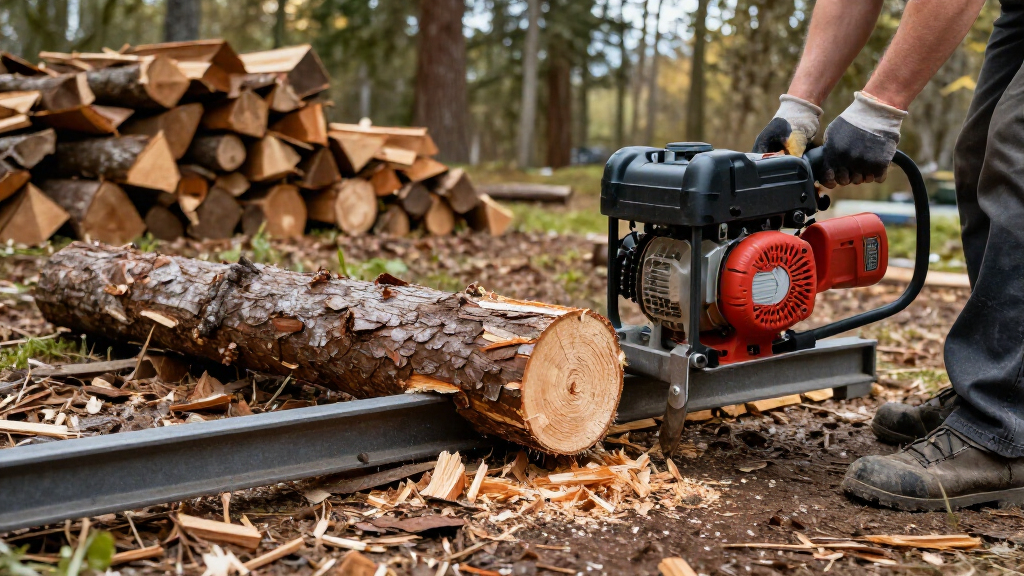
I ranked these gas-powered log splitters by how well their stated design and features match distinct buyer needs. I compared advertised tonnage, engine size, cycle and return features, horizontal or vertical operation, portability, wedge options, and log-lift assistance. Those factors affect what wood a machine is suited to and how much work the operator must do across a session.
The order favors useful balance and clear task fit over the biggest force figure alone. Midrange models earn a place near the top when they suit common firewood workloads without the added bulk of a heavy-duty machine; higher-capacity models rank for buyers who can use their extra force or handling features. I also distinguish models with similar engine sizes by their stated configuration and accessories. Product names and specifications do not establish real-world splitting results, so buyers should confirm current manufacturer details, including cycle time, operating orientation, towing requirements, and included equipment, before choosing.
Factors to Consider When Choosing Gas-powered Log Splitters
I’d choose a splitter by starting with the wood and work pattern, then checking which machine makes that job manageable. The following factors help avoid paying for capacity you will not use or buying a lighter machine that struggles with your usual rounds.
Match Splitting Force to Your Wood
Ton ratings give a useful comparison point, but they do not describe every part of performance. Wood species, grain, knots, moisture, and round diameter all affect how difficult a piece is to split. If your supply is mostly straight-grained, moderate-sized rounds, a 18- to 25-ton class machine may be a more practical match than a heavy-duty model. Tough, large, or knotty rounds make higher-capacity options more relevant, though more force does not remove the need to position wood safely. A common mistake is choosing by the biggest advertised number without considering how often the hardest pieces appear in the pile. I’d base the decision on the most difficult wood you routinely split, not a rare exception or an idealized test log.
Think About Work Pace, Not Just Cycle Claims
A fast cycle or rapid auto return can reduce waiting when you process a large batch, but cycle figures only tell part of the story. Loading, repositioning, clearing split pieces, and handling awkward rounds may take longer than the hydraulic stroke itself. Compare cycle claims using the same measurement conditions when available; manufacturers may describe a cycle differently. For occasional weekend use, a modest pace can be easier to justify than a machine chosen primarily for speed. For repeated, long sessions, return behavior and workflow can shape fatigue and total work time. I’d also check how the controls operate and whether the machine’s layout allows a steady, safe rhythm.
Choose Horizontal, Vertical, or a Flexible Setup
Horizontal operation is familiar and suits many rounds that one person can lift onto the beam. Vertical operation can reduce the need to raise a heavy round, which matters when larger wood is part of the routine. Some splitters support both positions, but changing orientation and setting up the machine still take time. Buyers sometimes focus on a vertical option without checking how securely and conveniently the machine changes position. Think about the largest rounds you expect to handle and whether you can move them to the splitter at all. A flexible design is most useful when your wood sizes vary, not simply because it offers another configuration.
Weigh Portability Against Stability and Storage
Portable gas splitters can be easier to move between a storage area and a worksite, but “portable” does not mean effortless to lift or maneuver. Check the complete machine’s weight, dimensions, wheel setup, and any stated towing limits before planning transport. Larger frames and higher-capacity equipment can require more room and a suitable vehicle or storage spot. A compact model may be a better choice when jobs are small and the splitter must fit in a crowded shed. On the other hand, choosing the lightest machine can become inconvenient if it is not suited to the wood or workload. Match portability to where you split, where you store the machine, and how you will move it.
Treat Log Lifts and Multi-Way Wedges as Workflow Tools
A log lift can reduce repeated lifting of heavy rounds, while four-way or six-way wedges can produce multiple pieces in a pass. These features matter most when the workload is frequent and rounds are large enough to make handling a burden. They also add complexity, bulk, and setup considerations, so they are not automatic upgrades for occasional use. Multi-way wedges may not suit every species, grain pattern, or desired split size; a single split can still be the better approach for stubborn wood. Consider who will operate the machine and whether the added equipment fits that person’s strength and workflow. I’d prioritize safer, easier loading before paying for features aimed mainly at increasing output.
Plan for Gas-Engine Care and Safe Operation
A gas-powered splitter can work away from an electrical outlet, but its engine needs routine fuel, oil, and maintenance attention. Read the manual for the required fuel and oil, service intervals, storage steps, and cold-start guidance before purchase. Long storage periods make fuel management especially relevant, and the machine needs a ventilated outdoor operating area. Check for suitable safety guards, clear operating instructions, stable placement, and controls that keep hands away from the splitting zone. Do not assume that a higher ton rating makes a machine safer or that an advertised feature replaces safe handling practices. If you want minimal engine upkeep or indoor use, a gas model may not fit your needs.
Frequently Asked Questions
Is a 20-ton gas log splitter enough for the firewood I split at home?
It can be enough when most of your rounds are moderate in size and split without unusually difficult knots or grain. This roundup includes several 20-ton options, but their features differ: the Landworks adds rapid auto return, while the SuperHandy models provide portable alternatives. If your wood regularly includes large, twisted, or knotty rounds, a higher-capacity class may be a better fit. Think about your typical pile rather than the occasional oversized piece. Check the manufacturer’s stated limits and operating details against the wood you actually process.
Should I choose a log splitter with a log lift?
A log lift is most useful if you split heavy rounds often and want to reduce repeated lifting onto the beam. The Full Boar 35-ton and BILT HARD 35-ton models in this roundup include log-lift features, making them more task-focused than basic high-force options. A lift adds equipment and can make a machine larger or more involved to set up. It may not help much if your rounds are light enough to handle comfortably or if you split only a small amount of wood. Consider the weight and size of your usual rounds, your handling limits, and the space available around the splitter.
Does a higher ton rating always mean a better gas splitter?
No. A higher rating may suit tougher or larger wood, but it does not by itself tell you how quickly the machine works, how easy it is to move, or how much effort loading requires. In this lineup, some high-force models add log lifts or multi-way wedges, while others stand out for a different configuration such as the YARDMAX 36-ton half-beam design. Those details can matter more than a small difference in the advertised tonnage for your routine. Match capacity to the hardest wood you split regularly and compare the rest of the workflow. Confirm each model’s specifications with its manufacturer before purchase.
Is a portable gas log splitter practical if I need to move it between properties?
It can be practical, especially for buyers whose work is spread across several locations, but portability depends on more than a product label. Check the splitter’s weight, dimensions, wheels, towing instructions, and the vehicle or storage space you have available. The portable SuperHandy and Landworks 20-ton models are distinct options in this roundup, yet their suitability still depends on your transport setup and wood workload. A larger machine may be harder to move even if it offers more capacity or handling equipment. Verify the manufacturer’s transport guidance and never assume a splitter is road-ready without checking its stated requirements.
What should I check before buying a gas-powered splitter for occasional use?
Start with your actual wood volume, storage space, and willingness to maintain a gas engine. Occasional use may favor a simpler, lower-capacity machine over a large splitter with accessories you rarely need. Check required fuel and oil, service intervals, startup instructions, and how the machine should be prepared for storage between seasons. Also consider whether you can lift your typical rounds onto the beam or would benefit from vertical operation or a log lift. Read the operating manual and confirm what equipment is included, since product names alone may not describe the full package.
Conclusion
For a balanced starting point, I recommend the Full Boar 28-Ton Gas-Powered Log Splitter as the best overall pick in this lineup. Buyers prioritizing portability and a return-speed feature should compare the Landworks Portable 20-Ton as a value-focused option, while newcomers with routine, moderate-sized firewood may prefer a simpler 18- to 20-ton model after checking its operating instructions and stated limits. For a premium, heavy-work setup, look to the Full Boar 35-Ton with log lift or the BILT HARD 35-ton model with lift and multi-way wedges. If your specific need is a two-way half-beam configuration, the YARDMAX 36-Ton stands apart. I’d make the final choice by matching your regular wood, lifting needs, transport plan, and maintenance comfort to the machine—not by tonnage alone.