TL;DR

Get business pricing on tools and workshop supplies
- Business-only prices and quantity discounts
- Tax-exempt purchasing
- Multiple users, one account, clear invoices
A lawn tractor can often pull far more than it can safely stop or steer, so the published towing limit in your operator’s manual — not the hitch rating and not horsepower — is the controlling number. Tongue weight affects steering, slopes multiply stopping distance and rollover risk, and brakes on most lawn tractors are designed for the tractor alone, not a loaded, unbraked trailer.
You can bolt a Class III receiver rated at 3,500 pounds onto a lawn tractor that’s only rated to tow 500. The hitch will hold. The machine behind it won’t. That gap between what the hardware can carry and what the tractor can control is where towed-load accidents happen — jackknifed dump carts on hills, light front ends wandering into a ditch, transmissions cooked by a load the engine moved just fine.
The central fact is simple: a lawn tractor’s ability to pull a load does not mean it can safely control or stop it. Engine power, traction, transmission durability, hitch strength, steering and braking are six separate limits, and the lowest one governs. Most people only think about the first.
In this guide you’ll learn how to find your machine’s real towing number, how tongue weight changes steering, why slopes rewrite every rule, and why braking — not pulling — is usually the wall you hit first. Real numbers, real scenarios, no hand-waving.
The operator’s manual’s gross towed weight — including the empty cart — is the controlling limit; an aftermarket hitch’s pound rating only describes the hitch…
Brakes, not engine power, are the usual real constraint: most lawn tractor brakes are sized for the tractor alone, and hydrostatic resistance is not a substitu…
Excess tongue weight lightens the front axle and steals steering; the 10–15% road-trailer tongue rule does not automatically apply to lawn tractors and dump ca…
Slope limits are typically lower while towing than while mowing — ignore any generic ’15-degree rule’ and reduce loads by half or more on grades.
Transmission overheating shows up as fading power, slipping, belt smell or noise — ‘it pulled it once’ is not proof the load is within continuous-duty capabili…
Towing Behind a Lawn Tractor: Hitch Ratings, Slopes and Braking Reality
A lawn tractor can often pull far more than it can safely stop or steer. The published towing limit in your operator’s manual — not the hitch rating, not horsepower — is the controlling number. You can bolt a 3,500-lb Class III receiver onto a tractor rated to tow 500 lb. The hitch will hold. The machine behind it won’t.
Engine power, traction, transmission durability, hitch strength, steering and braking are six separate limits — and the lowest one governs. Most people only think about the first.
Six Separate Limits — the Lowest One Governs
A lawn tractor’s ability to pull a load does not mean it can safely control or stop it. Each system on the machine has its own ceiling, and exceeding any single one — not the average — creates the failure.
Engine Power
Usually abundant — the limit most people check, and rarely the one that matters.
Traction
Rear tires slip on wet grass, gravel and grades long before power runs out.
Transmission
Overheating shows up as fading power, slipping or belt smell — after the pull, not during.
Hitch Strength
The steel, welds and bolt holes — rated for the component only, never the machine.
Steering
Excess tongue weight levers the front axle up and steals steering authority.
Braking ★
Sized for the tractor alone — not a loaded, unbraked trailer. Usually the real wall.
The Ratings Table That Prevents Accidental Overloads
Cart makers sell cargo space, so they quote payload. Tractor makers worry about what the machine must accelerate, hold back and stop, so they quote gross. Confusing the two is how people overload a machine without realizing it.
| Rating | What It Measures | Common Trap |
|---|---|---|
| Payload | Cargo only | Marketed as “cart capacity” — ignores the cart’s own weight |
| Trailer weight | Empty cart or trailer | Steel dump carts run 100–300 lb empty |
| Gross trailer weight | Trailer + cargo | ★ The number your manual limit actually applies to |
| Tongue weight | Downward force at hitch | 10–15% rule is a highway rule — not a lawn tractor rule |
| Combined weight | Everything, moving | What really determines stopping distance |
The fix is arithmetic, not restraint: subtract the empty cart weight from your towing limit first, and treat what’s left as your true cargo budget. A “600-pound” cart on a “600-pound” tractor is already over the limit before a single shovel of dirt. Weigh the loaded trailer or use supplier weight tickets — wet soil can weigh half again as much as dry.
Why Tongue Weight Makes Your Steering Go Light
Too much tongue weight levers the front axle upward — vague steering, front wheels responding late, skittering over ruts. Too little, and the trailer sways or hops the hitch on bumps. Both are bad; light steering on a slope is the one that flips machines.
sway · hitch hop
per your manual
front axle unloads
Keep cargo low
In the trailer bed — a high load raises the center of gravity and amplifies weight transfer on turns.
Side to side
Off-center cargo creates asymmetric tongue load and pulls the tractor sideways on slopes.
Against shifting
A sliding load changes tongue weight mid-hill — the balance you set at the top is not the balance at the bottom.
Never improvise
Don’t fix poor balance with improvised rear ballast — it adds braking demand and transmission load.
Slopes Rewrite Every Rule
A trailer that feels manageable on level ground can push the tractor downhill, reduce rear-tire grip, jackknife or pull it sideways on a slope. Side slopes add rollover risk; turns and bumps amplify weight transfer. Ignore any generic “15-degree rule” — slope limits while towing are typically lower than while mowing.
The load pushes back
On a grade, the trailer’s weight becomes a pushing force. Most lawn tractor brakes act on the transaxle — sized for the tractor alone. Hydrostatic resistance is not a substitute for brakes.
Rollover risk
Combined weight shifts to the downhill tires. Avoid sharp turns, wet grass, loose gravel, mud, leaves, ruts — and never tow near drop-offs or ditches.
Leverage & overturn
Raising the hitch point or pulling from a bumper, seat bracket or axle housing creates dangerous leverage and increases the chance of a rear overturn. Use only the approved low pin-style drawbar.
Seven Steps That Take Five Minutes
A safe tow behind a lawn tractor comes down to a repeatable routine — the same checks, every time, before the key turns.
Confirm the manual’s gross towed weight — trailer + cargo — and the maximum tongue weight. No spec listed? Contact the manufacturer, never estimate from horsepower.
Weigh the load or use supplier weight tickets. Damp gravel in a “half-full” 10 cu ft cart can exceed 500 lb.
Inspect the hitch — plate and frame for cracks, bending, corrosion; pin, clip, coupler and safety-retention hardware.
Check the trailer — tongue, axle, tires, wheel bearings, cargo restraints and any trailer brake system.
Balance the cargo — low, centered, secured, with stable permitted tongue load below fill-limit guidance.
Read the slope restriction — and cut the load by half or more on any grade. Slow speed, no sharp turns.
Ballast only as approved — confirm wheel-weight and ballast requirements in the manual. Extra ballast increases braking demand and transmission load. No passengers, no public-road use unless explicitly permitted.
From Manual to Safe Haul — the Chain of Control
Your Manual’s Towing Limit Beats the Hitch Rating Every Time
Towing behind a lawn tractor starts with one number: the maximum towed weight in your operator’s manual, and it includes the empty cart or trailer itself. A “500-pound” dump cart usually describes payload — what goes inside it — not total weight. Add the cart’s own 75–150 pounds of steel or poly and your actual gross load is well past 600 before you’ve hauled a single rock.
Here’s the mistake I see constantly: someone buys a lawn tractor with an aftermarket hitch stamped “2,000 lb” and assumes the machine can now tow 2,000 pounds. It can’t. That stamp describes the hitch component — the steel, the welds, the bolt holes. It says nothing about the tractor’s frame, transaxle, axles, tires or brakes. The tractor manufacturer’s limit still applies, unchanged.
Your manual is the controlling document, and so is the attachment’s manual. Look for these specifically:
- Maximum gross towed weight (trailer + cargo)
- Maximum tongue weight — the downward force on the hitch
- Approved attachment types and hitch location
- Slope restrictions and ballast or wheel-weight requirements
- Passenger and public-road warnings
If your manual gives no towing spec at all, contact the manufacturer. Don’t estimate from horsepower and don’t copy a limit from a similar-looking model — two tractors with the same 22 hp engine can have different transaxles, different brakes and towing limits hundreds of pounds apart.
No horsepower formula reliably predicts towing capacity. The manual’s number is the number.
As an affiliate, we earn on qualifying purchases.
The Six Numbers That Decide Whether Your Load Is Legal
Weight ratings for towing behind a lawn tractor fall into six distinct numbers, and confusing them is how people overload a machine without realizing it. Gross trailer weight is the empty trailer plus everything in it. Tongue weight is the downward force at the hitch. Combined weight is tractor + operator + trailer + cargo — the mass your brakes actually have to stop.
Why does the distinction matter so much? Because each number taxes a different part of the machine. Gross trailer weight stresses the transaxle and hitch. Tongue weight stresses the rear tires and — through the lever action of the hitch — either loads or unloads the front axle. Combined weight is the number your brakes and tires answer to. You can be comfortably under your gross towing limit and still be over your tongue weight limit, which means the machine that pulls fine can’t steer. That’s why checking only one number gives you false confidence.
Here’s the comparison that matters:
| Rating | What It Measures | Common Trap |
|---|---|---|
| Payload | Cargo only | Marketed as “cart capacity” — ignores cart weight |
| Trailer weight | Empty cart or trailer | Steel dump carts run 100–300 lbs empty |
| Gross trailer weight | Trailer + cargo | The number your manual limit applies to |
| Tongue weight | Downward force at hitch | Often 10–15% of gross on road trailers — not a lawn tractor rule |
| Combined weight | Everything, moving | What determines stopping distance |
The traps in that table aren’t marketing malice — they’re a genuine mismatch in how each industry uses words. Cart makers sell cargo space, so they quote payload. Tractor makers worry about what the machine must accelerate, hold back and stop, so they quote gross. When you buy a “600-pound” cart for a “600-pound” tractor, you’ve already exceeded the limit by the cart’s own weight before loading a single shovel of dirt. The fix is arithmetic, not restraint: subtract the empty cart weight from your towing limit first, and treat what’s left as your true cargo budget.
Volume lies even when the math is right. A heaping wheelbarrow of wet topsoil can weigh 300 pounds; a “half-full” 10 cu ft cart of damp gravel can exceed 500. Material density swings wildly with moisture and compaction — wet soil can weigh half again as much as dry — so weigh the loaded trailer or use supplier weight tickets instead of eyeballing it. The tradeoff is time: weighing takes minutes, and several smaller loads take extra trips. But that’s the honest cost of staying inside the limits. What you’re really buying with those extra trips is brake margin on the first downhill — and that’s a purchase you can’t make retroactively.
heavy-duty lawn tractor trailer hitch
As an affiliate, we earn on qualifying purchases.
As an affiliate, we earn on qualifying purchases.
Why Tongue Weight Makes Your Steering Go Light (and What to Do)
Tongue weight is the quiet killer in lawn tractor towing. Too much of it and the load levers the front axle upward, stealing steering authority right when you need it most — mid-turn, near a ditch. Too little and the trailer sways or hops the hitch on bumps. Both are bad; light steering on a slope is the one that flips machines.
Scenario: you’ve loaded a dump cart with firewood, all of it shoved against the front bulkhead because that seemed tidy. You pull out, and the tractor’s steering feels vague — the wheels respond late, the front end skitters over ruts. That’s tongue weight over the limit, unloading your front tires. Stop immediately and shift cargo rearward or remove some.
Road-trailer guidance targets roughly 10–15% of gross weight on the tongue, but that figure was developed for cars and highway trailers. It is not a universal rule for a lawn tractor or dump cart — follow the specific tractor and trailer instructions instead. General loading rules that always apply:
- Keep cargo low in the trailer bed
- Center it side to side
- Secure it against shifting — a sliding load changes tongue weight mid-hill
- Stay below sidewall or fill-line limits
And don’t fix poor balance by bolting on improvised rear ballast unless the manual approves it. Extra weight adds braking demand and transmission load — you may trade one problem for two.
As an affiliate, we earn on qualifying purchases.
Slopes Rewrite Everything: The Downhill Push Nobody Talks About
Towing on a slope changes the physics entirely: a trailer that feels boring on flat grass can push the tractor downhill, unload the rear tires, jackknife, or drag the machine sideways across a side slope. Side slopes are the rollover risk; downhill runs are the runaway risk. Turns and bumps amplify both.
Forget any generic “15-degree rule” you’ve read online. Some manuals allow less than 15 degrees; many specify a lower slope limit while towing than while mowing. Slope angle, surface condition, load height, trailer design and operator position all move the safe number.
Rules that hold on any grade:
- Reduce the load substantially — half the flat-ground load is a sensible target on grades.
- Select the lowest suitable gear before descending, never mid-hill.
- Do not coast, shift to neutral, or stop and restart on a slope.
- Travel straight up or down per the manual’s orientation — usually straight up is safer for traction, straight down for control.
- Avoid wet grass, loose gravel, mud, leaf cover and ruts.
- Stay well clear of drop-offs, ditches, retaining walls and pond edges.
If control starts deteriorating on a descent, resist the instinct to slam the brakes or cut the wheel — either can pivot the trailer around. Ease off, keep it straight, and look for level ground. Prevention is the only dependable strategy here. Lighter load, slower speed, or skip the hill entirely and make two trips around it.
As an affiliate, we earn on qualifying purchases.
Braking Is the Real Ceiling — Your Tractor Wasn’t Built to Stop a Trailer
Here’s the braking reality: most lawn tractors have brakes sized for the tractor itself — a small disc or drum on the transaxle — not for a heavily loaded, unbraked trailer shoving from behind. Hydrostatic drive resistance helps regulate downhill speed, but it is not trailer braking and should never be treated as a guaranteed emergency-stop system.
Stopping distance grows with total mass, speed, grade, wet or loose surfaces, worn tires, and any angle the trailer pushes from. Double your speed and you roughly quadruple stopping distance; add 600 pounds of gravel behind you on a damp 10-degree grade and you can multiply it again.
Before any serious hauling job, run this control check on private, level, open ground at walking speed: the tractor should start, steer and stop smoothly with no wheel lock, no front-end lightness, no trailer shove, no excessive stopping distance. If it passes, that proves the load is manageable on level ground — and only on level ground. It says nothing about the hill behind your barn.
Utility trailers with their own brakes improve control, but only when tractor and trailer are engineered to work together. And note: adding trailer brakes does not increase the tractor’s published towing, hitch or axle ratings. The manual number stands.
Ask yourself one question before every loaded descent: can I stop this combination in the distance I can see? If the honest answer is no, the load is too heavy for that hill.
The Hitch and the Transmission: Two Limits People Discover Too Late
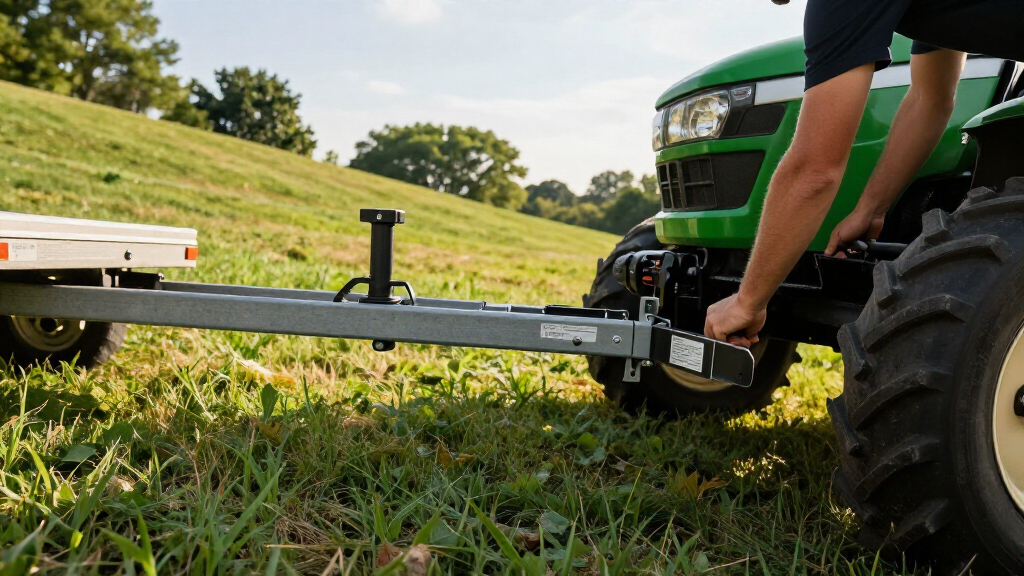
Most lawn tractors use a low pin-style drawbar designed for compatible carts. Raising the hitch point — or pulling from a seat bracket, axle housing or bumper — creates leverage that can rotate the machine backward, especially when a wheel drops into a rut under heavy pull. The approved drawbar location exists for a reason: it keeps pull forces low and behind the rear axle where they can’t lift the front end.
Why is hitch height so consequential? Think of the tractor as a lever pivoting on its rear axle. Pull from a point below the axle and the force presses the front end down — stable. Pull from above it and the same force rotates the nose upward; under a hard yank, that can rear the machine or, on a steep pull, flip it. The higher the attachment point, the more mechanical advantage the load gains over you. That’s why “it bolts on, so it must work” reasoning fails here: the question isn’t whether the bracket fits, it’s where the force lands.
Inspect before every heavy job: hitch plate and frame for cracks, bending or corrosion; the pin, clip and coupler; trailer tongue, axle, tires and wheel bearings; cargo restraints. A $3 hitch clip that’s worn half through is the cheapest failure point on the whole combination — and the tradeoff of skipping inspection is that the failure arrives at maximum load, mid-hill, when every part is under the most stress it will ever see.
The transmission is the other silent limit, and it fails differently from everything else on the tractor. Brakes warn you with distance; steering warns you with feel; the hydrostatic transaxle often gives only subtle symptoms until damage is done. These units are sensitive to sustained high load, slow climbing and repeated towing on grades because a hydrostatic drive working hard at low speed gets no airflow across it to shed heat — the exact conditions towing creates. A tractor can move the load while quietly overheating its transaxle and chewing through belt life. Watch for: pulling power that fades as the machine warms, slipping or surging, belt smell, transmission noise, fluid leaks. Stop the moment performance changes. The implication matters: heat damage is cumulative and largely invisible, so “it pulled it once” is not evidence the load is within continuous-duty capability — that’s a one-time pass, not a rating. The tradeoff for pushing a heavy load anyway is a transmission lifespan measured in seasons instead of decades.
Newer electric tractors add a twist: instant torque makes them feel exceptionally capable, but that feeling is misleading — battery power doesn’t upgrade the hitch, frame or brakes, and range can fall sharply under heavy towing because drag loads keep the motor at high draw continuously. Regenerative braking helps on descents, but its availability varies with battery state and temperature: a cold or nearly full battery may accept little or no regen, exactly when you’d want it most. Published limits still govern.
Your Pre-Tow Checklist: Seven Steps That Take Five Minutes
A safe tow behind a lawn tractor comes down to a repeatable routine. Here’s mine, built the hard way after years of hauling firewood, gravel and brush across acreage:
- Confirm limits in both manuals — tractor and trailer. The lower number wins.
- Calculate total load including the cart’s own weight. If you’re guessing, guess light.
- Inspect the hitch — pin, clip, plate, frame, trailer tongue, tires, bearings.
- Check brakes and transmission operation on flat ground before loading up.
- Balance and secure cargo — low, centered, positive tongue weight within spec.
- Walk the route and flag slopes, soft ground, ruts and anything you’d rather not discover with 600 pounds behind you.
- Downsize the load whenever conditions are questionable. Two trips beat one recovery.
While towing: low steady speed, generous following and stopping distance, gradual braking and steering, no sudden anything. Keep people — especially kids — clear of the tractor and hitch area, and check behind the entire combination before reversing; a trailer adds blind spots and swings wide. And keep the whole rig off public roads unless it’s street-legal in your state, which almost none are.
Frequently Asked Questions
How much weight can my lawn tractor tow?
There is no reliable formula based on horsepower, engine size or tractor weight. Use the maximum gross towed weight printed in your operator’s manual — typically 500–1,000 pounds for consumer machines — and apply the lower of the tractor, hitch or attachment limits. Contact the manufacturer if no spec is listed.
Does the towing limit include the cart itself?
Almost always yes — a gross towing limit covers the empty trailer plus everything in it. A “600-pound capacity” dump cart that weighs 120 pounds empty leaves you 480 pounds of actual cargo. Confirm the terminology in your manual.
Can I increase towing capacity by installing a stronger hitch?
No. A heavier hitch cannot strengthen the tractor frame, transaxle, axles, tires or brakes. The manufacturer’s published towing limit applies regardless of hitch hardware. Stronger hitches only add attachment compatibility.
What should I do if the trailer starts pushing the tractor downhill?
Avoid abrupt braking or sharp steering — both can jackknife the trailer. Keep the wheels straight, ease off smoothly if you have any control left, and crawl to level ground. Then reduce the load or reroute before continuing.
Why does my steering feel light when towing?
Excessive tongue weight is lifting the front axle — usually from cargo packed too far forward or unapproved rear ballast. Stop immediately, shift the load rearward or remove weight, and don’t continue with reduced steering control, especially near slopes.
Can I tow downhill with a hydrostatic tractor?
Only within the manual’s towing and slope guidance. Hydrostatic drive resistance helps regulate speed but is not a braking system, and a heavy trailer can push a tractor faster than it can safely stop. Descend in the lowest gear, slow, straight, and heavily reduced.
Is an electric lawn tractor safer for towing because of regenerative braking?
Not necessarily. Regeneration may help on descents, but its availability varies with battery state, temperature and system design, and it doesn’t raise hitch, frame or brake ratings. Published towing and slope limits remain the deciding factor — and towing range drops sharply under load.
Conclusion
One takeaway to carry out of this: the lowest limit governs. Your engine may pull it, your hitch may hold it, your tires may grip it — and your brakes still can’t stop it. Before the next loaded haul, open both manuals, weigh the load honestly, walk the route, and ask whether you could stop the whole combination in the distance you can see. If the answer is no, split the load. Nobody ever regretted making a second trip.
Fall yard work Picks
leaf blowers
As an affiliate, we earn on qualifying purchases.