TL;DR

Get business pricing on tools and workshop supplies
- Business-only prices and quantity discounts
- Tax-exempt purchasing
- Multiple users, one account, clear invoices
A four-wheel yard cart supports the full payload and suits heavy loads on broad, fairly level routes, while a two-wheel cart pivots more easily but makes you balance part of the load. On slopes and sharp turns, a low center of gravity, wide wheel spacing, secure cargo, good tire grip, slow speed, and effective brakes matter more than wheel count.
A yard cart that feels planted on the driveway can become a runaway load the moment wet grass tilts under its tires. One rut, one hurried turn, and 300 pounds of soil starts leaning downhill while the handles kick against your palms. The cart has not changed, but the forces acting on it have.
You will learn why the choice between two-wheel and four-wheel yard carts is not simply a wheel-count contest. The useful questions involve center of gravity, track width, steering design, tire grip, load placement, and whether the operator must support part of the payload. Those details decide whether a cart tracks calmly or answers a turn with a sharp clunk and a sideways lurch.
This guide gives you a practical way to match a cart to your acreage, slopes, gates, and hauling jobs. You will see how each design behaves while crossing a grade, descending under load, turning beside a raised bed, and carrying loose or liquid material. You will also get a short operating routine that helps you test an unfamiliar cart before filling it to the rated limit.
Choose two wheels for moderate loads, narrow paths, and frequent pivots only when you can comfortably balance and restrain the handles.
Choose four wheels for bulky or heavy cargo on broad, fairly smooth routes, but add effective braking when hills are part of the job.
Cross slopes with a lighter, lower, centered load—or reroute straight up or down when the cart maker permits that direction.
Slow before every turn because speed, steering angle, cargo height, and a pivoting front axle can combine to shrink your rollover margin.
Treat maximum payload as a structural rating; tire PSI, incline limits, towing speed, surface grip, and load placement still control safe capacity.
Two-Wheel vs Four-Wheel Yard Carts: Stability on Slopes and Turns
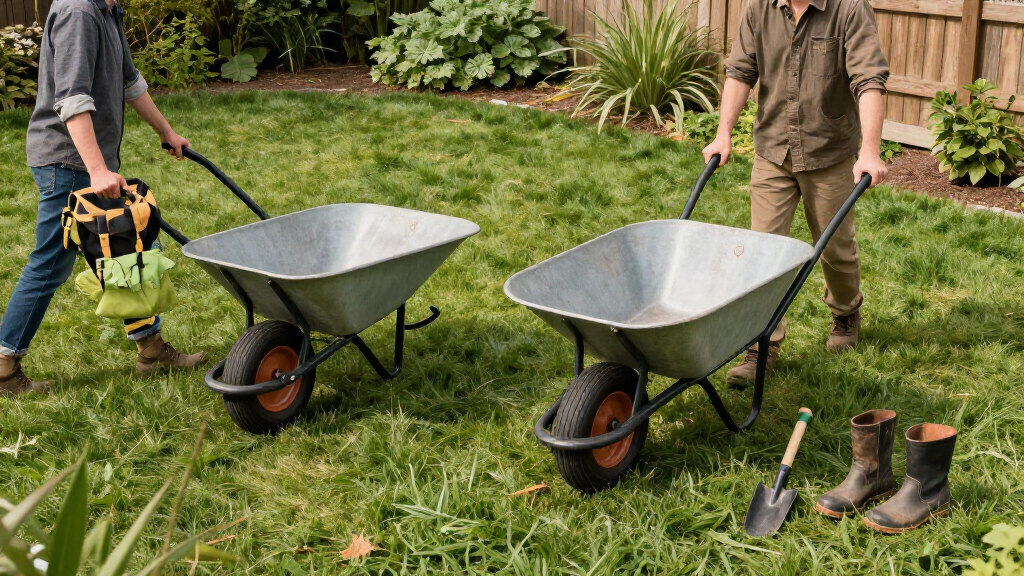
Four wheels support the full payload; two wheels pivot with precision. Yet on a wet grade or in a sharp turn, geometry, grip, load height, speed, and braking matter more than wheel count.
Choose it for moderate loads, narrow paths, frequent pivots, and deliberate wheel placement.
Choose it for bulky or dense cargo on firm, fairly level ground—with braking for hills.
A controlled 150-pound load is safer than an unstable cart filled to a 300-pound structural rating.
Which cart fits the work you actually do?
Wheel count is the opening specification, not the verdict. Match the cart to the route, load, gates, turning space, footing, and your ability to restrain the handles.
Agile, direct, operator-balanced
The wheels sit near the load’s center of mass. Your hands lift, lower, steer, and stabilize the remaining weight.
Supportive, capacious, route-dependent
The chassis carries the complete load, reducing handle effort and making loading or unloading easier.
The practical tradeoff: two wheels give active control but make the operator part of the balance system; four wheels provide passive support but give the operator less ability to lift a side away from trouble.
Control changes with the terrain
A design that feels effortless on packed gravel can become difficult on wet grass, a rut, or a tight downhill corner.
| Handling factor | Two-wheel cart | Four-wheel cart |
|---|---|---|
| Load support | Wheels carry most of the load; the operator balances the handles. | All four wheels support the load without handle lifting. |
| Tight turns | Pivots in a small area and follows the operator’s line. | Needs a broader arc; some steering systems shrink the support footprint. |
| Heavy cargo | Practical only while handle weight and balance remain manageable. | Better suited to bulky or dense loads on firm, gentle routes. |
| Slopes | Direct control, but the operator must restrain and stabilize the load. | Supports the load yet may roll away or push a tow vehicle downhill. |
| Rough paths | Often easier to lift or steer around a root, rut, or stone. | A rigid wheel may lift and shift weight abruptly to the other three. |
| Parking | Must rest securely on its legs and wheels; never trust a slope. | Stable on level ground; use wheel locks or chocks on a grade. |
The center of gravity decides when the cart tips
During cross-slope travel, weight migrates toward the downhill wheels. Once the combined center of gravity passes the downhill contact line, grip and steering cannot restore balance.
Crossing the grade compresses your safety margin
A taller load moves the center of gravity closer to the downhill edge. A rut, soft patch, or sudden turn can push it beyond the support footprint in an instant.
What raises instability fastest?
Relative influence varies by cart, but these interacting conditions consistently reduce control.
How a hurried turn becomes a sideways lurch
Turning sends weight toward the outside wheels. Speed, steering angle, load height, and surface irregularity compound one another.
Speed enters the turn
Momentum resists the change in direction.
Steering angle tightens
A short radius increases lateral force.
Weight moves outward
Outside tires gain load as inside tires unload.
Footprint narrows
A pivoting axle may bring the support lines inward.
Rollover margin falls
A high or shifting load can cross the support edge.
Four tires can remain on the ground while stability worsens. A sharply turned pivoting front axle may narrow a wagon’s effective support footprint, making a tall load vulnerable during a tight turn.
Choose for the whole journey, not the easiest ten feet
Inspect gates, surface changes, drainage, turning points, braking distance, and places where you may need to stop.
Frequent pivots
Moderate cargo, tight corners, and careful placement favor a lighter cart that follows your hands.
Preferred: two-wheel cartRepeated heavy trips
A supported chassis reduces lifting and lets you pause or unload without balancing the handles.
Preferred: four-wheel cartSideways rollover risk
Reduce the load, keep it low and centered, or reroute straight up or down if the maker permits.
Preferred: reroute firstGravity adds momentum
Use a lighter load, slow speed, secure cargo, reliable grip, and service brakes where available.
Required: positive restraintWheel contact changes
Place each wheel deliberately. A rigid four-wheel chassis can transfer weight suddenly when one tire lifts.
Preferred: agility over volumeThe load moves
Leave headroom, use dividers or straps, and avoid abrupt starts, stops, and steering corrections.
Required: contain and secureTest control before filling to the rated limit
An unfamiliar cart should earn your confidence gradually. Begin light, rehearse the difficult points, and stop if the route demands hurried corrections.
Walk the route
Remove hoses, stones, branches, and wheel-catching hazards. Mark soft ground and escape paths.
Set the load
Place dense items low, centered, and secured. Keep cargo below the bed rail when practical.
Test lightly
Use a partial load to check handle weight, steering response, tire grip, and braking.
Rehearse turns
Slow before steering. Use wide arcs and verify that cargo does not climb toward the outside wheels.
Control the slope
Reduce the load, keep others downhill out of the path, and never stand below an uncontrolled cart.
Maximum payload is primarily a structural rating. Tire pressure, incline limits, towing speed, surface grip, braking, load placement, and operator control still determine the safe working load.
The stability chain
Which Cart Gives You Better Control for the Work You Actually Do?
Two-Wheel vs Four-Wheel Yard Carts: Stability on Slopes and Turns comes down to how each design supports and steers its load. A two-wheel cart trades hands-off stability for tight control, while a four-wheel cart carries the full weight but needs more room and can behave badly on grades or sharp turns.
| Handling factor | Two-wheel cart | Four-wheel cart |
|---|---|---|
| Load support | The wheels carry most of the load, but the operator balances the handles. | All four wheels support the load without handle lifting. |
| Tight turns | Pivots in a small space and follows the operator’s chosen line. | Needs a broader arc; some steering systems reduce the support footprint. |
| Heavy cargo | Manageable only when handle weight and balance stay reasonable. | Better for bulky or dense loads on firm, gentle routes. |
| Slopes | Offers direct control, but the operator must restrain and stabilize the load. | Supports the payload, yet may roll away or push a tow vehicle downhill. |
| Rough paths | Often easier to lift or steer around a root or stone. | A rigid wheel may lift, abruptly shifting weight to the other three. |
| Parking | Must be secured because it rests on its legs and wheels. | Stable on level ground, but wheel locks or chocks are needed on a grade. |
The practical tradeoff is between active control and passive support. With two wheels, your hands become part of the cart’s suspension and balance system: you can react to a root or steer away from a rut, but fatigue or poor footing immediately reduces your control. Four wheels isolate you from most handle weight, which preserves energy during repeated trips, yet the cart follows its own wheel paths and gives you less ability to lift one side away from trouble.
Suppose you are moving six bags of mulch through a 36-inch gate, around tomato cages, and onto a narrow wood-chip path. A two-wheel cart can pivot almost in place, and you can raise one handle slightly when a tire catches a buried root. The operator must support enough handle weight to keep the load from pitching, though, so those bags still demand steady arms and sound footing.
Now move the same load across a broad, packed-gravel driveway. A four-wheel wagon lets you stop, open the tailgate, and unload without balancing anything. According to Outdoor Pro Masters, four contact points make loading easier, but they do not automatically provide better rollover resistance on steep or uneven ground [1].
This distinction affects how you should compare capacities. A four-wheel cart may let you move more weight because the chassis carries it, but that advantage disappears if the route forces tight turns, crosses a grade, or lacks enough braking distance. A two-wheel cart may have the lower rated payload yet remain the more controllable tool when precise wheel placement matters more than volume per trip.
Wheel count is only the opening spec. A low, wide cart with well-placed cargo can resist tipping better than a taller cart wearing two extra wheels.
As an affiliate, we earn on qualifying purchases.
Why Straight Up or Down the Slope Usually Keeps the Load Safer
Two-Wheel vs Four-Wheel Yard Carts: Stability on Slopes and Turns favors neither design when you travel across a steep grade. Cross-slope travel pushes the center of gravity toward the downhill wheels, leaving less margin when a tire drops into a rut, cargo shifts, or you steer downhill too quickly.
That margin matters because a cart does not need to slide before it tips. As the combined center of gravity of the cart and cargo approaches the line through the downhill tire contacts, the uphill wheels carry progressively less weight. Once the center of gravity passes that line, steering corrections and extra grip cannot restore balance; gravity is already rotating the load downhill.
Imagine hauling split oak across a lawn that falls toward a drainage ditch. The uphill wheels ride on firm turf, while a downhill tire sinks into a soft mole run with a wet scritch. A load stacked above the bed rail now leans toward open space, and your recovery time may be less than a second.
Stability depends on the slope angle, wheel spacing, bed height, cargo height, tire grip, and your route. A wide stance increases resistance to sideways tipping, while a low load keeps its mass closer to the ground. Heavy objects placed on the downhill side erase much of that advantage. This is why cutting load height can improve safety more than merely removing the same amount of lightweight material from the bottom of the bed.
- Travel straight up or down whenever the manufacturer permits it and you have secure footing.
- Cut the payload before entering a grade; make two calm trips instead of one overloaded trip.
- Keep dense cargo low and centered, with nothing stacked loosely above the bed.
- Walk the route first and remove hoses, stones, branches, and other wheel-catching hazards.
- Keep people and animals downhill out of the path, even when the cart has brakes.
Going straight does not make every slope safe; it changes the main risk from sideways rollover to loss of uphill or downhill control. Climbing creates a different problem. A loaded two-wheel cart can pull backward if your boots slip, while a four-wheel cart can gather reverse speed unless brakes, wheel locks, or another rated restraint stop it. If the route is slick enough that you cannot pause without sliding, the route is wrong for a manually controlled load.
Descending adds gravity to every pound in the bed. Parking locks do not equal service brakes; a lock holds a stopped wheel, while a service brake regulates movement. Locking a wheel during travel can make a tire skid, and a skidding tire usually offers less directional control than a rolling tire. Outdoor Pro Masters recommends reducing the load, moving slowly, following published incline limits, and never placing your body directly below an uncontrolled cart [1].
The tradeoff is therefore simple but important: a shorter route across a slope may save steps, while a longer route that follows the fall line or reaches gentler ground preserves more rollover margin. When the load is dense, loose, or high, the extra distance is usually the cheaper choice.
As an affiliate, we earn on qualifying purchases.
How to Turn Without Letting the Load Climb Over the Outside Wheels
Two-Wheel vs Four-Wheel Yard Carts: Stability on Slopes and Turns rewards slow, wide steering. A turn shifts weight toward the outside wheels, and the shift grows as speed, load height, and turn sharpness increase. Brake before steering, use a broad arc, and keep the bed level whenever the route allows.
Speed matters disproportionately because the sideways force produced during a turn rises rapidly as speed increases. A pace that feels only slightly quicker can demand much more grip and create a much stronger outward weight transfer. A broad radius reduces that demand, giving the tires and the operator more time to correct the cart before the inside of the bed begins to lift.
A two-wheel cart can pivot beside a compost bin with little forward travel. That tight arc is useful, but the operator must support the cart against twisting and sideways lean. If one handle drops while a 100-pound stone sits off-center, the bed can roll toward that hand faster than you can straighten your stance. The maneuverability advantage therefore comes with a physical requirement: you must be able to resist both handle weight and rotational force throughout the turn.
Four-wheel wagons carry a quieter risk. On a traditional wagon with a pivoting front axle, the front wheels swing inward during a hard turn, narrowing the effective support area beneath the bed. Add a tall stack of firewood, a shallow rut, and a brisk walking pace, and the outside tires become a tipping edge. All four tires may still touch the ground at first, so wheel contact alone is not proof that the wagon retains a wide, stable base.
- Slow down before the corner. Do your braking while the wheels still point straight.
- Choose the widest practical arc. A broad turn produces less sideways weight transfer than a sudden pivot.
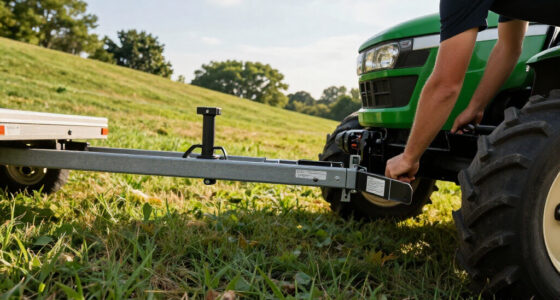
- Watch the inside wheels. Tow-behind carts cut inside the tractor’s path and may clip a stump, post, or raised-bed corner.
- Pause after a hard wheel strike. Check the load instead of jerking the cart back on course.
- Secure anything that can roll or slosh. Logs, tools, and liquid containers can move after the cart begins turning.
Braking before the corner separates two competing demands. Straight-line braking uses tire grip to reduce speed, while steering uses grip to change direction. Asking the tires to do both at once on wet grass or loose gravel makes either sliding or understeer more likely. Entering slowly preserves grip for the turn and reduces the need for a sudden correction.
Consider a lawn tractor towing soil around a maple tree. The tractor clears the trunk, but the cart tracks several feet inside the tractor’s arc and bumps a root with a hollow thump. If the driver snaps the wheel outward, the combination of a high soil mound, angled front axle, and lifted inside tire can overturn the cart.
A tighter turn may seem efficient in a confined yard, but the time saved is small compared with the consequences of unloading a tipped bed or damaging an axle. If the route cannot accommodate a broad turn, reduce the load, lower its height, or reposition the cart in several slow movements.
Never make a sharp downhill turn. Slow while straight, keep the load low, and change direction on the flattest ground available.
yard cart with good tire grip and brakes
As an affiliate, we earn on qualifying purchases.
As an affiliate, we earn on qualifying purchases.
Load the Bed This Way to Cut Handle Strain and Sideways Lean
The safest yard-cart load is low, centered, evenly spread, and secured. On a two-wheel model, arrange the cargo around the axle so you retain manageable handle weight. On a four-wheel model, share the weight between both axles unless the manufacturer gives a different loading pattern.
These goals solve different problems. Keeping weight low increases the angle the cart can lean before its center of gravity passes the tire line. Centering it side to side keeps both wheels or wheel pairs similarly loaded, while distributing it front to rear preserves predictable handle or tongue weight. Securing the cargo prevents that careful balance from changing after the first bump.
Two-wheel balance has a sweet spot, but it is not zero handle weight. Put too much material behind or beyond the axle and the handles may rise, pitching the cart forward. Pack too much toward your hands and your back, shoulders, and grip must carry a punishing share of every trip. A small, positive handle load gives you feedback and control; a rear-heavy cart can unexpectedly lift its handles when the wheels strike an obstacle or the bed tilts.
For a real example, load ten 20-pound pavers into a two-wheel cart one layer at a time. Place the first pavers flat over the axle, then add equal numbers forward and rearward while checking the handles. When you lift, you should feel firm control without needing a deadlift just to clear the support legs. Testing after each layer matters because the same total weight can feel entirely different when shifted only a few inches relative to the axle.
A four-wheel bed removes that lifting job, yet poor distribution still affects handling. Loading a tow-behind cart heavily at the rear can alter tongue weight and reduce the lawn tractor’s steering or rear-tire traction. Too little positive tongue weight may encourage sway, while excessive tongue weight can overload the hitch or change the towing vehicle’s balance. A structural payload rating tells you what the frame can carry on stated conditions; it does not promise control on loose gravel, wet turf, or a descent.
Loose material creates organized chaos inside the bed. Gravel rolls outward during a turn, damp soil slumps after a bump, and water hits the container wall with a heavy slosh. This moving mass can produce a second weight transfer after you have already begun correcting the first one, which is why partly filled liquid containers and unblocked round objects can feel especially unpredictable. Keep dense loose material below the bed rim, strap tall containers, and block round logs so they cannot gather momentum.
Dumping deserves the same care. Park on firm, level ground, chock the wheels if the manual calls for it, stand clear of the bed’s travel, and release the latch with a controlled grip. A raised dump bed moves the center of gravity upward, which makes a side slope especially unforgiving. Material that sticks and then releases suddenly can also jerk the cart, so a level dumping site provides room for that change without adding a downhill pull.
As an affiliate, we earn on qualifying purchases.
The Tire, Brake, and Steering Specs That Matter More Than Extra Wheels
Tire size, inflation, brakes, and steering geometry can change cart behavior more than adding two wheels. Large tires cross holes and roots with less resistance, matched pressure keeps the bed level, and true service brakes help control downhill speed. Steering design decides how much support remains under the load during a turn.
These features affect different stages of the same event. Tires determine whether the cart maintains contact and grip, steering determines where the support footprint moves, and brakes determine whether speed stays low enough for both systems to work. A weakness in one area can cancel strength elsewhere: four wide tires offer little reassurance if the wagon enters a corner too fast with no effective moving brake.
Large-diameter wheels approach a root at a shallower angle, so they tend to roll over it instead of stopping dead. Wide tires spread weight across soft soil and reduce sinking, though they can feel heavy when you steer on firm ground. That steering effort is the tradeoff for flotation because a larger contact patch must scrub across the surface during a tight pivot. Aggressive tread helps on loose earth, but no tread pattern cancels an overloaded cart or an excessive grade.
Pneumatic tires cushion sharp impacts and often grip well when inflated to the cart maker’s stated PSI. A soft tire on one side makes the bed lean and can cause a persistent pull downhill. It also changes rolling resistance, so the operator may mistake an inflation problem for bent steering or uneven cargo. Foam-filled and solid tires avoid punctures, but their firmer ride sends more shock into the frame and cargo when they hit stones.
For example, a four-wheel wagon carrying garden tools may look level in the shed. Outside, one tire at 8 PSI instead of the specified 20 PSI squats into the grass, and the wagon begins tugging left. The issue feels like bad steering, but the uneven tire height has already shifted the load. Adding more cargo would amplify the lean and tire deflection rather than settle the wagon.
Wheel locks hold parked carts; service brakes regulate moving carts. Hand brakes, drag brakes, mechanical systems, and electronically controlled braking can help on hilly acreage, provided the equipment has a published incline rating and receives regular checks. A brake that acts on only one side can pull the cart off line if its adjustment is uneven, while a brake that locks abruptly can trade rolling control for a downhill skid. Test braking with a light load on a clear, gentle grade before trusting it with stone, logs, or soil.
Steering also creates a choice between maneuverability and support geometry. A pivoting axle turns tightly but can swing the front contact points inward, while automotive-style steering may preserve a more consistent footprint at the cost of complexity, price, or turning radius. Compare the steering system in its fully turned position, not only while the wheels point straight.
Before servicing a powered cart, switch it off, remove the key, disconnect the battery as directed, and chock the wheels. Wear gloves and eye protection around damaged hardware or battery terminals. Have a qualified service professional repair burned wiring, a damaged charger, or braking faults rather than improvising around high-current electrical parts.
Use This Six-Step Check Before You Commit to a Cart or a Full Load
Choose a yard cart by matching its dimensions, controls, tires, and ratings to your worst regular route, not your smoothest stretch of lawn. Measure gates, inspect grades, compare braking systems, and test a small payload. The label’s maximum capacity is a frame limit, not a promise of safe handling everywhere.
The worst regular route is the useful benchmark because it exposes the constraints that determine every trip: the narrowest opening sets maximum width, the sharpest corner tests steering, and the steepest descent determines how much braking and traction you need. Buying for the easy section can leave you with a cart that carries a large load but cannot safely deliver it.
- Walk your hauling route. Measure the narrowest gate and note side slopes, roots, drainage dips, loose gravel, and places where you must turn.
- Read every applicable rating. Check payload, incline, towing speed, tongue weight, tire pressure, and any separate limit for dumping or rough terrain.
- Compare stance and bed height. Favor a low bed and wide track when rollover resistance matters, while allowing enough clearance for your paths.
- Check the human workload. Lift the empty handles, imitate a turn, and decide whether you can support and restrain the expected two-wheel load.
- Inspect control hardware. Look for usable service brakes, secure latches, replaceable tires, tight axle hardware, and steering without binding or excess play.
- Run a light-load trial. Start on firm, level ground, then test gentle grades and broad turns without approaching the published limits.
Use the results as a system rather than a feature checklist. A low bed improves rollover resistance but may lose ground clearance in ruts. A wide track adds stability but may not fit the gate. Large tires cross roots more easily but can raise the bed and require more turning space. The right cart is the combination whose compromises suit the route, not the model that wins the most individual specifications.
Say you maintain two wooded acres with a 48-inch gate, a long gravel lane, and a vegetable plot behind the house. A two-wheel cart may handle pruning debris and mulch through the garden, while a braked four-wheel or powered cart better fits repeated firewood runs on the lane. One cart can do both jobs, but the compromise may be more effort in the garden or less control on the hill.
If you must choose one cart, base the decision on the job with the greater consequence of failure. Extra effort on level garden paths is inconvenient; inadequate braking during a loaded descent is hazardous. That reasoning may justify a braked cart even if it is less nimble around beds, or it may favor a smaller two-wheel model when every route is narrow and loads can remain moderate.
Electric-assist carts add low-speed power, powered reverse, and sometimes electromagnetic braking. They reduce pushing effort, yet their battery and drive hardware add weight, and motor torque can exceed tire grip on wet grass. That means assistance can help you climb while making traction and stopping performance more critical on the return trip. Favor controllable low-speed response, a published incline limit, useful brakes, and enough runtime for your route rather than chasing the largest payload number.
Battery-versus-gas also has honest tradeoffs. Battery power gives you quiet starts, low-speed control, and no exhaust beside the garden, while gas can suit long workdays away from an outlet. Battery weight may improve drive-wheel traction but also increases the mass the brakes must restrain; gas equipment offers rapid refueling but adds heat, noise, maintenance, and fuel handling. Neither power source fixes a high center of gravity, poor tire pressure, or reckless steering; powered equipment still answers to the same slope physics [2].
Frequently Asked Questions
Is a four-wheel yard cart always more stable than a two-wheel cart?
No. Four wheels support the full payload and stand well on reasonably level ground, but slope stability still depends on track width, bed height, load placement, steering geometry, and tire contact. A low, wide two-wheel cart can resist sideways tipping better than a narrow four-wheel wagon carrying cargo above its rails.
Which type of yard cart is safer on a hill?
Neither design wins on every hill. A low, wide, lightly loaded cart with strong tire grip and effective brakes offers the better setup, while a steep or slick grade may be unsuitable for either type. Four wheels remove handle lifting but can roll away; two wheels give direct balance control but demand strength, footing, and restraint.
Should I move a loaded cart across a slope?
Straight up or down is generally safer than crossing a slope when the manufacturer allows the route. Crossing shifts the center of gravity toward the downhill wheels, and a rut or sudden turn can tip the bed. If you cannot avoid the traverse, reduce the load, center it low, move slowly, and keep people out of the downhill path.
Why can a four-wheel wagon tip in a sharp turn?
A sharp turn transfers weight toward the outside wheels, and a pivoting front axle may narrow the wagon’s effective support footprint. A high stack of firewood or a mound of damp soil makes that weight shift stronger. Slow before steering and use a broad turning radius, especially near slopes or ruts.
Are pneumatic tires safer than solid cart tires?
Pneumatic tires usually cushion roots and stones while providing useful grip, but they only work properly at the specified pressure. One soft tire can tilt the bed, increase drag, and pull the cart sideways. Solid tires resist flats, though their harsher ride can make cargo bounce or shift on rough ground.
How much weight can I carry on a slope?
Carry no more than the cart maker’s specific slope-rated load, which may be far below the maximum payload printed on the bed. If the manual provides no slope guidance, make smaller trips and avoid steep ground. A 1,000-pound structural rating does not mean you can control 1,000 pounds on wet grass.
Can I tow a four-wheel cart with a lawn tractor or ATV?
Only tow a cart designed for that use, and stay within the vehicle’s towing, tongue-weight, speed, and slope limits. An unbraked loaded cart can push a light tractor during a descent or swing inside its path during a turn. Test the combination at low speed on firm, level ground before entering a grade.
Conclusion
Your best choice is the cart you can keep low, balanced, slow, and under control on the hardest part of your route. Favor two wheels for tight garden work and moderate loads; favor four wheels for heavy cargo on wider, gentler paths. If hills are unavoidable, put brakes, tire grip, and published incline limits ahead of bed size or headline payload.
Before the first serious haul, load a few bags, walk the route, and feel how the cart brakes and turns. That quiet test run tells you more than a glossy capacity number. When the bed is full and gravel starts rattling downhill, you want the cart to follow your hands—not ask your boots to win an argument with gravity.
Halloween Picks
halloween
As an affiliate, we earn on qualifying purchases.