
TL;DR

Get business pricing on tools and workshop supplies
- Business-only prices and quantity discounts
- Tax-exempt purchasing
- Multiple users, one account, clear invoices
ATV towing attachments connect your machine to a cart or trailer, but the hitch does not raise the ATV’s towing or payload limits. Match pin or receiver hardware to the ATV and trailer, match a ball exactly to the coupler, and measure tongue weight with the loaded trailer at towing height. Follow the lowest applicable rating and keep the load low, balanced, and secured.
A hitch stamped for a heavy load can still leave your ATV steering light and your trailer bouncing if the connection or load balance is wrong. On a gravel lane, that mismatch can turn a routine cart of firewood into a hard-to-control rig.
This guide explains how pin, ball, and receiver hitches differ, how to match ball sizes and couplers, and how to check tongue weight before you head across the property. You’ll also see why a higher hitch rating does not give your ATV permission to tow more.
Think of the setup as a chain: the ATV, mount, hitch, coupler, trailer, and load each have limits. Your working limit is the lowest one in that chain, with the ATV’s payload limit in play too. A few careful checks at the shed beat a loose connection halfway down a rutted trail.
Use the lowest applicable rating across the ATV, hitch, trailer, and coupler.
Match a trailer ball exactly to the coupler marking: common sizes are 1⅞ in, 2 in, and 2⁵⁄₁₆ in.
Measure tongue weight with the loaded trailer at towing height, then recheck after changing cargo or setup.
Count tongue weight, riders, passengers, accessories, and gear against the ATV’s payload limit.
Secure pins or couplers, attach required safety chains, keep cargo low and balanced, and inspect the connection before travel.
Field guide · ATV towing
ATV Towing Attachments: Pin Hitches, Ball Sizes and Tongue Weight
A secure towing setup depends on every connection and every load limit. Match the hitch to the trailer, match the ball to the coupler, and measure tongue weight with the loaded trailer at towing height.
At a glance
Five checks before the first loaded trip
A suitable attachment keeps a compatible trailer connected; it does not raise the ATV’s towing capacity or make an unstable load safe. Check the manuals and markings before choosing hardware.
Use the lowest applicable rating across the ATV, hitch, trailer, and coupler.
Match the ball exactly to the coupler marking: 1⅞ in, 2 in, or 2⁵⁄₁₆ in.
Measure loaded tongue weight at towing height; recheck after cargo or setup changes.
Count tongue weight, riders, passengers, accessories, and gear against payload.
Retain pins and latches, attach required chains, and inspect before travel.
01 · Choose the connection
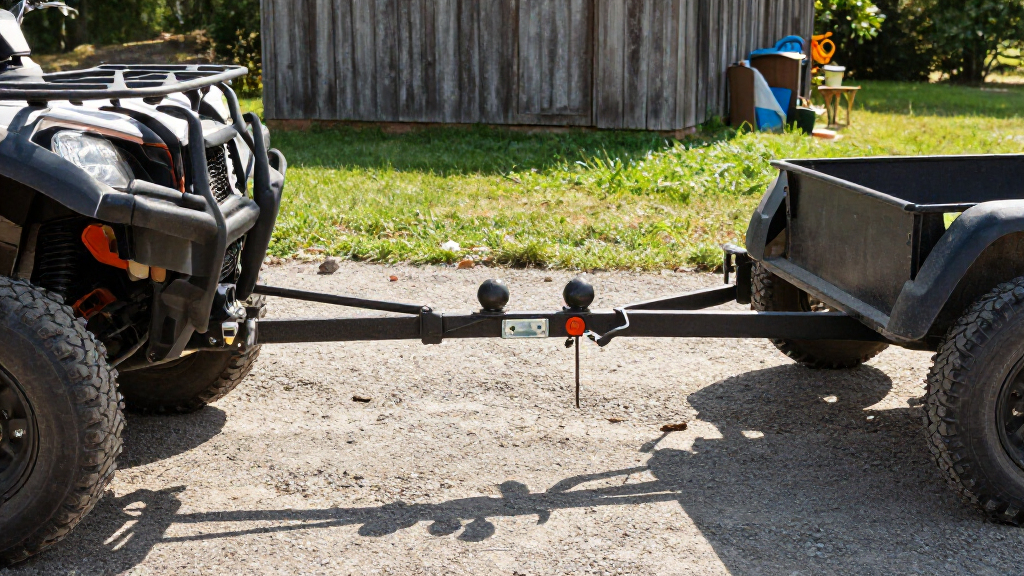
Pin, ball, and receiver hitches do different jobs
The right connection is the one your ATV supports and your trailer was built to use. These types are not interchangeable just because each can attach something behind the machine.
| Hitch type | Connects to | Check before towing |
|---|---|---|
| Pin or clevis | Matching trailer eye or implement | Hole diameter, plate fit, pin retention |
| Ball | Matching ball coupler | Exact ball size, coupler latch, rating |
| Receiver | Compatible receiver insert | ATV dimensions, mount fit, insert rating |
Pin hitch
A clevis or plate uses aligned holes and a removable pin. Check plate thickness, trailer-eye fit, and retention. Excess play can hammer the pin and holes over rough ground.
Ball hitch
The ball must match the coupler marking and documentation exactly. Seat the coupler fully, close its latch, and use the specified safety pin or lock.
Receiver style
A square tube accepts compatible inserts, but ATV dimensions and ratings do not automatically follow automotive standards. Inspect every added joint.
02 · Match the ball
“Close enough” is not a safe fit test
Common North American ball sizes are shown below. Read the ball stamp, coupler marking, and trailer documentation before connecting.
Wrong size can release
A smaller ball inside a larger coupler may not be captured by the latch. A larger ball will not fit a smaller coupler; forcing it can damage parts or prevent secure latching.
Seat, latch, and retain
Confirm the coupler sits fully on the ball and the latch closes as specified. Attach required safety chains to suitable points, leaving room to turn without dragging or binding.
03 · Tongue weight and balance
Measure the trailer as it will be towed
Tongue weight is the downward force a loaded trailer puts on the hitch. Too little can encourage sway or bouncing. Too much can overload the hitch, frame, suspension, or rear axle and make steering feel light.
Use the right measurement
Load the trailer for work, set it at towing height, and measure with a suitable scale. Recheck after shifting cargo or changing the trailer setup. Follow the ATV and trailer makers’ limits; no single percentage suits every combination.
Keep cargo controlled
Distribute weight so the trailer stays stable. Keep cargo low, centered, and secured; avoid overloading or placing heavy cargo far behind the trailer axle.
The working limit follows the weakest link
Use the lowest applicable rating. The ATV’s payload limit also includes tongue weight, riders, passengers, accessories, and gear. A heavy-duty hitch cannot raise the vehicle’s rated limits.
04 · Five-step pre-trip flow
Check the full connection at the shed
Read ratings
Check ATV, hitch, trailer, and coupler limits. Use the lowest applicable rating.
Confirm fit
Match the pin, ball, or receiver hardware to the intended connection.
Load and measure
Secure cargo low and centered; measure tongue weight at towing height.
Retain connection
Secure the pin or latch and attach required chains as directed.
Inspect and travel
Check wear and looseness; tow at controlled speed with room to stop.
05 · Inspection and buying notes
Fitment claims still need a model check
Recent product changes are mostly incremental: wider model-specific fitment, adjustable mounts, corrosion-resistant finishes, and removable accessory compatibility. Ratings and fit vary, so verify current product documentation instead of relying on “universal” claims.
- Inspect the hitch, pin, ball, coupler, chains, and mounting points for wear, cracks, looseness, or corrosion.
- Allow more stopping room; avoid steep slopes, sudden turns, and abrupt braking.
- Use only an adapter documented as compatible and rated for the intended load.
- Follow ATV and trailer manuals, including any public-road restrictions. A hitch does not make the rig street-legal.
Match the hitch to your ATV and trailer before you load
ATV towing attachments connect a machine to a trailer or implement, but each part must fit the ATV and the load. A hitch is only one link in the towing setup; it cannot increase the ATV’s rated towing capacity or make an unstable load safe. Check the ATV manual, hitch documentation, and trailer or coupler markings before choosing hardware.
A pin hitch usually uses a clevis or plate with aligned holes and a removable pin. It works well with carts and implements made for that connection. Check the hole diameter, plate thickness, pin retention, and trailer-eye fit. These details determine whether the connection can move as designed without excess play. A loose fit can hammer the pin and holes over rough ground; a pin that is too large or a plate that does not align can bind or fail to seat. If the holes do not line up cleanly or the pin has no way to stay retained, the parts are not ready for the trail.
A ball hitch connects to a trailer coupler, while a receiver-style hitch accepts a compatible insert. Neither label guarantees a fit. ATV receiver dimensions and ratings are not automatically the same as automotive standards, and a model-specific mount may need to clear a rack, bumper, or rear accessory. A mount that sits too low can strike the ground at a ditch; one that interferes with an accessory can restrict movement or prevent secure installation.
For example, a mount that bolts to one ATV’s frame may sit too low on another, causing a small trailer to scrape over a ditch. Check mounting pattern and ground clearance, then use the lowest applicable rating among ATV, hitch, trailer, and coupler. The lowest number governs because the weakest rated part can limit the whole setup even if the other parts are stronger. A suitable attachment helps keep a trailer connected; it does not raise any of those ratings. [1]
As an affiliate, we earn on qualifying purchases.Popular right now

LG 85-Inch QNED73B Mini LED 4K Smart TV (2026)

Samsung 75-Inch M80H Series Mini LED 4K Smart TV (2026)

Hisense 85 U7 Mini-LED ULED 4K UHD Smart Google TV (85U7SG, 2026)
Choose the exact ball size stamped on the coupler
ATV towing attachments with ball couplers need an exact size match: the ball must match the marking on the coupler and the trailer documentation. Common North American sizes are 1⅞ in, 2 in, and 2⁵⁄₁₆ in. The size is usually stamped on the ball and often on the coupler. A smaller ball in a larger coupler can separate from the trailer because the latch may not capture it correctly; do not use it. A larger ball will not fit a smaller coupler, and forcing it can damage parts or leave the latch unsecured.
“Close enough” is not a useful fit test. Imagine you borrow a neighbor’s utility trailer for a load of split wood. The coupler looks like it should fit your ball, but the trailer plate calls for 2 inches and your ball is 1⅞ inches. The gap may not be obvious while stationary, but bumps and changes in direction can let an improperly captured coupler lift free. Stop and fit the correctly sized, properly rated hardware before towing.
When you connect the right parts, seat the coupler fully over the ball and latch it as the trailer maker specifies. The latch is what retains the coupler around the ball during movement, so check that it closes completely and use its safety pin or lock if specified. Attach required safety chains to suitable points and check that they do not drag or bind during a turn; chains can provide a backup if the main connection comes loose, but only when attached and sized as directed. If the trailer uses a pin-style clevis instead, do not treat a pin alone as a substitute for a ball coupler; use only an adapter documented as compatible and rated for the intended load.
That last point matters on bumpy ground, where a partly seated coupler or loose pin can shift as the trailer jolts. Read both markings, check the latch or pin retention by hand, and confirm the connection again after loading. Exact fit is a basic part of keeping the trailer where it belongs. [1]
Compare pin, ball, and receiver hitches by the job they do
ATV towing attachments suit different connections: pin hitches suit matching clevises, ball hitches suit matching couplers, and receivers accept compatible inserts. The right choice is the one your ATV supports and your trailer was built to use. These types are not interchangeable just because each can attach something behind the machine. Choosing by the trailer’s existing connection usually avoids extra adapters and another interface whose fit and rating would also need to be verified.
| Hitch type | Connects to | Check before towing |
|---|---|---|
| Pin or clevis | Matching trailer eye or implement | Hole diameter, plate fit, pin retention |
| Ball | Matching ball coupler | Exact ball size, coupler latch, rating |
| Receiver | Compatible receiver insert | ATV dimensions, mount fit, insert rating |
For a lawn cart with a matching clevis, a pin connection can be a simple, direct setup. Its straightforward connection is convenient for frequent attachment changes, but the pin and holes still need to fit closely and remain retained. For a small trailer with a ball coupler, you need a ball that matches its stamped size. A receiver can add flexibility if the ATV mount and insert are designed to work together, but that flexibility comes with more joints to inspect, and the square tube alone tells you neither fit nor capacity.
For example, a property owner may swap a cart for a small enclosed trailer during spring cleanup. The ATV’s existing pin hitch may serve the cart, but that does not make a ball adapter safe by default. An adapter adds another connection point, so looseness or a low rating there can become the limiting issue. Check the adapter’s fit and rating along with the ATV and trailer limits. A product described as “universal” still needs to fit securely on your specific model. [1]
Measure tongue weight with the trailer loaded for work
ATV towing attachments carry tongue weight: the downward force a loaded trailer puts on the hitch. Too little can let a trailer sway or bounce, while too much can overload the hitch, frame, suspension, or rear axle and reduce steering control. The goal is not simply to minimize this force: a stable trailer needs suitable load balance, but the force must remain within all manufacturer limits. Measure it with the trailer loaded as you plan to tow, at the height where it will be hitched, since both cargo placement and hitch height affect the reading.
Use a suitable scale under the coupler, following its instructions, and make sure the trailer is supported safely while you take the reading. A reading taken with an empty trailer may tell you little about a full load of compost or fencing posts because added cargo changes both total weight and its distribution around the axle. There is no single tongue-weight percentage that suits every ATV and trailer; use the manufacturers’ limits and aim for a stable setup that stays within them. If the loaded reading exceeds a limit, changing cargo placement may help, but reducing the load may be necessary.
Here’s a practical example: you load a small utility trailer with bags of feed, then move two heavy bags from near the axle to the rear gate. That change can reduce the downward force at the hitch and make the trailer more prone to wag. The effect comes from shifting weight farther behind the axle, which can make the trailer less stable as it moves. Put the cargo low and distribute it so the trailer remains stable, then recheck the scale after a major change in cargo or trailer setup.
Remember that tongue weight also counts toward the ATV’s payload limit. If your machine carries a rider, passenger, rack accessories, and gear, the trailer’s downward force draws from that carried-load allowance too. This force bears on the ATV while hitched, so adding a passenger or equipment can use up capacity that seemed available before the trailer was connected. Towing capacity and payload are separate limits, and you need to stay within both.
Run these five checks before your first loaded trip
ATV towing attachments need a quick fit and load check before each trip, especially after you change trailers or cargo. A short walk-around can catch a loose pin, mismatched ball, or load that has shifted before it gets onto a slope. Work through the connection in order, from ATV mount to trailer cargo.
- Check the ratings. Read the ATV manual, hitch documentation, and trailer or coupler markings; follow the lowest applicable limit.
- Confirm the fit. Verify the mounting pattern, pin or ball size, and ground clearance. Do not rely on “universal” without checking the actual fit.
- Secure the connection. Retain the pin, or seat and latch the ball coupler fully. Attach safety chains where required or supplied, following the manuals and local rules.
- Balance the cargo. Keep the load low, centered, and secured. Avoid overloading or placing heavy cargo far behind the trailer axle.
- Inspect and recheck. Look for cracks, corrosion, wear, and looseness. Recheck after moving cargo or changing the setup.
For instance, before hauling a half load of gravel across a damp field, you might find the coupler latch has not engaged fully after the trailer was parked on uneven ground. Fix the connection before moving, then drive at a controlled speed, allow more room to stop, and take wide, gradual turns. These choices give you more time and space to respond because an ATV and trailer need longer to slow and can become unstable under abrupt steering or braking. Sudden braking and sharp turns are hard on both machine and trailer.
If a trailer sways or bounces, stop somewhere safe and check cargo balance, tongue weight, tire condition, speed, and the connection. A new sway is a sign to investigate the setup, since adding speed or continuing with a suspected loose connection can make the problem worse. Safe operation also depends on terrain and local rules; an ATV hitch alone does not make the ATV or trailer street-legal. [1]
Buy to the fit and rating, not the word “universal”
ATV towing attachments have established pin, ball, and receiver designs, while recent changes mostly add fit options such as model-specific mounts, adjustable positions, corrosion-resistant finishes, and compatibility with removable accessories. Those features can help a hitch fit a particular machine or clear an accessory, but they do not change the ATV’s towing or payload limits. Adjustable positions can also affect ground clearance and how the trailer sits, so check the selected position rather than assuming every adjustment works with every trailer.
Before buying, compare the mount pattern with your ATV and check whether the attachment clears the bumper, rack, and ground through the range of movement you expect. Look for a stated rating and read what it applies to. A high number printed on a hitch is not enough if your ATV manual sets a lower towing limit or a trailer coupler has its own rating. Ratings may refer to different kinds of loads, so compare like with like and follow the limits that apply to your actual setup.
Say you maintain several acres and use one ATV for a cart in summer and a small trailer in fall. An adjustable attachment may make those jobs easier, but only if each position fits securely and suits the trailer connection. You may still need separate rated hardware for a pin-style implement and a ball-coupler trailer. Flexibility is useful; a vague fit claim is not a substitute for checking dimensions.
Use current manufacturer manuals and documentation for your exact ATV and hitch model. When a product page says “universal” but does not give dimensions, fitment details, or a rating, you lack the information needed to confirm the setup. Buy for the connection you have, and treat the ATV’s published limits as the ceiling. [1]
Frequently Asked Questions
What size ball hitch does my ATV trailer need?
Match the ball to the size stamped on the trailer coupler and listed in the trailer documentation. Common North American sizes include 1⅞ in, 2 in, and 2⁵⁄₁₆ in. Never use a smaller ball in a larger coupler.
How do I measure tongue weight?
Load the trailer as you will tow it, then use a suitable scale under the coupler at towing height, following the scale’s instructions. Keep the trailer supported safely during the measurement. Recheck after you move cargo or change the setup.
How much tongue weight can my ATV handle?
Check your ATV manual and hitch documentation, and follow the lower applicable limit. Tongue weight also counts against the ATV’s payload allowance alongside riders, passengers, accessories, and carried gear. The safe number depends on your ATV and trailer.
Does a stronger hitch let me tow more?
No. A higher-rated hitch does not increase the ATV’s rated towing capacity or payload limit. Stay within the lowest applicable limit for the ATV, hitch, trailer, and coupler.
Can I tow on public roads or steep terrain?
That depends on your ATV, trailer, terrain, and local rules. Check both manuals and local requirements; an ATV hitch does not make the rig street-legal. For slopes, use controlled speed and avoid sudden turns or braking.
Conclusion
Before you tow, match the connection, check every rating, and measure tongue weight with the trailer loaded for the job. Keep cargo low and secured, and remember that the ATV’s payload limit still applies even when the hitch is rated higher.
Take those checks at the shed, while the rig is still and the ground is level. A well-fitted hitch should be the quietest part of your trip: no clank, no sway, just the steady crunch of tires on the trail.