
TL;DR

Get business pricing on tools and workshop supplies
- Business-only prices and quantity discounts
- Tax-exempt purchasing
- Multiple users, one account, clear invoices
Your ATV or mower’s towing safety depends on matching the right hitch pins, keeping tongue weight within 10-15%, and never exceeding the vehicle’s rated capacity. Regular checks and proper setup prevent accidents and damage.
Imagine hauling a heavy yard cart or trailer behind your ATV or mower. One wrong move—like using the wrong hitch pin or overloading—could turn a simple task into a safety nightmare. Towing isn’t just about hooking up and going; it’s about understanding the critical limits and components that keep you safe and your equipment in one piece.
In this guide, you’ll learn how hitch pins secure your attachments, why tongue weight matters more than you think, and what limits you should never push. Get ready to tow smarter—your property, your safety, and your wallet depend on it.
Always match hitch pins to receiver sizes and use corrosion-resistant, locking types for safety.
Maintain tongue weight around 10-15% of your trailer’s total weight to ensure stability.
Never exceed your ATV or mower’s towing or gross vehicle weight ratings to prevent damage or accidents.
Regularly inspect all hitch components for wear, rust, or damage before each use.
Distribute loads evenly and adjust tongue weight to avoid sway and loss of control.
Field Guide / Tow Safety
ATV & Mower Tow Attachments: Pins, Weight & Limits
Safe towing begins before the wheels move. Match the hitch pin, balance the load, verify every rating, and inspect the connection before each haul.
01 / Secure the connection
The small pin carrying a large responsibility
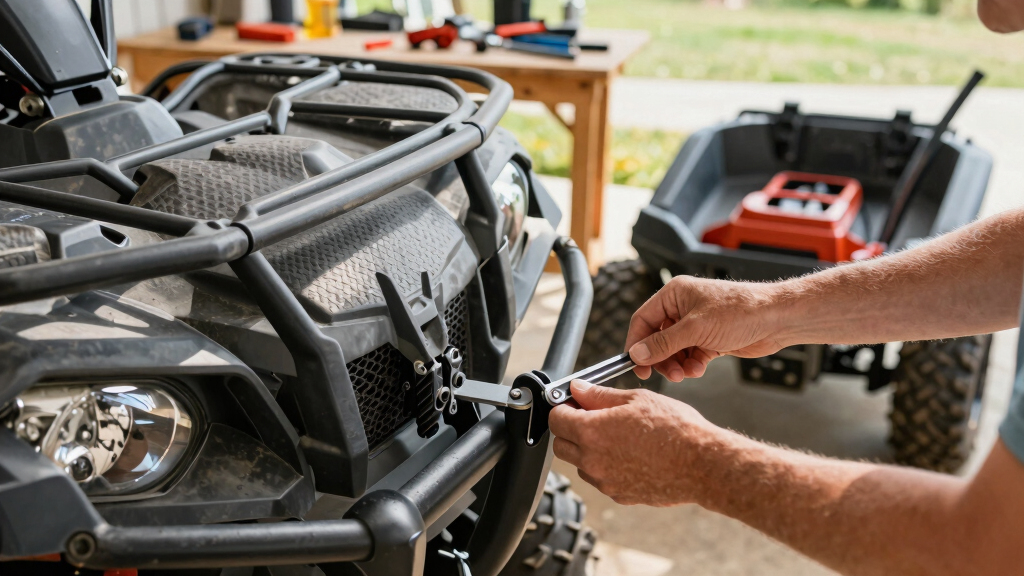
A hitch pin must match the receiver’s diameter and usable length. Excess clearance creates movement and wear; insufficient engagement or a weak retainer can allow the attachment to separate on rough ground.
Pin & Clip
Simple and economical for routine yard work. The retaining clip must seat fully and remain clear of brush or debris that could pull it loose.
Best for: light, predictable workLocking Pin
Adds protection against accidental removal and theft. Choose corrosion-resistant steel and confirm the lock closes beyond the receiver wall.
Best for: heavy loads and rough terrainQuick Release
Useful when attachments change frequently. Its rated strength, locking action and fit still need to match the equipment specification.
Best for: frequent attachment swaps02 / Balance the load
Tongue weight is the stability dial
Too little downward force encourages bounce and sway. Too much compresses the suspension, lightens steering response and overloads the hitch. Aim for the manufacturer-approved range—commonly 10–15%.
Loaded trailer weight
× 0.10 to 0.15
Example: 200 lb × 10–15%
TARGET = 20–30 LBThe towing stability spectrum
03 / Measure and adjust
Four steps to a controlled haul
Measure with the trailer loaded as it will actually be used. A bathroom scale may work for lighter attachments; heavier setups require an appropriately rated tongue-weight scale.
| Condition | Handling signal | Likely effect | Corrective action |
|---|---|---|---|
| Within range | ✓ Stable | Predictable tracking and steering | Secure the load and recheck before travel |
| Too little | ✗ Sway / bounce | Unstable trailer movement | Shift dense cargo slightly toward the hitch |
| Too much | ✗ Rear compression | Poor steering and suspension strain | Shift cargo rearward without creating sway |
| Unknown | ~ Do not guess | Unquantified handling risk | Weigh the tongue and verify every rating |
Always defer to the ATV, mower, hitch and attachment manufacturers when their specified range differs from the general 10–15% guideline.
04 / Respect every limit
The lowest rating controls the setup
A strong hitch does not increase the tow vehicle’s capacity. Safe capacity is constrained by the weakest rated component, terrain, braking ability, payload and the manufacturer’s operating instructions.
Check two numbers
Towing capacity limits the trailer or attachment being pulled. GVWR limits the total allowable vehicle weight, including the machine, operator, cargo and imposed tongue weight.
These are general hitch-class figures—not automatic ATV or mower tow ratings. The machine’s manual and identification plate govern.
| Pre-tow check | Ready | Stop condition | Action |
|---|---|---|---|
| Pin fit | ✓ Correct diameter | ✗ Loose or undersized | Install the specified pin |
| Pin condition | ✓ Straight and clean | ✗ Bent, grooved or rusted | Replace before towing |
| Tongue weight | ✓ Verified range | ~ Unknown balance | Measure and redistribute |
| Rated capacity | ✓ Below all limits | ✗ Any limit exceeded | Reduce the load or change equipment |
| Load security | ✓ Even and restrained | ✗ Shifting or top-heavy | Reposition and secure cargo |
Traceability / Safe-tow chain
Every link protects the next
A safe connection is a system, not a single component. If one check fails, stop and correct it before moving the machine.
Use the specified hitch pin, keep tongue weight near 10–15% where manufacturer guidance permits, remain below every rated limit, balance the cargo, and inspect the complete connection before each use.
Why Choosing the Right Hitch Pin Matters for Safe Towing
Hitch pins are the unsung heroes of your towing setup. They hold your trailer, cart, or mower attachment securely, so you don’t end up chasing runaway equipment. Think of a hitch pin as a lock — if it’s worn, wrong-sized, or not secured properly, everything could fall apart.
For example, a common mistake is using a hitch pin that’s too small or a cheap clip that rusts over the season. That’s a recipe for disaster. A high-quality, corrosion-resistant hitch pin that matches your receiver size — typically 1/2 inch or 5/8 inch — keeps attachments locked tight, even on rough terrain.
Always check the pin’s diameter, length, and lock type before hooking up. A locking pin with a safety clip prevents accidental detachment, especially when hauling over uneven ground or at high speeds.
Choosing the correct hitch pin isn’t just about avoiding immediate failure; it’s about ensuring long-term safety and durability. An improperly sized pin can cause unnecessary wear or even catastrophic failure if it slips out during operation. High-quality pins also resist rust and corrosion, which is crucial for outdoor equipment exposed to the elements. Investing in the right pin reduces the risk of accidents and costly repairs, giving you peace of mind during every haul.
As an affiliate, we earn on qualifying purchases.
How to Calculate & Maintain Proper Tongue Weight
Tongue weight is the downward force your trailer or attachment exerts on the hitch. It’s a simple but vital factor. Too much weight and your ATV can become unstable; too little, and it might sway or bounce dangerously.
Why does this matter? Because improper tongue weight can drastically affect your control and safety. Excessive weight compresses your suspension, leading to poor handling and increased wear on your vehicle’s components. Insufficient weight, on the other hand, causes sway, making your trailer or attachment harder to control—especially at higher speeds or on uneven terrain. This imbalance can result in loss of control, tipping, or even detachment.
Most experts agree that 10-15% of your trailer’s total weight should rest on the hitch. For instance, if you’re towing a 200-pound yard cart, aim for about 20-30 pounds of tongue weight. Achieving this balance ensures stability without overloading your vehicle’s hitch or suspension.
Here’s a quick way to keep it right:
- Fill or load your trailer as usual, mimicking real use conditions.
- Use a bathroom scale under the hitch or a dedicated tongue weight scale to measure the downward force.
- Adjust your load—by shifting heavy items closer to the hitch or redistributing weight—to reach that 10-15% sweet spot.
Why is this adjustment critical? Because it directly impacts your vehicle’s handling, braking, and overall safety. Proper tongue weight reduces sway, improves steering response, and minimizes wear on your hitch and suspension components. Neglecting this can lead to dangerous instability, especially during turns or sudden stops. Regularly checking and maintaining correct tongue weight is a simple yet effective way to prevent accidents and extend your equipment’s lifespan.
As an affiliate, we earn on qualifying purchases.
Understanding Limits: How Much Can Your ATV or Mower Tow?
Every ATV or mower has a maximum towing capacity—a hard limit set by the manufacturer. Exceeding it risks damaging your machine or causing accidents. For example, a typical ATV might handle 1,000 to 2,000 pounds, but some lightweight models top out at 500 pounds.
Why is respecting this limit so important? Because pushing beyond it can cause excessive strain on your vehicle’s frame, suspension, and drivetrain. This strain accelerates wear and can lead to mechanical failure. Moreover, overloading reduces your vehicle’s ability to respond effectively, increasing the risk of sway, tipping, or loss of control, especially on uneven or inclined terrain.
Check your owner’s manual or specs plate for the exact figure. Also, consider the Gross Vehicle Weight Rating (GVWR), which includes your ATV or mower plus the load. Staying below this limit isn’t just about compliance—it’s about ensuring safe operation and longevity of your equipment.
Here’s a quick comparison:
| Hitch Class | Max Load (lbs) | Suitable For |
|---|---|---|
| Class I | up to 2,000 | Small trailers, yard carts |
| Class II | 3,500 | Larger attachments, medium trailers |
| Class III | 5,000 | Heavy-duty hauling, large mowers |
Matching your hitch class to your vehicle’s capacity isn’t just a technical detail—it’s a safety imperative. Overloading can cause sway, loss of control, or even catastrophic failure during operation. Always respect the manufacturer’s ratings, and when in doubt, consult a professional to ensure your setup is safe and appropriate for your specific equipment.
As an affiliate, we earn on qualifying purchases.
Quick Tips to Keep Your Towing Safe and Efficient
- Always verify your hitch and pin sizes match the attachment specs. Using mismatched sizes can cause sudden detachment or damage, especially when navigating rough terrain or making sharp turns.
- Maintain a tongue weight of 10-15% of the trailer’s weight. Proper weight distribution enhances stability, reduces sway, and improves overall control, especially on uneven surfaces.
- Never exceed your ATV or mower’s towing capacity. Overloading compromises handling, accelerates wear, and significantly increases the risk of accidents or mechanical failure.
- Inspect hitch components before each use for wear or damage. Rusted, bent, or worn parts can fail unexpectedly, causing dangerous situations during operation.
- Distribute load evenly to prevent sway or instability. Uneven loads shift the center of gravity and can lead to loss of control, especially during turns or sudden stops.
- Use high-quality, locking hitch pins for heavy loads or rough terrain. They provide extra security against accidental detachment and withstand harsh conditions better.
For example, if you’re hauling a 300-pound lawn roller, aim for about 30-45 pounds of tongue weight. Regular inspections can catch rusted pins or worn clips before they fail at the worst moment, preventing accidents and costly repairs. Remember, proactive maintenance and proper setup are your best defenses against towing mishaps.
As an affiliate, we earn on qualifying purchases.
Frequently Asked Questions
How do I know what size hitch pin I need for my ATV or mower?
Check your receiver hitch’s diameter—most are 1/2 inch or 5/8 inch. Your equipment’s manual or the hitch itself will specify the correct pin size. Using the wrong size can lead to accidental detachment, so double-check before hooking up.
What happens if I overload my trailer or attach too much tongue weight?
Overloading causes instability, sway, or even damage to your ATV or mower. It can also lead to dangerous accidents, especially on uneven terrain. Always stay within the rated capacities—your safety and gear depend on it.
How often should I replace hitch pins and safety clips?
Inspect them before each use. If you notice rust, bending, or wear, replace immediately. Regularly replacing worn pins prevents unexpected failures during towing. High-quality, stainless steel pins last longer and resist corrosion better.
Can I tow a heavier load if I add weight distribution systems?
Weight distribution systems help spread tongue weight more evenly, improving stability. However, they don’t increase your vehicle’s rated capacity. Always check your manufacturer’s limits before attempting heavier loads.
Is there a legal limit for towing with an ATV or mower?
Yes, local laws often specify maximum towing capacities. Plus, your equipment’s manual provides guidance. Exceeding these limits can lead to fines or insurance issues, so always stay within legal and manufacturer boundaries.
Conclusion
Proper setup and awareness of your towing limits can make the difference between a smooth chore and a dangerous mishap. Remember: matching the right hitch pin, keeping tongue weight in check, and respecting your vehicle’s capacity keeps you safe and your equipment lasting longer.
Next time you hook up, picture your setup as a finely tuned machine — every part working in harmony. Towing smarter isn’t just safer; it’s better for your property and peace of mind.
Columbus Day / Indigenous Peoples' Day Picks
long weekend sales
As an affiliate, we earn on qualifying purchases.