
TL;DR

Get business pricing on tools and workshop supplies
- Business-only prices and quantity discounts
- Tax-exempt purchasing
- Multiple users, one account, clear invoices
Two-stage blowers on sloped driveways work best when the drive system can move extremely slowly, hold a straight line and maintain grip without pushing you downhill. Choose tires for maneuverable paved areas, fitted chains for hard ice, and tracks for deep snow or uneven ground, while following the machine manual’s slope limits.
A 250-pound snow blower can turn from a useful tool into a sliding steel sled the moment its tires meet glazed ice. The engine may still roar, the auger may still chew, and the wheels may still spin, but none of that gives you reliable grip or secure footing.
Sloped driveways expose the main weaknesses of any walk-behind snow blower: limited traction, awkward steering, downhill momentum and sideways drift. You will learn when wheels, chains and tracks work best, why weight placement matters more than total weight, and which controls help you creep through heavy snow without fighting the machine.
This is not about chasing the biggest engine badge. Engine power matters when you hit a wet plow ridge, but power cannot make polished ice behave like dry asphalt. Your best setup matches the grade and surface, follows the operating limits in both manuals, and lets you stop work the moment your boots or machine start sliding.
Follow the slope limits in both the blower and engine manuals; tracks, chains and ballast do not make a prohibited grade approved.
Use aggressive tires on textured pavement, approved chains on hard ice, and tracks for deep snow, gravel or long straight climbs.
Set both tires to equal specified pressure and adjust both skid shoes evenly before blaming the steering system.
Choose a machine with a true crawl speed and predictable steering rather than buying on engine size alone.
Work in slow vertical passes, turn on flatter ground and stop as soon as your footing or the machine begins to slide.
Two-Stage Blowers on Sloped Driveways
Traction, weight placement and controlled movement matter more than the largest engine badge. A 250-pound machine can become a sliding steel sled when its tires meet glazed ice, even while the engine, auger and wheels keep working.
Fitted cross links add concentrated mechanical edges where plain rubber may slide.
A longer footprint improves flotation and reduces digging on gravel or uneven ground.
Tracks, chains and ballast never make a prohibited slope approved.
Use slow uphill or downhill passes when the manual permits.
Predictable low-speed drive is more useful than abrupt power.
A small tire-pressure difference can cause sideways pulling.
Loss of footing, heading or speed control means the grip margin is gone.
The hill stays the same. Its grip does not.
A moderate grade in dry powder can become hazardous after traffic, sunlight or the scraper exposes a polished frozen film. Measure the steepest section and inspect cross-slope, surface damage, edges and escape paths.
Aggressive tires
Directional tread concentrates weight into small patches and can reach a rough paved surface beneath fresh snow.
Fitted chains
Metal cross links can bite polished ice more effectively than unchained rubber tracks, provided clearance and fit are correct.
Track drive
A broad footprint spreads the load, limits trenching and helps keep useful weight on the driven contact area.
Track drive
Longer contact patches bridge small irregularities and support steady, straight climbing over softer ground.
Wheels plus assist
Wheels usually pivot and reposition more easily. Steering assist reduces the effort needed for deliberate corrections.
No automatic winner
Tires and tracks can both drift sideways. Cross-slope operation consumes traction needed for steering and braking.
Choose for what lies beneath the snow.
Flotation, mechanical bite and maneuverability solve different problems. Greater contact area does not automatically produce more grip on smooth ice.
| Driveway condition | Usually favored | Why it works | Main tradeoff |
|---|---|---|---|
| Fresh snow on textured pavement | ✓Aggressive tires | Tread can reach and engage the rough surface. | Grip falls sharply on polished ice. |
| Glazed paved incline | ✓Approved chains | Cross links create concentrated biting edges. | Marks, vibration, clearance and retensioning. |
| Deep or loose snow | ✓Track drive | Lower ground pressure improves flotation. | Heavier steering and repositioning. |
| Gravel or irregular ground | ✓Track drive | Long footprint bridges soft spots and ruts. | Higher cost and more maintenance. |
| Narrow turns and compact storage | ✓Wheels | Short contact patch changes direction easily. | More likely to spin or dig into deep snow. |
| Sideways crown or cross-slope | ~Neither alone | Route choice and secure footing dominate. | Lateral drift remains possible with either drive. |
Always verify tire-chain approval, clearances, slope restrictions and operating procedures in the specific blower and engine manuals.
Useful weight is weight that stays on the drive.
Total mass alone does not guarantee control. Housing position, attachments, snow buildup and terrain can transfer load away from the driven wheels or tracks exactly when traction is needed.
Relative terrain advantage
Conceptual comparison based on the distinct jobs each system performs.
Where the load goes
A machine may be heavy yet still lose drive traction when the housing or terrain carries too much of that weight.
Extra engine power can clear a wet plow ridge. It cannot make polished ice behave like dry asphalt.
Clear the hill without fighting the blower.
Use the lowest practical speed, make deliberate vertical passes and preserve enough grip for steering and stopping.
Inspect the route
Find glaze, crowns, gravel pockets, walls, drop-offs and traffic exposure.
Set the machine
Equalize tire pressure and adjust both skid shoes evenly.
Select crawl speed
Choose smooth, predictable movement before entering the steep section.
Travel vertically
Run straight uphill or downhill when permitted; avoid traversing sideways.
Turn on flatter ground
Avoid sudden steering, speed or direction changes on the grade.
Stop at first slide
Do not add throttle when footing, direction or downhill speed becomes uncertain.
Directional tread must face correctly; remove packed snow and inspect for hardening.
Verify that both wheels are positively connected to the axle before climbing.
Use approved chains, confirm clearance and retension them after initial operation.
Removable traction cleats can help, but work must stop if footing is insecure.
Control is the limit.
A percentage grade describes geometry. It does not describe available traction, steering authority or operator footing.
Release the drive safely and follow the manual’s shutdown procedure. Never depend on the transmission as a parking brake.
Sideways drift means too little traction remains for reliable steering correction.
The operator cannot safely counter the momentum of a heavy walk-behind machine.
Do not operate where one slide could carry the blower or operator into an unrecoverable hazard.
Start With the Surface, Because the Same Hill Can Be Easy or Treacherous
Two-stage blowers on sloped driveways are controlled less by the hill’s appearance than by the grip under the machine. A moderate paved grade covered in dry powder can feel manageable, while the same grade over glaze ice can defeat tires, tracks and your winter boots within seconds. The important distinction is whether the drive system can convert wheel or track movement into forward motion. Once the available grip falls below the force needed to climb, extra throttle merely spins or polishes the surface.
Measure the driveway’s steepest section, not just its average rise. Then check for a sideways crown, broken pavement, gravel pockets, curbs, retaining walls and any route toward traffic. These details matter because gravity does not pull only backward on a crowned or uneven drive. A shallow cross-slope continually pulls the machine toward the low edge, forcing the operator to make steering corrections that consume some of the limited traction needed for climbing or braking.
Snow condition changes that traction equation from one pass to the next. Cold powder can provide a loose but usable layer for aggressive tread, whereas wet snow compresses into a dense film and repeated traffic can turn it into hard pack. Temperature also matters: sunlight or tire friction may briefly melt the surface, which can refreeze into a smoother layer after the first pass.
For example, a black asphalt driveway may offer a faint, sandpaper-like bite during the first pass. After the scraper polishes a thin frozen layer, that same surface can shine like dark glass. Your second pass now carries less traction and more downhill momentum, even though the grade has not changed. This is why a route that felt controlled at the start should not be assumed safe for the entire job.
There is no universal safe slope number for two-stage machines. According to Outdoor Pro Masters, the usable limit depends on the model’s instructions, surface grip, snow density, transmission behavior, side slope and your footing [1]. A percentage grade or angle describes geometry, not available traction or operator control. The blower manual and engine manual set the boundaries; extra ballast or tracks do not rewrite them, and favorable conditions do not authorize operation beyond a listed limit.
Stop immediately if you cannot keep secure footing, hold a straight path or prevent the machine from gaining speed. Those are signs that the remaining traction margin is already gone, not challenges to overcome with more throttle. Never rely on the drive system as a parking brake, and never work where a slide could carry the blower into a road, wall or drop-off.
As an affiliate, we earn on qualifying purchases.
Choose Wheels, Chains or Tracks by What Lies Beneath the Snow
Two-stage blowers on sloped driveways need a traction system matched to the surface beneath the snow. Wheels usually turn more easily, chains bite hard ice, and tracks spread weight across soft or uneven ground. No single drive type wins across pavement, gravel, powder and frozen glaze because flotation, mechanical bite and maneuverability solve different problems.
| Driveway condition | Usually favored | Main tradeoff |
|---|---|---|
| Textured pavement with fresh snow | Aggressive tires | Easy turning, but weak grip on polished ice |
| Glazed or hard-packed paved incline | Wheels with approved chains | Strong bite, with possible marks and vibration |
| Deep, loose snow | Track drive | Better flotation, but heavier steering |
| Gravel or uneven ground | Track drive | Stable movement, with added cost and maintenance |
| Tight turns and narrow storage | Wheels with steering assist | More agile, but easier to spin |
| Strong side slope | Neither automatically safe | Both tires and tracks can slide sideways |
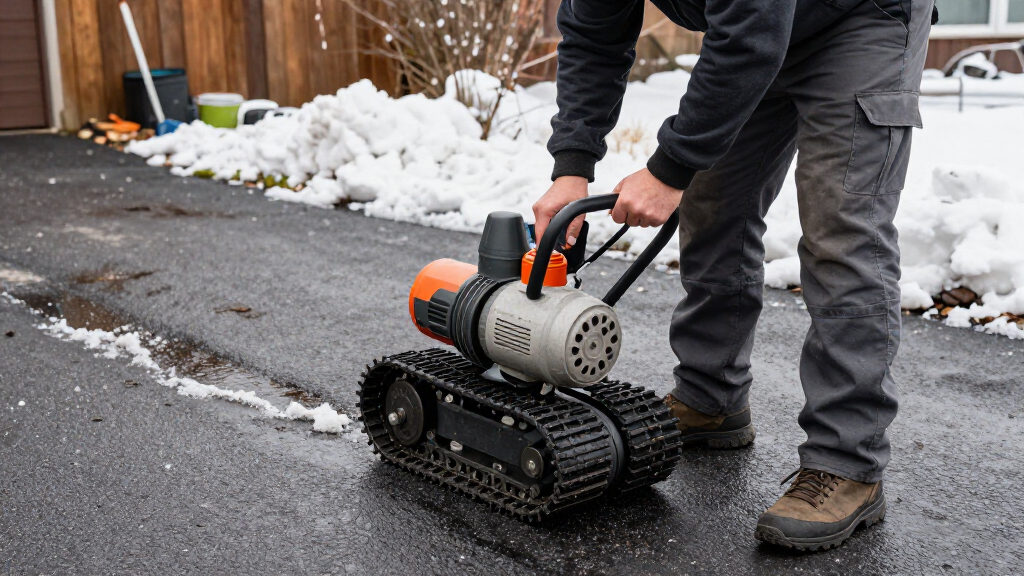
A tire concentrates the machine’s weight into two relatively small contact patches. That concentration can help an aggressive tread reach textured pavement, but it also lets the wheels sink into deep snow. A track creates a longer footprint, reducing ground pressure and bridging small ruts. The result is steadier progress in soft material, although the longer contact patch resists turning and can make quick corrections more physical.
Imagine a 90-foot gravel drive after 10 inches of dry snow. Tires can sink, claw out two trenches and leave the housing high-centered. Once the housing carries part of the machine’s weight, less weight remains on the driven tires, so spinning becomes even more likely. Tracks act more like snowshoes, spreading the load over a longer patch and helping the machine move without digging itself into the soft white layer.
Now move that machine onto a decorative paved apron coated with clear ice. The broad rubber tracks may slide like sneaker soles on a frozen pond, while properly fitted chains cut small mechanical edges into the surface. Tracks provide flotation and steady movement; chains provide concentrated bite. Those are different jobs, and greater contact area does not automatically mean greater friction on a smooth frozen surface.
The tradeoff with chains is that their advantage depends on fit and exposure. Cross links must contact the surface firmly enough to bite, but excessive looseness creates impact, vibration and possible interference with the machine. On intermittent bare pavement, those same metal edges can mark the driveway and transmit shock through the driveline.
A tracked blower also becomes a handful if the engine stops halfway uphill. Its extra weight and track resistance make it harder to roll, turn or guide back down. That resistance can feel reassuring while powered, yet become a recovery problem when the machine is disabled. Before buying, test whether you can move the machine with the engine off and fit it through your gate, storage door or trailer ramp. The best traction system is one you can control during both normal operation and a mid-slope failure.
two-stage snow blower tracks for deep snow
As an affiliate, we earn on qualifying purchases.
As an affiliate, we earn on qualifying purchases.
Get More Grip From Tires Before You Add More Machine
Good tires deliver their best slope performance when you set them up as a matched pair. Correct tread direction, equal pressure, sound rubber and positive axle engagement can fix pulling and wheel spin without adding major cost. On textured pavement, well-prepared tires can climb surprisingly well because both sides share the work instead of one wheel wasting traction while the other steers the machine off line.
Start with the pressure printed in the manual or tire guidance, using a low-pressure gauge suited to small equipment tires. A difference of only a few PSI can change the tire’s loaded radius and tread shape. One wheel may then travel a slightly different distance per revolution or place a different part of its tread against the ground, making the blower pull toward one side. That small tug becomes tiring on a long incline and hazardous beside a curb because every correction asks the tires to provide sideways grip as well as forward drive.
Lower pressure is not automatically better. A slightly larger footprint may help on some soft surfaces, but excessive deflection can distort the lugs, let the tire slip on the rim or reduce stability. Pressure should therefore be treated as a specified adjustment, not a traction experiment, and both tires should be checked cold under similar conditions.
One common driveway scene tells the story. The left tire carries firm pressure and bites cleanly, while the softer right tire squashes into a wider footprint. The blower keeps nosing right, so you wrestle the handles left on every pass. The effort feels like a steering defect, but equal tire pressure and even skid shoes often cure that behavior faster than adding ballast. Adding weight before correcting the mismatch would increase momentum without addressing the reason the machine wanders.
- Mount directional tires with the chevron tread facing the specified rotation so the lugs can shed snow rather than pack it toward the center.
- Clear packed snow from the lugs before it freezes into a smooth white ring that prevents the tread edges from reaching the surface.
- Check that each wheel pin or axle lock is fully engaged; a freewheeling side can imitate poor traction or a steering fault.
- Replace tires with hard, cracked or rounded tread rather than trusting their original appearance, because aged rubber and worn lug edges provide less compliance and bite.
- Inspect clearance before fitting manufacturer-approved chains, including space near cables, guards and the frame throughout a full wheel rotation.
Chains need the correct tire size, frame clearance and tension. A loose cross chain can slap the housing, snag a control cable or damage drive parts, while an overtight chain may distort the tire or overstress its fasteners. Retension new chains after a short test run because the assembly settles around the tire. Wear eye protection and gloves during installation, and keep the engine off with the ignition disabled while your hands are near the wheel area.
Chains can scratch decorative concrete, mark pavers and wear quickly on bare pavement. They also add a steady metallic chatter that you feel through the handles. Use them when ice bite outweighs surface appearance, and remove or limit them when the driveway repeatedly exposes dry pavement. The decision is not simply whether chains create more grip, but whether that grip justifies added vibration, maintenance and surface damage on the specific route.
adjustable snow blower weight ballast
As an affiliate, we earn on qualifying purchases.
As an affiliate, we earn on qualifying purchases.
Demand Slow, Predictable Steering Before You Chase More Horsepower
Two-stage blowers on sloped driveways need a genuinely slow first gear, smooth engagement and steering that does not unexpectedly turn downhill. A machine that crawls predictably gives its tires or tracks time to bite and gives you time to release the control before a small drift becomes a slide. High travel speed encourages spin, sideways drift and riding over packed snow because the housing receives material faster than it can process it.
Slow speed also preserves a margin for correction. On a slope, the available grip must handle propulsion, steering and resistance from the snow at the same time. If the drive system consumes most of that grip by pushing hard uphill, little remains for a steering input or an abrupt change in snow density. More engine power can maintain auger speed, but it cannot enlarge the contact patch’s traction budget.
A locked axle sends firm drive to both wheels and tends to hold a straight line, but turning it can feel like moving a loaded wheelbarrow through wet cement because one wheel must scrub or travel a different distance. Trigger steering releases one side when you command it, making the response deliberate but temporarily reducing drive on that side. Automatic differentials feel light on level pavement, yet a crowned driveway can make some designs wander toward the lower edge if unequal resistance causes an unexpected release or speed difference.
Consider a machine that turns beautifully under showroom lights on polished concrete. Add 8 inches of wet snow, a 12-percent incline and a ridge at the road, and the easy-turn system now reacts to uneven grip under each wheel. A deliberate trigger may give you more control than an automatic system that guesses when to unlock. The tradeoff is greater operator input: you must choose when to release a wheel and avoid making that change where sideways drift would be dangerous.
Transmission design shapes the whole experience. Common friction-disc drives offer preset ratios and straightforward service, but the lowest ratio may still feel brisk on a steep drive, particularly when the engine is operated at the speed needed for proper snow discharge. Hydrostatic systems generally offer continuously variable speed and smoother direction changes, allowing travel speed to be matched more closely to snow load. They add cost, weight and service complexity, so their value depends on whether finer control materially improves your route rather than simply adding a premium feature.
- Look for a slow working speed that does not require slipping the drive control, because partial engagement can create heat, wear and inconsistent movement.
- Test reverse for controlled movement, not raw speed, since recovery from a blocked pass should not require a sudden step downhill.
- Check for abrupt engagement, long delays or a lurch when changing direction; each makes balance and stopping distance harder to predict.
- Operate every steering and chute control while wearing your thick winter gloves, because a control you cannot release immediately is a safety problem on a grade.
Reverse is not a brake, and the drive system should never be treated like one. On descent, a heavy blower can push you even while the wheels turn slowly, especially if tire rotation does not positively restrain the machine. The better machine is not the one that races uphill; it is the one that creeps without drama, responds consistently under unequal loads and stops driving the instant you release the control.
best snow blower for sloped driveways
As an affiliate, we earn on qualifying purchases.
As an affiliate, we earn on qualifying purchases.
Put Weight Where It Helps Instead of Making the Blower Heavier Everywhere
Two-stage blowers on sloped driveways benefit from balanced weight distribution, not weight added at random. Load over the driven axle can improve traction by increasing the force pressing the tires or tracks into the surface, while front weight can hold the scraper against packed snow. Too much nose weight, however, can lighten the drive wheels and make steering harder. The same added mass also increases downhill momentum, so a gain in one condition can reduce control in another.
Think of the blower as a seesaw resting around its axle. Bolt a heavy object to the front, and the auger housing presses down while your handles feel heavier because the weight creates leverage at a distance from the axle. That leverage can help the scraper resist climbing, but it transfers load away from the driven wheels when they may need it most. Place weight high on the frame, and you raise the center of gravity, increasing the effect of every rut, sideways tilt and sudden correction.
This distinction explains why total machine weight is a poor shortcut for judging slope performance. A heavier blower may feel planted in deep snow, yet be more difficult to arrest on ice. What matters is where the load acts, how it changes as the housing climbs a ridge and whether the operator can still correct direction without lifting or forcing the handles.
A familiar example appears at the packed ridge left by a street plow. The housing keeps climbing over the gray, salt-streaked slab, so front ballast looks tempting. An approved weight kit may help the scraper stay planted because its mass and mounting point were selected for that machine. An improvised concrete block can overload the housing, alter steering and become a projectile if its fastener breaks. It may also conceal the underlying problem: taking too wide a bite, using an incorrect scraper setting or approaching a ridge the machine cannot process efficiently.
Use only manufacturer-approved ballast in the specified location. Homemade weights can overload axles, belts and housings, reduce downhill control, affect warranty coverage and make a tip-over far more severe. Approval matters because both the amount of weight and the mounting structure must be compatible with the machine.
Skid shoes and scraper height also change how weight reaches the ground. If one skid shoe sits lower, the housing can yaw and pull sideways each time it catches a seam. This is more than an uneven-clearing problem: the snag creates a steering force at the front of the machine, and the operator must spend traction and effort correcting it. On pavement, set both shoes evenly for close clearing without snagging; on gravel, raise the housing so the auger does not fire stones through the chute.
Some track machines offer raised, neutral and down-pressure housing positions. Down pressure scrapes packed snow more aggressively by shifting force toward the housing, but it can increase steering effort and reduce the machine’s ability to follow humps. A raised position can help transport or maneuvering but may leave more snow behind. A snow cab adds height, weight and wind area too, which can work against you on an exposed slope by raising the center of gravity and giving crosswinds another surface to push.
Use Six Controlled Moves to Clear the Hill Without Fighting the Blower
The safest working pattern uses slow, straight passes that run vertically rather than across the hill whenever the manual permits it. A straight uphill or downhill line reduces the continuous sideways pull that appears when the machine traverses a slope. You want predictable grip, room to stop and a clear escape route. Sudden turns and speed changes transfer load and demand extra traction at the exact moment gravity is already pulling the machine off course.
- Inspect the route first. Mark curbs, drains, drop-offs, retaining walls and the edge near traffic before snow hides them. Decide where each pass will end and where turns can occur without placing the machine broadside to the grade.
- Test your footing. Wear winter boots built for ice and add removable traction cleats when appropriate. Your feet are part of the control system: if they cannot resist the machine’s reaction forces, better tires on the blower will not keep you stable. If your feet slide during the test, do not bring a 200- to 300-pound machine onto the grade.
- Check the machine on level ground. Verify equal tire pressure, track or chain tension, scraper height, oil level, steering response and drive engagement. A level test separates mechanical pulling or delayed controls from behavior caused by the driveway itself.
- Begin with a narrow bite. Feed part of the housing into dense or wet snow instead of forcing the full width uphill. A partial cut lowers the snow-processing load, which reduces the drive force needed to keep moving and leaves more traction available for steering.
- Travel straight and slowly. Keep both hands on the controls, avoid crossing the slope, and make turns on the flatter area whenever possible. Maintain enough space that releasing the drive control stops propulsion before the machine reaches a hazard.
- Stop when grip changes. Wheel spin, sideways yaw, faster downhill movement or slipping boots indicate that the operating margin has narrowed. Shut down before clearing packed snow or inspecting the machine, disable the ignition, wait for every moving part to stop, and use the clean-out tool rather than your hands.
Suppose overnight wind packs 14 inches of snow against the garage while the street plow leaves a dense ridge below. Clear lighter snow first and take half-width cuts through the heavy bank. This creates working room and prevents the housing from receiving a full-width load while the drive system is also climbing. The engine keeps a steady note, the tires stay hooked up, and the housing processes snow instead of riding over it. If the machine still climbs the ridge, reduce the bite again rather than adding speed and impact.
Plan chute direction before each pass as well. Throwing snow uphill, into the wind or onto an area that must be cleared again increases workload and may create a heavier second layer. Direct discharge where visibility remains clear and where expelled snow, ice or gravel cannot strike people, vehicles or windows.
Gas engines add another slope limit that traction cannot reveal. Many small engines use splash lubrication, so operation beyond the permitted angle can move oil away from areas that need it, cause smoking or damage the engine. A machine may still feel stable while its engine is operating at a harmful angle, which is why traction alone cannot determine suitability. Check both manuals and maintain the specified oil level before working on a grade [1].
Battery stage snow blowers remove fuel handling and engine-oil angle concerns, and they start without a cold pull cord. Yet dense snow, low temperatures and repeated uphill passes can cut runtime sharply because the auger and drive system draw heavily at the same time, while cold cells provide less usable energy. Keep charged packs warm before use, follow the battery maker’s temperature guidance, and base your plan on usable winter runtime, not a mild-weather estimate. Spare capacity matters most when stopping halfway would leave the machine difficult to recover from the slope.
According to Outdoor Pro Masters, newer machines increasingly focus on fine speed control, trigger steering, adjustable track geometry, brighter lighting and multi-battery management rather than engine size alone [2]. These features address the points where slope work becomes difficult: matching speed to load, correcting direction deliberately, changing housing pressure and preserving visibility or runtime. That is the right direction: power clears snow, but control keeps the machine manageable.
Frequently Asked Questions
How steep a driveway can a two-stage snow blower handle?
There is no reliable universal grade because safe operation depends on the machine, engine, surface, side slope, snow and your footing. Follow the restrictions in both manuals, and treat ice or a downhill escape route toward traffic as reasons to use a different clearing method.
Are track-drive snow blowers safer on steep driveways?
Tracks usually provide better flotation and steadier straight-line movement in deep snow or on irregular ground. They can still slide sideways on ice, and their greater weight makes recovery harder if the engine stops or the machine begins moving downhill.
Are tire chains better than tracks on ice?
Properly fitted chains often provide more bite on glazed ice because their metal edges press into the hard surface. Unchained rubber tracks spread weight well but may slide on smooth ice; chains can also mark decorative pavement and need regular tension checks.
Why does my snow blower pull to one side on the slope?
Common causes include unequal tire pressure, uneven skid shoes, a wheel not locked to its axle, worn tread or a steering-clutch fault. A crowned driveway can create the same feeling, so test the machine on level ground before changing parts or adding weight.
Should I add weights to help my snow blower climb?
Add weight only through a manufacturer-approved kit installed in its specified location. Random front ballast can improve scraping while reducing driven-wheel load, raising steering effort and adding dangerous downhill momentum.
Can a battery two-stage blower handle a long, steep driveway?
A battery model can work when it has strong traction, a slow drive system and enough battery capacity for cold, dense snow. Plan for reduced runtime during heavy uphill work, keep spare packs warm before use and compare recharge time with the length of your clearing session.
Conclusion
Your best slope machine is the one you can control at a crawl, not the one with the largest engine or heaviest frame. Match wheels, chains or tracks to the actual surface, keep the machine balanced and adjusted, and stay within every manual-listed slope limit. When grip disappears, stop; horsepower cannot negotiate with ice.
Before the next storm turns your driveway white, test the drive, steering and emergency release on level ground while wearing your winter gloves. Then inspect the hill from bottom to top. A clean, straight track through fresh snow should come from steady traction and deliberate passes, not from you hanging on while the blower chooses the route.
Halloween Picks
halloween
As an affiliate, we earn on qualifying purchases.