TL;DR

Get business pricing on tools and workshop supplies
- Business-only prices and quantity discounts
- Tax-exempt purchasing
- Multiple users, one account, clear invoices
For snow removal on wood decks and composite surfaces, a compact single-stage snow blower with rubber or reinforced-polymer paddles usually presents less damage risk than a two-stage machine with an exposed metal auger. Clear debris first, test a hidden area, work with the board direction, and use a plastic shovel rather than a powered blower on stairs.
The first pass looked perfect—right until the machine reached a slightly raised deck board. The metal auger caught with a sharp clack, the blower jumped forward, and a pale scar appeared across the dark brown stain. One hidden board edge turned a routine snow job into a spring repair.
That is why equipment choice matters when you are clearing wood decks, composite steps, porches, and elevated walkways. A machine built to chew through plow-packed snow at the end of a driveway can be heavy, aggressive, and awkward in a space bordered by railings, doors, planters, and stair nosings.
You will learn why rubber paddles beat metal augers on many delicate hard surfaces, where that advice has limits, and how to clear snow without grinding grit into the boards. You will also get a practical setup process, a battery-versus-gas comparison, and clear guidance for deciding when a plastic shovel remains the smarter tool.
Choose flexible rubber or reinforced-polymer paddles over an exposed metal auger for most wood decks, capped composite surfaces, PVC boards, and narrow landing…
Remove mats, cords, grit, toys, hardware, and other hidden objects before starting; one trapped pebble can scratch an entire board.
Work in slow, straight passes with the board direction, avoid spinning in place, and finish thresholds or stair edges with a plastic shovel.
Never operate a powered snow blower on stairs, and do not place a heavy two-stage machine on an elevated deck without checking access, condition, and structura…
Inspect and replace worn paddles and scraper bars because a damaged or grit-loaded soft component can still mark decking.
Clearing Decks and Composite Steps
Why rubber paddles beat metal augers: flexible contact lowers the chance of gouging wood, scratching capped composite, chipping PVC edges, or turning a raised board into a dangerous traction point.
Compact single-stage blower
Choose rubber or reinforced-polymer paddles for smooth decks, porches, and narrow elevated walkways.
Shovel the stairs
Never operate a powered snow blower on steps. Use a plastic shovel or soft snow broom around stair nosings.
Flex spreads force. Metal concentrates it.
A flexible paddle bends at contact and follows shallow variations. A rigid metal edge can catch a lifted fastener, warped board, threshold, or railing base and focus force onto one vulnerable point.
Rubber or reinforced polymer
The paddle lightly sweeps a smooth surface, spreads contact across a wider area, and can deflect over minor irregularities.
Reduced point loading
Exposed metal auger
Rigid flighting may scrape coatings or catch an edge. Once caught, rotation can pull the machine forward with a sudden lurch.
Possible traction point
The deck-safety tradeoffs at a glance
Single-stage paddle machines favor surface protection and control. Two-stage auger machines favor deep-snow capacity, but their weight, width, and rigid rotating parts raise the stakes on confined or uneven decking.
| Feature | Rubber-paddle single-stage | Metal-auger two-stage |
|---|---|---|
| Surface contact | ✓Flexible paddles may lightly sweep the surface. | ~Rigid auger normally rides above it on skid shoes. |
| Damage risk | ✓Lower, though grit and worn components can scratch. | ✗Higher near raised boards, coatings, fasteners, and edges. |
| Tight-space control | ✓Easier to turn on narrow decks and landings. | ✗Needs more turning room and operator effort. |
| Snow capability | ~Best for light to moderate accumulation. | ✓Stronger in deep, wet, refrozen, or plow-packed snow. |
| Machine weight | ✓Often easier to move between storage and deck level. | ✗Often too heavy or bulky for elevated residential decks. |
| Best setting | ✓Smooth wood, capped composite, PVC, and paved walks. | ~Large driveways and broad, level paved areas. |
Guidance from the decking warranty and blower manufacturer always takes priority over general equipment advice.
Soft contact does not make every board safe.
Rubber means lower risk, not harmless operation. Reinforced paddles rotate quickly enough to mark coatings, catch damaged edges, or launch concealed hardware. Embedded grit can turn a soft scraper into coarse sandpaper.
Pressure-treated wood
Weathered stain, cupped boards, splinters, and raised fasteners create catch points. Pushing down can expose pale raw grain beneath a dark finish.
Primary risk: gouges and coating lossCapped composite
The cap resists moisture and ordinary splintering but is not scratch-proof. Quartz grit can draw a long silver-gray line across the finish.
Primary risk: cap abrasion and edge chipsPVC decking
PVC handles moisture well, yet dark boards reveal scratches clearly in low winter light. Cold conditions may reduce impact tolerance.
Primary risk: visible scratchesUse this seven-step setup
Most preventable damage begins before the paddles spin: hidden debris, poor visibility, raised edges, a worn scraper, or a careless discharge path. A deliberate setup protects the surface and everyone nearby.
Remove every loose object
Clear mats, cords, furniture, toys, bark, gravel, hardware, and frozen debris.
Inspect the boards
Locate warping, lifted composite edges, loose screws, drains, transitions, and thresholds.
Check wear components
Replace damaged paddles and scraper bars. Remove any grit embedded in their edges.
Read both rulebooks
Confirm the blower manual and decking warranty permit the planned equipment and technique.
Test a hidden area
Use light pressure and inspect for scratching, dulling, discoloration, or fibers.
Plan straight passes
Work with the board direction and avoid spinning the machine in place.
Control the discharge zone
Aim away from people, doors, windows, railings, vehicles, and neighboring property. Wear eye protection, gloves, sturdy boots, and any hearing protection specified in the equipment manual.
How one pebble becomes a twelve-foot scar
Damage is often a chain rather than a single mistake. Breaking any link—inspection, testing, straight travel, or component cleaning—can prevent the final mark.
Hidden grit
A pebble remains beneath fresh snow.
Scraper contact
The particle lodges under a worn edge.
Forward pressure
The operator forces the machine ahead.
Repeated abrasion
The trapped grit follows the same board.
Visible scar
Low winter sun reveals the full scratch.
Battery convenience versus gas endurance
Power source does not determine surface safety—the paddle and scraper system does—but it changes noise, exhaust, startup, maintenance, weight, and cold-weather performance.
Cordless electric
Quiet operation, push-button starting, no exhaust near doors, and low routine maintenance make battery machines attractive for residential decks.
Gas-powered
Longer continuous operation can help on larger properties, but fuel, exhaust, noise, maintenance, and machine mass make storage and deck access less convenient.
Sometimes the plastic shovel still wins.
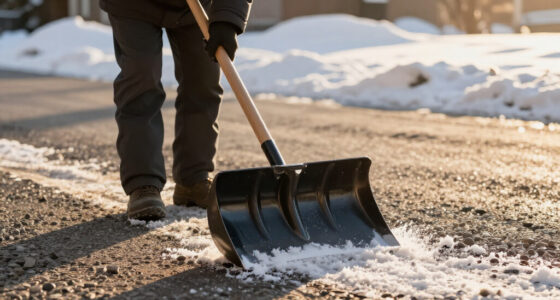
Choose hand clearing for stairs, narrow landings, thresholds, damaged boards, fresh or delicate coatings, uncertain warranties, heavy obstacles, and any area where the machine cannot travel in a controlled straight line.
Match the tool to the surface, not just the snowfall.
For smooth wood, capped composite, PVC, porches, and elevated walkways, a compact paddle machine usually offers the best balance of close clearing, lower weight, and gentler contact. Deep, compacted snow may exceed its strengths—but that does not automatically make a metal auger safe for a deck.
Check structure
Confirm access, deck condition, load, and machine weight.
Check warranty
Follow surface-specific manufacturer guidance.
Choose flexibility
Prefer intact rubber or reinforced-polymer paddles.
Clear deliberately
Use slow, straight passes with the board direction.
Finish by hand
Shovel stairs, thresholds, corners, and vulnerable edges.
Why Rubber Paddles Leave Fewer Scars Behind
Clearing decks and composite steps works best with flexible paddles because they bend slightly when they meet the surface, spreading contact across a wider area. An exposed metal auger stays rigid, so a raised fastener or board edge can focus force onto one small point and leave a gouge, chip, or scratch.
Think of the difference like wiping a countertop with a rubber squeegee instead of dragging a garden rake across it. The squeegee follows shallow dips, then springs back. The rake catches an edge, concentrates the load on a metal tooth, and keeps pulling until you stop it.
For instance, take a pressure-treated deck with five-year-old semitransparent stain. A reinforced paddle may sweep close enough to leave only a dusty white film of snow, while a metal edge can cut through the stain and expose bright, raw wood grain. That exposed strip will drink water during the next thaw.
Metal augers add another problem: traction at the wrong place. If the flighting catches a threshold, warped board, or railing base, the auger can pull the machine forward with a sudden kick. Skid shoes create clearance on level pavement, but they cannot make every uneven deck safe.
Rubber means lower risk, not harmless operation. Reinforced paddles spin fast enough to mark coatings, catch damaged boards, and throw hidden hardware.
Snow-blower operating manuals warn that rotating components can eject stones, screws, and other hidden objects at dangerous speed [1]. You still need a clean work area, a controlled discharge path, and eye protection, gloves, sturdy boots, and hearing protection where the equipment manual calls for it.
Popular right now

LG C2 Series 65-Inch OLED evo 4K Smart TV (OLED65C2PUA, 2022)

Ninja Luxe Café Mini Plus Espresso and Drip Coffee Machine with AutoFroth, Stainless Steel, ES351

Samsung 42-Inch S90H OLED 4K Smart TV Bundle
As an affiliate, we earn on qualifying purchases.
See the Deck-Safety Tradeoffs at a Glance
Rubber paddles beat metal augers on most decks because they offer gentler surface contact, lower machine weight, and easier turning in confined spaces. Metal-auger machines earn their keep in deep or compacted snow, but their weight and rigid rotating parts make them a higher-risk match for boards, nosings, and thresholds.
| Feature | Rubber-paddle single-stage blower | Metal-auger two-stage blower |
|---|---|---|
| Surface contact | Flexible paddles may lightly sweep the surface | Rigid auger normally rides above the surface on skid shoes |
| Damage risk | Lower, though grit and worn parts can still scratch | Higher around raised boards, coatings, fasteners, and edges |
| Maneuvering | Easier on narrow decks and small landings | Wide turning area and more operator effort |
| Snow capability | Best for light to moderate accumulations | Better for deep, wet, refrozen, or plow-packed snow |
| Weight | Often manageable for moving between storage and deck level | Often too heavy or bulky for elevated residential decks |
| Best setting | Smooth wood, capped composite, PVC, and paved walkways | Large driveways and broad, level paved areas |
A single-stage snow blower also tends to clean closer because many designs use the paddles and scraper bar near the surface. That close sweep is useful on a level 300-square-foot deck after four inches of dry snow. It becomes less friendly when sand, frozen bark, or a loose screw sits under the scraper.
A two-stage machine may make sense on a very large, strong, level deck with wide access and approved surface clearance. Before placing a heavy machine on an elevated structure, check its operating weight and the deck’s condition. If you have doubts about framing, loads, or code compliance, ask a licensed structural professional to review the deck and any permit requirements.
Match Your Technique to Wood, Composite, or PVC
Clearing decks and composite steps requires a surface-specific approach because wood can splinter, capped composite can abrade, and PVC can scratch even though it handles moisture well. No decking material is immune to damage, and embedded grit can turn a soft scraper into coarse sandpaper.
Pressure-treated wood is especially vulnerable after the stain or sealant begins to weather. Run a hard edge across a cupped board, and you may hear a dry scrape before seeing a pale streak or fuzzy splinters. Softer woods can mark even under plastic components when the operator keeps pushing down.
Composite decking resists rot and does not splinter like ordinary lumber, but its colored cap remains a finished surface. Cold weather can make some plastics less forgiving of impact, while a trapped grain of quartz or driveway grit can draw a long, silver-gray line. Deck care guides commonly recommend nonmetal snow tools and warn against abrasive debris [2].
PVC boards bring similar tradeoffs. They shed water and clean easily, yet a dark charcoal board can reveal scratches the moment low winter sun crosses it. For instance, one pebble beneath a worn scraper bar can follow the machine for 12 feet, leaving a line that no amount of brushing will hide.
Read both the decking warranty and the blower manual before the first storm. If the deck is new, softly coated, damaged, or explicitly limited to hand tools, use a plastic shovel or soft-bristle snow broom. Manufacturer guidance outranks a general rule about why rubber paddles beat metal augers for snow removal on wood decks.
Use This 7-Step Setup Before the Paddles Start Spinning
Clearing decks and composite steps safely starts before you press the starter because most preventable damage comes from objects, raised edges, poor visibility, or a careless discharge path. A five-minute inspection can save a scratched board, broken window, jammed paddle, or trip to retrieve a frozen dog toy.
- Remove everything loose. Pick up mats, extension cords, toys, hoses, planters, furniture covers, and ice-melt bags.
- Sweep away hard debris. Clear stones, grit, bark, screws, and frozen clumps that the machine could drag or throw.
- Inspect the boards. Find lifted composite edges, warped wood, loose fasteners, cracks, drains, thresholds, and railing bases.
- Mark fixed hazards. Use visible stakes or flags where snow hides a step edge, drain, low light, or door threshold.
- Plan the discharge path. Aim away from people, pets, glass, doors, vehicles, heat-pump equipment, and neighboring property.
- Test a hidden patch. Make one slow pass near an inconspicuous corner, then check for marks before continuing.
- Wear the right gear. Use eye protection, gloves, slip-resistant boots, fitted clothing, and any other PPE listed in the manual.
Imagine a six-inch snowfall covering a deck from wall to railing. The white surface looks clean, but a black rubber welcome mat sits buried near the door. If the paddle catches it, the machine can stop hard, pull sideways, or shred the mat into pieces that whip around the housing.
If the blower jams, release the controls, switch it off, disconnect the battery or spark-plug lead as directed, and wait for every moving part to stop. Never reach into the auger or chute with your hand. Use the supplied cleanout tool and follow the manufacturer’s lockout steps [1].
For a corded machine, use only an outdoor-rated cord and GFCI-protected supply, keep connections out of snow and standing water, and unplug before inspection. If the outlet is damaged, ungrounded, warm, or lacks proper protection, leave it off and call a licensed electrician.
Make Cleaner Passes Without Grinding the Surface
The cleanest deck-clearing method uses slow, straight, overlapping passes with little downward pressure and no spinning turns. Work with the board direction when practical, let the paddles move the snow, and leave a thin protective layer if the finish is delicate or the scraper sits aggressively.
Start at the house and send snow toward an open yard area, provided the chute points away from doors, windows, people, and equipment. On a 12-by-20-foot deck, clear a narrow exit lane first. Then widen it with passes that overlap by roughly a quarter of the machine’s intake width.
The motion should feel like mowing a tidy strip of lawn: line up, move forward, stop the rotating action before a tight pivot, reposition, and begin the next strip. Do not scrub back and forth over one stubborn patch. That repeated contact builds friction and drags any hidden grit across the same piece of decking.
For instance, wet snow around a sliding-door threshold often packs into a gray ridge. A heavy shove can drive the scraper into the metal sill or composite edge. Stop several inches short, switch the machine off, and finish that small area with a plastic shovel held nearly flat.
Keep the housing away from rail posts and stair nosings. Do not force the intake under benches or beneath a low railing where you cannot see. If one pass leaves an inch behind, make another light pass after moving loose snow rather than leaning your body weight onto the handle.
Never operate a powered snow blower on deck stairs. Use a plastic shovel or snow broom so the machine cannot roll, tip, or pull you down the flight.
Choose Battery or Gas Without Buying More Machine Than You Need
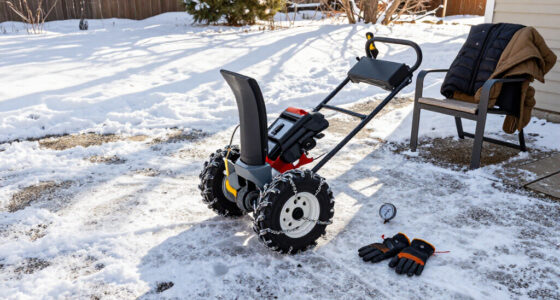
A cordless electric paddle blower suits many residential decks because it starts with a button, produces no exhaust at the door, and usually weighs less than a comparable gas machine. Gas offers longer refueling-based work sessions, but noise, fumes, maintenance, and machine weight matter more in a tight outdoor living space.
Battery runtime depends on pack capacity, snow density, temperature, clearing width, and how hard the machine works. A setup that clears a 400-square-foot deck and short walkway during four inches of powder may drain much faster in eight inches of wet snow. Cold packs can also deliver less useful runtime than warm, freshly charged ones.
Store batteries where their manual allows, install them just before clearing, and keep a charged spare if the deck is only one part of the route. Never charge a wet, frozen, swollen, or damaged pack. Let a cold battery reach the permitted charging temperature indoors, away from combustible clutter.
Gas still makes sense when you manage long walkways, broad paved areas, or repeated storms that exceed battery capacity. Yet exhaust can collect near doors, windows, and covered porches, filling the air with a sharp fuel smell. Refuel only with the engine off and cool, outdoors, using the fuel and storage practices in the manual.
For a modest deck, manageable weight and controllable power beat oversized specifications. This is not an acreage job or a PSI contest. You need enough runtime to finish without rushing, a chute you can aim precisely, and a machine light enough to guide without wrestling it into the railing.
Know When Deep Snow Calls for a Different Plan
Rubber-paddle machines work best in light to moderate snowfall on relatively flat, hard surfaces; deep, wet, refrozen, or plow-packed snow can overwhelm their intake and discharge capacity. When accumulation exceeds the machine’s rating, clear it in layers or switch to a hand-tool plan suited to the deck.
A two-stage snow blower can move heavy snow more forcefully because a metal auger feeds a separate impeller. That strength helps on a wide driveway after a municipal plow leaves a dense gray wall. On a deck, the same machine may be too heavy, too wide, and too eager to catch high boards or stair edges.
Suppose a storm drops 14 inches overnight onto a second-story composite deck. Do not wrestle a heavy two-stage machine up the stairs or drive it across an unknown structure. Use a plastic shovel to remove the snow in shallow lifts, push rather than throw when possible, and keep piles from building against doors and railings.
Deep snow also adds structural load, especially when rain turns light powder into a heavy, wet blanket. Cracking sounds, visible sagging, loose ledger connections, leaning posts, or movement underfoot call for an immediate stop. Keep people off the area and ask a licensed structural professional to inspect it; deck code and permit requirements deserve the same respect as equipment limits.
Ice requires restraint too. Do not ram the blower into frozen ridges or use a metal chopping edge that can scar the boards. Apply only a decking-approved ice treatment, follow its label, and give it time to loosen the bond before using a plastic tool.
Buy and Maintain the Parts That Actually Protect Your Deck
The best deck machine has rubber or reinforced-polymer paddles, a nonmetal replaceable scraper, manageable weight, precise chute control, and written manufacturer guidance for delicate hard surfaces. The words single-stage snow blower alone do not prove deck compatibility because some models use harder plastic, exposed metal, or aggressive scraper designs.
- Check the contact parts: Look beneath the housing and identify every component that can approach the deck.
- Check the weight and width: Confirm you can move and turn the machine without lifting it over occupied stairs.
- Check speed control: A smooth, easy-to-modulate drive helps near doors and railings.
- Check parts supply: Replacement paddles and scraper bars should be readily available.
- Check the written guidance: Verify that both the blower maker and decking maker permit the intended use.
Paddles and scraper bars are wear items. As they shorten, the machine may leave more snow, vibrate, or force the housing closer to the surface. Replace a paddle when it reaches its wear indicator or becomes cracked, torn, hardened, or uneven; replace the scraper when it develops sharp edges or exposed metal.
For instance, a blower that cleaned nearly bare boards last winter may leave half an inch this season. That loss does not automatically mean the motor is weak. Turn the machine off, disconnect its power as directed, and inspect paddle length, mounting hardware, and scraper wear.
Before each storm, run a gloved hand over the scraper only after full power isolation and inspect it under bright light. A tiny embedded stone can feel like a sharp tooth. Remove debris using the manual’s method, tighten permitted fasteners to the specified torque, and let an authorized service shop handle damaged housings or electrical components.
Frequently Asked Questions
Will rubber paddles scratch composite decking?
Rubber paddles are less likely to scratch composite decking than exposed metal augers, but they can still cause marks. Grit beneath the scraper, worn paddles, excessive pressure, sharp wear edges, and lifted boards raise the risk, so clean the surface and test a hidden area first.
Can I use a two-stage snow blower on a deck?
A two-stage blower may work on a large, strong, level deck when the machine and decking manufacturers permit it, but its weight and metal auger make it a higher-risk option. Check skid clearance, access width, deck condition, and structural capacity; ask a licensed structural professional if the framing or load raises doubts.
Do rubber paddles touch the deck surface?
On many single-stage machines, the paddles lightly contact or sweep close to the surface, which helps collect snow cleanly. Exact clearance depends on the design, scraper setting, paddle wear, and deck profile, so check the manual and avoid assuming every paddle machine works the same way.
Can I run a snow blower down composite steps?
No—do not operate a snow blower on stairs. The machine can tip, roll, catch a nosing, or pull you off balance while rotating parts remain close to your legs. Clear composite steps with a plastic shovel or soft snow broom, working from a stable position.
How much snow can a rubber-paddle blower handle?
A rubber-paddle blower performs best in light to moderate snow within its published intake rating. Deep powder may require shallow layers, while wet, compacted, or refrozen snow can clog the chute or overload the drive; begin clearing earlier during a long storm rather than waiting for one heavy pass.
Are battery snow blowers better for decks?
Battery models are often lighter, quieter, and easier to maneuver, and they produce no exhaust beside doors or windows. Their limits are runtime, charging time, and reduced cold-weather performance, so match the battery capacity to your deck, walkways, snowfall depth, and expected clearing time.
Conclusion
Your safest default is simple: use a light, controllable rubber-paddle machine on a clean, level deck, then switch to a plastic hand tool near stairs, thresholds, railings, and damaged boards. Read the decking warranty, inspect the contact parts, and stop treating “rubber” as a promise that nothing can go wrong.
Prepare the surface before the storm buries its hazards, then let the machine do the work without forcing it. The result should be a clear path, an unmarked deck, and the soft hiss of snow leaving the chute—not the metallic crack of an auger finding wood.