
TL;DR

Get tools and workshop supplies delivered free — and shop member deals
- Fast, free delivery on millions of items
- Access to Prime Big Deal Days deals on October 6–7
- Prime Video, Amazon Music and more included
Amp-hours measure a battery’s energy storage; higher Ah means longer run time and more power. For deep snow, a battery with 5-7 Ah or more is recommended, but actual performance varies based on snow density and blower design.
Ever tried clearing a foot of snow with a battery-powered blower? It’s satisfying until the battery runs out just as you hit the heavy, wet patches. Battery amp-hours (Ah) aren’t just a number; they’re your secret weapon against deep snow. Knowing what they deliver can turn a frustrating chore into a manageable task.
This guide cuts through the fluff. You’ll learn how Ah impacts runtime and power, what recent tech improvements mean for you, and how to pick the right capacity for your winter battles. Because in snow removal, capacity isn’t just about numbers—it’s about getting the job done.
Battery Snow Blowers in Deep Snow: What the Amp-Hours Deliver
Amp-hours measure stored capacity—not guaranteed clearing time. More Ah gives your blower a larger energy reserve, but wet density, snow depth, motor efficiency and machine design determine how quickly that reserve disappears.
Minutes from a typical 4–5 Ah battery in snow up to about 6 inches.
Resistance rises sharply as depth, compaction and moisture increase.
Possible on many capable models, subject to density and blower design.
Modern packs extend the useful clearing window for demanding storms.
01 / Capacity translated
What the Ah number means at the end of your driveway
Think of amp-hours as the size of the energy tank. A larger tank usually runs longer, but it cannot remove the resistance created by deep, wet snow. Match capacity to conditions—not merely to the biggest number on the box.
Quick cleanup
Best for shallow powder, decks and short paths. A 4 Ah pack may reach about 30 minutes in light snow, then fall much faster under a dense load.
The practical zone
A better match for moderate driveways and deeper storms. The extra capacity provides a useful buffer when snow becomes compacted or wet.
Heavy-storm buffer
More useful operating time for large areas, repeated passes and 12–16-inch accumulation—balanced against extra battery weight and cost.
02 / Load versus runtime
Snow density can matter as much as snow depth
The motor draws harder when the auger must lift compacted or water-heavy snow. That added resistance converts stored capacity into work more quickly, shrinking runtime even when the battery’s Ah rating never changes.
In dense, wet conditions, the useful window may narrow to roughly 20–30 minutes. Divide the driveway into zones or keep a charged spare ready.
ILLUSTRATIVE RELATIVE MOTOR DEMAND · ACTUAL DRAW VARIES BY AUGER, MOTOR, WIDTH, SPEED AND SNOW WATER CONTENT.
03 / Fit by conditions
Choose capacity around the snow you actually clear
Published depth ratings are useful starting points, not promises. Battery capacity, clearing width, traction, auger design and operator pace work as a complete system.
| Battery class | Best snow profile | Typical task | Deep / wet snow | Tradeoff |
|---|---|---|---|---|
| 2–3 Ah | Shallow, dry powder | Steps and short paths | ✗ Poor fit | Lightest, shortest reserve |
| 4–5 Ah | Up to about 6 inches | Small residential areas | ~ Conditional | Balanced weight and cost |
| 6–7 Ah | Moderate to deep snow | Typical driveway | ✓ Recommended | More weight, stronger buffer |
| 8–10 Ah | Frequent deep accumulation | Large residential areas | ✓ Strongest fit | Highest cost and pack weight |
RUNTIME RANGE: APPROXIMATELY 20–45 MINUTES PER CHARGE ACROSS DEEP-SNOW USE CASES, DEPENDING ON CAPACITY, TEMPERATURE, DENSITY AND MACHINE DESIGN.
04 / Technology progression
Better batteries are only half the improvement
Modern snow blowers stretch each stored amp-hour through efficient motors, thermal controls and modular power systems. The result is steadier performance and less waiting between driveway sections.
Brushless motors
Reduce energy waste and deliver responsive power when the auger encounters a heavier patch.
Interchangeable packs
Swap a depleted battery for a charged one and continue without a full charging pause.
Smart battery management
Thermal monitoring and health controls help protect cells during cold, high-demand operation.
12 Ah+, faster charging
Future packs, modular systems and app monitoring aim to extend runtime without unmanageable size.
05 / The performance chain
Stored energy becomes clearing distance through a connected system
No single specification tells the entire story. Follow the energy from the pack to the pavement to see why two blowers with the same Ah rating can finish very different amounts of work.
Capacity
Amp-hours establish the size of the available energy reserve.
Conversion
Motor efficiency determines how much stored energy becomes useful torque.
Resistance
Depth, moisture, compaction and cold increase demand on the system.
Result
Machine design and clearing pace determine runtime and finished area.
06 / Before you buy
A four-part deep-snow check
What Does Amp-Hours Actually Mean for Snow Clearing Power?
When you see a battery rated in Ah, think of it as the amount of energy stored in the battery. More Ah means more stored power, which translates into longer run times and the ability to tackle more snow without stopping. But why does this matter so much in practical terms? Because the difference in capacity can determine whether you finish your driveway in one go or need multiple recharges, especially during heavy snowfalls.
For instance, a 4 Ah battery might power a snow blower for about 30 minutes in light snow, but if you’re facing dense, wet snow, that runtime could drop significantly, forcing you to stop and recharge. Conversely, a 7 Ah battery provides a buffer—allowing you to clear a larger area or thicker snow before needing a recharge. This tradeoff between capacity and runtime impacts your efficiency and convenience. Larger batteries mean more weight and potentially higher costs, so understanding how much capacity you need helps balance performance with practicality. Recognizing this relationship helps you choose a battery size that aligns with your typical snow conditions and driveway size, ensuring you’re not caught short mid-shovel.
As an affiliate, we earn on qualifying purchases.
How Deep Snow Challenges Battery Snow Blowers and What Capacity You Need
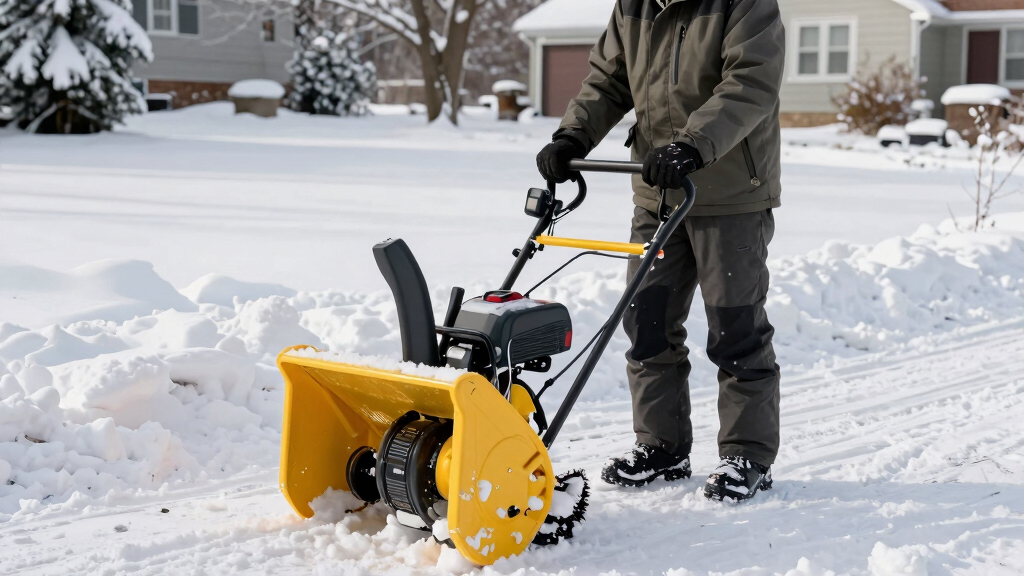
Deep snow, especially over 12 inches, tests the limits of your battery-powered snow blower. Thicker, wetter snow increases resistance, demanding more power from the motor, which in turn drains the battery faster. If your battery capacity isn’t sufficient, you might find yourself stopping midway, frustrated by insufficient runtime. This is why choosing the right capacity isn’t just about convenience; it’s about ensuring your snow removal is effective and efficient. Larger capacities—say, 6 to 8 Ah or more—provide the extra energy reserve needed to handle these tougher conditions without frequent recharging.
For example, with a 7 Ah battery, you can clear a 16-inch snowbank in one pass, but in dense, wet snow, the runtime might be limited to around 20 minutes. That means you need to plan accordingly—perhaps by breaking the task into sections or having spare batteries ready. The tradeoff is that higher capacity batteries tend to be heavier and more expensive, but they offer peace of mind and better performance in challenging conditions. Recent advancements now include batteries up to 10 Ah, which significantly extend operation time and make clearing large, heavy snowfalls more manageable without constant interruptions. So, understanding how snow depth and density impact power demands allows you to select a battery that will keep you moving, rather than stopping short due to power limitations.
As an affiliate, we earn on qualifying purchases.
Understanding the Progression of Battery Technology and Its Impact
The evolution of battery technology is a game-changer for snow removal. As capacities increase and new features emerge, users benefit from longer runtimes and more reliable operation. Early models with 2-3 Ah batteries are now being replaced by units equipped with 8, 9, or even 10 Ah batteries, making deep snow clearing more practical than ever. Brushless motors, for instance, are now common, offering increased efficiency and less energy waste, which means your batteries last longer and your blower works harder in tough conditions.
Interchangeable battery systems are another recent innovation, allowing you to quickly swap out a drained battery for a fresh one, minimizing downtime. This means you can continue clearing snow without waiting for recharging. For example, a recent model with a 9 Ah battery can clear a 16-inch snowbank in a single pass with minimal power drop-off, illustrating how technological improvements directly enhance deep snow handling. These advancements are making battery-powered snow blowers more competitive with traditional gas models, especially for homeowners facing frequent, heavy snowfalls. Staying informed about these innovations helps you select equipment that’s future-proof and capable of handling the most challenging winter conditions.
As an affiliate, we earn on qualifying purchases.
Progression and Future Trends in Battery Snow Blower Technology
As battery technology continues to advance, expect even greater capacities, faster charging times, and smarter features tailored for heavy snow conditions. Manufacturers are investing in developing batteries that can deliver 12 Ah or more while maintaining manageable weight and size. Innovations like rapid charging and modular battery packs mean you can get back to clearing snow faster and with less hassle. Furthermore, integration of smart sensors and app controls allows users to monitor battery health and optimize performance, ensuring your equipment is ready when you need it most. These trends point toward a future where battery snow blowers will be even more powerful, longer-lasting, and user-friendly, making winter chores less of a burden and more manageable.
By keeping an eye on these developments, you can make informed decisions about upgrading your equipment or choosing models that incorporate the latest tech, ensuring your winter snow removal is efficient, effective, and less stressful.
high capacity battery for snow blower
As an affiliate, we earn on qualifying purchases.
As an affiliate, we earn on qualifying purchases.
Conclusion: Making the Most of Your Battery Power in Deep Snow
Understanding how amp-hours influence your battery snow blower’s performance is key to effective winter snow removal. Larger capacity batteries provide longer runtimes and better handling of heavy, wet snow, but they also add weight and cost. Recognizing the balance between capacity, weight, and snow conditions helps you choose the right equipment for your needs. Technological advances continue to push the capabilities of battery-powered snow blowers, making them more reliable and efficient than ever before.
As you plan your snow removal strategy, consider your typical snow depth, density, and driveway size. Investing in a higher Ah battery or a model with recent tech improvements can save you time, effort, and frustration. Remember, the right battery capacity ensures you won’t be left mid-cleanup due to power limitations, especially during heavy storms. With the right knowledge and equipment, you can tackle winter’s worst with confidence and ease. Next steps include assessing your snow conditions and exploring models with advanced batteries—your winter snow removal success depends on it.
Halloween Picks
halloween
As an affiliate, we earn on qualifying purchases.