TL;DR

Get business pricing on tools and workshop supplies
- Business-only prices and quantity discounts
- Tax-exempt purchasing
- Multiple users, one account, clear invoices
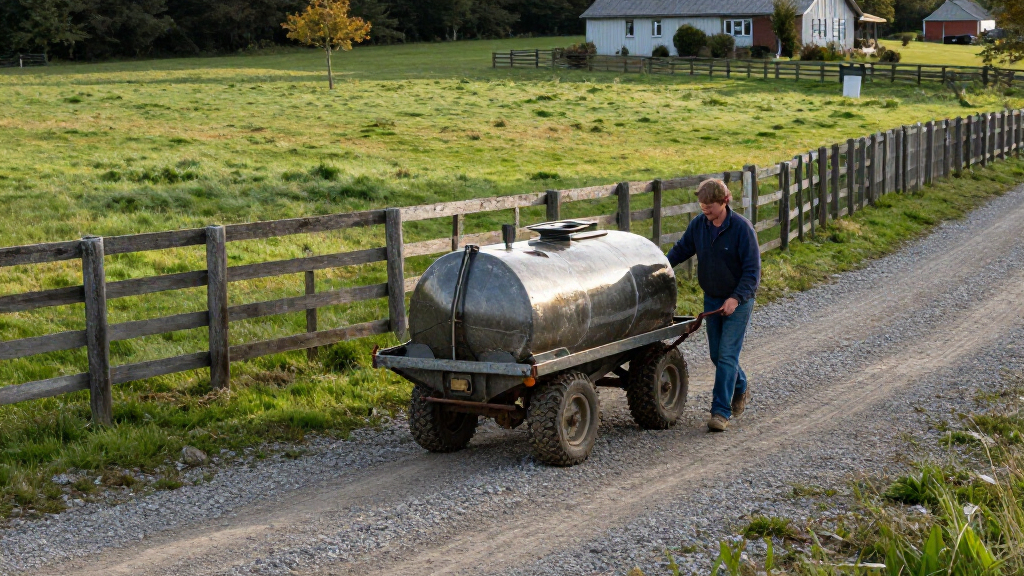
Water weighs about 8.34 pounds per US gallon, so a 55-gallon load adds roughly 459 pounds before the tank, cart, pump, and hoses. Check every equipment rating, secure the tank low and centered, and account for slosh, slopes, braking, and the route before hauling water across acreage.
Water weighs about 8.34 pounds per US gallon; add the tank, pump, hoses, and gear to estimate moving cargo.
Check cart and tank instructions, including whether capacity means payload or total weight, and use the lowest applicable limit.
A partly filled tank can surge; baffles reduce movement but do not prevent tipping or replace secure restraints.
Keep the tank low, centered, and supported, and plan around slopes, ruts, soft ground, turns, and unloading.
For drinking or animal water, use potable-water-rated storage and hoses and keep them clean.
Hauling Water Across Acreage Tanks, slosh and cart limits
A larger tank can cut refill trips, but water adds substantial moving weight. Check equipment ratings and plan for the route before loading.
Calculate the full moving load
Add the empty tank, pump, hoses and gear; check whether the cart rating means payload or total weight.
Multiply US gallons by 8.34 pounds, or litres by about 1 kilogram.
Include the tank, pump, fittings, hoses and other cargo.
Follow the lowest applicable cart and tank limit for the load and route.
Match the route to the load
Ruts, slopes and soft ground can make a rated load harder to control.
| Route condition | What changes | Practical response |
|---|---|---|
| Firm, level lane | More predictable rolling | Stay within ratings; secure the load |
| Ruts or gravel | Jolts can shift the load | Slow down; consider a lighter load |
| Soft soil | Wheels can sink or drag | Use equipment suited to the surface |
| Side slope or sharp turn | Balance and steering are less forgiving | Choose a safer route or reduce the load |
Control slosh and stabilize the tank
Partly filled tanks can surge when starting, stopping or turning, affecting balance and steering.
Keep it low and centered
Support the base and restrain the tank against sliding or tipping.
Reduce water movement
Baffles limit surge but do not replace secure mounting or careful driving.
Move at a walking pace
Avoid abrupt steering and braking, especially on uneven ground.
Plan filling and water use
Prepare the trip from loading through unloading.
- Identify slopes, ruts, gates, soft ground and the unloading spot before filling.
- Leave expansion room where the tank maker requires it; use a suitable cap or vent.
- Expect handling to change as water is discharged.
- For drinking or animal water, use potable-water-suitable tanks and hoses and keep them clean.
Calculate the real load before choosing a tank
Hauling water across acreage starts with one simple calculation: multiply gallons by 8.34 pounds, then add the tank and everything riding on the cart. Water weighs about 1 kilogram per litre, so a tank’s advertised capacity tells you how much water it can hold, not whether your cart can carry it. A 55-gallon load adds roughly 459 pounds before you count hardware. That distinction matters because capacity is a volume label, while the cart experiences force from the complete moving load, including hardware and the cart itself if the rating includes it. For example, if a polyethylene tank weighs 30 pounds and your pump and hoses add another 20, a full 55-gallon setup carries about 509 pounds of cargo. The extra 50 pounds is not negligible: it may use up the remaining margin on a cart rated for a lighter payload, and it is present on every bump, turn, and stop. That figure still leaves out the cart itself if its rating covers the combined load rather than cargo alone. Read the cart manual and tank mounting instructions carefully; use the lowest applicable rating. A rating is a boundary, not a guarantee that every surface or maneuver will feel equally controlled.- Water: gallons × 8.34 pounds, or litres × about 1 kilogram.
- Equipment: add the empty tank, pump, fittings, hose, and any tools.
- Cart rating: check whether it means payload or total weight.
Popular right now

Ninja Mega Kitchen System Blender and Food Processor, 1500W, 72-oz Pitcher, 8-Cup Bowl, Black (BL770)

Dyson Cyclone V10 Origin Cordless Vacuum

Dreame G10 Pro Wet and Dry Vacuum Mop
As an affiliate, we earn on qualifying purchases.
Match cart capacity to the ground you actually cross
A cart’s rated capacity only helps when the route and setup fit the conditions behind that rating. Check the manufacturer’s limits for the cart, tank mounting, tires, and towing vehicle, then account for ruts, slopes, soft soil, and turns that add jolts or make control harder. A smooth-driveway rating does not automatically describe a bumpy pasture crossing. The same load can demand more from the wheels and operator when the ground drags, tilts, or interrupts the cart’s motion.| Route condition | What changes | Practical response |
|---|---|---|
| Firm, level lane | More predictable rolling and steering | Stay within every rated limit and keep the load secure |
| Rutted gravel or pasture | Wheels jolt and the tank load shifts | Reduce speed and consider a lighter load |
| Soft soil or garden path | Wheels can sink or drag | Use equipment suited to the surface; avoid overloading |
| Side slope or sharp turn | Balance and steering become less forgiving | Avoid the route or reduce the load and maneuver gently |
Control slosh before it steers the cart for you
A partly filled tank can send water surging from side to side or front to back as you start, stop, or turn. The water’s weight does not disappear; it shifts position, so the combined center of weight can move while the cart is moving. That moving mass can change the cart’s balance and make steering less predictable, especially on uneven ground. Baffles can reduce the surge by interrupting the water’s movement, but they do not stop it or replace secure mounting and careful driving. For instance, imagine a 40-gallon tank that is half full as you turn around a gate on a sloped path. The water rolls toward the outer side of the turn just as one wheel crosses a rut; the cart may lean or pull when you expect it to track straight. The concern is not only tipping: a sudden pull can also make a narrow turn harder to hold or cause the towing vehicle to change direction unexpectedly. A full tank has less room for water to surge, but it weighs more, so neither a full nor a partly filled tank makes an over-limit cart safe.If your route forces sharp turns or repeated bumps, pick a tank and cart arrangement designed for that kind of use, and check the manufacturers’ instructions. A purpose-built water trailer may offer a better-supported tank and appropriate running gear than an improvised light cart, though it still must be rated for the load and route. Your best clue is how the loaded setup behaves at a walking pace on firm, level ground; do not use a test run to push beyond the stated limits. Smooth handling on level ground is a useful check for loose mounting or poor balance, but it cannot establish safety on a slope or over a rut.Baffles reduce water movement; they do not make a cart tip-proof. Keep the tank restrained, keep your speed low, and avoid abrupt turns and braking.
Secure the tank low, centered, and supported
A safe setup for moving water keeps the tank’s base supported, its center of weight low, and the tank firmly restrained against sliding or tipping. Low placement reduces the leverage that can make the cart lean, while centering helps keep one side from carrying a disproportionate share of the load. Follow the tank maker’s mounting guidance and check the cart’s frame, axle, wheels, tires, hitch, and brakes where fitted. A tank perched high or off-center can make a cart less stable before the wheels even reach a slope.- Place the tank where the cart maker specifies, centered across the frame.
- Support the tank across its base as directed; do not let it bridge unsupported gaps.
- Use restraints suited to the mounting points and tank instructions.
- Check the tires, axle, hitch, and any brakes before loading.
- Recheck restraints after the first short, slow trip.
Plan the route, pace, and unload as one trip
A safe water run begins before you fill the tank: identify the surface, slopes, ruts, gates, and unloading spot, then travel at a walking pace with gentle steering and braking. The route determines where the load may shift and where you will need to slow, stop, or maneuver. The water and cart behave differently over rough ground than they do beside a hose bib. Do not ride on a utility cart unless its maker designed it to carry passengers.- Walk the route empty. Find cross-slopes, soft spots, tight gates, and sharp turns; pick a path that avoids them where possible.
- Check the loaded limit. Calculate water, tank, pump, and gear weight, then compare with each maker’s rating.
- Fill and close the tank correctly. Leave expansion room where the tank instructions call for it, and use the specified cap or vent arrangement.
- Move slowly. Keep a steady walking pace, avoid sudden turns or stops, and take extra care on uneven ground.
- Unload deliberately. Choose a stable place and control the discharge so the changing load does not surprise you.
Choose a pump and tank for the water you need
The best tank size depends on how much water you use, how far you travel, what the cart can safely carry, and how you plan to dispense it. Larger tanks can cut refill trips, while smaller loads are easier to manage on narrow paths or uneven acreage. This is a practical tradeoff: fewer trips reduce time spent refilling, but each trip carries more mass and may be harder to steer, stop, or unload. A pump and quick-connect hose can save time at the destination, but they add weight and need storage that suits the job. For instance, if you carry 15 gallons to a vegetable garden each evening, a smaller tank may be easier to turn around beside beds than a 55-gallon setup. If you refill a distant livestock trough, a larger tank may reduce trips—provided the full system weight, mounting, route, and unloading method all fit the equipment limits. Battery-powered transfer pumps can simplify dispensing without a nearby outlet; check runtime, flow rate, and battery capacity for your actual run. A pump that moves water quickly may shorten unloading, but its battery or fuel, weight, and connections still belong in the load plan. Gas-powered equipment can suit longer or higher-demand work, but adds fuel and maintenance considerations.- Tank: choose capacity around actual use and safe payload.
- Pump: compare flow rate and runtime with the volume you need to unload.
- Hose: pick a length and fitting that reach without creating a trip hazard.
- Baffles: useful for reducing surge, with no substitute for secure restraint.