
TL;DR

Get business pricing on tools and workshop supplies
- Business-only prices and quantity discounts
- Tax-exempt purchasing
- Multiple users, one account, clear invoices
Loading a zero-turn on a trailer safely requires a manufacturer-approved ramp slope, a fully coupled and chocked trailer, straight low-speed travel, and rated restraints attached to approved structural points. Check the mower’s loaded weight, loading direction, ROPS clearance, tongue weight, and tie-down tension before leaving, then stop after the first few miles to inspect everything again.
A zero-turn can climb a hill all afternoon and still tip backward on a trailer ramp in seconds. Loading is unusually hazardous because the mower carries substantial weight near the rear, the steering reacts quickly, and the tires have little room to recover when traction breaks at a ramp edge.
You need more than a sturdy-looking gate and two straps from the shed. This guide shows you how to check ramp angle, stop the trailer from moving, understand ROPS and anti-tip equipment, choose real tie-down points, and account for attachments that shift the mower’s balance.
The goal is a loading routine that feels almost boring: hitch locked, wheels chocked, ramp dry, mower centered, and restraints tight. That quiet routine matters when your 1,000-pound machine is perched two feet above the ground and the ramp is humming beneath its tires. Get the setup right before you touch the controls, because the ramp will punish improvisation faster than an open acre ever will.
Calculate ramp angle from trailer deck height and horizontal ramp run; a 24-inch rise over a 72-inch run equals about 18.4 degrees.
Couple the trailer to the tow vehicle, apply the parking brake, chock the wheels, and deploy fitted stabilizers before loading.
Follow the mower manual for loading direction, ROPS position, seat-belt use, deck position, and approved transport points.
Use rated structural anchors and typically four independent restraints rather than relying on the parking brake, gate, deck, or accessories.
Check tongue weight, attachment weight, ramp capacity, and restraint tension again whenever the mower configuration changes.
Set a Ramp Angle Your Mower Can Climb Without Tipping
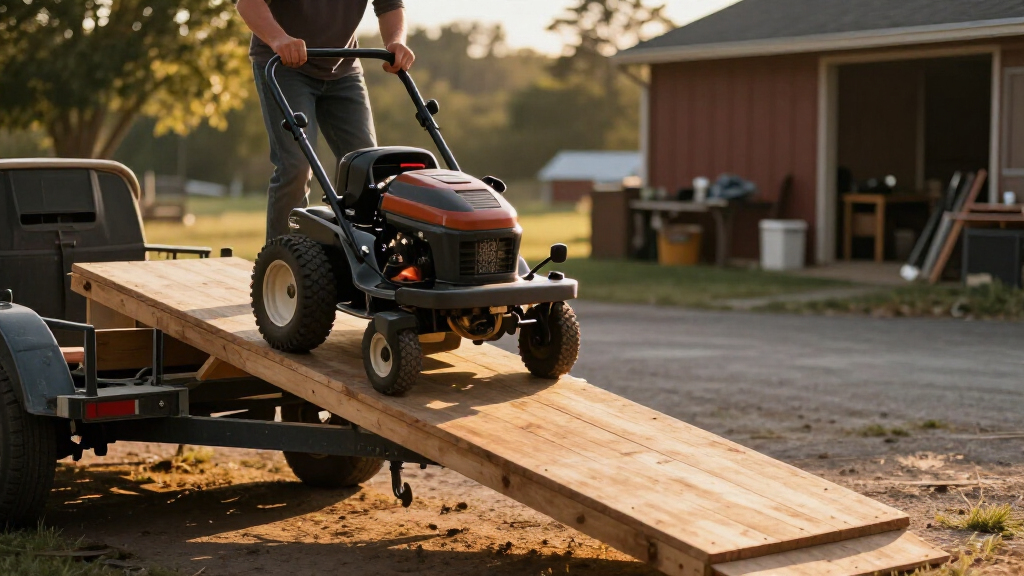
Loading a zero-turn on a trailer starts with keeping the ramp within the limits stated by the mower and ramp manufacturers. A longer ramp or lower trailer deck reduces the slope, improves tire grip, and softens the breakover where the deck can scrape or hang up. Your mowing slope rating does not automatically cover trailer loading.
You can estimate the angle with angle = arctan(deck height ÷ horizontal ramp run). A trailer deck that sits 24 inches high with 72 inches of horizontal run produces an angle of about 18.4 degrees. Measure the horizontal ground distance, not the ramp’s sloped length, because those numbers are not interchangeable.
That difference catches owners all the time. You buy a six-foot gate, see a long sheet of expanded metal, and assume the approach is mild; then the mower’s deck wheels scrape while the rear tires claw at the steel. If your manual permits less than 18.4 degrees, that setup remains outside the limit no matter how steady your hands feel.
| Setup change | What it improves | What you still need to check |
|---|---|---|
| Longer rated ramp | Reduces slope and softens the breakover | Horizontal run, wheel-load rating, and attachment method |
| Lower trailer deck | Reduces climb height | Ground clearance beneath axles and deck |
| Full-width gate | Gives both drive wheels more margin | Gate capacity and center support |
| Loading from a firm rise | Can reduce the effective slope | Level side-to-side footing and trailer stability |
A ramp must carry the mower’s fully equipped operating weight, including fuel, bagger, weights, sprayer, or other attachments. Ask whether its rating covers concentrated wheel loads, not only evenly spread cargo. Two narrow rails leave little forgiveness; one small steering input can put a tire into open air.
Never prop up an unsupported ramp with loose blocks, scrap lumber, or a bucket. Use a rated ramp attached positively to the trailer, resting on firm, level ground with a dry, non-slip surface.
zero-turn mower trailer ramp straps
As an affiliate, we earn on qualifying purchases.
As an affiliate, we earn on qualifying purchases.
Lock Down the Trailer Before the Mower Touches the Ramp
The safest loading sequence begins with the trailer fully coupled to the tow vehicle, the tow vehicle parked, and the trailer wheels chocked. Stabilizer legs support the rear when fitted, while the hitch, parking brake, and chocks stop the trailer from rolling, pivoting, or lifting at the tongue. A tongue jack alone cannot do that job.
- Park on firm, level ground and place the tow vehicle in Park or in gear as its manual directs.
- Latch the coupler completely, connect the safety chains, and verify the hitch ball and receiver ratings.
- Chock the trailer wheels on the appropriate sides so the trailer cannot creep during loading.
- Deploy loading or stabilizer legs when the trailer provides them.
- Attach and inspect the ramp, then clear people, pets, tools, and loose grass from the loading zone.
An uncoupled utility trailer can behave like a seesaw. The rear drops as the mower climbs, the tongue rises, and a trailer that looked planted a moment ago starts rolling across the driveway. With a rear-heavy zero-turn halfway up, you have very little time or steering room to recover.
Give yourself a clean work zone extending beyond both sides of the ramp. Keep children and helpers away from the trailer edge and never ask someone to stand behind the mower to guide you. One slipping tire can send the machine backward with hundreds of pounds of force.
Check the ramp pins, gate cables, welds, hinges, mesh, and safety latches before each load. A rusty hinge may look solid until the mower’s rear tire rolls onto it and the gate gives a sharp metallic crack. The key facts and safety priorities are simple: couple first, stabilize second, and approach only after every connection passes inspection.
As an affiliate, we earn on qualifying purchases.
Use ROPS and Anti-Tip Parts for the Jobs They Actually Do
Loading a zero-turn on a trailer requires you to treat anti-tip hardware and a rollover protective structure as different systems. Rear rollers, wheelie bars, bumpers, and frame extensions may limit contact or rearward rotation, but only a manufacturer-approved ROPS preserves a survival zone during certain overturns.
A small roller behind the engine can look reassuring, especially when the mower’s nose feels light on the ramp. Yet that roller may protect turf or stop minor rear contact rather than carry the machine during a rollover. Do not use appearance as proof; read the component description in the mower manual [1].
When the ROPS stands upright and locks correctly, manufacturer guidance normally calls for using the seat belt. The belt keeps you inside the protected area instead of throwing you beneath the mower. If you must fold the ROPS for clearance, follow that model’s instructions because the seat-belt guidance can change when the bar is lowered.
Enclosed trailers create a common trap. The upright ROPS clears the open door, then strikes the lower roof or rear header as the front tires rise onto the deck. Measure clearance through the whole loading path, including the ramp breakover, rather than checking only the doorway while the mower sits on flat ground.
Never drill, weld, bend, or clamp unapproved hardware to a ROPS. Damage or alteration can weaken the structure, and neither the ROPS nor a wheelie bar makes an excessive ramp angle acceptable.
For example, a canopy, bagger, or spreader may move the center of gravity enough to change how the mower feels. A zero-turn mower is especially sensitive when one drive wheel climbs faster than the other. Check overhead clearance and attachment weight every time the machine’s setup changes.
As an affiliate, we earn on qualifying purchases.
Drive Straight and Slow Without Fighting the Steering
Loading a zero-turn on a trailer should happen at the slowest practical speed, on a dry ramp, with both drive wheels moving evenly and the mower traveling straight. Follow the manufacturer’s specified loading direction because a high rearward weight bias, attachments, and limited rear visibility make one universal forward-or-reverse rule unsafe [1].
Forward travel may feel natural, but climbing forward can place more weight behind the rear axle and raise the front. Reversing may keep the heavy end uphill in some setups, yet it reduces your view and makes control movements less familiar. A full bagger or rear weights can turn yesterday’s stable approach into today’s tipping risk.
Line up several feet before the ramp so you do not need a correction on the incline. Raise the deck only if the manual directs it, center the tires, take one steady breath, and feed both control levers smoothly. Never turn across the ramp, stop halfway, or make a diagonal approach.
Consider a mower whose left tire hits damp grass tracked onto the mesh while the right tire stays on dry steel. The right side surges ahead, the mower twists, and the ramp edge suddenly feels much closer. Clean the surface before loading; mud, oil, frost, wet clippings, and loose gravel can cut traction without warning.
Do not walk beside a self-propelled zero-turn while reaching for its controls unless the manufacturer provides a dedicated procedure and control mode. You lose the seat’s stable control position and can enter the mower’s path if it slides. Keep your hands deliberate, your body in the approved operating position, and every bystander outside the rollover zone.
If the mower hesitates, scrapes, spins a tire, or feels light at the front, back away only when you can do so under control. Rework the setup instead of adding speed. Momentum hides bad geometry for a second, then hands the problem back with more force.
trailer wheel chocks for lawn mower
As an affiliate, we earn on qualifying purchases.
As an affiliate, we earn on qualifying purchases.
Place the Mower Where the Trailer Tracks Straight
Correct mower position keeps the trailer within every weight rating and gives a conventional bumper-pull trailer suitable tongue weight. Roughly 10–15% of the loaded trailer weight on the hitch is a common starting range, but the trailer and tow-vehicle manuals set the actual requirement [2].
Too little tongue weight lets the trailer sway, sometimes beginning as a faint wiggle in the mirror before building into a violent side-to-side swing. Too much tongue weight can overload the hitch, rear axle, tires, or suspension. The correct position must also keep the trailer below its gross vehicle weight rating and individual axle ratings.
Use the lowest rating anywhere in the system. That includes the trailer, axles, tires, receiver, hitch ball, tow vehicle, ramp, gate, anchors, and restraint hardware. A 7,000-pound trailer label does not rescue a 3,500-pound-rated hitch ball or a gate that cannot handle the mower’s wheel loads.
Accessories matter more than their size suggests. A rear collection system packed with damp clippings can add weight behind the drive axle, while a front-mounted attachment can push the balance the other way. If you transport several configurations, mark the trailer deck only after checking actual axle and tongue weights on suitable scales.
Imagine hauling the same mower on Monday with empty catcher bags and on Friday after installing rear weights for a slope job. Parking at the same painted line may no longer produce the same tongue weight. The load has changed its personality, even though the mower occupies the same patch of deck.
Once positioned, disengage the blades, set the parking brake, shut down the machine, and remove the key. Lower the deck or attachment if the manual calls for it. Never turn mower on inside an enclosed trailer longer than needed; carbon monoxide can build rapidly, even when the rear door remains open.
Choose Tie-Down Points That Cannot Bend or Tear Away
Loading a zero-turn on a trailer is not complete until rated restraints connect manufacturer-approved mower points to structural trailer anchors. Many operators use four independent restraints, two controlling the front and two controlling the rear, so the mower cannot move forward, backward, sideways, or upward during hard braking.
Use designated transport points whenever the mower provides them. Otherwise, use only structural frame locations approved by the manufacturer or dealer. Steering levers, seat brackets, deck shells, lift linkages, plastic guards, hydraulic hoses, wiring, accessory mounts, and anti-scalp wheels can bend, cut, or tear loose.
- Use visible WLL labels: Working load limit states allowable service load; breaking strength does not.
- Inspect every component: Reject cut webbing, burned fibers, damaged stitching, bent hooks, cracked ratchets, or distorted chain links.
- Protect the restraint path: Keep webbing away from sharp steel, exhaust heat, tires, belts, fans, and moving linkages.
- Control every direction: Choose angles that resist sideways travel as well as braking and acceleration forces.
- Recheck after departure: Tire compression, vibration, webbing stretch, and hook movement can reduce tension.
Crossed straps can improve lateral control when the anchors and frame points create clean angles. They can also rub across tires or pull against fragile components, so crossed is not automatically better. Straight or crossed restraints work only when the complete geometry blocks movement without chafing.
A parking brake helps while you attach the restraints, but it is not cargo securement. A closed gate is not a tie-down either unless the trailer manufacturer designed and rated it as part of a containment system. During a sudden stop, the mower wants to keep moving; rated restraints must win that argument.
After tightening, push firmly at the mower’s frame and watch for movement. Snug the restraints without crushing tires, loading bearings sideways, or bending frame parts. Stop after the first few miles in a safe location, then inspect and retension before road vibration turns a slightly loose hook into a free one.
Give Battery Mowers and Final Checks Extra Attention
Battery zero-turns need the same loading discipline as gas machines, plus inspection of the battery enclosure, retention system, and high-voltage areas. Large traction batteries can make an electric mower heavier than a similar-looking gas model, so use the listed transport weight rather than judging by deck width or body size.
A 60-inch electric mower can sit low and feel planted, yet its battery mass may push the trailer closer to an axle, tire, or ramp rating. Confirm the weight with the deck, operator when the ramp rating requires it, and every attachment installed. Battery versus gas is not a shortcut; the scale settles the question.
Do not transport or charge a battery that shows swelling, smoke, leakage, unusual heat, a sharp chemical smell, or serious impact damage. Keep straps away from battery cases and high-voltage cables. Permanently installed traction packs require the mower manufacturer’s procedure, not instructions written for removable hand-tool batteries.
Before driving away, inspect the coupler, chains, electrical plug, breakaway cable, tires, wheel lugs, lights, ramp retention, mower position, ROPS clearance, and every restraint. Secure the discharge chute, catcher lids, fuel cap, canopy parts, and loose tools. A flapping chute at highway speed can become a cracked hinge or roadside hazard.
For example, you may finish loading at dusk after mowing five rough acres. Your ears still carry the engine’s drone, and fatigue encourages a quick latch-and-go departure. Use a written walk-around checklist; it catches the loose ramp pin and twisted rear strap that tired eyes glide past.
If you smell fuel, find a hot strap near the muffler, or see battery damage, stop and correct the hazard before transport. Wear gloves and eye protection when handling damaged hardware, and keep ignition sources away from fuel vapors. For electrical damage inside a high-voltage battery system, use an authorized service professional rather than opening the enclosure yourself.
Frequently Asked Questions
What is the maximum safe ramp angle for a zero-turn mower?
No single ramp angle fits every zero-turn. Use the maximum stated by the mower and ramp manufacturers, accounting for loading direction, attachments, surface condition, and deck clearance. A normal mowing-slope rating does not automatically authorize the same angle during trailer loading.
Should you drive a zero-turn forward or backward onto a trailer?
Follow the mower manufacturer’s transport instructions. Forward loading can increase rearward tip risk on a rear-heavy machine, while reversing can reduce visibility and make steering less intuitive. Baggers, rear weights, sprayers, and front attachments can change the answer.
Are two ratchet straps enough for a zero-turn mower?
Four independent restraints commonly provide better control by resisting movement at both the front and rear. The required number depends on mower weight, anchor geometry, restraint design, manufacturer instructions, and local transport law. Two straps should never be assumed adequate simply because the parking brake is set.
Can you attach tie-down straps to the mower deck or ROPS?
Do not use the deck or ROPS unless the mower manufacturer explicitly approves that exact attachment point. Deck shells can bend, and unapproved loading can damage a ROPS. Use marked transport points or approved structural frame members instead.
Why do ratchet straps loosen after a few miles?
Tires compress, webbing stretches, hooks settle, and vibration redistributes the load. Stop after the first few miles in a safe location and check every restraint. Retighten as needed without crushing tires or placing harmful force on bearings and frame parts.
Can you load a zero-turn onto an uncoupled trailer?
No, an uncoupled trailer can roll, pivot, or lift at the tongue as the mower climbs the ramp. Couple it fully to the tow vehicle, apply the tow vehicle’s parking brake, chock the trailer wheels, and use fitted stabilizer legs. A tongue jack does not replace those controls.
Conclusion
Your safest move happens before the engine starts: measure the ramp, stabilize the trailer, confirm the loading direction, and identify the tie-down points. If any number, rating, or attachment point remains uncertain, pause and check the mower, trailer, and restraint manuals or ask the manufacturer rather than betting a heavy machine on a familiar-looking setup.
A good load leaves no drama behind it. The mower climbs in one straight, controlled line, settles over the axles, and stays planted when you pull each restraint tight. Build that routine now, and the only sound at departure will be four firm ratchets clicking and the trailer tracking quietly behind you.
Halloween Picks
halloween
As an affiliate, we earn on qualifying purchases.