
TL;DR

Get business pricing on tools and workshop supplies
- Business-only prices and quantity discounts
- Tax-exempt purchasing
- Multiple users, one account, clear invoices
Pound ratings on dump carts show the maximum safe weight they can carry, but actual capacity depends on material density and proper load distribution. Always match your cart’s rating to your needs and towing capacity for safe operation.
Dump carts are the workhorses of yard projects—hauling gravel, soil, mulch, and more. But those big, bold pound numbers stamped on the side? They can be confusing. Are they the total weight of the load? The weight of the cart? And how do they translate into real-world hauling?
Getting a grip on what those ratings mean will save you from overloading, damage, or even accidents. Whether you’re a homeowner tackling a big landscaping job or a pro hauling heavy materials day after day, understanding capacity ratings makes all the difference.
Pound ratings show the maximum safe weight a dump cart can handle, including the load and the cart’s own weight.
Material density drastically affects how much volume you can load without exceeding weight limits.
Always match your cart’s capacity to your typical loads and towing vehicle’s capacity.
Overloading risks damage, tipping, and accidents—never push beyond the rated capacity.
Using load estimation and even weight distribution helps prevent overloads and prolongs your cart’s lifespan.
Dump Cart Capacity Ratings: What the Pound Numbers Really Mean
The number is a safety ceiling—not a loading goal. Material density, weight distribution, cart construction, terrain, and the tow vehicle all determine how much you can move safely.
Common for lighter residential hauling.
More flexibility for soil and mixed loads.
Requires capable running gear and tow vehicle.
Approximate weight of one cubic yard.
One pound number. Three checks.
A capacity badge is only useful when you understand what the manufacturer includes and how the complete hauling system is limited.
Confirm the definition
Determine whether the manual lists payload only or a total that includes the cart. Product terminology can vary, so the manual and data plate take priority.
Count total weight
The towing vehicle must manage the empty cart plus its load. Never assume that a cart’s rating proves your ATV, tractor, or mower can tow it.
Respect conditions
Slopes, rough terrain, speed, braking distance, tire pressure, and uneven loading can reduce stability even when the measured load is below the stated limit.
The bed can look half-empty and still be overloaded.
Approximate material weights vary with moisture, particle size, and compaction. Use these figures for planning, then verify uncertain or high-risk loads.
| Capacity rating | Approx. mulch volume | Approx. heavy-material volume | Planning signal |
|---|---|---|---|
| 500 lb | ≈0.8 yd³ | ≈0.17 yd³ | Best suited to smaller, lighter loads |
| 1,000 lb | ≈1.6 yd³ | ≈0.33 yd³ | Watch dense and moisture-heavy materials |
| 2,000 lb | ≈3.3 yd³ | ≈0.66 yd³ | Verify tow rating before using full capacity |
Fewer trips can become one expensive failure.
Overloading adds stress to the frame, axle, tires, hitch, and tow vehicle while reducing control during transport and dumping.
Frame damage
Bending, cracking, and failed welds can develop immediately or through repeated overloading.
Axle and tire strain
Excess load increases bearing, wheel, tire, and axle stress—especially over rough ground.
Tipping risk
A high, off-center, or shifting load can destabilize the cart during turns or dumping.
Longer stopping
The tow vehicle must accelerate, steer, and stop the combined mass without losing traction.
Five checks before the wheels move.
A disciplined loading sequence helps prevent overload, improves stability, and extends the service life of the cart.
Read
Confirm the cart, hitch, and vehicle limits in their manuals.
Estimate
Multiply planned volume by the material’s approximate density.
Balance
Spread weight evenly and avoid a high or off-center pile.
Inspect
Check tires, hitch, latch, frame, and load security.
Move
Travel slowly, avoid abrupt turns, and dump on stable ground.
Example: 2 yd³ of mulch × 500 lb/yd³ ≈ 1,000 lb. Add the empty cart weight when checking the tow vehicle’s total requirement.
Higher capacity is useful only when the whole system supports it.
Start with your typical material, then account for towing capacity, terrain, frequency of use, and a sensible operating margin.
500–1,000 lb
A practical range for mulch, leaves, and moderate residential loads. Confirm that bed volume is sufficient.
1,000–2,000 lb
Offers more flexibility for soil and mixed materials, provided the tow vehicle and terrain are suitable.
2,000+ lb
Look for reinforced construction, capable tires and axles, and a tow vehicle rated for the combined operating weight.
The rating is the start of the decision—not the end.
Load by weight. Balance by position. Tow by the lowest approved limit.
Bottom line: never push beyond the rated capacity. When material weight is uncertain, reduce the load or measure it before hauling.
not a target
What Do the Pound Ratings on Dump Carts Actually Mean?
The pound rating on a dump cart is the maximum weight it can safely carry, including the load and the cart’s own weight. Think of it as a safety ceiling, not a target weight. For example, a cart rated at 1,500 pounds means you shouldn’t load more than that to prevent damage or tipping.
But here’s the catch: the actual volume you can load depends on the material’s density. One cubic yard of wet soil can weigh around 2,000 pounds, which already exceeds many small to medium carts’ ratings. So, understanding whether you’re loading heavy soil or lightweight mulch is key.
Why does this matter? Because exceeding the weight limit can lead to structural damage, decreased lifespan of your equipment, or dangerous tipping accidents. Knowing the specific weight limits ensures you don’t push your equipment beyond its safe operating parameters, preserving its integrity and your safety.
As an affiliate, we earn on qualifying purchases.
How Material Density Changes Your Load Limits
Materials vary wildly in density. Think of mulch versus gravel. Mulch is light—roughly 400-600 pounds per cubic yard—so you can load more volume without hitting the weight limit. Gravel, on the other hand, is dense—around 3,000 pounds per cubic yard—making it easy to overload if you’re not paying attention.
For example, a dump cart rated for 2,000 pounds can hold about 3.3 cubic yards of mulch but only around 0.66 cubic yards of gravel. This difference impacts how much you can safely haul without exceeding the pound rating.
Understanding this tradeoff is crucial because it affects your planning. If you ignore the density differences, you risk overloading on heavy materials like gravel, which can lead to cart damage or tipping hazards. Conversely, for lighter materials, you might underestimate how much volume you can load, leading to inefficient trips. Recognizing the influence of material density allows you to plan loads more accurately, balancing safety with efficiency.
As an affiliate, we earn on qualifying purchases.
Comparison Table: Common Dump Cart Capacity Ratings & Material Weights
| Capacity Rating | Approximate Max Volume of Light Material (e.g., Mulch) | Approximate Max Volume of Heavy Material (e.g., Soil, Gravel) |
|---|---|---|
| 500 pounds | 0.8 cubic yards | 0.17 cubic yards |
| 1,000 pounds | 1.6 cubic yards | 0.33 cubic yards |
| 2,000 pounds | 3.3 cubic yards | 0.66 cubic yards |
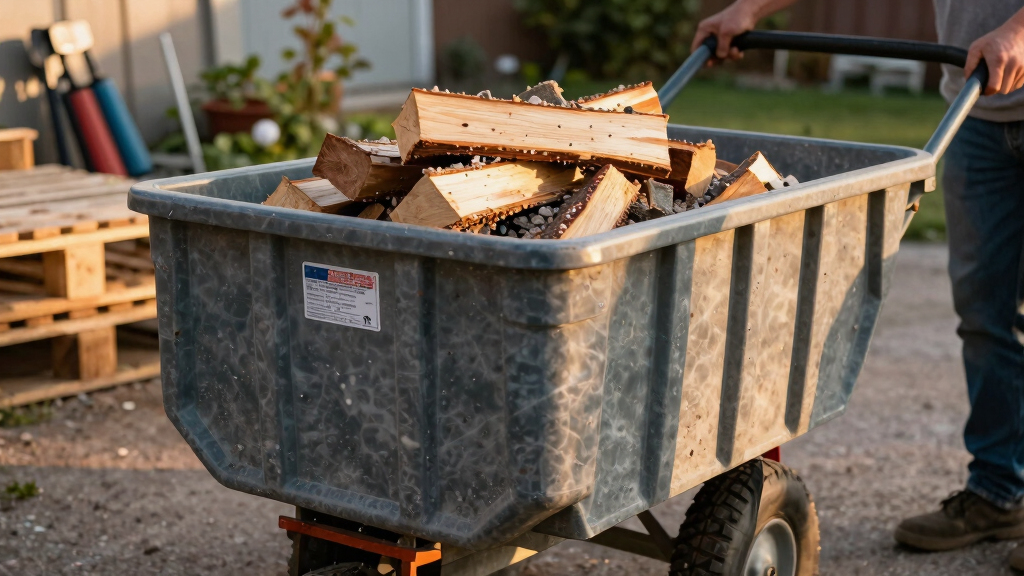
garden dump cart for soil and gravel
As an affiliate, we earn on qualifying purchases.
As an affiliate, we earn on qualifying purchases.
Why Overloading Your Dump Cart Is a Dangerous Game
Overloading might seem tempting—more load, fewer trips. But it’s a risky gamble. Overload the cart, and you risk bending or breaking the frame, damaging the axle, or even tipping over during dumping.
For example, a homeowner once overloaded a 1,000-pound rated cart with 1,500 pounds of wet soil. It worked fine until the cart suddenly tipped, spilling heavy mud all over her driveway. Don’t be that person. Stick to the rated weight.
Beyond the immediate risk of tipping, overloading can cause long-term damage to your equipment. The frame and axles are designed to handle specific loads; exceeding these limits can lead to cracks, bending, or complete failure over time. This not only endangers your safety but also results in costly repairs or replacements. Recognizing the signs of overloading—such as difficulty maneuvering or unusual sounds—can prevent accidents before they happen. Always respect the rated capacity to ensure your equipment lasts and your work remains safe.
As an affiliate, we earn on qualifying purchases.
How to Safely Load and Tow Your Dump Cart
- Know your cart’s rated capacity. Never exceed it.
- Distribute the weight evenly across the bed.
- Use a scale or estimate based on material density to avoid overloading.
- Ensure your towing vehicle can handle the total weight.
- Load on flat, stable ground and secure the load if needed.
For instance, when hauling mulch, you can roughly estimate a cubic yard weighs around 500 pounds. Load accordingly—about 2 cubic yards max for a 1,000-pound rated cart. Remember, uneven loads can cause instability, so distribute weight evenly to maintain balance and prevent tipping during transport or dumping. Always double-check your total weight against your vehicle’s towing capacity to avoid overburdening your vehicle, which can be dangerous and lead to mechanical issues.
Choosing the Right Dump Cart for Your Needs
Pick a cart whose pound rating matches your typical loads. If you often haul wet soil, go for a 2,000-pound capacity. If mulch or lighter materials are your main fare, a 500–1,000 pound cart might suffice.
Match the cart to your towing vehicle as well. A lightweight ATV or small tractor can’t tow the same weight as a full-sized truck. Always check your vehicle’s towing specs first.
Additionally, consider the type of terrain you’ll be working on. Heavy-duty, reinforced carts are better suited for rough, uneven ground, while lighter models work well on smooth surfaces. Think about how often you’ll use the cart and the kinds of loads you typically carry—investing in a slightly larger capacity than your current needs can provide extra safety margin and flexibility for future projects.
What’s Next? Making Smarter Choices for Safe Hauling
Understanding what the pound numbers mean transforms how you approach yard work. It’s about safety, efficiency, and longevity. Don’t just look at the number—think about what you’ll actually be hauling.
Remember, a cart rated at 2,000 pounds isn’t just for heavy loads. It’s a tool to keep your project smooth and safe. Use the right one for your materials, and load smart.
Frequently Asked Questions
How do I know if my dump cart is overloaded?
Check the weight of your load with a scale or estimate based on material density. If it exceeds the rated capacity, unload some material. Also, observe for signs like the cart tipping, difficulty maneuvering, or unusual strain on the frame, which indicate overload conditions.Can I modify my dump cart to carry more weight?
Modifications can compromise safety and often void warranties. They may weaken the structural integrity of the cart, increasing the risk of failure. It’s safer to select a model with a higher rated capacity designed for larger loads if needed, rather than risking unsafe modifications.What should I do if my cart tips during dumping?
Stop immediately. Ensure your load is evenly distributed and within weight limits. Use level ground for dumping, and consider reducing the load size if tipping issues persist. Proper load management and stable ground are key to preventing tipping accidents.How does the weight of my towing vehicle affect hauling safety?
Your vehicle must handle the combined weight of the cart and its load. Exceeding your vehicle’s towing capacity can cause steering issues, mechanical stress, or accidents. Always verify your vehicle’s towing limits and stay within them for safe operation.Conclusion
Understanding what those pound numbers really mean changes everything. It’s about working smarter, safer, and getting more out of your hauling equipment. Don’t just see a number—see a limit that keeps your project moving smoothly and safely.
Next time you load your dump cart, remember: size matters, but knowing your limits matters more. Keep it safe, and your yard work will be a whole lot easier—and less messy.
Fall yard work Picks
leaf blowers
As an affiliate, we earn on qualifying purchases.