
TL;DR

Get business pricing on tools and workshop supplies
- Business-only prices and quantity discounts
- Tax-exempt purchasing
- Multiple users, one account, clear invoices
Cart wheel and bearing replacement is less about finding something that looks close and more about matching wheel diameter, hub length, axle diameter, bearing bore, bearing outside diameter, bearing width, and fork spacing. Measure clean, unworn surfaces with digital calipers, check the supplier’s dimensioned drawing, preserve every spacer, and test the repaired cart unloaded before adding weight.
A wheel can match the old one across the tread and still be completely wrong for your cart. The hub may pinch between the fork legs, the bearing may rattle on the axle, or the mounting height may leave one corner floating. What looked like a five-minute repair can end with a loaded cart wobbling across the barn floor.
You will learn how to measure the wheel, bearing, axle, fork, and mounting hardware as one connected system. You will also see why tiny metric-versus-imperial differences matter, how tread material changes rolling effort, and when replacing a cart wheel makes more sense than pressing in fresh bearings. The goal is simple: buy once, fit once, and put the cart back to work safely.
Think of the assembly as a short chain. Every link—bore, spacer, hub, fork, washer, and fastener—sets the position of the next one. A single wrong dimension can make the whole chain pull crooked, much like one twisted link makes a gate chain jump and chatter under tension.
Measure wheel diameter, tread width, hub length, axle diameter, bearing bore, bearing outside diameter, bearing width, fork opening, and mounting dimensions in…
Never treat 12 mm and 1/2 inch as interchangeable; the 0.7 mm gap can cause wobble, impact wear, and early bearing failure.
Keep every washer, sleeve, and internal spacer in order because the spacer stack lets the axle stay tight without clamping the wheel.
Calculate baseline capacity from maximum loaded weight divided by load-bearing wheels, then allow for three-wheel loading, thresholds, speed, and shifting carg…
Test the repaired cart empty and at 25%, 50%, and 100% load before returning it to regular hauling.
Cart Wheel and Bearing Replacement: Getting Sizes That Actually Match
A wheel that looks right can still bind, wobble, or leave one corner floating. Treat the wheel, bearings, axle, spacers, fork, and mounting hardware as one connected system—then buy once, fit once, and return the cart to work safely.
Nine dimensions before you order
Remove the wheel, clean away rust and debris, and arrange every washer, sleeve, nut, and spacer in installation order. Record millimeters and inches whenever possible.
Wheel diameter
Measure through the center. Avoid flattened tread, embedded debris, and severely worn spots.
Tread width
Measure only the rolling surface—not the projecting hub, washers, or axle hardware.
Hub length
Measure the complete hub width. It must clear the fork without excessive lateral play.
Axle diameter
Measure a clean, unworn, unthreaded section. Bolt-head and wrench size reveal nothing useful.
Bearing bore
Match the axle or specified sleeve precisely. Never assume metric and imperial sizes interchange.
Outside diameter
This controls the bearing-to-hub fit and must match the wheel’s machined recess.
Bearing width
Width affects hub seating, internal spacer length, and the assembled clamping stack.
Fork opening
Measure the clear inside distance between the fork legs at the wheel location.
Height and mounting
Record overall height, plate size, hole pattern, hole diameter, stem size, length, and thread pitch.
Small differences, large consequences
Matching diameter alone is not enough. A correct-looking wheel can still have the wrong hub, bore, bearing width, offset, or installed height.
| Dimension pair | Actual difference | Fit verdict | Likely result |
|---|---|---|---|
| 12 mm axle / 1⁄2-inch bore | 0.7 mm | ✗ Incorrect | Wobble, impact wear, and axle hammering |
| 16 mm axle / 5⁄8-inch bore | 0.125 mm | ~ Risky | Small but measurable operating play |
| 100 mm fork / 104 mm hub | 4 mm too wide | ✗ Incorrect | Wheel binds or fork legs spread |
| 75 mm / 80 mm caster height | 5 mm | ✗ Incorrect | Rocking and uneven wheel loading |
| Drawing and measured stack agree | Within tolerance | ✓ Confirmed | Correct clamp, alignment, and rotation |
Mismatch scale
Relative size of common dimensional traps. Even the shortest bar can matter at a bearing interface.
The stamped code is a clue, not the final answer
Clean the shield gently, illuminate it from an angle, and photograph faint markings before removal. Confirm the code against a dimensioned supplier drawing because identical bores can hide different outside diameters, widths, clearances, seals, and load ratings.
Plain bore or sleeve
Simple, economical, and tolerant of slow, dirty service. Inspect the sleeve for scoring and wear.
Roller bearing
Suited to substantial radial loads at moderate travel speeds when the assembly stays aligned.
Ball bearing
Provides efficient rotation when axle fit, fork alignment, spacer length, and sealing are correct.
Flanged bearing
A projecting lip controls axial location in the hub. Match flange geometry as well as dimensions.
Rubber-sealed bearing
Common “2RS” descriptions indicate two rubber seals, but naming must be verified by manufacturer.
Metal-shielded bearing
Common “ZZ” descriptions indicate two metal shields. They resist debris but are less water-tight.
Each part positions the next
The axle fastener should clamp the stationary inner-race stack while the wheel rotates freely. Missing or incorrect spacing transfers damaging side load into the bearings.
Check for a missing internal spacer, incorrect bearing width, misplaced washer, over-wide hub, bent fork, or excessive fastener torque. Tightening harder cannot correct a dimensional mismatch.
Bearing only—or complete wheel?
Fresh bearings make sense only when the remaining wheel assembly can locate and support them correctly under real working loads.
Replace the bearing
- Hub recess is round, clean, and undamaged
- Tread is sound and wheel diameter remains usable
- Axle is straight with an unworn bearing surface
- Correct bearing and spacer dimensions are available
- Replacement cost and pressing effort are sensible
Replace the complete wheel
- Hub is cracked, oval, enlarged, or badly corroded
- Tread is split, flat-spotted, loose, or heavily worn
- Bearing seat no longer holds the outer race securely
- Axle or fork damage changes alignment
- Correct internal parts cannot be identified or sourced
Add margin for three-wheel loading, thresholds, potholes, speed, uneven floors, and shifting cargo. Tread material also changes rolling effort, noise, floor protection, and shock absorption.
Test progressively before regular hauling
Measure These Nine Dimensions Before You Order Anything
Cart wheel and bearing replacement starts with nine measurements: wheel diameter, tread width, hub length, axle diameter, bearing bore, bearing outside diameter, bearing width, fork opening, and mounting dimensions. Record each value in millimeters and inches when possible, using clean parts and digital calipers rather than a ruler [1].
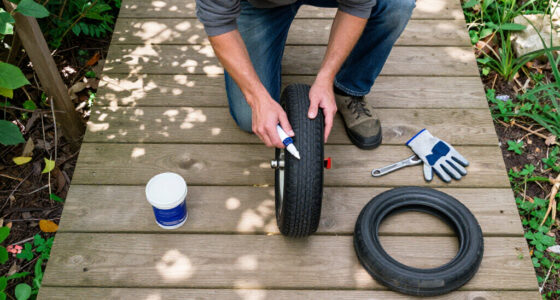
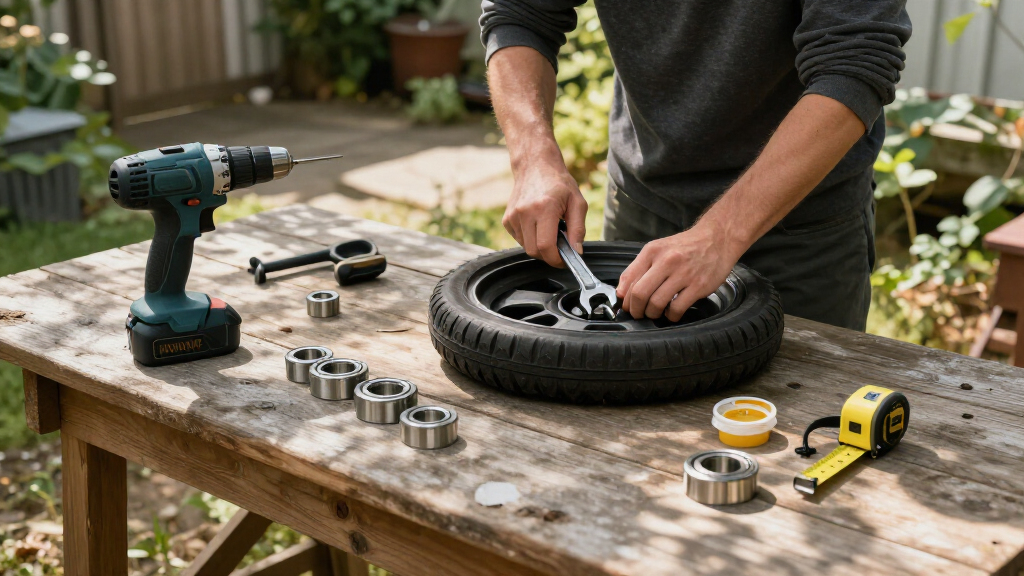
Remove the wheel and lay every washer, sleeve, nut, and spacer on a clean towel in installation order. Brush away packed mud and stringy grass before measuring. On a yard cart that has spent five seasons hauling split oak, a crust of rust can easily add enough thickness to mislead a quick measurement.
- Wheel diameter: Measure straight through the center, avoiding flattened tread or stuck debris.
- Tread and hub width: Measure the rolling surface separately from the full hub length.
- Axle diameter: Measure the smooth bearing surface, not the threads or bolt head.
- Bearing dimensions: Record bore, outside diameter, and width as three separate numbers.
- Fork opening: Measure the clear inside distance between the fork legs.
- Caster mounting: Record plate size, bolt-hole spacing, hole diameter, or stem diameter, length, and thread pitch.
Getting sizes that actually match requires measurements from several spots. An axle worn to 12.3 mm near the loaded side may still measure 12.7 mm beside the washer, revealing that it began life as a 1/2-inch axle. Measure the unworn section, then inspect for grooves, corrosion, and bending before trusting the number.
Do not estimate axle size from the bolt head. The wrench size tells you about the head, not the smooth surface supporting the bearing.
As an affiliate, we earn on qualifying purchases.
See Why a Part That Looks Right Can Still Ruin the Fit
Cart wheel and bearing replacement fails when one close-looking dimension hides a real mismatch. A wheel with the right diameter can still have the wrong hub length, bearing bore, or bearing width. Those small errors create binding, wobble, noisy rolling, and wear that can destroy a new part within weeks.
| Dimension pair | Actual difference | Likely result |
|---|---|---|
| 12 mm axle and 1/2-inch bore | About 0.7 mm | Loose fit, wobble, and axle hammering |
| 16 mm axle and 5/8-inch bore | About 0.125 mm | Small but measurable play |
| 100 mm fork and 104 mm hub | 4 mm too wide | Wheel binds or fork spreads |
| 75 mm and 80 mm caster heights | 5 mm height change | Uneven load sharing and rocking |
Imagine fitting a 1/2-inch bearing onto a 12 mm axle. It slides on beautifully—almost suspiciously easily—but the 0.7 mm gap lets the inner race knock against the axle like a loose hammer handle. Tightening the nut harder will not correct the fit; it may only crush the spacer stack or clamp the wheel.
The same trap appears when you measure the threaded part instead of the axle’s smooth bearing surface. Threads have peaks and valleys, so the caliper reading does not represent the working diameter. Finding something that fits the threads says little about how the wheel or bearing will sit under a load of wet soil.
Old wheels can also lie. Rubber compresses, pneumatic tires lose pressure, and plastic hubs wear oval. Use the supplier’s dimensioned drawing, not a product title such as “10-inch utility wheel,” because that label rarely tells you the hub, bore, offset, or installed height.
industrial caster wheels with bearings
As an affiliate, we earn on qualifying purchases.
As an affiliate, we earn on qualifying purchases.
Read the Bearing Before Dirt Erases the Best Clue
Cart wheel and bearing replacement becomes easier when you find the code stamped into a bearing shield. That code usually points to the bearing series and dimensions, while suffixes describe details such as seals or shields. Clean the side gently, use angled light, and photograph faint markings before removal [2].
A four-digit code may hide behind a washer or internal sleeve. Turn the wheel slowly under a bright shop light; shallow lettering often flashes silver for a moment against the dark seal. On a garden cart stored beside fertilizer, a soft nylon brush and a dab of mild cleaner can reveal numbers buried under gray dust and dried grease.
Do not identify a bearing from its bore alone. Two bearings can share a 12 mm inside diameter while using different outside diameters, widths, clearances, seals, or load ratings. That is like choosing boots by foot length while ignoring width and ankle height: the headline number matches, but the working fit does not.
- Plain bore: The wheel turns directly on an axle or removable sleeve.
- Sleeve bushing: A simple choice for slow, dirty, budget-minded service.
- Roller bearing: Handles substantial radial loads at moderate travel speeds.
- Ball bearing: Cuts rolling resistance when the axle and fork stay aligned.
- Flanged bearing: Uses a lip to control its position in the hub.
- Sealed bearing: Keeps more grit and water out while retaining factory lubricant.
Suffixes such as 2RS and ZZ commonly refer to two rubber seals and two metal shields, though exact naming varies by manufacturer [2]. Rubber seals usually block dirty water better; metal shields often create less drag. Match the original protection level or choose one suited to the cart’s actual exposure, then confirm every dimension.
heavy duty cart wheel and bearing set
As an affiliate, we earn on qualifying purchases.
As an affiliate, we earn on qualifying purchases.
Keep the Spacer Stack Intact So the New Wheel Spins
A new wheel that binds after tightening usually has a missing spacer, incorrect bearing width, misplaced washer, or over-wide hub. The axle fastener must stay secure without squeezing the rotating parts. Preserve the original hardware order, check the internal spacer, and test rotation after each assembly change.
- Photograph the assembly from both sides before loosening the axle.
- Remove parts in order and place them left-to-right on a clean towel.
- Check the internal spacer between paired bearings for wear, crushing, or loss.
- Install each bearing correctly, pressing only on the race being fitted.
- Rebuild the stack with every washer, sleeve, and guard in its original position.
- Tighten and spin the wheel, checking for drag, wobble, and fork contact.
Many ball-bearing wheels use two bearings with a steel tube between their inner races. When you tighten the axle, that tube carries the clamping force. If the tube is 1 mm too short, the inner races pull inward and side-load the balls; the wheel changes from a quiet spinner to a gritty pepper mill.
Use a press, vise, or suitable bearing driver with slow, even pressure. Press the outer race when fitting a bearing into a hub and the inner race when fitting it onto a shaft. Force sent through the balls or rollers can dent the raceways, creating a rhythmic tick that grows louder under load.
Do not strike a sealed bearing directly with a steel hammer. Wear eye protection and gloves, support the hub squarely, and stop if the bearing starts crooked. A cracked cast hub or bent fork calls for replacement, not more force.
After assembly, the axle bolt usually remains stationary while the bearing’s outer races and wheel rotate. If the bolt turns with the wheel, inspect the spacer stack and inner-race clamping. Test the cart empty, then add weight in stages rather than dropping a full load of stone onto an unproven repair.
measuring calipers for wheel dimensions
As an affiliate, we earn on qualifying purchases.
As an affiliate, we earn on qualifying purchases.
Choose a Wheel That Carries the Load and Suits the Ground
The correct replacement must match both dimensions and working conditions. Start by dividing the maximum loaded cart weight by the number of wheels that truly carry weight, then add room for uneven floors, shifting cargo, and impacts. Match the tread to surface, speed, moisture, chemicals, noise, and temperature.
A four-wheel cart rated around a simple average can still ride on three wheels when one corner crosses a shallow drain. A 600-pound loaded cart divided by four suggests 150 pounds per wheel, but that number understates the strain when one wheel lifts. A steel threshold can send a sharp jolt through the remaining wheels like a hammer blow.
Required capacity per wheel equals maximum loaded weight divided by load-bearing wheels. Treat that as a starting point, not the purchase rating. Powered towing, long travel, speed, dropped cargo, potholes, and cracked concrete all raise stress beyond a quiet static load.
- Rubber: Quiet and forgiving on tile or smooth concrete, with more rolling resistance and commonly lower capacity.
- Polyurethane: A useful balance of capacity and floor protection, though hardness and formulation vary.
- Nylon or polyolefin: Easy rolling and chemical resistance, but noisy over seams and gravel.
- Steel or cast iron: Strong under heavy loads, yet loud and hard on finished floors.
- Pneumatic: Soft over roots and ruts, but pressure checks and puncture repairs come with the ride.
- Foam-filled or semi-pneumatic: Fewer ordinary flats, traded for extra rolling effort.
For example, a cart hauling mulch across two acres of lumpy turf benefits from a larger pneumatic wheel at the specified tire PSI. A shop cart rolling 200 feet a day across sealed concrete may feel better on non-marking polyurethane. The soft tire floats over bumps; the firm tread rolls like a clean billiard ball on a smooth floor.
Never substitute a general yard-cart wheel on lifting gear, vehicle-support equipment, medical equipment, or regulated machinery without approval from the manufacturer or a qualified engineer. Dimensional fit does not prove safety. Load ratings, braking behavior, conductivity, and legal requirements still govern the job.
Know When a Bearing Repair Will Cost More Than a New Caster
Replace only the bearing when the tread, hub, bearing seat, fork, and mounting hardware remain sound. Replace the wheel when its tread or hub has failed. Replace the entire caster when damage reaches the swivel, fork, kingpin, brake, plate, or stem.
A bearing-only repair makes sense on a thick polyurethane wheel with an undamaged hub and a readable standard bearing code. You clean the seat, press in a matched pair, reinstall the correct spacer, and recover years of service. Before, the cart growled across concrete; after, it rolls with the soft hum of a skateboard on fresh pavement.
Choose a complete wheel when the tread is cracked, flat-spotted, chunked, chemically softened, or heat damaged. Replace it as an assembly when a loose outer race has enlarged the bearing seat, because a fresh bearing will spin in the hub instead of staying fixed. If two bearings, seals, and a spacer approach the cost of an assembled wheel, the complete unit also saves fitting time.
Move up to a full caster when the fork is bent, the swivel race rocks, the brake slips, or the mounting stem is damaged. A replacement with a different overall caster height can tilt the deck and unload another wheel, so compare installed height and rolling radius. On a four-caster nursery cart, even a small height mismatch can make the frame click back and forth as the load shifts.
Replacing a cart component also gives you a chance to select current features that solve a real problem: sealed bearings, corrosion-resistant hardware, non-marking tread, thread guards, or static-dissipative material. Those features offer no rescue when the dimensional stack is wrong. Treat them as useful finish work, not a substitute for measurements.
If the cart carries loose firewood, bags of feed, or hand tools, inspect the matching wheel on the same axle. You do not always need a full set, but paired wheels should share diameter and tread behavior. A hard nylon wheel beside a soft rubber wheel can make the cart pull sideways under load.
Use This Final Fit Check Before the Cart Goes Back to Work
A safe final check confirms free rotation, controlled side play, secure hardware, full fork clearance, matching height, and stable tracking. Test the cart empty on a flat surface, then add its normal load gradually. Stop if you hear clicking, feel heat, see wobble, or find fresh metal dust.
Start by lifting the repaired corner and spinning the wheel by hand. It should move smoothly without scraping a fork leg or brake part. A slight seal drag can be normal, but a wheel that stops as if someone pinched it usually points to a compressed spacer stack, crooked bearing, or hub that is too wide.
Push the empty cart ten yards over smooth ground, then cross the kind of seam or threshold it meets during normal work. Listen for a regular tick, clunk, or dry growl. On a utility cart carrying garden tools, a click once per revolution often exposes a bent wheel, damaged raceway, or debris caught near the tread.
Add about 25%, 50%, and then 100% of the planned working load, checking the axle nut and wheel temperature between runs. Warmth that builds quickly can signal misalignment or excessive drag. Keep hands clear of pinch points, wear work gloves and eye protection, and support raised equipment with rated stands rather than trusting a jack alone.
After the first full work cycle, inspect the fastener, washers, and bearing seats again. Look for polished rub marks, spreading fork legs, black seal debris, or a nut that has moved. That short follow-up catches a poor fit before an afternoon of hauling turns it into a damaged axle and another repair order.
Frequently Asked Questions
Can I replace a cart wheel with one of a different diameter?
Sometimes, but a different wheel diameter changes deck height, ground clearance, load sharing, and brake position. Supporting wheels should normally keep compatible rolling radii and caster heights. If one new caster stands 10 mm taller, a four-wheel cart may rock on three corners like a short-legged table.
Is the axle diameter always the same as the bearing bore?
No. A sleeve, reducer bushing, or shouldered spacer may sit between the axle and bearing. Remove and measure each piece separately; otherwise, you may order a bearing that matches the sleeve’s outside diameter but not the actual axle.
Can I use a 1/2-inch bearing on a 12 mm axle?
No. A 1/2-inch bore is about 12.7 mm, leaving roughly 0.7 mm of extra diameter around a 12 mm axle. The bearing may slide on easily, but the looseness can cause wobble, hammering, noise, and rapid wear.
Why does my new cart wheel bind when I tighten the axle bolt?
Common causes include a missing or short internal spacer, excessive hub width, incorrect bearing width, misplaced washers, or bent fork legs. Looseness at the nut is not the cure. Recheck the complete hardware stack and confirm that tightening clamps the bearing inner races through the spacer without squeezing the rotating wheel.
Should I replace both bearings in a two-bearing wheel?
Replace both bearings as a matched service pair unless inspection and manufacturer guidance give you a sound reason not to. Both bearings have carried the same load and met the same dirt and water. One rough bearing can also send vibration and misalignment into its partner.
Can I hammer a bearing into a plastic or metal wheel hub?
Avoid direct hammer blows. Use a press, vise, or correctly sized driver that applies even force to the outer race as the bearing enters the hub. Wear eye protection, support the hub squarely, and stop if the bearing tilts or the hub begins to crack.
How much side play should a cart wheel have?
The wheel needs enough clearance to turn freely, but visible wobble, knocking, or impact movement signals worn or mismatched parts. Acceptable play varies by caster design and load. Check the axle, bearing bore, spacers, washers, and hub seat rather than hiding movement by crushing the assembly with the nut.
What measurements should I send to a wheel supplier?
Send the wheel diameter, tread width, hub length, axle diameter, bearing bore, bearing outside diameter, bearing width, fork spacing, bearing code, and mounting dimensions. Add loaded cart weight, wheel count, speed, floor type, moisture or chemical exposure, and clear photographs with a ruler or caliper visible.
Conclusion
Measure the whole assembly, not the label on the tire. A dependable repair matches the axle, bearing, spacer, hub, fork, mounting height, load, and ground conditions as one system. Write every dimension down, compare it with a supplier’s drawing, and reject any part that needs force, improvised washers, or an overtightened nut to hide a mismatch.
Then test the cart in stages and listen. The right wheel should roll with a steady, quiet sound—no clunk, scrape, hot hub, or side-to-side dance. A few careful minutes with calipers can save the axle, protect the load, and keep your cart moving cleanly from shed to far fence.
Fall Picks
fall essentials
As an affiliate, we earn on qualifying purchases.