
TL;DR

Get business pricing on tools and workshop supplies
- Business-only prices and quantity discounts
- Tax-exempt purchasing
- Multiple users, one account, clear invoices
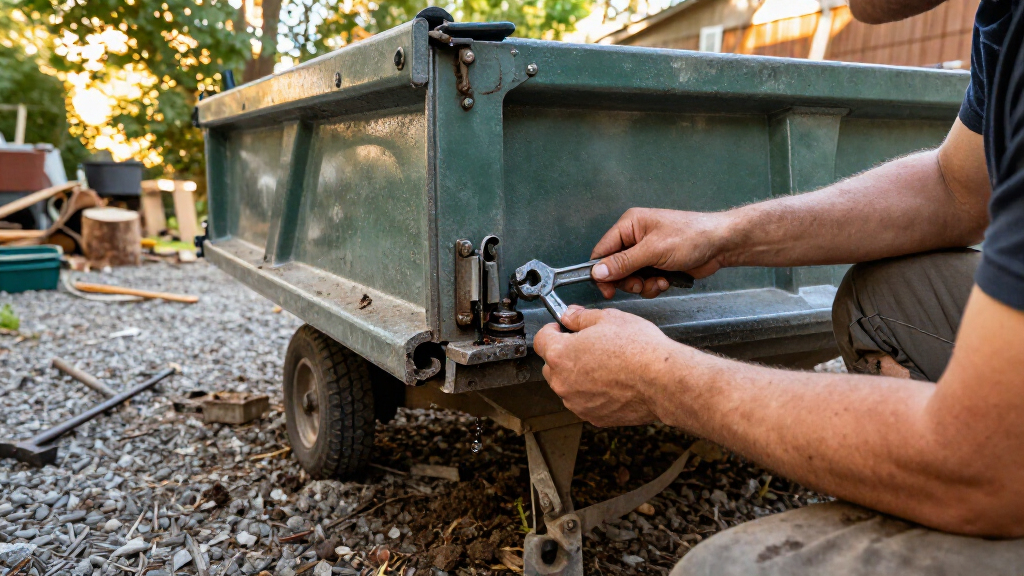
A dump cart that will not tip or latch often has debris, rust, loose or worn hardware, a shifted catch, a misaligned pivot, or an excessive or uneven load. Park level, disconnect the cart, unload it, and inspect before adjusting; clean and lubricate only as the manual permits, then test the empty cart through a full cycle. Stop using it if structural parts are damaged or the latch cannot hold the bed securely.
A dump cart should tip with a controlled lift and return with a solid latch click. When the bed hangs halfway or refuses to lock down, that small hitch can turn a simple load of gravel into a frustrating wrestling match—and forcing it can put your hands in a pinch point.
A dump cart that will not tip or latch often has a problem at the pivot, latch, linkage, or frame. Packed mud, rust, loose hardware, a shifted catch, or a load packed against the bed can all interrupt the cycle. The cart may be repairable, but you need to identify which action is failing before you reach for a wrench.
This guide walks you through a safe, unloaded inspection, explains what each symptom usually points to, and shows when basic cleaning or adjustment ends and a proper repair begins. You’ll also see why a little lubricant can help a dry pivot—but cannot straighten a bent bracket or make a damaged latch trustworthy.
Park on level ground, disconnect the cart, unload it, and keep hands clear before inspection.
If the latch will not release, inspect the catch and linkage; if it releases but the bed will not rotate, inspect the pivot, obstructions, and load.
Clean grit and rust before applying the manufacturer’s recommended lubricant; lubrication cannot fix bent or worn parts.
Make only small, manual-approved adjustments, and tighten or replace hardware to the manufacturer’s specifications.
Stop using the cart if the frame, pivot, weld, or bed is damaged, or if the latch will not hold securely.
Dump Cart Won’t Tip or Latch: Pivot and Alignment Fixes
A cart that sticks may have debris, rust, misalignment, worn hardware, or an uneven load. Match the symptom to the mechanism, inspect safely, then test it empty.
Make the cart safe to inspect
Park level, disconnect the cart, unload it, and keep hands clear of pinch points.
Use firm, level ground and disconnect the tow vehicle or power source.
Keep the bed empty. Never work beneath a raised bed without a rated support.
Cycle the empty cart fully and confirm the latch holds before loading.
Let the symptom guide the check
Different failures point to different parts of the tipping cycle.
| Symptom | Inspect first |
|---|---|
| Latch will not release | Catch, release linkage, cable, and debris |
| Latch releases; bed stays put | Pivot, obstructions, frame clearance, and load |
| Bed tips; latch will not engage | Catch alignment, pins, bracket, and return path |
Clean, align, and maintain
Inspect both sides where accessible, and follow the cart manual for products and adjustments.
Clear grit first
Remove packed soil, stones, and surface rust before applying the recommended lubricant.
Check full movement
Look for loose linkage, worn pins, a disconnected cable, or a shifted catch.
Remove binding weight
An excessive, uneven, or stuck load can bind the bed; troubleshoot only when empty.
Start with a safe, unloaded inspection
Before you troubleshoot a dump cart that will not tip or latch, park on firm, level ground, disconnect the tow vehicle or power source, and unload the bed. Those steps take the cart out of motion and remove the weight that can trap the pivot or shift the bed while you inspect it. Keep hands clear of the space between the bed and frame.
If the bed must stay raised for a repair, support it with an appropriately rated prop designed for that purpose. A hydraulic cylinder, the latch, or a loose piece of lumber is not a safe support. A loaded bed can drop suddenly, and even an empty steel or poly bed can pinch fingers as it swings.
For example, if you’ve hauled wet soil across a sloped garden and the bed stopped partway through its return, don’t climb underneath to see what caught. Lower it only if you can do so safely, move the cart to level ground, then remove the load and inspect from the side. Wear gloves and eye protection when scraping packed grit or rust; sharp edges and springing linkage can surprise you.
Keep the cart unloaded during troubleshooting. Never work beneath a raised bed unless a rated support holds it securely.
Start by checking the manufacturer’s manual for the rated capacity, lifting method, lubrication points, and any model-specific support or adjustment instructions. Cart designs vary: a small lawn cart and a heavy-duty garden trailer may use different pins, bushings, latches, and release mechanisms.
Popular right now

Samsung The Frame Pro LS03HW 65-inch Neo QLED TV with 27-Month Axiom Care

Samsung 65 The Frame QLED 4K TV (2026) QN65LS03HEFXZA Bundle

Shark HydroVac MessMaster Wet/Dry Vacuum & Mop Combo (AW261)
As an affiliate, we earn on qualifying purchases.
Match the symptom to the part that needs attention
A dump cart that will not tip or latch gives you useful clues: note whether the latch releases, whether the bed rotates, and whether the latch catches when the bed returns. A bed that will not release points first to the latch or its linkage. If it releases but will not rotate, inspect the pivot, frame clearance, obstructions, and load. If it tips but won’t latch afterward, check the catch, alignment, and return path.
That distinction saves time. Imagine a cart whose release handle moves freely, but the bed stays planted. Replacing a cable won’t solve a seized pivot. Now imagine the bed lifts normally, but the latch tongue misses its catch on the way down. Extra grease on the pivot won’t put that catch back in line.
Try this simple symptom check with the cart empty, parked level, and your hands away from moving parts:
- Latch will not release: look for soil or stones packed around the catch, a stuck latch, a disconnected or stretched cable, and loose or shifted hardware.
- Latch releases; bed stays put: check for an obstruction, corrosion or binding at the pivot, uneven gaps, and signs of a bent bracket.
- Bed tips; latch will not engage: check for debris in the catch, a loose latch bracket, worn pins, or an uneven return.
These symptoms point to likely trouble spots, not a guaranteed diagnosis. For instance, an overloaded bed can bind the pivot and make a healthy release feel broken. Unload it completely before deciding a part has failed, and check the manual before testing a lever or mechanism that has a model-specific operating sequence.
Free a sticky pivot without hiding real damage
A stiff dump-cart pivot often moves more freely after you remove packed soil, stones, and surface rust, then apply the lubricant specified by the manufacturer. Clean the joint first so grit does not grind between the moving surfaces. Lubrication can reduce friction, but it cannot repair a damaged bushing, bent bracket, cracked weld, or misaligned frame.
With the bed down and the cart unloaded, inspect both sides of the pivot where you can see them. Look for uneven gaps, rust scale, a pin working out of position, damaged bushings, or fresh scrape marks where metal has been rubbing. Compare left and right. A clean pivot on one side and a packed, rusty joint on the other can explain why the bed lifts at an angle.
For instance, after mowing a damp acre, grass and mud can dry into a hard ring around a pivot pin. Brush away loose material, use a suitable scraper where the manual permits, and apply the recommended product to the designated pivot points. Move the bed through its full cycle only when you can do so safely, and wipe away excess lubricant if it will collect dust and clippings.
There is no universal lubricant for every cart. A product that suits a bare metal pin may be wrong for a polymer bushing, and a sticky grease can collect fine sand in a dusty field. If the manual is missing, identify the pivot material and operating conditions before choosing a product. If cleaning and correct lubrication do not free the empty bed, stop and check for bent or worn parts instead of applying more force.
Get a latch and release linkage to move and catch
A latch works only when its release moves freely and its catch lines up with the bed in the closed position. If your dump cart latch won’t release, clear packed dirt and stones from the catch first, then check for a cable that has stretched or disconnected, a loose linkage, worn pins, or a shifted bracket. If it releases but will not catch, focus on the return path and the alignment between latch and catch.
Try a visual check before you adjust anything: operate the release from its normal position while watching the linkage from a safe distance. Does the latch move through its full travel? Does it return on its own as designed? Does the catch meet it squarely as the bed comes down? For example, if the release cable moves but the latch barely shifts, a worn pin or loose connection may be robbing the mechanism of travel.
Remove visible debris with a brush and follow the manual for cleaning and lubrication. If the manufacturer allows adjustment, make small changes, tighten only to specified torque where given, and recheck the latch with the empty bed. Do not pry against the frame, bend a latch tongue, or pull the bed into alignment with a strap. A latch that barely catches under no load may fail when you cross uneven ground.
Keep the cart out of service until the latch holds reliably. If the latch slips, the linkage is damaged, or the release does not return as intended, contact the manufacturer or a qualified repairer for compatible parts and model-specific instructions. The latch is a safety-critical part of the cart’s working cycle, not a cosmetic fitting.
Correct loose hardware and alignment without forcing the bed
A dump cart that returns unevenly or misses its catch may have loose fasteners, a shifted latch bracket, worn pins, or a bent pivot component. Alignment problems often show up as unequal gaps, fresh scrape marks, a bed that sits crooked, or a latch that meets one edge of its catch. Look at both sides of the bed and frame before reaching for an adjustment.
Start with a careful inspection of bolts, pins, brackets, and visible welds. Tighten fasteners only to the manufacturer’s specifications; guessing can strip threads, crush a bushing, or leave a joint loose. Replace worn pins and bushings with compatible parts. For instance, if a pin has worn into an oval shape, tightening its nut will not restore the round bearing surface the pivot needs.
If the manual permits a latch adjustment, make one small change at a time and test the empty bed after each change. Keep a note or photo of the starting position so you can reverse an adjustment that makes the fit worse. The bed should meet its supports evenly, and the latch should engage fully without a shove or a pry bar.
Stop if you see a cracked weld, a bent bed, a distorted bracket, or hardware that will not stay aligned. Those are structural problems, and a quick bend with a hammer can weaken the part further. Ask the manufacturer or a qualified repairer whether the component needs replacement or an approved repair. Model-specific service guidance matters, especially on heavier carts whose loaded beds can carry substantial force through the pivot.
Rule out an overloaded or badly balanced bed
An excessive, uneven, or stuck load can make a working pivot feel seized and keep a dump cart from tipping smoothly. Wet soil weighs more than loose dry clippings, while gravel or stone can pile into a dense wedge against the front wall. The cart’s rated capacity and loading guidance—not the apparent size of the bed—set the safe limit.
Before diagnosing hardware, remove the load and check whether material has wedged between the bed and frame. For example, a half-yard of damp compost piled hard against the front can press the bed down and shift its balance, while a stone caught near one pivot can make one side bind. Unload from a stable position and avoid standing in the path of material that may slide or roll.
When you reload, spread material evenly and keep it within the manufacturer’s capacity. A load that is too far to one side can twist the bed and make the latch miss when you return it. On a sloped property, park on level ground before dumping; gravity can pull an unbalanced bed sideways and make the cart harder to control.
Battery-powered and gas-powered tow vehicles both have limits, but engine strength does not raise the cart’s rated capacity or make an overloaded bed safe to tip. If a cart binds only when full, reduce the load and inspect for trapped material before assuming the pivot needs replacement. A smooth empty cycle is useful evidence, but it does not excuse exceeding the cart’s posted capacity.
Test the repaired cart in a controlled order
After cleaning, lubrication, or a permitted adjustment, test the empty cart through a full tip-and-return cycle on level ground. The bed should release, rotate without binding, return evenly, and engage the latch securely. Keep everyone clear of the bed’s path, and stop if it twists, scrapes, drops, or catches only partway.
- Check the work: confirm tools are clear, fasteners are secure to the manual’s specifications, and no prop or debris remains in the mechanism.
- Test the release: operate the handle or lever from its normal position, keeping fingers clear of the linkage and latch.
- Tip the empty bed: use the cart’s intended method and watch for uneven movement, rubbing, or a sudden drop.
- Return and latch: lower the bed under control, then confirm that the latch fully engages and stays engaged.
- Recheck: inspect the pivot and latch for shifting hardware or fresh scrape marks before putting the cart back to work.
For example, if the empty bed completes the cycle but the latch clicks only when you push one corner down, the return is probably uneven or the catch remains misaligned. Do not load the cart to “see if it holds.” Repeat the inspection or get repair guidance first.
Use the manual’s operating procedure if it differs from these general steps. A cart’s design may call for a specific lifting motion or release sequence. Return it to service only when the mechanism moves smoothly and the latch holds every time through repeated empty cycles.
Know when pivot or latch trouble needs a repairer
Stop using the cart if you find a cracked frame or pivot bracket, a failed weld, a visibly bent bed, or a latch that cannot hold the bed securely. Those are signs that cleaning and adjustment will not restore dependable operation. A cart that still binds after basic cleaning and inspection also needs model-specific repair guidance.
Do not keep hauling loads while hoping the latch will catch next time. On a rough path, a bed that unlatches can shift material or swing unexpectedly; even a small cart can injure someone nearby or damage equipment. Mark the cart out of service and keep it parked where nobody will use it until the fault is resolved.
Contact the manufacturer for the service manual, compatible replacement parts, and any model-specific adjustment or repair instructions. A qualified repairer can assess structural damage and determine whether a bracket or bed can be repaired safely. For example, a bent latch mount may look like a simple alignment issue from above while its weld has already started to separate underneath.
Keep the cart’s model information and a clear photo of the damaged area ready when you ask for help. Do not weld, heat, drill, or bend a load-bearing component unless the manufacturer or a qualified professional confirms that repair method. If the latch cannot retain the bed reliably after an approved repair, the cart is not ready to return to work.
Frequently Asked Questions
Why won’t my dump cart tip?
Common causes include a latch that has not released, a seized or obstructed pivot, a bent or misaligned frame, or an excessive or uneven load. Unload the cart and check which part of the cycle stops before changing hardware.
Why won’t the bed unlatch?
Look for packed debris at the catch, a stuck latch, damaged or disconnected linkage, loose hardware, or a shifted latch bracket. Do not pry against the frame or force the release; consult the manual for model-specific inspection and adjustment steps.
Why does the bed tip but refuse to latch afterward?
The catch may be obstructed, worn, loose, or misaligned, or the bed may be returning unevenly. Keep the cart unloaded until the latch engages fully and holds reliably through repeated empty cycles.
What lubricant should I use on a dump-cart pivot?
Use the lubricant specified in the cart’s manual. If you cannot find the manual, identify the pivot and bushing materials and consider the cart’s dusty or wet working conditions before choosing a product; some lubricants attract grit or may not suit particular bushings.
Can I adjust the dump-cart latch myself?
Basic inspection and tightening may be appropriate if the manufacturer’s manual allows it. Make small adjustments, test the empty cart, and never bend or force a latch that must hold the bed securely.
When should I stop using the cart and get a repair?
Stop if the frame or pivot bracket is cracked, a weld has failed, the bed is visibly bent, the latch will not hold, or the mechanism still binds after basic cleaning and inspection. Ask the manufacturer or a qualified repairer for model-specific guidance and compatible parts.
Conclusion
When a dump cart sticks, start with the empty bed, the pivot, the latch, and the load. Clean away grit, check alignment, and use only the maintenance and adjustment steps allowed by the manual. A lubricant can quiet a dry joint, but damaged metal needs proper repair.
Test the cart empty until the bed tips smoothly and the latch catches every time. Then put it back to work—one secure click at a time, with the trail behind you clear and the load within capacity.