
TL;DR

Get business pricing on tools and workshop supplies
- Business-only prices and quantity discounts
- Tax-exempt purchasing
- Multiple users, one account, clear invoices
Ice melts work by dissolving into the film of liquid water naturally present on ice, creating brine that has a lower freezing point than pure water. Rock salt is inexpensive and useful above roughly 15°F, while calcium chloride works faster in deeper cold; neither is harmless to pets, plants, concrete or waterways, so accurate application and cleanup matter more than a pet-safe label.
A fistful of extra ice melt can leave you with slick brine, sore dog paws and a white crust creeping across your garage floor. More pellets do not automatically clear ice faster. Once enough chemical is down, excess product often sits there like gravel, waiting for boots, tires and curious tongues.
You will learn why rock salt slows down near 15°F, why calcium chloride bites into colder ice and why a cheerful paw print does not prove a product is harmless. You will also see how pavement temperature, moisture and application rate change the result. Those details matter when your front steps are glazed at dawn and your dog needs to get outside now.
The practical goal is simple: create safe footing with less chemical. That means shoveling before snow packs down, matching the deicer to the surface temperature and sweeping away leftovers once the ice releases. You protect paws, concrete, plants and metal at the same time—and spend less money feeding salt to the storm drain.
Measure pavement temperature, not just air temperature; rock salt loses much of its practical speed below roughly 15°F.
Shovel first, apply only the label-directed amount and scrape loosened ice before diluted brine refreezes.
Treat pet-safe and salt-free as marketing descriptions until the ingredient list shows what the bag actually contains.
Wipe and dry paws after treated walks, and contact a veterinarian after substantial ingestion or persistent symptoms.
Keep chloride away from planting beds, sweep leftover granules and use grit where traction matters more than melting.
Winter surface science / field guide
Ice Melt Chemistry
Rock salt, calcium chloride and what “pet-safe” really means. The goal is not to make ice vanish—it is to break the pavement bond, restore footing and leave less chemical behind.
01 / Essential chemistry
Ice melt needs water before it can work
A deicer dissolves into the microscopic liquid film on ice. The resulting brine freezes at a lower temperature than pure water and works along the pavement–ice boundary.
Find moisture
The pellet must encounter or attract liquid water. Dry powder and deep cold slow the first useful reaction.
ICE + LIQUID FILMForm brine
Dissolved ions interfere with the formation of an orderly ice crystal, lowering the solution’s freezing point.
DEICER + H₂O → BRINEBreak the bond
Brine spreads beneath the ice. Scraping then removes loosened material before dilution and falling temperatures refreeze it.
LOOSEN → SCRAPE → SWEEP02 / Material comparison
Match the deicer to the job
Working range, speed, price and cleanup burden vary. “Works down to” claims often reflect ideal conditions rather than a typical driveway.
| Material | Best practical use | Cold performance | Cost | Primary tradeoff |
|---|---|---|---|---|
| Rock salt / NaCl | Routine pavement above about 15°F | ~ Slows in deep cold | ✓ Low | Corrosion, vegetation and freshwater damage |
| Calcium chloride | Cold, bonded ice and fast spot treatment | ✓ Strongest here | ~ High | Wet concentrate can irritate or burn paws |
| Magnesium chloride | Moderately cold conditions and blends | ✓ Better than NaCl | ~ Medium | Still adds chloride; purity varies |
| Potassium chloride | Milder cold and blended products | ✗ Slow | ~ Medium | Ingestion can be medically serious |
| CMA | Prevention, light ice, sensitive surfaces | ~ Limited | ✗ High | Slow against thick, hard ice |
| Sand or grit | Immediate traction without melting | ✗ No melting | ✓ Low | Dust, sediment and sweeping required |
No row means harmless. Sodium, calcium and magnesium chloride all release chloride ions into runoff.
03 / Practical temperature range
Why calcium chloride bites into colder ice
It attracts moisture, releases heat while dissolving and forms a brine that stays liquid substantially below rock salt’s practical range.
Hygroscopic calcium chloride draws in water and can begin forming brine when conditions are relatively dry.
Dissolution is exothermic. That helps start melting but can add discomfort when concentrated wet pellets contact paws.
Its brine remains liquid deeper into the cold—yet wind, thick ice and dilution still reduce field performance.
04 / Read beyond the paw print
“Pet-safe” is a claim, not a chemistry
There is no single universal consumer-deicer standard that makes every “pet-safe,” “pet-friendly” or “salt-free” product harmless.
What the label does not prove
It does not mean edible, paw-proof, chloride-free or environmentally harmless. “Salt-free” may only mean no sodium chloride while calcium, magnesium or potassium chloride remains.
✗ Front-panel artwork is not evidenceTrace the exposure chain
05 / Less chemical, safer footing
The five-step dawn routine
Good winter maintenance is a sequence, not a fistful. Remove bulk snow, target bonded ice and clear the residue once chemistry has done its job.
Shovel early
Remove snow before traffic compresses it into a hard, bonded layer.
Check pavement
Use surface temperature and moisture—not air temperature alone.
Measure
Apply the smallest label-directed amount only where ice remains bonded.
Scrape
Remove loosened ice before diluted brine refreezes as a slick film.
Sweep and wipe
Collect leftover granules and rinse, wipe and dry paws after treated walks.
Prevent access to stored product. After substantial ingestion—or persistent vomiting, drooling, lethargy, paw irritation or unusual behavior—contact a veterinarian promptly.
Why Ice Melt Needs Water Before It Can Start Working
Ice melt chemistry starts when a deicer meets the microscopic film of liquid water that is naturally present on ice. The chemical dissolves into that film and creates brine, which has a lower freezing point than pure water. No brine, no useful melting action.
That is why ice melts work by dissolving into moisture, not by simply scorching a hole through the ice. Calcium chloride does release heat as it dissolves, but even that chemical must form a solution. Think of brine as a small work crew: it pries at the bond between pavement and ice, then spreads along the surface as traffic or a shovel moves it.
Suppose your shaded driveway sits at 12°F after a dry, powdery snowfall. Coarse rock salt may remain visible for an hour because little moisture is available and the cold slows brine formation. On a sunny walkway at 28°F, the same salt can grow wet quickly, loosen the ice and leave a grainy slush you can scrape away.
Pavement temperature matters more than air temperature. Sunlight can warm dark asphalt above the reported air temperature, while an elevated bridge deck or exposed front step may stay colder. Federal Highway Administration winter-maintenance guidance emphasizes pavement conditions, storm timing and calibrated application rather than relying on air temperature alone [1].
Ice melt creates brine; it does not make ice vanish. You still need drainage, scraping and cleanup to keep diluted brine from freezing again as a thin sheet of black ice.
As an affiliate, we earn on qualifying purchases.
See Which Deicer Fits Your Temperature, Surface and Budget
Ice melt chemistry gives each material a different working range, speed and cleanup burden. Rock salt wins on price near freezing, while calcium chloride earns its higher cost in deeper cold. Chloride-free choices reduce some corrosion concerns, but they usually cost more or work more slowly.
| Material | Best practical use | Main tradeoff |
|---|---|---|
| Rock salt | Routine pavement treatment above about 15°F | Slow in deep cold; adds sodium and chloride |
| Calcium chloride | Cold, stubborn ice and fast spot treatment | Higher cost; wet concentrate can irritate paws |
| Magnesium chloride | Moderately cold conditions and reduced-sodium blends | Still contributes chloride and can irritate tissue |
| Potassium chloride | Blended products used in milder cold | Slower; ingestion poses added risk for some pets |
| CMA | Prevention, light ice and corrosion-sensitive areas | Expensive and weak against thick, hard ice |
| Sand or grit | Immediate traction where melting is unnecessary | Does not melt ice; requires sweeping and drain control |
For example, a 600-square-foot asphalt drive at 25°F rarely justifies premium calcium chloride from curb to garage. Shovel first, then use rock salt only on the remaining bonded patches. At −2°F, rock salt may sit like pale pebbles while calcium chloride begins drawing moisture and forming brine.
Commercial calcium chloride products often advertise performance near −25°F, compared with rock salt’s practical slowdown below roughly 15°F. Those figures are not promises for every driveway. Thick ice, wind, shade, dilution and low application rates can blunt performance, while sunlight and vehicle traffic can help.
No row in the table says harmless. Every sodium, calcium or magnesium chloride pellet releases chloride ions into runoff. CMA and other acetate products avoid chloride, yet concentrated organic runoff can consume oxygen while breaking down, and their slower action may not suit a steep walk that needs grip before sunrise.
As an affiliate, we earn on qualifying purchases.
What a Pet-Safe Label Really Promises—and What It Does Not
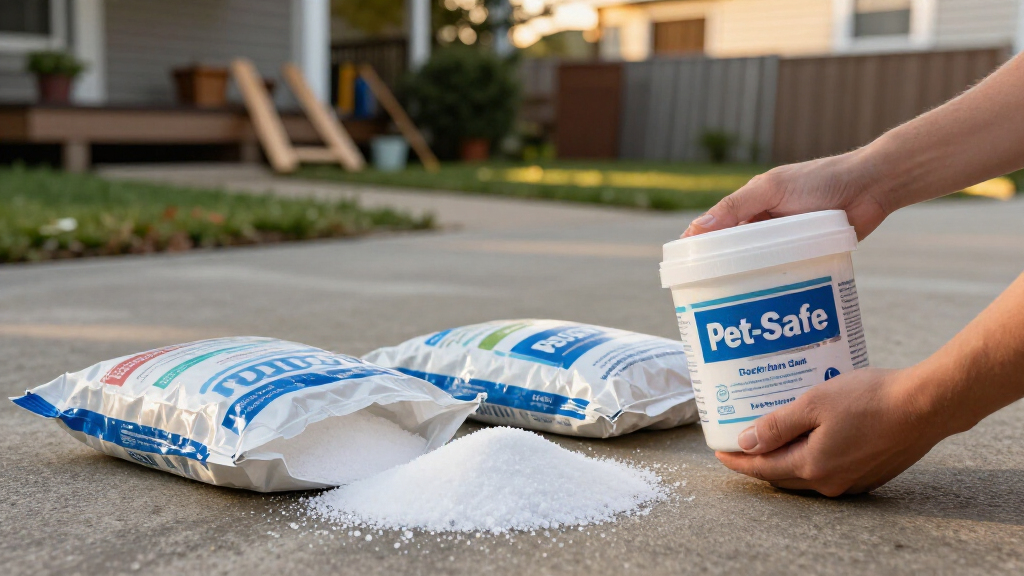
Ice melt chemistry matters more than the words pet-safe because that phrase has no single universal performance or toxicity standard across consumer deicers. A manufacturer may mean lower sodium, rounder granules or reduced irritation when used as directed. The label does not mean edible, paw-proof or harmless.
- Reduced sodium chloride: The blend may replace some rock salt with magnesium chloride, calcium chloride or an acetate.
- Rounded or colored granules: These can improve visibility or reduce sharp edges, but they do not prove lower toxicity.
- Bittering agents: An unpleasant taste may discourage licking, yet it cannot prevent every ingestion.
- Chloride-free ingredients: CMA may reduce chloride-related corrosion, though it remains a chemical deicer that requires controlled use.
Imagine a bag covered with green leaves and paw prints. The fine print lists magnesium chloride as the first ingredient. That product may contain less sodium than rock salt, but it can still lodge between toes, draw moisture from paw pads and enter a cat’s mouth during grooming.
Even the phrase salt-free can mislead you. In everyday packaging, it may mean the product contains no sodium chloride while still using calcium, magnesium or potassium chloride—each one a chemical salt. Read the full ingredient list and application rate, not the front-panel artwork.
What about beet-enhanced products? Beet-processing byproducts can help brine cling to pavement and reduce bouncing, but they do not cancel the chloride mixed with them. The dark brown liquid may look earthy and mild, yet concentrated organic runoff can affect water quality. Natural is a description, not a safety certificate.
More effective and safer are separate claims. A stronger cold-weather deicer may let you apply less material, but concentrated residue still needs cleanup.
As an affiliate, we earn on qualifying purchases.
Use Less Ice Melt Without Giving Up Safe Footing
You can cut exposure by removing snow early, treating only bonded ice and applying the smallest label-directed amount. Anti-icing before a forecast storm can stop a hard bond from forming, while sweeping after the melt keeps loose pellets away from paws, plants and indoor floors.
- Check pavement temperature. Use an infrared thermometer on the shaded portion of the walk, not the sunny porch wall. A reading of 10°F calls for a different material than a reading of 27°F.
- Shovel to bare pavement. Move the loose snow before applying chemicals. Treating a three-inch blanket wastes product because the brine becomes diluted and travels with the slush.
- Apply an even, sparse pattern. Follow the bag’s measured coverage rate. Pellets should not form crunchy white rows along every edge.
- Give the brine time to loosen the bond. Scrape the softened layer rather than waiting for every patch to become liquid.
- Sweep and store. Collect undissolved granules, move salty slush away from planting beds and seal the bag where children and animals cannot reach it.
Consider two neighbors facing the same 20-by-30-foot driveway. One throws several coffee cans of salt over packed snow; the other shovels, spot-treats wheel tracks and scrapes again 20 minutes later. The second driveway often clears with far less chemical because the deicer attacks the bond instead of trying to digest the whole snowfall.
Pre-wetting salt or applying label-approved liquid brine can make particles activate faster and reduce bouncing on large properties. A calibrated spreader also prevents the heavy stripes you see when a hopper gate sticks open. On acreage, measure the lane and parking pad separately; square footage beats guesswork every time.
Never pour hot water over a frozen step. It can run into cracks, cool rapidly and return as glassy ice. Vinegar and fertilizer mixtures bring their own risks to concrete, plants and pets, so kitchen-cabinet chemistry is not automatically gentler.
ice melt with low environmental impact
As an affiliate, we earn on qualifying purchases.
As an affiliate, we earn on qualifying purchases.
Protect Paws Before Irritation Turns Into an Emergency
Protect pets by avoiding visible granule piles, wiping paws and lower legs after every treated walk, and calling a veterinarian after substantial ingestion or persistent symptoms. Most small exposures cause local irritation or stomach upset, but large doses can disturb electrolytes and become life-threatening.
Wet granules can hide between toe pads where pressure and moisture create a concentrated brine. You may first notice red skin, limping, repeated licking or a dog refusing to place one paw on the floor. Rinse with lukewarm water, dry carefully between the toes and check for cracks rather than letting the animal keep licking.
Take a common winter scenario: your 25-pound dog crosses a treated apartment entrance, then spends the elevator ride cleaning its feet. Ten minutes later, it drools and vomits. Remove any remaining residue, photograph the product label and contact your veterinarian or an animal poison service for advice tied to the ingredient, amount and body weight.
Sodium-containing products can drive blood sodium dangerously high after a large ingestion. Calcium chloride can cause marked mouth, paw and digestive irritation, while potassium chloride deserves added caution in animals with heart or kidney disease. Veterinary toxicology guidance lists weakness, tremors, confusion, seizures, breathing trouble and collapse among signs that call for urgent care [2].
Do not induce vomiting unless a veterinary professional directs you. Ice melt is also different from ethylene-glycol antifreeze, but an unidentified puddle near a garage may contain more than one automotive chemical.
Boots can help dogs with cracked pads, though fit matters: loose boots twist, while tight cuffs rub. For cats, prevention usually means keeping deicer outside, sealing the bag and wiping tracked residue from entry floors before grooming turns a few crystals into an swallowed dose.
Keep Salt From Eating Away at Concrete, Metal and Plants
Ice melt chemistry affects more than frozen water because every chloride deicer sends chloride into soil, groundwater and metal seams. You reduce damage by limiting the dose, controlling drainage and removing salty slush. Switching chloride types changes some effects, but it does not make chloride disappear.
Sodium can disrupt soil structure and make it harder for roots to take up water. By spring, the evidence may appear as brown leaf edges, thin grass or a bare strip beside the drive. When you plow or shovel, place salty snow on a gravel drainage area rather than piling it against a young maple or vegetable bed.
Concrete damage has no one-line answer. A dense, well-cured slab with good drainage may tolerate winter exposure better than a new, porous walkway full of hairline cracks. Brine enters those pores, freezes, expands and works the surface like a slow pry bar; repeated cycles can leave scaling, pits and loose flakes.
New concrete needs special care. Follow the installer’s curing guidance and the deicer manufacturer’s surface restrictions before spreading anything. If a walkway shows wide cracks, settlement or exposed reinforcing steel, have a qualified concrete professional inspect it; chemical choice cannot repair a structural problem.
Metal suffers too. Chloride brine rides under vehicles, creeps into fasteners and leaves orange rust around railings and garage-door hardware. Sweep dry pellets, rinse vulnerable metal during a mild spell when drainage will not refreeze, and wear gloves and eye protection when handling concentrated products.
For a lightly frosted garden path, grit may be the better tool. It gives boots bite without trying to melt the entire surface. You still need to sweep it before spring rain carries sediment into drains, but that cleanup can be a fair trade beside sensitive plants or a frequently used dog run.
Frequently Asked Questions
Is rock salt poisonous to dogs and cats?
Small incidental exposures more often cause irritated paws, thirst, drooling, vomiting or diarrhea than severe poisoning. A large ingestion of sodium chloride can cause dangerous salt toxicity, and cats may swallow residue while grooming. Contact a veterinarian if you suspect more than a few licked crystals or see persistent symptoms.
Is calcium chloride safer for pets than rock salt?
Calcium chloride is not automatically safer; it is simply more effective in cold weather. Using less product may reduce exposure, but wet calcium chloride can form a strong, irritating brine and release heat as it dissolves. Sweep excess pellets and clean paws after contact.
What temperature is too cold for rock salt?
Rock salt becomes slow and inefficient below roughly 15°F, or −9°C, in typical field use. It can form brine at lower temperatures under favorable conditions, but adding bigger handfuls usually raises corrosion and runoff without delivering equal melting power. Use pavement temperature to guide your choice.
Can you use ice melt on new concrete?
New concrete is especially vulnerable to brine penetration and freeze-thaw damage. Follow the installer’s curing period and the product label before applying any deicer, and use sand or grit for temporary traction when permitted. Ask a qualified concrete professional about cracked, poorly drained or structurally questionable slabs.
What should you do if your dog eats ice melt?
Remove the product, stop further licking and save the package or ingredient list. Call your veterinarian or an animal poison service with the animal’s weight, symptoms and estimated amount swallowed; seek urgent care for weakness, tremors, seizures, breathing trouble or collapse. Do not induce vomiting unless a veterinary professional tells you to do so.
Conclusion
Your best winter setup is not a mythical harmless pellet. It is the right material, used sparingly, on pavement you have already shoveled. Check the temperature, read the ingredients, protect your hands and eyes, and keep pets away from concentrated granules and brine.
When the surface clears, finish the job: scrape the slush, sweep the leftovers and wipe those paws. You want a driveway that feels firm under your boots—not a white, crunchy chemical trail stretching from the curb to the dog bowl. Let the shovel do the heavy lifting and make every pellet earn its place.
Fall yard work Picks
leaf blowers
As an affiliate, we earn on qualifying purchases.