
TL;DR

Get business pricing on tools and workshop supplies
- Business-only prices and quantity discounts
- Tax-exempt purchasing
- Multiple users, one account, clear invoices
Calculate loads per cubic yard by dividing 27 cubic feet by your cart or wheelbarrow capacity, then rounding up to the next whole trip. A 6-cubic-foot wheelbarrow needs five completely full loads on paper, but at a safer 75% fill level it needs six practical loads.
One cubic yard of mulch can turn into five easy trips or fourteen sweaty ones, depending on what you push across the lawn. The pile looks harmless in the driveway: a dark, steaming mound with that sharp cedar smell. Then the first wheel sinks into soft turf, the handles bite into your palms, and the distance to the back bed suddenly feels much longer.
You can remove most of that surprise with one number: 27 cubic feet. That is the volume in one cubic yard. Divide 27 by your cart or wheelbarrow capacity, and you have the mathematical load count before wet mulch, hills, gates, and sensible loading enter the job.
This guide gives you the quick-reference numbers, then turns them into a realistic work plan. You will see why a cart marked 6 cubic feet does not always move six cubic feet, how mulch depth changes the size of the job, and when weight capacity matters more than tray volume. The goal is simple: order the right amount, choose a safe load, and know how many times you will walk that route.
Divide 27 by the cart’s usable cubic-foot capacity, then round the final project total upward to a whole trip.
A 6-cubic-foot wheelbarrow needs five completely full trips per yard but six trips when loaded to a practical 75%.
One cubic yard covers about 162 square feet at 2 inches deep or 108 square feet at 3 inches deep.
Check the cart’s weight rating as well as its volume rating, especially with wet, fine, compost-rich, or rubber mulch.
Calculate and round the combined project total rather than rounding every connected bed separately.
Mulch Season Math
Loads per cubic yard by cart and wheelbarrow size. Start with 27 cubic feet, adjust for the amount you can safely carry, and round the final result upward to a whole trip.
The fixed volume behind every trip calculation.
Five full loads on paper; six practical loads at a 75% fill level.
A decimal means the last trip is partial, not optional.
Turn tray size into trip count
Use the cubic-foot capacity printed on the tray, frame label, or product specification. Divide 27 by that capacity and round upward. The calculation assumes the stated capacity is genuinely usable.
Find the rating
Read the tray or cart capacity in cubic feet. For gallons, use approximately 202 divided by gallon capacity.
Run the division
Divide 27 cubic feet by the usable capacity of the wheelbarrow, wagon, or garden cart.
Round once
Calculate the combined project total first, then round upward to the next whole trip.
Trips for one cubic yard
Capacity makes a dramatic difference: a 2-cubic-foot barrow requires fourteen trips, while a 12-cubic-foot cart requires three. These are theoretical counts at full stated capacity.
| Cart or wheelbarrow capacity | Mathematical loads | Whole trips required |
|---|---|---|
| 2 cu ft | 13.50 | 14 trips |
| 3 cu ft | 9.00 | 9 trips |
| 4 cu ft | 6.75 | 7 trips |
| 5 cu ft | 5.40 | 6 trips |
| 6 cu ft | 4.50 | 5 trips |
| 7 cu ft | 3.86 | 4 trips |
| 8 cu ft | 3.38 | 4 trips |
| 10 cu ft | 2.70 | 3 trips |
| 12 cu ft | 2.25 | 3 trips |
Assumption: every load reaches the stated tray capacity. Wet mulch, unstable terrain, and conservative loading increase the practical count.
The label is only a starting point
Rated capacity may describe a heaped tray rather than a comfortable working load. Multiply the rating by a realistic fill factor before calculating trips.
Usable capacity becomes 4.5 cubic feet. The calculation is 27 ÷ 4.5 = 6 practical loads.
Fill less when mulch is wet, the route slopes, the wheel sinks into turf, or gates and turns make a high load difficult to control.
Calculate the pile before the trips
A cubic yard measures volume, not ground area. Coverage depends directly on installed depth, so an extra inch can add substantial material and many more walks across the lawn.
Useful for a light seasonal refresh.
Common for established beds.
A common depth over bare soil.
Reserved for limited heavier-coverage needs.
Add connected bed areas before calculating volume. A single 5% to 10% allowance can cover irregular measurements, settling, low pockets, and minor spillage.
For ordering, plan approximately five cubic yards. At six practical trips per yard, that is about thirty wheelbarrow trips.
Weight can overrule volume
Mulch is purchased by volume, but a cart is also limited by weight. Moisture, particle size, material density, terrain, and cart design determine whether a full tray is manageable.
Density changes the load
Fine, compost-rich, and rubber mulch are generally denser than dry, coarse wood mulch. Equal volumes can demand very different effort.
Rain adds hidden strain
Freshly watered or rain-soaked mulch can become much heavier before the tray appears full. Check the cart’s weight rating.
Control beats capacity
Use smaller loads on slopes, ramps, stairs, soft soil, narrow paths, roots, and tight gates. A stable load is often the faster load.
When to reduce the fill factor
Move from a full-volume calculation toward a conservative working load as material density, moisture, instability, or route difficulty increases.
From flower bed to final trip
For a gallon-rated wagon, divide approximately 202 by its usable gallon capacity. A pickup-truck “load” is not standardized; bed dimensions, wheel wells, side height, and heaping all change the volume.
Two-wheel carts add stability, while battery-powered dump carts reduce effort on large properties and slopes. Collapsible wagons remain limited by fabric strength, wheel size, and weight capacity.
Get Your Trip Count From One Simple Formula
Loads per cubic yard are calculated by dividing 27 by the container capacity in cubic feet, then rounding upward to a whole trip. According to Outdoor Pro Masters [1], one cubic yard equals 27 cubic feet, so a 4-cubic-foot cart works out to 6.75 loads and requires seven trips.
The formula is loads per cubic yard = 27 ÷ capacity. Use the capacity printed on the tray, frame label, or product specification as your starting point. If the answer contains a decimal, round up to the next whole load; the final load will usually be partial rather than magically disappearing.
| Cart or wheelbarrow capacity | Mathematical loads per cubic yard | Whole trips required |
|---|---|---|
| 2 cu ft | 13.5 | 14 |
| 3 cu ft | 9 | 9 |
| 4 cu ft | 6.75 | 7 |
| 5 cu ft | 5.4 | 6 |
| 6 cu ft | 4.5 | 5 |
| 7 cu ft | 3.86 | 4 |
| 8 cu ft | 3.38 | 4 |
| 10 cu ft | 2.7 | 3 |
| 12 cu ft | 2.25 | 3 |
Take a common 3-cubic-foot wheelbarrow. Nine level loads move one yard, while four yards require 36 loads. That second number tells you far more about the afternoon ahead: on a 150-foot route, you will cover more than one mile going out and returning, even before trips to the shed or hose.
A cubic yard measures volume, not ground area. It is also about 202 US gallons, based on the standard gallon-to-cubic-inch relationship found in NIST volume tables [2]. If your wagon is labeled in gallons, divide 202 by its gallon capacity; a 40-gallon wagon works out to 5.05 loads, which means six trips when filled to that rating.
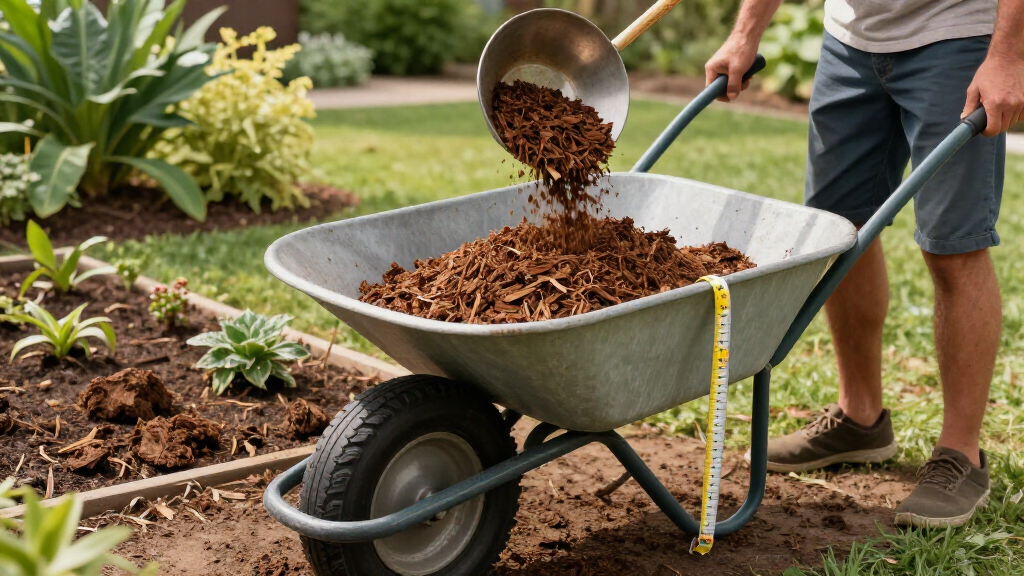
wheelbarrow with 6 cubic foot capacity
As an affiliate, we earn on qualifying purchases.
As an affiliate, we earn on qualifying purchases.
Turn the Label Capacity Into a Realistic Workload
Loads per cubic yard become realistic only after you adjust the label capacity for the amount you can safely carry. Multiply the rated volume by a fill factor, then divide 27 by that usable capacity. A 6-cubic-foot wheelbarrow filled to 75% carries 4.5 cubic feet and needs six trips.
The practical formula is actual loads = 27 ÷ (rated capacity × fill factor). A fill factor of 1.0 means the tray carries its full rated volume, while 0.75 means three-quarters full. Use 0.5 to 0.75 when wet material, slopes, roots, or a narrow gate make a brimming load hard to control.
Capacity labels can play a little trick on you. Some describe a heaped load rising above the rim, even though that loose brown dome spills at the first rut. Coarse bark also leaves airy gaps between chunks, while fine shredded mulch packs down and sits more quietly in the tray.
A rated load is a volume claim, not a promise that the load will feel stable. If the handles pull your shoulders forward or the wheel starts wandering, carry less.
Suppose you are moving rain-soaked hardwood mulch down a side yard with a shallow cross-slope. Your 8-cubic-foot cart should need four full trips per yard, but you load it to about 60% so the uphill wheel stays planted. Its usable capacity becomes 4.8 cubic feet, and 27 ÷ 4.8 = 5.63, so you should plan six trips.
Run the calculation for the entire project before rounding. If three connected beds need 0.6, 0.7, and 0.8 yard, the total is 2.1 yards; rounding each bed separately would falsely turn that into three yards. Separate rounding makes sense only when different deliveries or isolated work areas prevent you from sharing the leftover material.
As an affiliate, we earn on qualifying purchases.
Calculate Mulch Yardage Before Counting a Single Trip
Your trip estimate is only as good as your mulch-yard calculation. Multiply the bed area in square feet by the planned depth in inches, then divide by 324. A 500-square-foot bed covered 3 inches deep needs 4.63 cubic yards, so you would normally order about five cubic yards.
The formula is cubic yards needed = square feet × depth in inches ÷ 324. Measure rectangles as length times width, and split curved beds into a few smaller shapes you can measure without gymnastics. Add the results before you calculate volume, especially when one long border wraps around a deck or driveway.
| Installed mulch depth | Coverage from one cubic yard | Typical use |
|---|---|---|
| 1 inch | 324 sq ft | Light seasonal refresh |
| 2 inches | 162 sq ft | Refreshing an established bed |
| 3 inches | 108 sq ft | Common depth over bare soil |
| 4 inches | 81 sq ft | Limited situations needing heavier coverage |
Imagine a 30-by-12-foot island bed. Its 360 square feet need 3.33 yards at 3 inches deep, but only 2.22 yards at 2 inches. With a 6-cubic-foot wheelbarrow operating at a 75% fill factor, those choices equal roughly 20 trips versus 14 trips after rounding the project totals.
Depth changes plant health as well as workload. Around 2 to 3 inches suits many landscape beds, but piling mulch into a dark volcano against a tree trunk traps moisture where bark needs air. Leave trunks and plant crowns exposed, and check existing mulch before adding another layer.
For irregular beds, a 5% to 10% allowance covers rough measurements, small spills, low pockets, and normal settling. Do not add the allowance twice by padding every measurement and then padding the final order. One deliberate buffer gives you enough material without leaving a half-yard mound brooding beside the driveway.
As an affiliate, we earn on qualifying purchases.
Keep Heavy Mulch From Overloading You or the Cart
Safe loading depends on weight as well as volume, because mulch is sold by cubic yard while carts carry a stated maximum weight. Rain-soaked, fine, or compost-rich mulch can make a large tray too heavy before it looks full. Check both ratings and reduce each load on slopes, ramps, or soft ground.
Dry, coarse wood mulch feels springy and light, with bark pieces sliding over one another. Wet hardwood mulch lands with a dull thud and sticks to the shovel. Both can occupy the same six cubic feet, yet the wet load demands more grip, more braking force, and more effort at the handles.
A big tray often tempts you to chase fewer trips. On flat pavement, an 8- or 10-cubic-foot two-wheel cart can feel planted and calm. On a narrow hillside path, that same load may start steering you, especially when its high mound shifts toward the downhill side.
- Check the weight label: The frame, axle, tires, fabric body, and dump mechanism may each set a practical limit.
- Test the route: Walk gates, roots, steps, soft turf, tight turns, and cross-slopes before loading.
- Wear work gloves and sturdy footwear: Good grip and ankle support matter when a wheel drops into a rut.
- Push smaller loads downhill: Never depend on your back and arms to stop an overloaded cart on a slope.
- Keep children and pets clear: A loaded cart can tip, roll, or pinch fingers with little warning.
For example, a battery-powered dump cart can save your legs across two acres, but motor assistance does not give the tires extra side grip. Start with half loads on the steep section, use the lowest speed, and avoid wet side slopes. Follow the machine’s braking, incline, and payload limits rather than treating battery power as a free pass.
Traditional single-wheel wheelbarrows win in tight passages because you can pivot around shrubs and step over edging. Two-wheel garden carts trade some agility for better side-to-side stability. The better choice depends on the route: a winding 30-inch gate favors control, while a long gravel lane rewards capacity and steady tracking.
As an affiliate, we earn on qualifying purchases.
Compare Bags, Bulk Loads, Gallon Carts, and Pickup Beds
Loads per cubic yard can be compared across bags, gallon-rated wagons, bulk deliveries, and pickup beds by converting everything to a common volume. One cubic yard equals 27 cubic feet, about 202 gallons, 13.5 bags holding 2 cubic feet each, or 18 bags holding 1.5 cubic feet each.
| Mulch or container unit | Equivalent to one cubic yard | What changes in practice |
|---|---|---|
| 2-cu-ft bags | 13.5 bags | You must buy 14 whole bags |
| 1.5-cu-ft bags | 18 bags | Easy to stage near separate beds |
| 40-gallon wagon | 5.05 rated loads | Six trips after rounding |
| 6-cu-ft wheelbarrow | 4.5 rated loads | Five full trips or six at 75% fill |
| Pickup bed | No fixed equivalent | Dimensions and payload set the limit |
Bagged mulch gives you predictable packages and clean staging. If a front bed needs 13.5 bags containing 2 cubic feet each, you buy 14 bags and carry them close to the spreading point. You trade less shoveling for more packaging, lifting, vehicle loading, and plastic waste.
Bulk mulch often makes sense for several cubic yards, but price per yard tells only part of the story. Add the delivery fee, tarp space, cleanup, and every trip from the pile. A five-yard drop placed 20 feet from the beds can be easier than three yards dumped 200 feet away behind a closed gate.
A pickup-truck load is not a standard unit. Bed length, width between wheel wells, side height, suspension, and payload rating all matter, while a heaped load changes both volume and handling. Measure the bed and check the door-jamb payload label before accepting material; never let a loader operator use visual guesswork as your safety calculation.
A supplier’s bucket may hold one cubic yard, but bucket size and filling practice still deserve a quick question. Ask whether the quoted yard is level, heaped, or based on a calibrated bucket. Fresh arborist chips can also arrive coarse, damp, and loosely packed, so expect settling even when the delivered loose volume was correct.
Build a Trip Plan That Still Works After Rain
A dependable mulch plan combines total yardage, usable cart capacity, route conditions, and weather before the delivery truck arrives. Calculate the whole order, choose a conservative fill factor, and stage tools near the pile. This turns a vague weekend job into a clear count of loads, walking distance, and work blocks.
- Measure every bed. Add the square footage, multiply by mulch depth, and divide by 324.
- Add one project allowance. Increase the total by 5% to 10% when measurements are rough or beds contain many curves.
- Find usable cart volume. Multiply rated capacity by a realistic fill factor such as 0.75.
- Calculate total trips. Multiply the ordered yards by 27, divide by usable capacity, and round once at the end.
- Inspect the route. Open gates, move hoses, mark holes, and set boards over soft spots before loading.
- Recheck after rain. Reduce load size when the mulch or ground becomes wet, even if the new trip count is higher.
Suppose your beds need 4.63 yards and you order five. Your 8-cubic-foot garden cart is comfortable at 70%, giving you 5.6 usable cubic feet. The complete job becomes 135 ÷ 5.6 = 24.1, so you should plan 25 trips rather than multiplying a rounded per-yard estimate.
Now add a 120-foot route from driveway to beds. Twenty-five loaded runs plus 25 returns total about 6,000 feet, or 1.14 miles, before you spread a single forkful. That number may persuade you to split the work into morning and afternoon blocks, recruit help, or ask the supplier about a closer drop point.
Use a tarp under the delivery pile to keep gravel and mulch from mixing, but do not cover wet mulch tightly for long storage. Work in steady batches: move several loads, spread them, check depth, and repeat. The bed itself will tell on you if you rush; thin areas show pale soil, while overloaded patches rise like dark pillows around plant stems.
Online calculators and powered carts can cut arithmetic and effort, yet the field check still rules. If your tires rut the lawn, the cart feels nose-heavy, or loose bark spills at each bump, lower the fill factor. One extra trip costs minutes; a tipped cart, strained back, or damaged lawn can cost the rest of the day.
Frequently Asked Questions
How many wheelbarrow loads are in one cubic yard of mulch?
One cubic yard requires five full loads in a 6-cubic-foot wheelbarrow, nine loads in a 3-cubic-foot model, or 14 trips with a 2-cubic-foot barrow. Real counts can run higher because a comfortable working load often sits below the tray’s rated or heaped capacity.
Why did my cubic yard require more trips than the chart shows?
Your wheelbarrow probably carried less than its rated volume, or the mulch settled and spilled during handling. A 6-cubic-foot tray filled to 75% carries 4.5 cubic feet, changing the count from five theoretical trips to six practical trips.
How can I find my wheelbarrow capacity if the label is missing?
Check old specifications or measure the tray’s usable volume with containers of known capacity. For example, repeated 5-gallon bucket fills provide a practical field estimate; divide the total gallons by 7.48 to convert them to cubic feet.
Does wet mulch take up more space in a cart?
Moisture mainly increases weight, though it can also change how mulch compacts and settles. A wet load may occupy similar nominal volume but feel far harder to start, turn, and stop, so reduce the fill level and respect the cart’s weight limit.
Is a garden cart better than a wheelbarrow for moving mulch?
A two-wheel garden cart will usually be more stable and higher-capacity on broad, fairly level routes. A single-wheel wheelbarrow is more agile around shrubs, roots, and narrow gates, so choose by terrain and access rather than capacity alone.
Conclusion
Plan from usable capacity, not the biggest number printed on the tray. Start with 27 cubic feet per yard, adjust for the load you can control, and round only after calculating the full job. That small bit of math gives you a sound mulch order, a believable trip count, and a safer pace when rain turns the pile heavy and the lawn slick.
Before delivery day, measure the beds, walk the route, and write the expected number of trips on a scrap of tape stuck to the cart. When the last partial load rattles lightly across the yard and lands exactly where the mulch runs out, you will know the calculation earned its keep.
Halloween Picks
halloween
As an affiliate, we earn on qualifying purchases.