
TL;DR

Get business pricing on tools and workshop supplies
- Business-only prices and quantity discounts
- Tax-exempt purchasing
- Multiple users, one account, clear invoices
A buying guide attributed to Thorsten Meyer AI compares 10 portable power stations, ranging from an 88Wh compact model to units listed at 3,584Wh. It recommends the Jackery Solar Generator 1000 v2 for general use, but the supplied material does not provide independent testing, complete specifications or enough evidence to verify its rankings and performance claims.
Thorsten Meyer AI has published a 2027 guide comparing 10 portable power stations, from an 88Wh device charger to models listed with capacities above 3,000Wh. The guide recommends the Jackery Solar Generator 1000 v2 as its general-use pick, while presenting larger Jackery and EcoFlow models as options for heavier backup needs; the supplied material does not establish that the products were independently tested.
The comparison frames buying as a tradeoff among battery capacity, AC output and portability. Its listed models include the 88Wh MARBERO Portable Power Station, the 292Wh Jackery Explorer 300 and Jackery Solar Generator 300, 1,024Wh Anker SOLIX C1000 Gen 2, 1,070Wh Jackery Explorer 1000 v2 and Solar Generator 1000 v2, 3,072Wh EF ECOFLOW DELTA 3 Ultra, and 3,584Wh Jackery HomePower 3600 Plus. The Anker SOLIX C300 DC is listed at 288Wh.
The guide gives the Jackery 1000 v2 a 1,070Wh capacity and 1,500W AC output, describing it as a balanced choice for camping and light home backup. It lists the HomePower 3600 Plus at 3,584Wh and 3,600W output, with 7,200W parallel output, and the EcoFlow DELTA 3 Ultra at 3,072Wh, 3,600W continuous output and 7,200W surge output. These figures are presented in the supplied buying guide and have not been independently confirmed here.
Smaller units are positioned for a different job. The MARBERO model is listed at 3.2 pounds, 88Wh and 120W surge output; the Jackery Explorer 300 is listed at 292Wh and 7.1 pounds. The Anker C300 DC has seven ports but no AC outlets, according to the source. The guide also says the C1000 Gen 2 can recharge in 49 minutes and that the EcoFlow model supports fast charging, but it gives no test conditions for those charging claims.
Match Capacity to the Job
The comparison matters because a station’s advertised capacity alone does not show whether it can run a particular appliance. Buyers also need to check continuous and surge output, the device’s power draw, usable energy, available outlets and recharge options. A compact unit can be convenient for phones and other electronics but, as the guide itself cautions, is not a substitute for a higher-output system when running heating or cooking equipment.
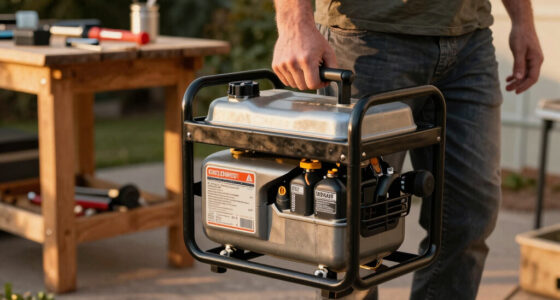
Weight also changes what “portable” means. The guide lists the Jackery Explorer 1000 v2 at 23.8 pounds, compared with 3.2 pounds for the MARBERO, and lists the HomePower 3600 Plus at 77.2 pounds. Larger stations may suit stationary backup better than frequent carrying. Readers considering home use should check the manufacturer’s instructions and confirm that the unit’s output and connection method fit their intended equipment; the roundup does not provide a full appliance-by-appliance runtime comparison.
Popular right now

Dyson V8 Cyclone Cordless Vacuum

Ninja DualBrew Pro Specialty Coffee Maker, Black, CFP301

Samsung The Frame Pro LS03HW 65-inch Neo QLED TV with 27-Month Axiom Care
As an affiliate, we earn on qualifying purchases.
From Campsite Power to Backup
The source presents portable stations across two broad use cases: charging devices away from mains power and providing limited backup at home. It identifies the Jackery Solar Generator 1000 v2 and the Jackery Solar Generator 300 bundle as solar kits, while describing solar compatibility more broadly as common among the products. The supplied details do not list panel performance or comparable solar recharge times for all 10 models.
The list contains repeated or closely related entries: the Anker SOLIX C1000 Gen 2 appears twice, and the Jackery Explorer 1000 v2 and Solar Generator 1000 v2 are both included. The latter is described as a package with a 200W solar panel, while the Explorer entry is presented as a standalone station. Those distinctions matter when comparing package price and included equipment, but the source does not provide prices or a full explanation of its selection method.
““The main tradeoff you will face is between weight and power.””
— Thorsten Meyer AI buying guide
Testing and Rankings Need Detail
The source says the post was created with AI assistance, but does not describe how products were tested, how rankings were scored or whether the listed specifications were checked against current manufacturer data. It also supplies no publication date beyond the 2027 framing, no product prices, and no consistent runtime or solar-recharge measurements. The C1000 Gen 2 appears twice, and some entries lack weight, chemistry or output details in the summary table.
Claims such as “best overall,” “under an hour” charging and suitability for home backup should be read as the guide’s assessments unless corroborated by product documentation or independent tests. Actual performance may vary by load, temperature, charging source and operating conditions. The source does not clarify whether the listed 7,200W figures are available in ordinary use or only with specified configurations.
Check Specs Before Buying
The next step for readers is to compare the guide’s figures with current manufacturer specifications and prices, then match continuous output and capacity to the devices they plan to power. Buyers should also check weight, outlet types, included solar panels, recharge times and warranty terms. The source does not announce further testing or a date for an updated edition, so any later revisions remain unknown.
Key Questions
Which model does the guide recommend for general use?
The guide names the Jackery Solar Generator 1000 v2, listed at 1,070Wh and 1,500W AC output. That is the source’s recommendation, not an independently verified ranking.
Which stations are presented as home-backup options?
The guide highlights the Jackery HomePower 3600 Plus and EF ECOFLOW DELTA 3 Ultra for higher-output use. Buyers should verify appliance compatibility and manufacturer guidance before relying on either for backup.
Are the smallest models suitable for kitchen appliances?
The guide positions the 88Wh MARBERO and sub-300Wh models mainly for electronics. Whether any station can run an appliance depends on its output rating and the appliance’s power demand.
Are the charging-speed claims independently tested?
The supplied material says the Anker C1000 Gen 2 recharges in 49 minutes, but provides no test method or conditions. The charging claim should be checked against the manufacturer’s specifications.
Does the roundup establish which station is best value?
No prices or detailed scoring method are included in the supplied material. Its value and durability recommendations are editorial judgments that readers cannot independently compare from the provided figures alone.
Source: Thorsten Meyer AI