TL;DR

Get business pricing on tools and workshop supplies
- Business-only prices and quantity discounts
- Tax-exempt purchasing
- Multiple users, one account, clear invoices
Most yard and jobsite tasks require far less capacity than you think. By listing your devices’ wattage and usage time, you can pick a power station that keeps you going without overpaying for unnecessary capacity.
Imagine the smell of fresh-cut grass, the hum of your saw, and the bright glow of work lights—powered reliably, no matter where you are. Portable power stations have become the go-to for yard work, small construction, or emergency backup. But how much watt-hour capacity do you really need? Choosing too big means extra weight and cost; too small, and you’re left hanging. This guide clears the fog, showing you how to size your power station based on real needs—saving you cash, space, and frustration.
We’ll walk through what watt-hours mean in practical terms, how to estimate your actual power needs, and what recent advances make these devices smarter and more reliable. Ready to get the right juice for your yard and jobsite? Let’s dive in.
Calculate your total watt-hour needs by listing devices, wattages, and estimated run times. This prevents overpaying or underpowering.
Most yard and light construction tasks require 500-1500Wh; choosing within this range balances portability and power.
Larger capacity units weigh more and cost more, so match your capacity to your actual usage to save hassle and money.
Recent battery tech like LiFePO4 extends lifespan and improves safety, making portable power stations more reliable than ever.
Adding solar panels can turn your portable station into a renewable, off-grid powerhouse—great for sustainable yard work.
Yard + Jobsite Power Guide / Capacity Without Guesswork
Portable power stations: the watt-hours you actually need
Most yard and light construction jobs need far less battery capacity than buyers expect. List each device, multiply wattage by run time, then add a sensible buffer. The result is reliable power without paying for unnecessary weight, bulk, or capacity.
The capacity range that balances mobility and useful run time for most yard and light jobsite work.
About five theoretical hours for a 100W drill before allowing for conversion losses and changing loads.
Buy for your real workflow—not the biggest number on the box.
Core sizing principleFor lighting, drills, saws, blowers, and mixed light-duty use.
Allows for inverter losses, unexpected use, and future flexibility.
From device charging to multi-tool and appliance support.
Typical charge-cycle range, depending on chemistry and care.
Three steps turn tool labels into a capacity target
Watt-hours measure stored energy—the battery equivalent of a fuel-tank size. Wattage tells you how quickly a device drains that tank.
List every device
Include drills, lights, saws, blowers, chargers, laptops, and anything likely to run at the same time. Check each label or manual for its rated wattage.
Multiply watts by hours
A 150W blower used for one hour requires 150Wh. A 50W light running for four hours requires 200Wh. Repeat for every device.
Add totals and a buffer
Sum the individual watt-hours, then add 10–20%. The margin covers conversion inefficiency, longer sessions, and small additions to your setup.
A mixed-tool afternoon
Shop near 700Wh for a practical fit.
Common tools create very different energy demands
Low-wattage lighting can run all evening. High-draw cutting or mowing equipment can consume the same energy in a fraction of the time.
| Device | Typical wattage | Estimated use | Watt-hours needed | Load profile |
|---|---|---|---|---|
| LED work light | 20–50W | 8 hours | 160–400Wh | Low |
| Power drill | 100–300W | 2–4 hours | 200–1,200Wh | Variable |
| Small circular saw | 500W | 1–2 hours | 500–1,000Wh | High |
| Electric lawn mower | 1,500–2,000W | 0.5–1 hour | 750–2,000Wh | Peak |
How quickly each device fills the capacity budget
Important: capacity is only half the specification. Confirm that the station’s continuous inverter output—and its short surge rating—can start and sustain your highest-draw tool.
Match capacity to the way you really work
The largest station offers more stored energy, but it may also cost more, weigh over 50 pounds, and become cumbersome to move around a yard or between sites.
150–500Wh
Best for short sessions and low-draw equipment where compact size matters most.
- Phones and laptops
- LED task lighting
- Brief drill use
500–1,500Wh
A strong balance of usable run time, transportability, and multi-device flexibility.
- Lights plus cordless-tool charging
- Drills, blowers, and intermittent saws
- Typical yard and light construction days
1,500–2,000+Wh
Worth considering for high-draw equipment, longer runtimes, or several simultaneous loads.
- Electric mowers
- Large tools and appliances
- Extended backup use
Portability decreases as stored energy rises
Capacity
More watt-hours extend runtime and support mixed loads, but unused capacity delivers no practical value.
Weight
Large batteries become tiring to move frequently. Consider distance, stairs, terrain, and handle design.
Cost
Calculate first so the budget goes toward useful output, battery quality, safety, and charging speed.
Modern battery technology stretches every watt-hour
Recent improvements make portable stations more durable, easier to monitor, faster to recharge, and more practical for repeated outdoor use.
LiFePO4 durability
Lithium iron phosphate technology can improve cycle life, thermal stability, and long-term reliability—valuable for equipment used week after week.
Solar compatibility
Compatible panels can replenish energy off-grid, reduce dependence on wall outlets, and extend multi-day yard or remote-site use.
Improved battery management
Modern BMS designs monitor charging, temperature, and discharge behavior to protect cells and optimize performance.
Fast and expandable
Rapid AC or solar charging reduces downtime, while modular battery options let capacity grow when the workload genuinely expands.
Battery care still matters
Cycle life varies by chemistry and manufacturer. Avoid unnecessary deep discharges, store the unit according to its manual, keep ventilation clear, and choose certified equipment with overcharge and discharge protection.
From tool list to reliable off-grid work
Calculate the workload, then buy the nearest practical capacity above it.
For most yard and light jobsite tasks, 500–1,500Wh is the useful middle ground. Check inverter output for tool startup, add a 10–20% energy buffer, and favor durable battery chemistry over capacity you may never use.
What is Watt-Hours and Why It Matters for Your Power Needs
Watt-hours (Wh) measure the total energy a portable power station can store—think of it as the size of its fuel tank. The bigger the Wh, the longer you can run your tools or lights. For example, a 500Wh unit can power a 100W drill for about 5 hours (500 ÷ 100 = 5). But the real significance lies in understanding how this capacity translates into your workflow. If you underestimate your needs, you risk running out of power at critical moments, causing delays and frustration. Overestimating, on the other hand, leads to unnecessary weight, size, and expense, making your setup less portable and more costly. The key is finding that balance—knowing what your typical usage looks like and how capacity impacts your mobility and budget. This understanding helps you choose a power station that is not just sufficient but optimized for your specific tasks, ensuring efficiency without compromise.
In essence, watt-hours matter because they directly influence your operational flexibility. A unit with too little capacity can limit what you can do, forcing you to carry multiple smaller units or risk downtime. Conversely, a larger capacity might be overkill, adding weight and expense without tangible benefits. Recognizing these tradeoffs is essential for making an informed choice that enhances productivity while keeping your setup manageable.
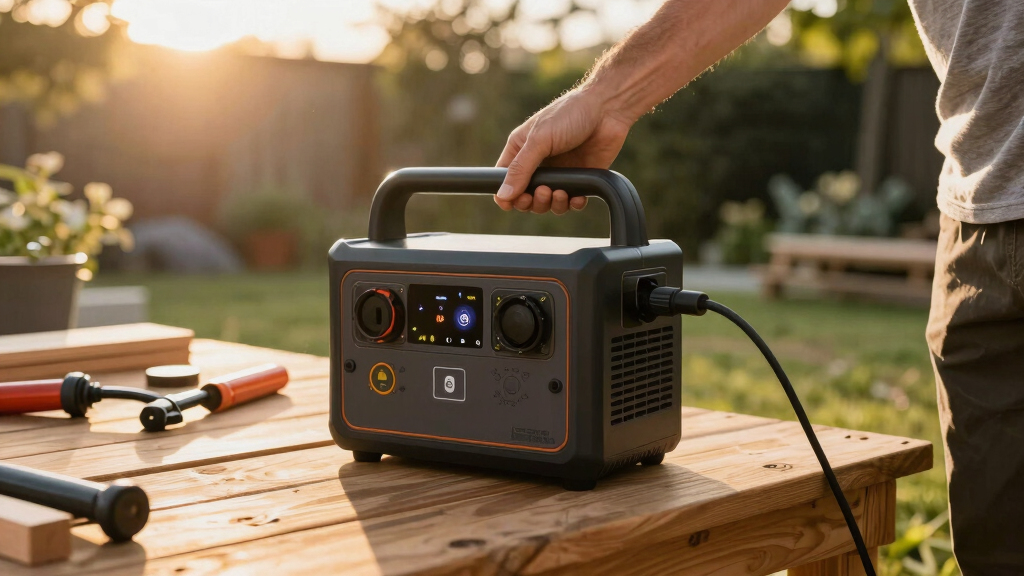
portable power station for yard work
As an affiliate, we earn on qualifying purchases.
As an affiliate, we earn on qualifying purchases.
How to Calculate Your Actual Watt-Hour Needs in 3 Easy Steps
- List all devices you plan to power—drills, lights, mowers, etc. Write down their wattage and estimated usage time. Understanding these details helps you visualize your energy footprint and avoid over- or underestimating your needs.
- Multiply each device’s wattage by its run time. This calculation gives you the energy in watt-hours for each device, which is crucial for assessing whether a power station can handle your workload. Remember, this step highlights how different tools contribute to your total energy consumption and where your biggest demands lie.
- Add all these watt-hour totals together. The sum indicates the capacity you should look for. Adding a buffer—around 10-20%—accounts for inefficiencies, unexpected device usage, or future expansion. This buffer acts as a safety net, ensuring your power source remains reliable even if your needs grow or if devices draw slightly more power than expected. Striking the right balance here prevents future shortages and extends the utility of your investment.
For example, if you have a 150W leaf blower used for 1 hour (150Wh), a 50W work light for 4 hours (200Wh), and a 100W drill for 2 hours (200Wh), your total requirement is 550Wh. Adding a 20% buffer brings you to around 660Wh, which ensures you have enough capacity for typical tasks and some margin for safety or future needs. This method promotes smarter purchasing, tailored to your actual work patterns, and helps avoid costly overbuying or underpowering.
500Wh portable generator for construction
As an affiliate, we earn on qualifying purchases.
As an affiliate, we earn on qualifying purchases.
How Much Watt-Hours Do Common Yard and Jobsite Devices Need?
| Device | Typical Wattage | Estimated Usage Time | Watt-Hours Needed |
|---|---|---|---|
| LED Work Light | 20-50W | 8 hours | 160-400Wh |
| Power Drill | 100-300W | 2-4 hours | 200-1200Wh |
| Small Circular Saw | 500W | 1-2 hours | 500-1000Wh |
| Lawn Mower (electric) | 1500-2000W | 0.5-1 hour | 750-2000Wh |
Understanding these numbers in context reveals the true demands of your typical equipment. For instance, an LED work light might only need around 300Wh for a full evening of work, making it easy to power with a small to medium station. A drill or circular saw, however, can quickly push your requirements into higher capacity territory, especially if used continuously or with multiple tools. Recognizing the typical power draw and usage duration helps you identify the right capacity range, avoiding the trap of overestimating or underestimating your needs. This understanding simplifies decision-making and ensures your power station can handle the real workload—saving money and reducing the risk of mid-job power failures.
As an affiliate, we earn on qualifying purchases.
Watt-Hours You Actually Need for Yard and Jobsite Tasks
Most small to medium yard and construction tasks can be handled with a 500-1500Wh power station. The key is to understand that these tasks often involve running a few tools or lights for a few hours at a time, which generally falls within this range. For example, powering a couple of LED lights, a drill, and a leaf blower for a few hours typically sums up to less than 1000Wh. This size strikes a good balance—light enough to be portable yet capable enough to handle most common tasks efficiently. This range also offers enough flexibility to run multiple devices without constantly swapping batteries or plugging and unplugging. It’s the sweet spot for most yard and light construction projects, providing enough capacity to get the job done without the burden of excessive weight or cost.
Going beyond 1500Wh becomes advantageous only if you plan to operate larger tools or run multiple devices continuously for extended periods. But keep in mind, larger capacity units tend to be heavier, more expensive, and less portable, which can negate some of the convenience benefits. Therefore, choosing a capacity that aligns with your typical workload ensures you don’t overspend or compromise on portability. For instance, a 700Wh station can run a 150W leaf blower for about 4.5 hours or a drill for roughly 7 hours—ample for most yard projects. The goal is to match your power needs with a size that is manageable and cost-effective, ensuring you have reliable power without unnecessary bulk.
solar compatible portable power station
As an affiliate, we earn on qualifying purchases.
As an affiliate, we earn on qualifying purchases.
The Tradeoffs: Battery Capacity, Weight, and Cost
More capacity means more power, but it also adds weight—sometimes over 50 lbs for large units. That can make a difference if you’re hauling the station around a large yard or multiple job sites. Heavy units can cause fatigue and slow down your workflow, especially if you need to move them frequently. The tradeoff between capacity and portability is crucial; selecting a larger battery may provide peace of mind for longer or more demanding tasks but can also lead to increased fatigue and setup time.
Cost is another significant factor. Larger capacity units tend to be more expensive—sometimes double or triple the price of smaller ones. While this might seem justified for extensive use, it’s often unnecessary for casual or occasional projects. Over-investing in capacity can lead to wasted money if your actual usage doesn’t require it. Conversely, opting for a smaller, lighter unit might save money and make transportation easier but could limit your work if your needs grow. The key is to assess your typical workload and choose a capacity that offers a good balance—enough to cover your regular tasks comfortably without paying for unused power or dealing with unwieldy weight.
For example, a lightweight 300Wh model might suffice for occasional light use, while a 1500Wh station is better suited for frequent, heavy-duty tasks. Carefully consider how often you’ll need to run your tools and for how long, then select a capacity that aligns with those needs while keeping weight and cost in check. This strategic approach ensures you get the best value and usability from your investment, avoiding the pitfalls of over- or under-capacity choices.
Recent Tech Improvements Making Portable Power Smarter and Safer
Battery technology has come a long way. Lithium iron phosphate (LiFePO4) batteries now offer longer lifespans—up to 2000 cycles—compared to traditional lithium-ion. They’re safer, too, with less risk of overheating or fire. This means your investment will last longer and operate more reliably, reducing the need for frequent replacements and the concern over safety hazards. These advances are especially important for jobsite environments where safety and durability are paramount, giving users peace of mind and reducing maintenance costs.
Fast-charging features and solar compatibility mean less downtime. Some models can recharge fully in just a few hours from AC outlets or solar panels, making off-grid work more feasible. This rapid recharge capability ensures you’re not left waiting when you need power quickly, and solar options promote sustainability—reducing reliance on grid electricity and fuel-powered generators. As solar technology becomes more efficient and affordable, integrating it with portable power stations is increasingly practical, enabling continuous operation in remote or off-grid locations.
Enhanced battery management systems (BMS) monitor and protect the battery, extending its life and ensuring safe operation. Real-time data displays help you keep track of charge levels and usage, preventing over-discharge and potential damage. These smart features make the devices more user-friendly and reliable, giving you greater control and confidence in their performance. Overall, recent technological improvements are transforming portable power stations into safer, longer-lasting, and more intelligent tools that meet the evolving demands of yard and jobsite work.
Frequently Asked Questions
How do I know what capacity I need for my yard tools?
Make a list of all your tools, note their wattages, and how many hours you typically use them. Add up the watt-hours needed for each to find your total capacity. Always add a buffer of around 20% for safety.Can a portable power station replace my generator for yard work?
For small to medium tasks—driving drills, lights, small equipment—a good portable station can do the trick. But for heavy, continuous power needs like running a large compressor or long hours of operation, a traditional generator might still be necessary.How long will a battery last, and how do I keep it healthy?
Most lithium batteries last between 500 and 2000 charge cycles. To extend lifespan, avoid deep discharges, store in a cool, dry place, and follow the manufacturer’s charging recommendations.Are solar-compatible power stations worth considering?
Absolutely. They reduce reliance on grid power, cut fuel costs, and enable off-grid work. While initial setup costs are higher, the long-term savings and sustainability can be significant.What’s the ideal size for yard and light construction projects?
A capacity between 500-1500Wh strikes a good balance. It’s enough to power multiple devices for several hours without being too heavy or expensive.Conclusion
Picking the right watt-hour capacity isn’t about chasing maximum power—it’s about matching your actual needs. A modest, well-chosen station keeps your tools running without turning your yard into a rolling battery farm. Think smart, stay safe, and power your projects confidently.
Remember, the best power station is the one that fits your work—no more, no less. Now go get the juice you need and get back to doing what you do best: getting things done.
Halloween Picks
halloween
As an affiliate, we earn on qualifying purchases.