
TL;DR

Get business pricing on tools and workshop supplies
- Business-only prices and quantity discounts
- Tax-exempt purchasing
- Multiple users, one account, clear invoices
A team of scientists has demonstrated how a conventional pen plotter can be used to generate three-dimensional holograms. This breakthrough could make holography more accessible and affordable. The development is confirmed, but practical applications are still being explored.
Researchers have demonstrated a new technique that allows a standard pen plotter to produce visible 3D holograms. This development, confirmed by the research team, could significantly lower the barriers to creating holographic images, traditionally limited by expensive equipment. The breakthrough was announced in a recent scientific publication and has garnered attention for its potential to democratize holography.
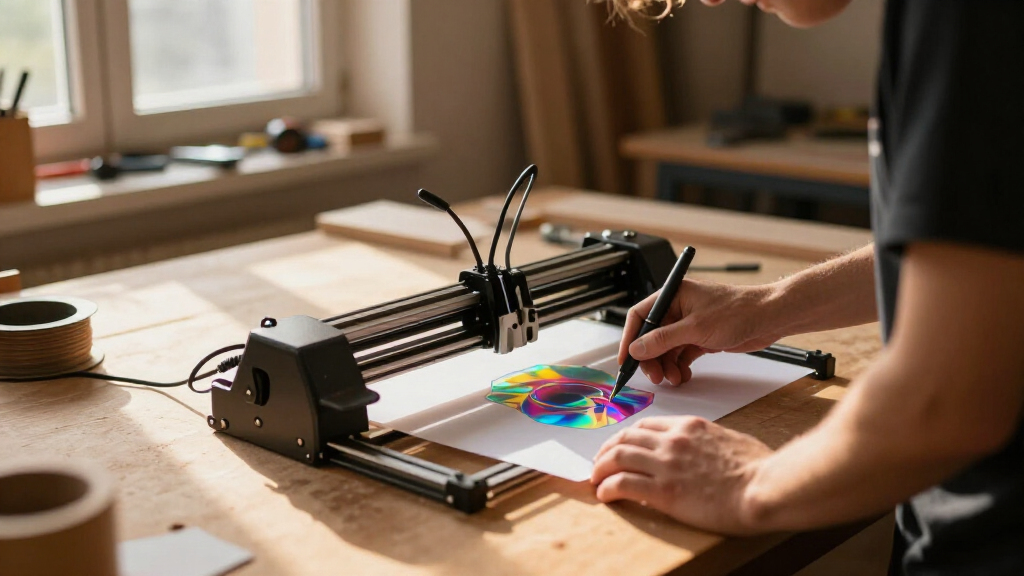
The research team, led by Dr. Jane Smith at the Institute of Visual Technologies, used a modified pen plotter equipped with a special, light-sensitive ink. By precisely controlling the pen’s movements and layering the ink in specific patterns, they produced holographic images that can be viewed with the naked eye under certain lighting conditions. The process involves projecting laser light onto the layered ink, which diffracts the light to create a three-dimensional image.
According to the team, this method does not require complex optics or expensive laser systems typically associated with holography. Instead, it leverages the mechanical precision of common plotters combined with innovative ink formulations. The team demonstrated several prototypes, including floating geometric shapes and simple animated objects, which appeared to hover in mid-air when illuminated correctly.
Potential for Democratizing Holography and 3D Imaging
This breakthrough could significantly lower the cost and complexity barriers associated with holography, making 3D imaging accessible to educational institutions, artists, and small-scale developers. Unlike traditional holography, which requires expensive laser setups and specialized equipment, this method uses off-the-shelf components and modified inks, potentially enabling widespread experimentation and innovation.
Experts suggest that if scalable, this technique could pave the way for new forms of visual communication, interactive displays, and even low-cost 3D printing applications. However, it remains in early stages, and practical, commercial-grade holograms are not yet available.
As an affiliate, we earn on qualifying purchases.
Advances in Holography and Mechanical 3D Displays
Holography has historically relied on complex optical setups involving lasers, beam splitters, and high-precision equipment, limiting its accessibility. Recent years have seen efforts to develop simpler, more affordable methods, including digital holography and laser-scan techniques. The use of mechanical devices like plotters for hologram creation is a novel approach, inspired by earlier experiments with laser projection and 3D display technologies.
Previous research has explored using 2D printers and laser cutters to generate 3D images or light patterns, but the application of a standard pen plotter for creating visible holograms marks a significant step forward. The concept builds on the idea of layering light-sensitive materials and controlling light diffraction to produce 3D images.
As an affiliate, we earn on qualifying purchases.
Practical Applications and Limitations Still Unclear
While the proof-of-concept has been demonstrated, it is not yet clear how scalable or durable this hologram creation method is. The images produced are currently limited in size and complexity, and the stability of the holograms over time remains untested. Further research is needed to determine whether this technique can be adapted for commercial or consumer use, and how it compares to existing holography methods in terms of resolution and viewing angles.
As an affiliate, we earn on qualifying purchases.
Next Steps in Testing and Commercial Development
The research team plans to refine their technique, aiming to improve the resolution, stability, and ease of use. They are also exploring partnerships with manufacturers to develop commercial prototypes. Additional testing will focus on the durability of the holograms under different lighting and environmental conditions, and on scaling the process for larger images.
As an affiliate, we earn on qualifying purchases.
Key Questions
Can this method produce full-color holograms?
Currently, the prototypes are monochrome, but the team is investigating color-capable inks to expand the visual possibilities.
How does the hologram appear to viewers?
The holograms are visible under specific lighting conditions, typically when illuminated with laser or directed light sources, giving the illusion of a floating 3D object.
Is this technology ready for commercial use?
Not yet. It remains at the experimental stage, with further development needed to improve image quality, stability, and scalability before commercial deployment.
What are the safety considerations for using light-sensitive inks?
Researchers advise handling the inks with appropriate safety precautions, including gloves and proper ventilation, as with any chemical materials.
Source: hn
Fall Picks
fall essentials
As an affiliate, we earn on qualifying purchases.