
TL;DR
Proper pressure, nozzle width, and cleaning along the grain are vital for safe, effective deck cleaning. Recent tech advances and best practices help you get a clean deck without risking damage.
Imagine trying to scrub a stubborn stain off your deck with a garden hose. If you use too much pressure, you risk splintering the wood. Too little, and you won’t get it clean. That’s the balancing act every homeowner faces when pressure washing wood decks.
In this guide, you’ll learn how to dial in your pressure washer, choose the right nozzle fan width, and clean along the grain for the best results. No fluff, no guesswork—just proven techniques to keep your deck looking great and lasting longer.
Keep pressure between 500-1,500 PSI to avoid gouging or splintering your deck.
Use a wider fan (25° or 40°) nozzle for safer, more even coverage on delicate wood.
Always clean along the grain to prevent fiber lifting and achieve a smooth finish.
Adjust your nozzle and pressure based on the wood type and stain stubbornness.
Combine low-pressure washing with eco-friendly solutions and soft brushes for best results.
Field guide / safer deck care
Pressure Washing Wood Decks
Pressure, fan width and grain direction form one connected control system. Dial them in together to lift grime without gouging boards, raising fibers or shortening the life of your deck.
The three-control system
Control beats raw force.
Safe cleaning is a balancing act: pressure supplies energy, fan width distributes it, and grain direction determines how the wood fibers respond. Change one control and reassess the other two.
Use only the force the stain needs.
Begin near 500 PSI. Increase gradually after testing a hidden area. Excess pressure cleans quickly but may leave permanent gouges and splinters.
Spread the energy across the board.
Choose 25° or 40°. A broad fan lowers point force and produces more even coverage. Narrow jets demand exceptional care.
Travel with the fibers, never across them.
Follow each board end to end. Smooth, overlapping passes reduce fiber lifting, streaking and rough patches.
Pressure sweet spot

Westinghouse ePX3500 Electric Pressure Washer, 2500 Max PSI 1.76 Max GPM with Anti-Tipping Technology, Onboard Soap Tank, Pro-Style Steel Wand, 5-Nozzle Set, for Cars/Fences/Driveways/Home/Patios
Delivers 2500 max PSI and 1.76 max GPM (at lowest pressure), and 2000 rated PSI and 1.2 rated…
As an affiliate, we earn on qualifying purchases.
As an affiliate, we earn on qualifying purchases.
Stay inside the useful zone.
Too little pressure may leave algae and embedded grime behind. Too much can erode soft fibers and scar the surface. Test first because wood species, age and condition change the safe limit.
Relative cleaning-force spectrum
Move upward only when cleaner, dwell time and gentle brushing have not released the contamination.
Nozzle selection

Heavy Duty Jet Sweeper Nozzle, Durable Solid Brass Fan Spray Nozzles, Water Broom For Garden Hose, Leak Free Nozzle For Hose Outdoor High Pressure, Fits Standard 3/4" Garden Fit For Driveway, Patio
【Wide Fan Spray for Fast Cleaning】This fan spray nozzle delivers a wide, flat water pattern for efficient outdoor…
As an affiliate, we earn on qualifying purchases.
As an affiliate, we earn on qualifying purchases.
Wider fans create a larger margin for error.
The narrower the fan, the more water force is concentrated on one point. For general deck washing, begin wide and reserve concentrated streams for controlled spot work only.
Red jet
Highest gouging risk. Not recommended for general wood-deck cleaning.
Yellow fan
For stubborn, tested spots only. Keep moving and use conservative pressure.
Green fan
Balanced coverage and cleaning power for many sound wood decks.
White fan
Broad, forgiving coverage for softer, older or more delicate boards.
At-a-glance comparison
Westinghouse ePX3500 Electric Pressure Washer, 2500 Max PSI 1.76 Max GPM with Anti-Tipping Technology, Onboard Soap Tank, Pro-Style Steel Wand, 5-Nozzle Set, for Cars/Fences/Driveways/Home/Patios
Delivers 2500 max PSI and 1.76 max GPM (at lowest pressure), and 2000 rated PSI and 1.2 rated…
As an affiliate, we earn on qualifying purchases.
As an affiliate, we earn on qualifying purchases.
Match the setup to the surface.
Use this matrix as a starting point, not a substitute for a hidden-area test. Weathered cedar and redwood typically require more restraint than sound, pressure-treated pine.
| Approach | Coverage | Cleaning force | Wood safety | Best use |
|---|---|---|---|---|
| 40° broad fan | Wide and even | Low | ✓ Highest | Older wood, cedar, routine rinsing |
| 25° medium fan | Balanced | Moderate | ✓ Strong | General deck cleaning |
| 15° narrow fan | Limited | High | ~ Caution | Tested stubborn spots |
| 0° pencil jet | Point contact | Extreme | ✗ Poor | Avoid for deck surfaces |
| Cleaner + soft brush | Controlled | Low pressure | ✓ Highest | Mold, algae and delicate fibers |
Rule of thumb: increase dwell time and agitation before increasing impact force.
Fiber-safe motion

DeckMax Premium Deck Cleaner Kit | Deck Cleaner and Mildew Remover | Cleans up to 1,500 Sq. Ft. | Safe for Trex, Timbertech & Wood Decking | Powerful & Eco-Friendly Deck's Cleaning Solution
POWERFUL DECK CLEANER & MILDEW REMOVER – This deck cleaner and mildew remover is a professional-grade deck cleaning…
As an affiliate, we earn on qualifying purchases.
As an affiliate, we earn on qualifying purchases.
Follow the board, follow the grain.
Think of wood fibers like hair: moving with their natural direction keeps the surface smoother. Crossing or opposing them can raise fibers, create streaks and accelerate wear.
Travel end to end
Hold a consistent 6–12 inch distance and overlap each smooth pass for uniform cleaning.
Do not cut across fibers
Cross-grain motion encourages rough patches, visible striping and lifted or splintered fibers.
Traceability / complete workflow
A seven-step, damage-aware routine.
Clear
Remove furniture, debris and loose dirt.
Pre-wet
Wet boards and protect nearby plants.
Set wide
Fit a 25° or 40° fan nozzle.
Test low
Begin near 500 PSI in a hidden area.
Move with
Follow grain in overlapping passes.
Spot treat
Use cleaner or a brush before more force.
Protect
Dry fully, then seal or stain as needed.
Safer modern methods
New tools favor precision.
Recent deck-care trends reduce reliance on aggressive pressure. The result is better control, less fiber damage and more surface-specific treatment.
Adjustable nozzle technology
Fine-tune spray angle and pressure without repeatedly changing tips, making it easier to respond to board condition.
Biodegradable cleaners
Modern solutions loosen organic buildup so lower-pressure rinsing can deliver a deeper, gentler clean.
Wood-specific guidance
Manufacturer recommendations increasingly account for cedar, redwood, pressure-treated pine and weathered surfaces.
Hybrid cleaning
Low-pressure rinsing plus chemical dwell time or soft-bristle agitation tackles mold and algae without brute force.
of common pressure-washing damage may be prevented
Use the correct pressure and fan width, travel with the grain, maintain distance and test the complete setup before cleaning visible boards.
Quick answers
Before you pull the trigger.
The safest response to uncertainty is always the same: widen the fan, lower the pressure, increase distance and test in an inconspicuous location.
What is the safest pressure setting?
Use 500–1,500 PSI. Start at the low end and increase only when a hidden-area test shows the wood is unharmed.
Which nozzle fan width should I choose?
Start with 40° for delicate boards or 25° for general cleaning. Narrower tips require careful spot testing.
Along or against the grain?
Always travel along the grain. This limits fiber lifting and creates a smoother, more uniform finish.
Can pressure washing damage wood?
Yes. Excess pressure, narrow jets, close working distance and cross-grain passes can cause permanent damage.
Is there a gentler alternative?
Use a biodegradable cleaner, soft-bristle brush and low-pressure rinse—especially for softer or weathered wood.
Should the deck be sealed afterward?
Inspect the finish after the wood dries fully. Reapply a compatible sealer or stain when protection has worn away.
Why Your Pressure Setting Makes or Breaks Your Deck’s Look
Proper pressure is the foundation of safe cleaning. For wood decks, 500 to 1,500 PSI is the sweet spot. Too high and you risk gouging the wood, leaving permanent scars that can compromise the deck’s integrity and aesthetic. Too low, and dirt, grime, and algae won’t be effectively removed, leading to a buildup that can accelerate deterioration over time.
Choosing the right pressure is a tradeoff: higher pressure can clean faster but increases the risk of damage, especially on softer woods. Conversely, lower pressure is gentler but may require more time and effort to achieve a thorough clean. Testing on a hidden area helps you find the optimal balance—aim for a steady, gentle stream that lifts debris without harming the surface. Remember, control and consistency matter more than raw force, as inconsistent pressure can cause uneven wear or damage.
How Fan Width (Nozzle Size) Controls Safety and Coverage
Fan width, controlled by nozzle size, influences both safety and cleaning efficiency. A wider fan (25° or 40°) disperses water over a larger area, reducing the force on any single point and thus minimizing the risk of gouging or splintering delicate wood fibers. This makes it ideal for general cleaning and for decks with softer or older wood that might be more susceptible to damage.
Narrow nozzles (15° or 0°) concentrate the force into a smaller area, providing powerful cleaning for stubborn stains or detailed work. However, this concentrated force can easily damage softer woods or cause splintering if used improperly. The key is understanding the tradeoff: wider nozzles offer safer, more forgiving coverage, but may be less effective on stubborn grime; narrower nozzles deliver more power but require precise handling and testing beforehand.
Imagine cleaning a redwood deck: a wide fan gently lifts dirt without risking damage, while a narrow jet might gouge fibers if you’re not cautious. Always test on a hidden spot before tackling visible areas to avoid costly mistakes.
Cleaning Along the Grain: Your Secret to a Smooth Finish
Cleaning along the grain of the wood is essential because it preserves the natural structure and appearance of the deck. When you move the spray with the grain, you reduce the risk of lifting fibers or causing splintering, which can compromise both the look and longevity of the wood. Think of it like combing hair: going against the grain causes frizz and damage, similarly, cleaning against the grain can create rough patches and uneven wear.
When a homeowner initially cleaned against the grain, they noticed streaks and a rougher surface. Switching to moving with the grain resulted in a smoother, more uniform finish that highlights the natural beauty of the wood. This technique also helps maintain the wood’s protective surface, preventing water infiltration and decay over time.
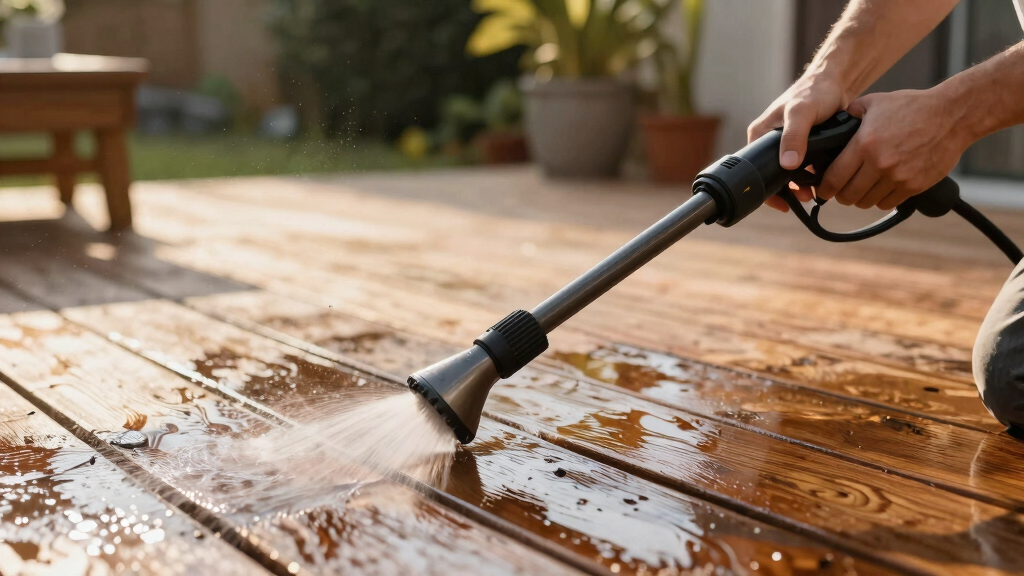
To do this effectively, start from one end of each board and work your way down, maintaining a consistent distance of 6 to 12 inches. Use steady, overlapping passes to ensure even coverage, and always follow the natural direction of the wood fibers. This careful approach not only improves appearance but also extends the life of your deck by reducing unnecessary fiber damage.
Latest Tech and Trends Making Deck Cleaning Safer and Easier
Recent innovations include adjustable nozzles that let you fine-tune spray angle and pressure, enabling more precise control tailored to your deck’s material and condition. These tools help prevent damage, especially on softer woods like cedar or pressure-treated pine, by allowing you to apply just enough force without risking gouges or splinters.
Eco-friendly cleaning solutions are gaining popularity because they reduce the need for high-pressure rinsing, which can be risky for delicate fibers. Combining low-pressure washing with biodegradable cleaners and soft brushes can deliver a deep clean that preserves the wood’s integrity. This approach minimizes environmental impact and extends the lifespan of your deck.
Manufacturers now provide detailed guidelines tailored to different wood types and conditions, helping you avoid common pitfalls such as over-pressurizing or using incompatible cleaners. Hybrid methods—low-pressure rinsing combined with chemical cleaning or gentle scrubbing—are proving especially effective for decks with stubborn stains, mold, or algae buildup, offering a safer alternative to aggressive pressure washing.
Putting It All Together: Your Step-by-Step Deck Cleaning Routine
- Prep the area: Remove furniture, sweep, and wet the deck with a garden hose.
- Choose the right nozzle: Start with a 25° or 40° fan for safety and coverage.
- Set your pressure: Keep it between 500-1,500 PSI, adjusting after testing to find the optimal balance.
- Maintain proper distance: Keep 6-12 inches from the surface to avoid damage while ensuring effective cleaning.
- Clean with the grain: Use smooth, overlapping passes along the wood fibers to prevent fiber lifting and achieve a uniform finish.
- Inspect and re-clean: Focus on stubborn spots, adjusting pressure or nozzle as needed, always prioritizing gentle techniques.
- Finish with sealing or staining for longer-lasting protection.
This routine ensures you get a clean, damage-free deck that’s ready to enjoy or protect with a fresh stain.
Frequently Asked Questions
What is the safest pressure setting for cleaning a wood deck?
The safest pressure setting is between 500 and 1,500 PSI. Always start low, test on a hidden spot, and adjust upward only if needed, ensuring you don’t gouge or splinter the wood.How do I choose the right nozzle fan width?
For decks, a 25° or 40° fan width offers a broad, gentle spray that’s less likely to cause damage. Use narrower nozzles only for stubborn stains or detailed work, and always test first.Should I clean along or against the grain?
Always clean along the grain of the wood. This prevents fiber lifting and splintering, resulting in a smoother, more natural finish.Can pressure washing damage my wood deck?
Yes, if done improperly. Excessive pressure, narrow nozzles, or cleaning against the grain can cause permanent damage. Using the right settings and technique is key.Are there alternative methods to pressure washing for cleaning decks?
Absolutely. Soft-bristle brushes combined with eco-friendly cleaners and low-pressure rinsing can clean effectively without risking damage, especially on softer woods.Conclusion
Mastering pressure, nozzle size, and cleaning technique transforms deck maintenance from a risky chore into a craft. Each element plays a role in preserving your wood’s beauty and durability.
Next time you reach for your pressure washer, remember: a gentle touch and smart choices go a long way. A well-cleaned deck isn’t just about looks—it’s about protecting your investment and enjoying it for years to come.