
TL;DR

Get tools and workshop supplies delivered free — and shop member deals
- Fast, free delivery on millions of items
- Access to Prime Big Deal Days deals on October 6–7
- Prime Video, Amazon Music and more included
A lumber grade stamp carries information that a price tag and visual inspection cannot: the board’s grade, species, grading agency, mill and moisture condition. Those details connect framing lumber to published strength values and building-code span tables, though a stamp does not guarantee that every board in a store bin meets its grade.
A lumber grade stamp identifies who made and graded a framing board, its species and grade, and how wet the wood was when it was surfaced—details that affect whether it is rated for structural use and how far it can span. A Family Handyman report says shoppers who choose boards mainly by price and appearance can miss information used in building-code design tables.
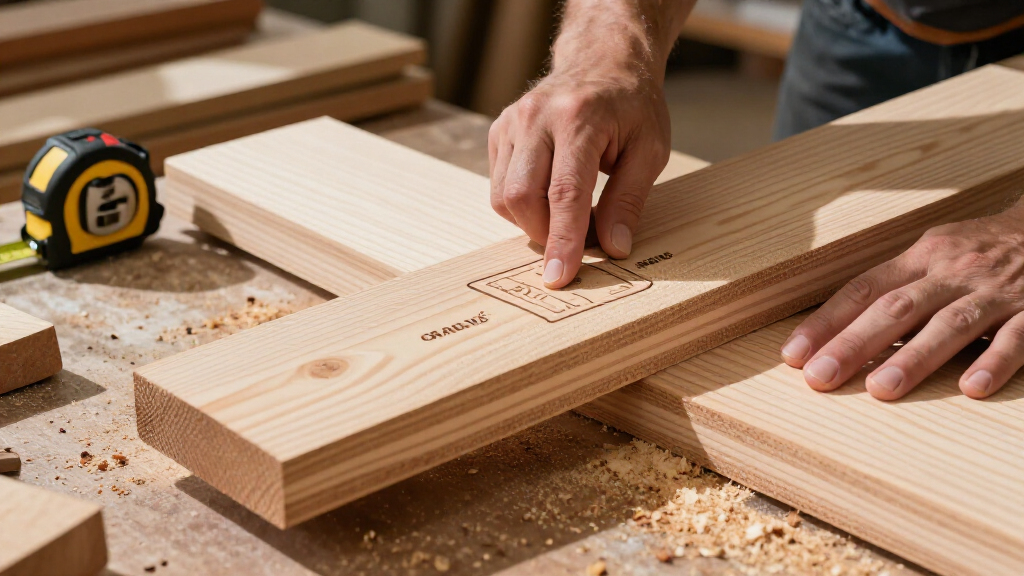
The report describes the stamp as a block of ink usually found a foot or two from the end of framing lumber. Its five standard fields identify the mill, the grading agency, the board’s grade and species, and its moisture condition at surfacing. Some stamps also include a surfacing note. The grade concerns how features such as knots, splits and holes affect strength; it is not the same kind of rating used for plywood.
A board’s species and grade correspond to published design values, which are used in span tables to determine how far a joist or rafter of a given size and spacing can reach between supports. The report says the 2024 International Residential Code requires sawn lumber used to support floors, walls or roofs to bear a grade stamp or a certificate of inspection.
Family Handyman cites Pete Austin, the Western Wood Products Association’s director of quality, describing a buyer who rejected five sound boards for wane—the loss of wood or bark along an edge—then selected five replacements that were below grade. The anecdote illustrates why appearance alone can mislead, but the report does not present it as a statistical study of lumber buyers.
Why Grade Matters in Framing
For people buying lumber for a structural project, the stamp is a link between a board on the rack and the design values used to plan a building. Grade and species affect the values that inform span tables; picking a board based only on appearance does not establish that it is suitable for a particular floor, wall or roof application.
The stamp also helps distinguish boards that may look similar but are governed by different grading rules. The report gives the example of a Stud-grade board and a No. 2 board of the same species at the same store. Their grades describe different allowances for defects, so visual similarity does not mean they have identical ratings or uses.
There are limits to what a stamp tells a buyer. It does not promise that every individual piece in a retail bin is on grade, and it does not replace checking the project’s plans, applicable code requirements or the relevant span table. The report says design values are intentionally conservative, but buyers still need to match the board’s rating to the intended load and layout.
As an affiliate, we earn on qualifying purchases.
How Lumber Grades Are Supervised
The report says lumber grades are assigned by a qualified grader or an agency-approved grading machine under rules overseen by organizations accredited by the American Lumber Standard Committee (ALSC). The federal lumber standard, PS 20, sets the framework for agencies that grade dimension lumber. ALSC’s January 2026 list cited in the report includes seven U.S. grading agencies and ten Canadian ones.
Grading is not an exact science because wood is a natural material. Paul Conway, ALSC’s executive vice president, wrote that agencies check mills by the unit, or banded bundle, and a unit is considered on grade when 95% or more of its pieces meet the grade. That production-level check is not a guarantee about every board a customer picks from a store’s bin.
The report says ALSC requires agencies to inspect each mill at least 12 times a year, and PS 20 bars accreditation of an agency controlled by a producer whose products it inspects. A single national grading rule applies to dimension lumber, so a No. 2 grade has the same meaning across accredited agencies, even when their stamps and regional species differ. The mill number is mainly useful for tracing a board or batch; the agency mark identifies who supervised its grading.
“I don’t think that they fully understand what it is they’re buying.”
— Pete Austin, director of quality at the Western Wood Products Association
As an affiliate, we earn on qualifying purchases.
What the Stamp Cannot Guarantee
The report does not establish how often retail boards fall below their stamped grade, or how frequently shoppers misread the markings. The account of five rejected boards and five replacements is an example shared by a veteran grader, not a measure of typical store conditions. Conway’s explanation says the 95% threshold applies to a mill’s inspected unit, not to a promise that every individual board in a retail bin is on grade.
Nor does the stamp by itself determine whether a board suits a particular project. The appropriate choice depends on details such as species, grade, board dimensions, spacing and load. The report explains that moisture information reflects the wood’s condition when surfaced, but the supplied material does not provide the full range of stamp abbreviations or specific moisture thresholds. It also does not describe a change to the building code or lumber-grading rules; its focus is on helping readers understand existing markings.
As an affiliate, we earn on qualifying purchases.
Check the Grade Before Building
For a buyer, the next step is to read the whole stamp rather than relying on the price label or appearance. Confirm the grade and species against the plans and applicable span information, and check an unfamiliar agency logo against ALSC’s published list. The mill identifier may help trace a problem but does not change the board’s design rating.
For load-supporting work, the report points to the code requirement for stamped lumber or a certificate of inspection. If the intended use or the meaning of a marking is uncertain, buyers should consult the project’s designer or a qualified building professional rather than assume that a board is appropriate because it looks sound. The report identifies no upcoming policy decision or deadline; the immediate takeaway is to use the stamp as part of selecting and verifying framing lumber.
As an affiliate, we earn on qualifying purchases.
Key Questions
What information appears on a lumber grade stamp?
The stamp identifies the mill, grading agency, grade, species and moisture condition when the lumber was surfaced. Some stamps also include a surfacing note.
Does a No. 2 grade mean the same thing across agencies?
According to the report, accredited agencies follow one National Grading Rule for dimension lumber, so a No. 2 grade has the same meaning across those agencies.
Does a stamp guarantee every board in a store bin is on grade?
No. ALSC executive vice president Paul Conway said inspection applies to a mill’s production unit, which is considered on grade when at least 95% of its pieces meet the grade. That does not guarantee every piece selected from a retail bin is on grade.
Why do species and grade matter for a framing board?
They connect the board to published design values used in span tables. Those tables help determine how far lumber of a particular size, species, grade and spacing can span between supports.
What should I do if I do not recognize the grading-agency logo?
Check the mark against the ALSC list of accredited grading agencies cited in the report. The report says a logo that is not on that list is not an accredited grade stamp, and the board counts as unstamped.
Source: rss
Fall yard work Picks
leaf blowers
As an affiliate, we earn on qualifying purchases.