
TL;DR

Get business pricing on tools and workshop supplies
- Business-only prices and quantity discounts
- Tax-exempt purchasing
- Multiple users, one account, clear invoices
A Hunker report describes crushed granite as an alternative to conventional gravel driveways, citing tighter compaction and a reported lifespan of 20 years or more when properly installed and maintained. The report lists crushed granite at $25 to $50 per cubic yard, while noting that installation requires excavation, layered compaction and drainage planning.
Crushed granite is being presented as an alternative to standard gravel driveways, with a Hunker report saying its angular pieces can compact more tightly and resist shifting when properly installed. The material’s listed price—$25 to $50 per cubic yard—overlaps with the report’s range for gravel, but the installation involves more preparation and the stated durability depends on proper installation and maintenance.
Unlike gravel, which the report describes as naturally eroded pieces with varied shapes, crushed granite is made by breaking solid granite into more uniform, angular pieces. Those pieces can interlock under compaction while still allowing water to drain. The report says loose gravel can shift and develop ruts over time, even when steps are taken to hold it in place. It says a properly installed and maintained crushed granite driveway can last 20 years or more; this is a general claim in the source, not a guarantee for every driveway.
Hunker gives an average material cost of $25 to $50 per cubic yard for crushed granite, compared with $15 to $75 per cubic yard for gravel. These are material-price ranges, not complete project estimates: the supplied report does not specify labor, delivery, regional variation or the total quantity a driveway would require. It describes installation as more involved than simply spreading stone.
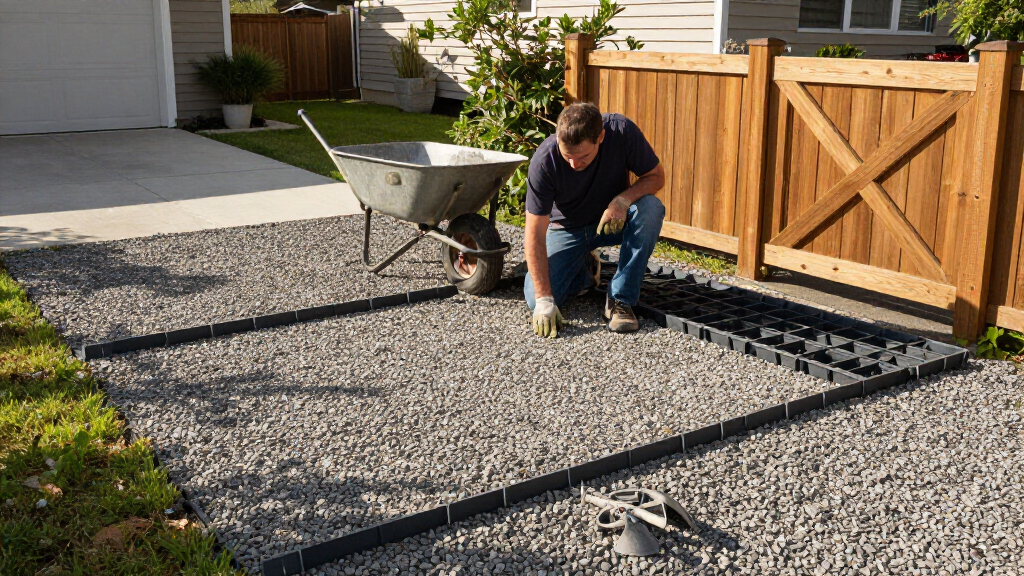
For driveways expected to carry regular vehicle traffic, the report says installers recommend excavating to a depth of 6 to 8 inches. The base is graded to direct drainage; landscape fabric may be added, and edge restraints are installed to limit movement. Crushed granite is then placed and compacted in layers of about 2 inches, with water used to aid compaction. A finer grade is generally used for the top layer to fill gaps.
The Cost of a Firmer Driveway
For homeowners who regularly rake, refill or level a loose-stone driveway, a material that compacts firmly may mean less visible displacement and fewer ruts over time. The report’s cost ranges suggest that crushed granite can be competitive with gravel on material price, but that comparison alone does not establish which option is cheaper for a finished driveway.
The trade-off is preparation. Excavation, drainage grading, restraints and careful placement in compacted layers affect the finished result and add work beyond laying stone. Homeowners comparing bids should ask whether quoted prices include those steps, as well as delivery and labor, rather than judging options only by the per-cubic-yard cost.
Appearance and local conditions also matter. Crushed granite retains a stone look, but the source does not provide a standard color, regional price data or performance testing across different climates and soils. Its reported durability should be treated as conditional on installation and maintenance, not as a promise of a maintenance-free surface.
crushed granite driveway installation kit
As an affiliate, we earn on qualifying purchases.
As an affiliate, we earn on qualifying purchases.
Granite, Limestone and Fine Stone
The report distinguishes crushed granite from decomposed granite, a much finer material described as nearly sand-like. Although both come from granite, they are not interchangeable in appearance or texture. Hunker says decomposed granite can be compacted, but heavy rain and vehicle traffic may cause rutting and displacement over time.
Crushed limestone is another angular stone that can compact well and is described as usually cheaper than crushed granite. The report says limestone is more vulnerable to long-term weathering and erosion; it also notes that erosion may gradually raise soil pH. That can matter to gardeners growing acid-loving plants. The choice between granite and limestone therefore depends partly on local availability, price and site conditions, according to the report.
As an affiliate, we earn on qualifying purchases.
Project Costs and Site Conditions
The supplied report does not name a particular driveway project, homeowner, contractor or study behind the durability estimate. It does not give a publication date, explain how the 20-year-or-more figure was measured, or provide comparisons from controlled testing. The estimate is presented as conditional on proper installation and maintenance.
Actual costs and performance remain site-specific. The source gives no local price breakdown, labor estimate, drainage assessment or guidance on how soil, slope, climate and vehicle use affect a given driveway. It also does not say how often maintenance may be needed. Homeowners should obtain local quotes and check applicable rules before choosing a material or altering drainage.
As an affiliate, we earn on qualifying purchases.
Compare Local Driveway Quotes
The report describes material options and an installation method, but does not announce a new product, policy or scheduled industry change. The practical next step for homeowners considering a replacement is to compare local estimates for crushed granite, gravel and other available stone, asking contractors to itemize excavation, base preparation, drainage, edging, material, compaction and maintenance.
Before work begins, property owners can confirm that the planned slope will direct water appropriately and ask what depth and stone grade suit their expected traffic. Local suppliers can also clarify current material prices and availability. Those details—not the broad price ranges alone—will determine whether crushed granite is a suitable and affordable alternative at a particular home.
edge restraints for gravel driveway
As an affiliate, we earn on qualifying purchases.
As an affiliate, we earn on qualifying purchases.
Key Questions
How much does crushed granite cost compared with gravel?
Hunker lists crushed granite at $25 to $50 per cubic yard and gravel at $15 to $75 per cubic yard. Those figures are material ranges, not full installed-project costs, and local prices may differ.
Does crushed granite last longer than a gravel driveway?
The report says a crushed granite driveway can last 20 years or more if it is properly installed and maintained. It does not provide a guarantee or a study establishing how every driveway will perform.
What does crushed granite installation involve?
The described process includes excavation, grading for drainage, optional landscape fabric, edge restraints and compaction in layers. For regular vehicle traffic, the report cites a recommended excavation depth of 6 to 8 inches.
Is decomposed granite the same as crushed granite?
No. Both are granite-based, but the report describes decomposed granite as much finer, with a texture close to sand. It says heavy rain and vehicle traffic can cause it to rut or move over time.
Could crushed limestone be a less expensive option?
According to Hunker, crushed limestone is usually cheaper than crushed granite and its angular pieces can compact well. The report also says limestone is more susceptible to weathering and erosion, which may gradually raise soil pH.
Source: rss
Halloween Picks
halloween
As an affiliate, we earn on qualifying purchases.