
TL;DR

Get business pricing on tools and workshop supplies
- Business-only prices and quantity discounts
- Tax-exempt purchasing
- Multiple users, one account, clear invoices
Foam cannons on pressure washers meter soap through a venturi orifice, and foam quality depends on matching that orifice to your machine’s GPM — 1.1 mm for most electric washers under ~1.8 GPM, stock 1.25 mm for gas machines at 2.0+ GPM. Your true dilution is the bottle mix multiplied by the injector’s draw rate (10:1–20:1), which you can measure with a 10-minute catch-can test and tune to the product’s target PIR, typically 1–4%.
Your foam cannon isn’t broken. It’s mismatched. You screwed a $20 cannon onto your electric pressure washer, pulled the trigger, and watched sad, watery suds slide off the hood like skim milk. Meanwhile your buddy’s gas rig lays down foam so thick it looks like piped shaving cream.
Here’s the part most guides skip: the soap brand barely matters. Foam thickness comes down to the relationship between orifice size, your machine’s flow rate (GPM), and your bottle dilution — and once you understand how foam cannons on pressure washers actually meter soap, you can fix yours for about five bucks. Think of it like pairing a carburetor to an engine: the same fuel behaves completely differently depending on how it’s metered.
Below you’ll get the core facts every guide should establish but most skip: the two-dilution model, a simple orifice-selection table keyed to your machine, and a 10-minute catch-can test that dials in any soap on any washer. No guesswork. No wasted product.
Match the orifice to your GPM: 1.1 mm for electric washers under ~1.8 GPM, stock 1.25 mm for gas machines at 2.0+ GPM — GPM, not PSI, drives injector suction.
Your real dilution is bottle dilution multiplied by injector draw (10:1–20:1). Measure it with the catch-can test and tune to the soap’s target PIR, usually 1–…
Watery foam checklist, in order: orifice size, soap amount, mix knob position, water temperature and hardness, clogged aerator.
Rinse the cannon with clean water after every use — dried soap in the orifice and mesh aerator is the slow killer of foam quality.
Premium cannons like the PF22.2 or MJJC S V3 buy consistency and durability, not dramatically thicker foam — match the orifice first, upgrade second.
Foam Cannons on Pressure Washers: Orifice Matching & Dilution That Works
Your foam cannon isn’t broken. It’s mismatched.
Sad, watery suds almost never mean bad soap. Foam thickness comes down to orifice size, your machine’s flow rate (GPM), and your bottle dilution — and once you understand how the venturi meters soap, you can fix yours for about five bucks.
“The soap brand barely matters. GPM — not PSI — drives the cannon’s suction.”
The part most guides skipThe Two Dilutions That Decide How Strong Your Foam Really Is
Every foam cannon dilutes your soap twice. The concentration landing on your paint is the product of both — detailers call it the PIR (Panel Impact Ratio), and many snow foam makers now print a target PIR because a bottle ratio alone means nothing without your injector’s draw rate.
What you mix in the reservoir — typically soap-to-water for snow foams.
The venturi pulls that solution into the water stream and dilutes it again.
The strength your paint actually sees — the number to calibrate to.
Same bottle, four-times-apart foam
You pour 2 oz of concentrate into a 32 oz bottle — roughly 1:15. Your cannon draws at 15:1, so your panels see about a 0.4% solution — under most targets, which explains the weak cling. Richen the bottle toward 1:5 and you land just over 1%, right in the pocket. Two owners can mix identical bottles and end up four times apart — one on a gas rig drawing 10:1, the other on an electric pulling 20:1.
Where your mix actually lands
Bar scale: 4% PIR = full width · dashed band = target zone
The $5 Orifice Swap That Fixes Watery Foam on Electric Washers
Most cannons ship with a ~1.25 mm orifice sized for gas machines at 2.0+ GPM. Electrics commonly move 1.1–1.8 GPM, which weakens the venturi and kills suction. Match the orifice to your machine’s rated GPM, not its sticker pressure — a 2,000 PSI electric at 1.3 GPM foams worse than a 1,900 PSI unit at 1.7 GPM.
Flow rate by machine class · GPM drives the draw
Bar scale: 2.8 GPM = full width · below 2.0 GPM the stock 1.25 mm orifice starves the venturi — run 1.1 mm
| Machine | Typical flow | Orifice to run | What you’ll see if it’s wrong |
|---|---|---|---|
| Electric, compact1,600–1,800 PSI class | 1.1–1.4 GPM | 1.1 mm | ✗Watery foam, weak suction with stock 1.25 mm |
| Electric, full size1,800–2,000 PSI class | 1.4–1.8 GPM | 1.1 mm | ✗Thin foam that only improves with the mix knob maxed |
| Gas2.0+ GPM territory | 2.0–2.8 GPM | Stock 1.25 mm | ✗Over-rich foam — weaken the bottle dilution |
| Any pulsing machineSurging under load | — | One size larger | ✗Pump starving — orifice too restrictive or clogged |
2.3 GPM + stock orifice
Whipped-cream ridges that stack on the hood and hold a long dwell.
1.2 GPM + stock 1.25 mm
Gray dishwater that slides off the panel like skim milk. Same knob setting.
1.2 GPM + 1.1 mm orifice
Ten minutes with a wrench — the same bottle goes to shaving-cream foam with a five-minute dwell.
Orifice too large for your machine’s flow — go smaller (1.1 mm).
Orifice too restrictive — go larger, or check for a clogged mesh aerator.
Dial In Any Soap in 10 Minutes with the Catch-Can Test
The catch-can test measures your cannon’s real injector draw rate so you can hit any product’s target PIR instead of guessing. All you need is a bucket, a measuring cup, and ten minutes.
Fill
Fill the cannon bottle with plain water to a marked line — no soap.
Spray
Foam into an empty bucket for a timed run, knob where you normally run it.
Catch
Measure the total water collected in the bucket with a measuring cup.
Draw
Measure how much solution the bottle actually used during the run.
Divide
Bucket volume ÷ bottle draw = your true injector ratio (e.g. 15:1).
Now tune the bottle: richen or weaken until the product lands inside the label’s target PIR — usually 1–4%
Watery Foam? Work the Checklist Before Blaming the Soap
Nine times out of ten the fix is upstream of the chemistry. Check these in this order — each one is cheaper and faster than the last thing you’d suspect: the soap itself.
Orifice size
Matched to your GPM? Electric under ~1.8 GPM needs 1.1 mm.
Soap amount
Enough concentrate in the bottle? Start ~1–2 oz in 32 oz, adjust from there.
Mix knob
Turn toward maximum suction, then back off to preference once foam is thick.
Water
Warm water in the bottle improves mixing; hard water noticeably hurts foam.
Aerator
Check the stainless mesh for dried-soap clogs — the silent foam killer.
Rinse the cannon with clean water after every use. Dried soap in the orifice and mesh aerator degrades foam quality long before any part actually fails.
Premium cannons like the PF22.2 or MJJC S V3 buy consistency and durability — weighted pickups, finer adjustment — not dramatically thicker foam. Match the orifice first, upgrade second.
The chain that decides your foam · every link matters
How a Foam Cannon Actually Works — and Why Yours Falls Flat
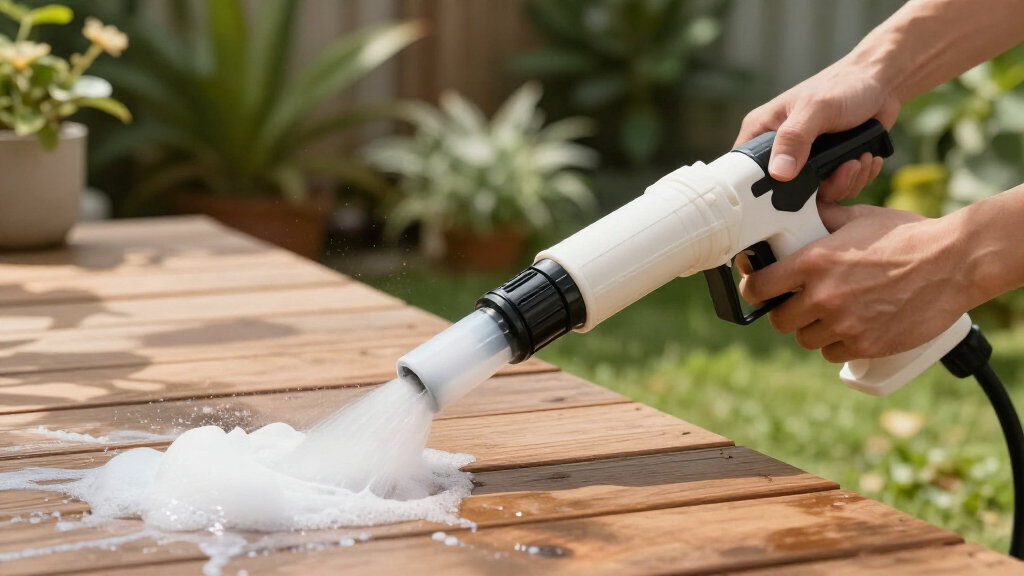
A foam cannon is a venturi-based chemical injector, not a soap sprayer. Water from your pressure washer accelerates through a small internal orifice, and that speed creates a low-pressure zone that siphons concentrated soap up from the bottle. The solution then hits an adjustable fan body, mixes with air, and exits as foam.
If you’ve ever put your thumb partway over a garden hose and watched the stream suddenly speed up, you’ve built a crude venturi with your own hand. It’s the same trick a perfume atomizer or an old-school carburetor uses: fast-moving fluid drags the slower fluid next to it along for the ride. In the cannon, that dragged-along fluid is your soap.
Trace the path and it clicks. Your machine pushes water through a brass orifice roughly 1.1 to 1.25 mm wide — about the width of a paperclip wire. Velocity spikes, pressure craters, and the pickup tube slurps soap like a straw. At the head, a stainless mesh aerator whips air into the stream with a sharp hiss, and the fan knob decides whether you get a wide mist or a wet blanket.
Here’s the lever most people never touch: that orifice meters everything. Too big for your machine’s flow, and the venturi effect weakens until suction dies. Too small, and the pump starves and surges. The brand of soap in the bottle? A distant third behind orifice size and GPM.
I’ve watched the same bottle of snow foam produce whipped-cream ridges on a 2.3 GPM gas washer and gray dishwater on a 1.2 GPM electric — same soap, same knob setting, two machines. The difference wasn’t chemistry. It was flow through the venturi, and it’s the single idea the rest of this guide hangs on.
pressure washer foam cannon orifice size
As an affiliate, we earn on qualifying purchases.
As an affiliate, we earn on qualifying purchases.
The Two Dilutions That Decide How Strong Your Foam Really Is
Every foam cannon dilutes your soap twice. Bottle dilution is what you mix in the reservoir — commonly 1:5 to 1:10 soap-to-water for snow foams. Injector dilution happens when the cannon pulls that solution into the water stream, typically at 10:1 to 20:1. The concentration actually landing on your paint is the product of both.
Picture making iced tea from frozen concentrate. The bottle mix is the first pitcher you stir up; the injector is a second, much bigger pitcher of water that first pitcher gets dumped into. Skip either measurement and the strength in the glass — or on the panel — is anyone’s guess.
Detailers call that final number the PIR — Panel Impact Ratio. Many snow foam makers now print a target PIR on the label, often around 1–4%, because a bottle ratio alone means nothing without knowing your injector’s draw rate. Two owners can mix identical bottles and end up with foam four times apart in strength — one on a gas rig drawing 10:1, the other on an electric pulling 20:1.
Run the math on a real setup. You pour 2 oz of concentrate into a 32 oz bottle and top it with water — roughly 1:15. Your cannon draws that solution at 15:1 against the water stream, so your panels see about a 0.4% solution. That’s under most targets, which explains the weak cling. Richen the bottle toward 1:5 and you land just over 1%, right in the pocket.
This is where dilution that works gets serious, because the chemistry has diversified. High-pH pre-wash foams, pH-neutral maintenance foams, and ceramic-infused foams each carry different recommended strengths. Calibrate wrong and you’re either wasting concentrate or leaving a hot mix on your wax longer than you should.
electric pressure washer foam cannon upgrade
As an affiliate, we earn on qualifying purchases.
As an affiliate, we earn on qualifying purchases.
The $5 Orifice Swap That Fixes Watery Foam on Electric Washers
Most foam cannons ship with a ~1.25 mm orifice sized for gas pressure washers pushing 2.0 GPM or more. Electric machines commonly move 1.1–1.8 GPM, which weakens the venturi and kills suction. The standard fix is a 1.1 mm orifice — a few dollars in brass or stainless — and GPM, not PSI, is the number that matters.
For foam cannons on pressure washers, pressure is the push but flow is the volume doing the work. Injector draw is driven by how much water rushes through the venturi each minute, so a 2,000 PSI electric at 1.3 GPM foams worse than a 1,900 PSI unit at 1.7 GPM. Match the orifice to your machine’s rated GPM, not its sticker pressure.
| Machine | Typical flow | Orifice to run | What you’ll see if it’s wrong |
|---|---|---|---|
| Electric, compact | 1.1–1.4 GPM | 1.1 mm | Watery foam, weak suction with stock 1.25 mm |
| Electric, full size | 1.4–1.8 GPM | 1.1 mm | Thin foam that only improves with the mix knob maxed |
| Gas | 2.0–2.8 GPM | Stock 1.25 mm | Over-rich foam; weaken the bottle dilution |
| Any pulsing machine | — | One size larger | Pump starving; orifice too restrictive or clogged |
A neighbor of mine ran a 1,700 PSI, 1.2 GPM electric with the stock orifice for a year, convinced his soap was junk. Ten minutes with a wrench and a $4 1.1 mm orifice, and the same bottle went from skim milk to shaving-cream ridges that held a five-minute dwell. It’s one of the highest value-per-dollar upgrades in car care.
Symptom shortcut: watery foam on an electric washer means the orifice is too large for your flow — go smaller. A pulsing, surging machine means it’s too restrictive — go larger, or check for a clogged mesh aerator.
As an affiliate, we earn on qualifying purchases.
Dial In Any Soap in 10 Minutes with the Catch-Can Test
The catch-can test measures your cannon’s real injector draw rate so you can hit any product’s target PIR instead of guessing. All you need is a bucket, a measuring cup, and ten minutes:
- Mark the bottle. Fill it with your mixed solution and note the starting level — 300 mL works well.
- Spray into an empty bucket. Run the cannon until the bottle drops by exactly 300 mL, keeping the mix knob where you actually use it.
- Measure the total. Everything in the bucket — water plus drawn solution — is your total output. Say it reads 4,500 mL.
- Do the division. 300 ÷ 4,500 = a 1:15 draw rate. Multiply by your bottle strength to get PIR.
- Adjust and retest. Below the product’s target (often 1–4% PIR)? Richen the bottle or turn the mix knob toward max suction. Above it? Weaken the bottle.
Here’s a worked example. Say your snow foam wants 2% PIR and your test shows a 1:15 draw. You need the bottle at roughly 30% concentrate — about 9–10 oz in a 32 oz bottle — which is exactly why ‘two glugs’ advice fails. Without your draw rate, every number is a shot in the dark.
Run this test once per machine-and-soap combo and write the result on the bottle with a paint pen. From then on, mixing a perfect batch takes thirty seconds and zero memory.
best foam cannon for pressure washers
As an affiliate, we earn on qualifying purchases.
As an affiliate, we earn on qualifying purchases.
Foam Still Thin? Five Culprits to Check Before You Blame the Soap
When foam cannons on pressure washers underperform, the cause almost always traces to one of five things: a stock orifice on a low-flow electric washer, too little concentrate, the mix knob opened too far, cold or hard water, or a clogged aerator. Work through them in that order and you’ll solve nine out of ten foam complaints without buying anything but an orifice.
Here’s what that looks like in practice. A reader’s 1.3 GPM electric was laying down foam so thin it ran off the windshield before he could set the lance down. The orifice swap alone got him 80% of the way there; topping the bottle with warm water instead of cold hose water took care of the rest. Two fixes, zero new soap.
- Stock 1.25 mm orifice on an electric machine — the single most common cause; swap to 1.1 mm.
- Too little soap in the bottle — verify against the product’s target PIR, not folklore.
- Mix knob opened too far — start at maximum suction, then back off to taste.
- Cold or hard water — warm bottle water mixes better and builds stronger suds; hard water suppresses foaming in a way you can feel between your fingers.
- Clogged aerator or pickup filter — dried soap chokes the mesh; rinse the cannon after every use.
That last one earns its own habit. Residual soap dries inside the orifice and pickup tube, and your next session starts with half the aeration you paid for. A 30-second clean-water flush after each wash keeps the mesh clear and the draw consistent.
And treat the machine itself with respect. Wear eye protection, keep the spray off skin, and never run a gas washer indoors or in a closed garage — carbon monoxide builds fast. Keep the lance away from outlets, meters, and outdoor electrical boxes; if you’re washing anywhere near service equipment, shut the power off first or bring in a licensed pro.
Is a $60 Foam Cannon Worth It Over a $15 One?
Once your orifice matches your machine, the foam-thickness gap between a budget cannon and a premium one is modest. What the extra money buys is consistency and durability: weighted pickup tubes that draw at any bottle angle, wider mouths that don’t spill, stable bases, finer fan and mix adjustment, and stainless fittings that outlast cheap brass threads.
The wide-body designs that took off around 2019–2021 — the MTM Hydro PF22.2 is the one everyone copies, with later options like the MJJC S V3 — genuinely improved day-to-day use. The bottle stands upright instead of tipping onto the driveway. The weighted pickup tube follows the liquid when you tilt the cannon along a rocker panel. Adjustment clicks run finer, so your tune stays put wash after wash.
My honest take after years of property and fleet washing: match the orifice first, then decide. If you wash two cars a month, a matched $15 cannon does the job. Foam weekly, and the premium build pays for itself in un-spilled soap and lower blood pressure.
One wrinkle worth knowing: cordless pressure washers — the battery units from Ryobi, EGO, and others — often flow well under 1.5 GPM, which makes orifice matching matter even more. Look for cannons sold with multiple orifice sizes in the box, now a common practice, and don’t confuse cannons with garden-hose foam guns, a related but weaker category.
Frequently Asked Questions
What size orifice do I need for my electric pressure washer?
For most electric machines under about 1.8–2.0 GPM, a 1.1 mm orifice is the fix. The stock 1.25 mm orifice is sized for gas washers and can’t build enough venturi suction on lower flow. The swap takes about ten minutes with basic tools and costs a few dollars.
Why does my pressure washer pulse or surge when the foam cannon is attached?
Pulsing means the orifice is too restrictive for your machine — the pump is starving for flow. Move up one orifice size, or pull the cannon apart and check for a clogged mesh aerator or pickup-tube filter. Dried soap is the usual blocker, which is why a clean-water flush after every wash matters.
How much soap should I put in the bottle?
There’s no single right number, because it depends on your injector’s draw rate and the product’s target PIR — often 1–4% for snow foams. Start with 1–2 oz in a 32 oz bottle topped with warm water and the mix knob toward max suction. Then run the catch-can test and adjust the bottle strength until you hit the label’s target.
Does PSI or GPM matter more for foam?
GPM, and it isn’t close. The injector’s draw rate is driven by the volume of water moving through the venturi each minute, not by pressure. A 2,000 PSI electric at 1.3 GPM will always foam worse than a lower-PSI machine pushing 1.8 GPM with a matched orifice.
What’s the difference between a foam cannon and a foam gun?
A foam cannon needs a pressure washer — it relies on pressurized flow through a venturi to pull soap and whip it into dense foam. A foam gun attaches to a garden hose and aerates at household pressure, so the foam comes out wetter and weaker. Both have their place, but only the cannon gives you that clingy, shaving-cream blanket.
Can thick foam strip wax or damage a ceramic coating?
The foam itself is inert — the chemistry and dwell time decide what it does to your protection. High-pH pre-wash foams can degrade waxes and sealants, especially with long dwell in the sun, while ceramic coatings tolerate them far better. Follow the product label, don’t let foam dry on the panel, and stick to pH-neutral foams for maintenance washes.
Conclusion
Remember the diagnosis: your cannon was never broken. Orifice matching and dilution that works beats every soap upgrade on the shelf — a 1.1 mm orifice for most electric machines, the stock 1.25 mm for gas, and a catch-can test to land on your product’s target PIR. Total investment: about five dollars and ten minutes.
So this weekend, before you blame the bottle, pull that orifice and check what’s stamped on it. When the first pass lays down a blanket so thick you can’t see the paint — and it slides off in slow sheets carrying the grit with it — you’ll know the machine was fine all along. It just needed you to speak its language.
Halloween Picks
halloween
As an affiliate, we earn on qualifying purchases.