TL;DR

Get business pricing on tools and workshop supplies
- Business-only prices and quantity discounts
- Tax-exempt purchasing
- Multiple users, one account, clear invoices
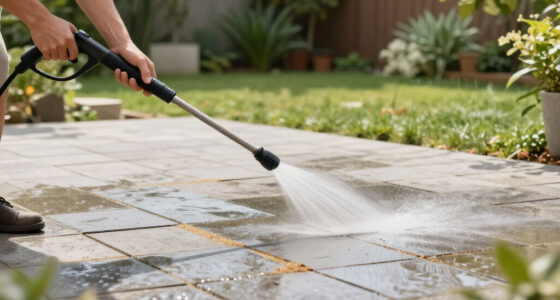
Wash softwood decks at 500–800 PSI (never above about 1,200), hardwoods at 1,000–1,500 PSI, using a 40-degree white tip held 8–12 inches off the boards, sweeping with the grain. Let a sodium percarbonate cleaner and an oxalic-acid brightener do the real work so pressure is only the rinse. If the grain already furred, dry the deck fully and knock the fuzz off with 60–80 grit sandpaper before staining.
The fastest way to ruin a good cedar deck takes about three seconds: one pass with a 0-degree tip, and the boards come up looking like a wool sweater. That fuzz has a name — furring — and once it shows up, you’re sanding before you can even think about stain.
Here’s the good news. Washing wood decks without furring the grain isn’t about buying a gentler machine. It’s about three numbers you control: pressure (PSI), tip angle, and wand distance. Get those right and a basic electric washer cleans a gray, weathered deck beautifully. Get them wrong and a 3,200 PSI gas unit will carve your boards like a turkey.
This guide gives you the exact numbers for softwoods, hardwoods, and composites, the two tips that are safe (and the two that gouge on contact), and the chemical-first process the pros use so pressure becomes the rinse — not the cleaner.
Softwoods (cedar, redwood, pressure-treated pine) clean safely at 500–800 PSI with ~1,200 as the hard ceiling; hardwoods tolerate 1,000–1,500; composite needs…
The white 40-degree tip is your default, green 25-degree handles tough spots on sound boards, and red 0-degree or yellow 15-degree tips will chisel the grain o…
Hold the wand 8–12 inches off the deck (up to 18 on weathered softwood), sweep with the grain board by board, and never stop the jet mid-board — stop marks and…
Furring is torn earlywood fiber, and it’s mechanical damage: the only fix is a 60–80 grit sanding pass after the deck dries, followed by brightener before stai…
Let sodium percarbonate cleaner and oxalic-acid brightener do the work so pressure stays a rinse — then give the deck a full 24–72 hours to dry before sealing.
Washing Wood Decks Without Furring the Grain
One pass with a 0° tip and cedar boards come up looking like a wool sweater. Avoiding furring isn’t about a gentler machine — it’s three numbers you control: pressure (PSI), tip angle, and wand distance. Get them right and a basic electric washer cleans beautifully; get them wrong and a 3,200 PSI gas unit carves your boards like a turkey.
“Pressure is the rinse. The cleaner does the lifting.”
The working rule the pros repeat
Why Your Deck Turns Fuzzy: What Furring Actually Is
Furring — also called fuzzing or raised grain — happens when the jet is too strong, too narrow, or held too close: it tears the softer earlywood fibers between the harder growth rings. Think of a board as drinking straws glued side by side — the earlywood is the weak glue joint, and a tight jet rips it out, leaving hard rings standing like ribs on a washboard. The damage is mechanical and permanent until sanded. Weathered wood gets it worst: UV breaks down the lignin that binds surface fibers, so a ten-year-old gray deck furs at pressures a fresh board would shrug off — work further below the published ceiling on gray wood.
The PSI Ceilings That Actually Keep Wood Safe
Stay under your wood’s pressure ceiling. And remember: the PSI on the box is measured at the pump, at zero distance — the wood only feels what arrives at its surface. A 2,800 PSI machine at 12 inches through a white tip can be gentler on cedar than a 1,500 PSI machine at 3 inches through a green one.
Pressure & Process by Decking Material
The tradeoff buried in the “lowest pressure that cleans” rule: lower pressure means slower work and more reliance on dwell time. You’re trading twenty minutes of patience for zero hours of sanding — a trade worth making every single time.
| Decking Material | Working PSI Range | Hard Ceiling | Risk Level | Field Notes |
|---|---|---|---|---|
| Cedar / redwood / pressure-treated pine | 500–800 PSI | ~1,200 PSI | High | Most furring-prone; start at 500 and nudge up only if needed |
| Ipe / mahogany / teak | 1,000–1,500 PSI | ~1,500 PSI | Moderate | Dense and forgiving, but lower pressure still cleans fine |
| Composite / PVC | Lowest effective | Per manufacturer | Warranty | High PSI can void the warranty — read the care guide first |
| Old, gray, weathered wood | Below published range | Well under 1,200 | Very High | UV-degraded lignin means gray wood isn’t sound anymore — step the wand back up to 18″ |
Two Tips Are Safe. Two Will Chisel Your Boards.
Tip angle is really just a way of tuning delivered PSI. Keep the fan aligned parallel to the board length, never across it — and turbo nozzles belong on concrete, not decking.
Your default. Wide, gentle fan that rinses cleaner and grime off without tearing earlywood. Safe on all decking at proper distance.
Stubborn spots only. Acceptable for tough grime on sound, durable boards — keep it moving and never on weathered softwood.
Never on wood. Concentrates the jet enough to fur the grain and etch boards on contact — treat it as a hard no.
The wool-sweater maker. A pencil jet that acts like a chisel — three seconds is all it takes to carve a cedar board.
How Close Is Too Close?
Distance is the third leg of the stool. Hold the wand 8–12 inches off the boards — up to 18 on weathered softwood — sweep with the grain board by board, and never stop the jet mid-board: stop marks and gouges are forever.
Stroke Technique
Long, overlapping sweeps along the grain, board by board. Start and end each pass beyond the board edges so the jet never dwells in one spot.
Test First
Spray an inconspicuous area — under a bench or behind a planter — and check for fuzzing before committing to the whole deck.
Never Stop Mid-Board
A paused jet carves a stop mark in a heartbeat. Keep the wand moving at a steady walking pace from edge to edge.
Let the Cleaner Do the Work: The Chemical-First Wash
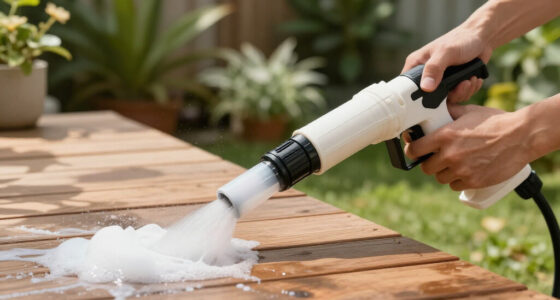
The process that minimizes damage runs chemical-first, so pressure stays a rinse — not the cleaner. Oxygen bleach (sodium percarbonate) is gentler than chlorine and biodegradable near landscaping; brightener is now a standard second step, not an optional one.
Pre-Wet
Saturate boards and nearby plants so cleaner dwells on the surface
Apply Cleaner
Sodium percarbonate (oxygen bleach) lifts gray and mildew chemically
Dwell
Let it sit per label — patience here replaces PSI later
Low-PSI Rinse
White 40° tip, 8–12″ off the boards, sweeping with the grain
Brighten
Oxalic-acid brightener neutralizes cleaner, restores pH, revives color
Dry 24–72h
Full dry-down before any sanding, staining, or sealing
If the Grain Already Furred
The Only Real Fix: Sand It Out
Furring is mechanical damage — no chemical will lay those fibers back down. The fix is physical, and it only works on fully dry wood.
- Let the deck dry completely — 24–72 hours after washing
- Knock the fuzz off with a light 60–80 grit sanding pass
- Follow with oxalic-acid brightener to even out tone
- Then stain or seal — skipping the sand means a blotchy, tiger-striped finish
The 2020s Shift: Soft Washing
Professionals increasingly rely on percarbonate chemistry and pressure under 1,000 PSI instead of high-PSI blasting — driven by furring awareness and voided warranties on treated lumber and composites.
- Adjustable pressure dials and electric units (~1,800–2,000 PSI max) marketed as deck-safer
- Oxygen-based, biodegradable cleaners replacing chlorine bleach near landscaping
- Composite/PVC now treated as its own low-pressure category
Why Your Deck Turns Fuzzy: What Furring Actually Is
Washing wood decks without furring the grain starts with knowing your enemy. Furring — also called fuzzing or raised grain — is what happens when a pressure washer’s jet is too strong, too narrow, or held too close: it tears the softer earlywood fibers between the harder growth rings, leaving the board fuzzy or ridged. The damage is mechanical, and it’s permanent until you sand it out.
Think of a deck board as a bundle of drinking straws glued side by side. The earlywood — the soft, fast-grown part of each growth ring — is the weak glue joint. The latewood bands are dense and hard. A tight jet slices between them, ripping out the soft stuff and leaving the hard rings standing like ribs on a washboard.
Weathered wood gets it worst. Sunlight breaks down lignin, the natural polymer that binds surface fibers together, which is why a ten-year-old gray deck furs at pressures a fresh board would shrug off. According to Outdoor Pro Masters field guidance, UV-degraded lignin is the single biggest reason older decks fuzz even at pressures that look safe on paper [1]. The practical implication: the older and grayer your deck, the further below the published PSI ceiling you should work — the numbers on paper assume sound wood, and gray wood isn’t sound anymore.
Here’s why furring matters beyond looks. Those torn fibers aren’t just ugly — they’re open straws. A furred surface drinks water, holds it longer after every rain, and invites mildew and rot to move in years earlier than they would on intact wood. And every harsh wash strips another layer of earlywood, so boards that get blasted year after year gradually thin into a permanent washboard texture that no sanding can fully flatten. Furring, in other words, compounds: each mistake makes the next one easier to make and harder to hide.
Take the classic May weekend: the deck’s gone gray and slick with algae, you borrow the neighbor’s gas washer, and ten minutes in the boards look clean but feel like a cat’s tongue. That’s furring. And here’s the kicker — stain soaks into those torn fibers unevenly, so skipping the sanding step leaves you with a blotchy, tiger-striped finish that stares at you all summer.
As an affiliate, we earn on qualifying purchases.
The PSI Numbers That Actually Keep Wood Safe
Washing wood decks without furring the grain comes down to staying under your wood’s pressure ceiling. For softwoods like cedar, redwood, and pressure-treated pine, work between 500 and 800 PSI, with about 1,200 PSI as the absolute ceiling. Hardwoods such as ipe, mahogany, and teak tolerate roughly 1,000–1,500 PSI — and composite or PVC decking wants even less.
| Decking material | Working PSI range | Hard ceiling | Field notes |
|---|---|---|---|
| Cedar / redwood / pressure-treated pine | 500–800 PSI | ~1,200 PSI | Most furring-prone; start at 500 and nudge up only if needed |
| Ipe / mahogany / teak | 1,000–1,500 PSI | ~1,500 PSI | Dense and forgiving, but lower pressure still cleans fine |
| Composite / PVC | Lowest effective pressure | Per manufacturer | High PSI can void the warranty — read the care guide first |
One thing worth understanding before you trust these numbers: the PSI on the box is measured at the pump, with a specific tip, at zero distance. It is not what lands on your deck. The wood only feels the pressure that actually arrives at its surface, and that figure drops as you widen the fan and step the wand back — which is exactly why tip angle and distance, covered in the next two sections, are really just ways of tuning delivered PSI. A 2,800 PSI machine at 12 inches through a white tip can be gentler on cedar than a 1,500 PSI machine at 3 inches through a green one.
The working rule the pros repeat: use the lowest pressure that cleans. Pressure is the rinse. The cleaner does the lifting. If 600 PSI with a good percarbonate soak strips the gray, dialing up to 1,500 buys you nothing except risk. There’s a real tradeoff buried in that rule, though — lower pressure means slower work and more reliance on dwell time. You’re trading an extra twenty minutes of patience for zero hours of sanding, and that’s a trade worth making every single time.
One honest tradeoff from the field: electric washers, which naturally top out around 1,800–2,000 PSI, get marketed as deck-safe, and they mostly are, because their lower flow forces you to slow down. Notice that their safety is partly behavioral, not just mechanical — the machine makes it hard to be impatient. A big gas unit isn’t evil; it just punishes impatience. If you’re running gas, use the throttle or an adjustable pressure dial to come down into range instead of relying on distance alone [2].
Real scenario: a 300-square-foot pressure-treated pine deck, ten years old, some black mildew spotting along the rail line. Start at 500 PSI, white 40-degree tip, cleaner doing the heavy lifting. If patches resist, nudge to 700 — don’t jump straight to the machine’s full bark.
deck cleaning pressure washer tips
As an affiliate, we earn on qualifying purchases.
As an affiliate, we earn on qualifying purchases.
Nozzle Tips: Two Are Safe, Two Will Chisel Your Boards
The safest tip for washing wood decks is the 40-degree (white) fan tip; the 25-degree (green) tip is acceptable for stubborn grime on sound, durable boards. Never let a 0-degree (red) or 15-degree (yellow) tip touch a deck board — they concentrate the jet like a chisel and gouge or fur the grain on contact. Turbo nozzles belong on concrete, not decking.
| Tip | Color | Spray pattern | Verdict on wood |
|---|---|---|---|
| 0-degree | Red | Pinpoint jet | Never — gouges trenches instantly |
| 15-degree | Yellow | Narrow fan | Never — strips soft fibers like a planer gone rogue |
| 25-degree | Green | Medium fan | Caution — tough grime on durable wood only |
| 40-degree | White | Wide fan | Safest default for all deck washing |
| Turbo / rotary | Varies | Spinning pinpoint | Avoid — a 0-degree jet that never stops moving |
Why does angle matter so much? Same water, spread over more wood. Pressure is force divided by area, and the tip is what sets the area. A 0-degree jet lands all its force on a line about the width of a pencil lead. The 40-degree fan spreads that identical force across a wide sheet, so the load per square inch of wood drops hard even though the machine hasn’t changed. That’s the whole trick: you’re not making the washer weaker, you’re making each square inch of board carry less of its punch.
The green tip deserves an honest word, because it’s where most people get into trouble. On sound, durable boards it cleans noticeably faster than white — that’s the appeal — but the margin for error shrinks with the fan. A one-second pause with the white tip might leave nothing; the same pause with green leaves a divot. If you reach for green, the deal you make is constant motion and full attention, and on weathered softwood it’s a deal you shouldn’t take at all.
Two implications most guides skip. First, tips wear out: a cheap brass nozzle erodes, its fan goes uneven, and a tip that was safe last season can start striping boards this one — replace them yearly; they cost a few dollars. Second, keep the fan aligned parallel to the board length, not across it — a sideways fan leaves scallop marks across the grain that read as stripes once you stain. Field example worth remembering: swapping from yellow to white on the same machine, same trigger pull, is often the whole difference between a deck that dries smooth and one that costs you a Saturday with the belt sander.
best pressure washer tips for softwood decks
As an affiliate, we earn on qualifying purchases.
As an affiliate, we earn on qualifying purchases.
How Close Is Too Close? Distance and Stroke Technique
Distance is the third leg of washing wood decks without furring the grain. Hold the wand tip 8–12 inches off the surface — up to 18 inches for soft, weathered wood — and never closer than 6 inches. Wash with long, overlapping strokes that run with the grain, board by board, starting and finishing each pass beyond the board’s ends so the jet never dwells in one spot.
Why does distance work? A fan jet sheds energy fast once it leaves the nozzle — the sheet of water spreads, drags air, and breaks up, so stepping back even a few inches measurably softens the blow. That makes distance your fine-tuning dial: once the PSI and tip are set, you don’t touch the machine again. You move the wand in an inch to coax a stubborn patch and back out an inch when the wood starts to look fuzzy. Experienced deck hands rarely adjust anything at the pump — they adjust with their arm.
- Test first. Pick a hidden board — behind the grill, under the bench — and wash a two-foot patch. Let it dry before you judge it. Fuzz shows up as wood dries, not while it’s wet, which is why people wash a whole deck happily and only discover the damage the next morning.
- Set your distance. Start at 12 inches and close in only until the dirt lifts. If you’re inside 6 inches, you’re doing the cleaner’s job with pressure.
- Sweep with the grain. Long strokes, each pass overlapping the last by a few inches, fan parallel to the boards. Working across the grain isn’t just inefficient — it pushes the jet under fiber ends and lifts them sideways.
- Work board by board. Start each stroke off one end of the board and run clean off the other. Stopping mid-board leaves a stop mark — a dark stripe that haunts you under semi-transparent stain. The stripe isn’t dirt; it’s a spot that got cleaned a fraction deeper than its neighbors, and stain telegraphs that texture difference permanently.
- Keep the wand moving. A jet resting in one spot for even a second can cup the soft grain.
Listen to the machine while you work. You’ll hear the pitch change when you’re too close — a hard, angry hiss instead of a soft wash. That sound is the earlywood letting go.
Sound fussy for what looks like spraying water? Ask anyone who has watched a fresh coat of stain dry with a permanent dark stripe across the third board, right where they paused to answer their phone.
As an affiliate, we earn on qualifying purchases.
Let the Cleaner Do the Work: The Chemical-First Wash
The process that minimizes damage runs like this: pre-wet, apply an oxygen bleach (sodium percarbonate) deck cleaner, let it dwell, rinse at low pressure, then follow with an oxalic-acid wood brightener. Chemistry loosens the grime so the washer only has to rinse it away — that’s how you stay under 800 PSI and still get a like-new deck.
The reason this order matters is worth understanding. Gray weathering and mildew aren’t just sitting on the wood — they’re bonded to the degraded surface fibers. Pressure blasts the grime off by taking some of that surface with it; a percarbonate cleaner instead releases oxygen that breaks the bond chemically, so the grime lets go on its own and the rinse only carries it away. Every PSI you don’t need is earlywood you keep. That’s the entire philosophy of deck-safe washing in one sentence: let chemistry break the bond, and let water carry away what’s already loose.
- Pre-wet everything. Soak the deck and the plants around it. Wet wood absorbs less cleaner; wet foliage shrugs off overspray.
- Apply the cleaner. Pump-spray a percarbonate-based deck cleaner. It’s gentler than chlorine bleach on wood fibers and far kinder to your landscaping — the trade now favors biodegradable, oxygen-based products for exactly that reason [2].
- Let it dwell 10–15 minutes. Keep the surface wet; mist it if it starts to dry. This is where the actual cleaning happens — and it’s the step impatient people skip, then compensate with pressure, which is precisely the wrong direction. The tradeoff is explicit: fifteen patient minutes of dwell versus two hours of sanding later.
- Rinse low and slow. 40-degree tip, 500–800 PSI, 8–12 inches, with the grain.
- Apply brightener. Oxalic acid neutralizes the alkaline cleaner, restores the wood’s pH, and brings back the warm honey color. Once treated as optional, pros now run brightener as a standard second step — and it isn’t cosmetic. Alkaline residue left in the wood interferes with stain curing and adhesion, so skipping brightener can shorten the life of the finish you’re about to pay for.
- Dry 24–72 hours before sanding or staining — longer in humid or shaded yards. Staining damp wood traps moisture and peels inside a season.
Why not chlorine? It works fast, but it can damage lignin and leave the surface fuzzy in its own right, and it’s rough on the hydrangeas along the deck edge. That’s the uncomfortable part people miss: chlorine can cause the very furring this guide exists to prevent, before the wand ever comes out. Sodium percarbonate — the same chemistry as oxygen laundry boosters — foams up, lifts the gray, and rinses clean.
Watch a percarbonate cleaner work on a mildewed board and you’ll see the payoff: the black spots fizz, the gray film slides off under a gentle rinse, and you never once squeezed the trigger hard enough to hurt anything.
Already Furred the Grain? Here’s the Fix
If your deck already dried fuzzy, the fix is light sanding: let the wood dry completely, make a quick pass with 60–80 grit sandpaper, brush or vacuum off the dust, then brighten and stain. You can’t wash furring away — those torn fibers have to come off mechanically, and no cleaner on the shelf will do it for you.
Use a random-orbit sander or a pole sander on the flats and a sanding block on edges, stairs, and around balusters. Stay at 60–80 grit and stop there — and the reason is more interesting than it sounds. Coarse grit shears the fuzz fast, while anything finer than about 100 starts to burnish the surface: it presses the remaining fibers flat and closes the wood’s pores instead of opening them. Stain needs open pores to penetrate evenly, so an over-polished deck and a furred deck fail the same way — blotchy absorption and a finish that wears off early. You’re knocking off fuzz, not refinishing a dining table.
There’s a cost implication here too. Sanding doesn’t just remove fuzz; it shaves off a thin layer of sound wood with it. That’s fine once. But a deck that gets furred and sanded every couple of seasons is a deck being worn away by its own maintenance — one more reason prevention beats repair by a wide margin.
Deep gouges are a different story. If a 0-degree tip carved trenches, the board may need heavy sanding or outright replacement — and on a deck where the damage is confined to a board or two, swapping those boards is often cheaper than the abrasive and the afternoon. And a badly splintered, decades-old deck sometimes shouldn’t be pressure washed at all — a soft wash, meaning cleaner plus a garden-hose rinse, is the honest call there.
The math is worth remembering. Sanding a 300-square-foot deck runs two to three sweaty hours and a sleeve of sandpaper. Preventing the furring costs nothing but a white tip and twelve inches of self-control.
Frequently Asked Questions
What PSI is safe for pressure washing a wood deck?
For softwoods — cedar, redwood, pressure-treated pine — work between 500 and 800 PSI and treat 1,200 PSI as a hard ceiling. Hardwoods like ipe or mahogany tolerate roughly 1,000–1,500 PSI, but lower still cleans. Whatever the wood, use the lowest pressure that lifts the dirt and let the cleaner carry the load.
Why is my deck fuzzy after washing, and how do I fix it?
That fuzz is furring — the jet tore the softer earlywood fibers between the hard growth rings. Let the deck dry completely, make a light pass with 60–80 grit sandpaper, clean off the dust, and apply a wood brightener before staining. Skip the sanding and your stain will absorb unevenly and dry blotchy.
Is chlorine bleach safe to use on a wood deck?
It cleans fast, but chlorine is harsh on wood fibers, can worsen fuzzing, and burns nearby plants. An oxygen bleach cleaner — sodium percarbonate — lifts gray weathering and mildew more gently and rinses biodegradable. It’s the product most deck pros reach for now.
Do I really need a wood brightener after cleaning?
Yes. Deck cleaners are alkaline and leave the wood’s pH raised, which darkens the boards and fights stain adhesion. An oxalic-acid brightener neutralizes the cleaner and restores the wood’s natural color. What used to be an optional step is now standard practice in the trade.
Is the technique different for composite or PVC decking?
Composite is a separate category: use even lower pressure, a 40-degree fan, and extra distance — and read the manufacturer’s care guide first, because high pressure can void the warranty. Many composite makers specify a maximum PSI and steer you toward soap-and-water or approved cleaners instead of blasting.
How long should a deck dry before staining or sealing?
Plan on 24–72 hours of dry weather, leaning longer when it’s humid or the deck sits in shade. The surface can feel dry while the board cores still hold moisture, and staining damp wood traps water that pushes the finish off within a season. When in doubt, give it another day.
Conclusion
Washing wood decks without furring the grain comes down to three numbers: 500–800 PSI, a white 40-degree tip, and a wand held 8–12 inches off the boards — while the percarbonate cleaner does the real work. Test one hidden board, wash with the grain, and let the deck dry before you judge it.
Do it right and the payoff is immediate: boards the color of fresh-cut cedar, water beading like mercury after the next rain, and a Saturday saved from the belt sander. Your deck will tell you how you treated it — every time you cross it barefoot.
Columbus Day / Indigenous Peoples' Day Picks
long weekend sales
As an affiliate, we earn on qualifying purchases.