
TL;DR

Get tools and workshop supplies delivered free — and shop member deals
- Fast, free delivery on millions of items
- Access to Prime Big Deal Days deals on October 6–7
- Prime Video, Amazon Music and more included
An N95 filters at least 95% of airborne particles and handles routine yard dust, pollen, and grass. A P100 filters 99.97% of particles, resists oil-based aerosols, and is the right call for mold cleanup, fine silica-style dust, and fumes from sprays or fuel. Fit and seal matter as much as the rating — a leaky P100 protects less than a sealed N95.
You can rake for two hours on a dry October afternoon and blow out gray snot for two days afterward. That’s not a badge of honor — that’s your lungs telling you the dust, pollen, and mold spores went straight past whatever flimsy mask you grabbed off the workbench.
Here’s the thing most homeowners miss: not all respirators filter the same stuff, and the difference isn’t marketing jargon. An N95 and a P100 have hard, tested performance numbers attached to them, and matching respirators to the actual hazard in your yard is the whole game. Wear the wrong one and you’re doing safety theater, not safety.
This guide breaks down what the ratings mean, which tasks call for which mask, and how to get a seal that actually works. Short version: dust and pollen are an N95 job. Mold, fine dust, and fumes are P100 territory. Let’s get specific.
N95 filters ≥95% of particles and suits routine dust, pollen, and mowing; P100 filters 99.97%, is oil-proof, and handles mold, fine dust, ash, and oil-containi…
Neither N95 nor P100 stops gases or vapors — spraying pesticides or solvent finishes requires organic vapor (OV/P100) cartridges, and carbon monoxide can’t be…
A leaky seal destroys the rating: run a positive/negative pressure seal check every time, and stay clean-shaven at the seal line.
Reusable half-masks with P100 cartridges beat disposables on cost by roughly season two if you’re doing yard work more than a couple times a month.
Visible mold over ~10 square feet, suspected asbestos, or jobs touching wiring are professional-territory — no respirator rating upgrades them to DIY.
N95 or P100 for Yard Work: Matching Respirators to Dust, Mold and Fumes
Not all respirators filter the same stuff — and the difference isn’t marketing jargon. N95 and P100 are hard, tested performance numbers. Match the mask to the actual hazard in your yard, or you’re doing safety theater, not safety.
What N95 and P100 Actually Mean
The letter is oil resistance — N means not oil-resistant, P means oil-proof. The number is filtration efficiency: 95 means at least 95% of airborne particles captured; 100 means 99.97%. Out of 10,000 particles, an N95 lets 500 through. A P100 lets 3 through.
| Feature | N95 | P100 |
|---|---|---|
| Filtration | ≥95% of particles | 99.97% of particles |
| Oil resistance | None — degrades with oil aerosols | Oil-proof |
| Typical form | Disposable cup or fold-flat mask | Reusable half-mask or full-face with cartridges |
| Breathing effort | Lower — easier to wear for hours | Higher — denser filter media |
| Typical cost | $1–5 per mask | $30–70 for mask, filters ongoing |
| Best yard use | Dust, pollen, grass, sawdust | Mold, fine dust, fumes, ash |
Which Mask for Which Job
Short version: dust and pollen are an N95 job. Mold, fine dust, and fumes are P100 territory.
Routine Nuisance Dust
Mowing, trimming, blowing leaves, spreading mulch, cutting firewood outside. Catches pollen, grass fragments, soil dust, and non-oil particulates at 95%+ efficiency — cheap enough that you’ll actually wear it.
Mold & Fine Dust
Ripping out moldy leaf litter, cutting rotted siding, cleaning a mildewed shed or anaerobic compost. Disturbed mold puts out millions of spores per cubic foot near the source — the 99.97% capture rate matters most exactly there.
Fumes & Vapors
N95 and P100 ratings only cover particles, not gases. A P100 does nothing against carbon monoxide or gasoline vapor. Spraying herbicides, pesticides, or solvent finishes requires organic vapor (OV/P100) cartridges — check the product label.
Why 95 vs 99.97 Compounds Fast
*Relative leakage of an N95 vs a P100 over the same exposure. Out of 10,000 airborne particles, the N95 passes 500 while the P100 passes 3 — a 167× gap that compounds into your lung tissue over a four-hour leaf-blowing session, not out of it.
The 60-Second Seal Check
A respirator that leaks protects you about as well as a tarp with a hole in it. A leaky P100 protects less than a sealed N95. Run this check every single time.
Clean Seal Line
Stay clean-shaven at the seal line. Beards and stubble break the seal and tank the filtration number fast.
Straps Behind Head
Buy strap-behind-the-head versions, not ear-loop style. Ear loops never hold a proper seal under a hat and safety glasses.
Negative Pressure
Cover the filters and inhale. The mask should suck snugly to your face with no air leaking at the edges.
Positive Pressure
Cover the exhalation valve and exhale gently. Feel for leaks at the nose bridge and cheeks. Any leak — readjust and retest.
Heat: disposables soak through with sweat and lose their shape. Oil mist: N-rated media degrades around two-stroke exhaust plumes. Wet work: a soaked N95 collapses and leaks. And once it’s loaded with dust or bent out of shape, it’s done — treat it as a single-day disposable.
Particles Aren’t the Whole Story
Read the pesticide label like it’s a contract — because it is. If it specifies a respirator, using less is documented noncompliance with the product’s registered use.
| Task | Right Setup | Why |
|---|---|---|
| Mowing / Leaf Blowing | N95 disposable | Pollen, clippings, topsoil — nothing oil-based or biologically nasty at concentration |
| Wildfire Smoke & Ash | P100 particulate | Captures fine PM2.5 ash; oil-proof |
| Mold Cleanup (>1–2 ft²) | P100 half-mask + sealed goggles | Millions of spores per cubic foot near the source; spores on eyeballs are their own miserable problem |
| Spraying Pesticides | OV/P100 combo cartridge | Most labels require NIOSH-approved organic vapor cartridges |
| Refueling / Small Engines | Ventilation first | Carbon monoxide can’t be filtered by anything you wear on your face |
| Painting / Staining Outdoors | OV/P100 combo cartridge | Solvent-based finishes need chemical gas absorption, not particle filtration |
Five Things to Remember
Match the rating to the hazard. N95 (≥95%) for routine dust, pollen, mowing. P100 (99.97%, oil-proof) for mold, fine dust, ash, and oil-containing fumes.
Particles ≠ gases. Neither stops vapors — pesticide spraying and solvent finishes need OV/P100 cartridges, and carbon monoxide can’t be filtered at all.
The seal is the weak link. Run a positive/negative pressure check every time, and stay clean-shaven at the seal line.
Reusables pay off. A half-mask with P100 cartridges beats disposables on cost by roughly season two if you’re out there more than a couple times a month.
Know when to call a pro. Visible mold over ~10 ft², suspected asbestos, or jobs touching wiring — no respirator rating upgrades them to DIY.
The golden rule: pair the mask with sealed goggles for mold, safety glasses for mowing — and an N95 worn correctly beats a P100 worn sloppy, every time.
What N95 and P100 Actually Mean (In Plain English)
The letter and number in a respirator rating tell you two things: how well it filters and what it can handle. The letter is oil resistance — N means not oil-resistant, P means oil-proof. The number is filtration efficiency: 95 means at least 95% of airborne particles captured, 100 means 99.97%.
That sounds like a small gap — 95 versus 99.97 — until you do the math. Out of 10,000 particles, an N95 lets 500 through. A P100 lets 3 through. Over a four-hour leaf-blowing session, that difference compounds into your lung tissue, not out of it.
Here’s the comparison laid out flat:
| Feature | N95 | P100 |
|---|---|---|
| Filtration | ≥95% of particles | 99.97% of particles |
| Oil resistance | None — degrades with oil aerosols | Oil-proof |
| Typical form | Disposable cup or fold-flat mask | Reusable half-mask or full-face with cartridges |
| Breathing effort | Lower — easier to wear for hours | Higher — denser filter media |
| Typical cost | $1–5 per mask | $30–70 for mask, filters ongoing |
| Best yard use | Dust, pollen, grass, sawdust | Mold, fine dust, fumes, ash |
One more wrinkle: P100s come as disposable masks (usually labeled N99/P100-style) or as filter cartridges on a reusable elastomeric half-mask. The cartridge route costs more up front but gives a better seal and cheaper per-day cost if you’re out there every weekend on five acres.
As an affiliate, we earn on qualifying purchases.
When an N95 Is Genuinely Enough for the Job
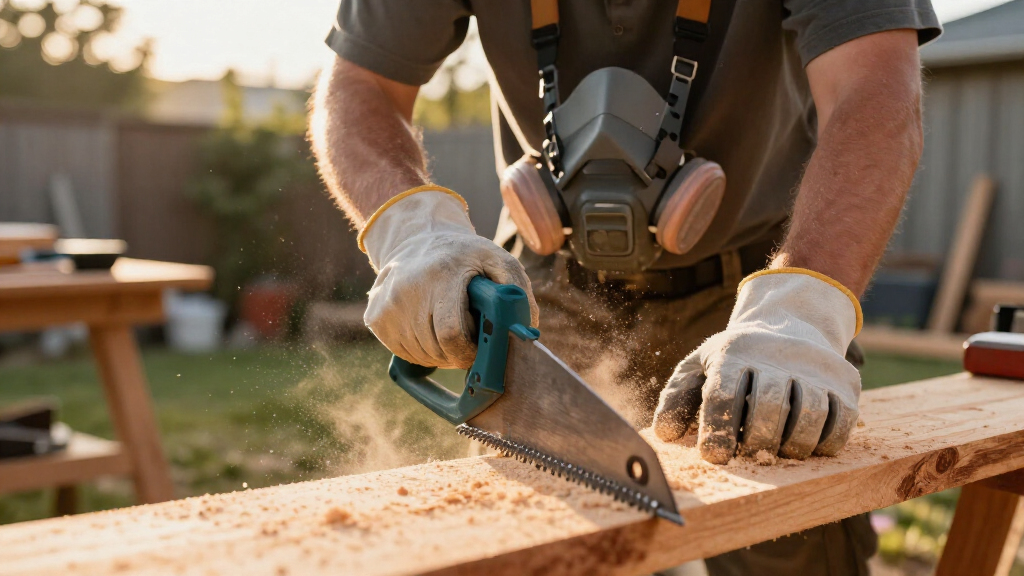
An N95 is the right tool for routine nuisance dust: mowing, trimming, blowing leaves, spreading mulch, cutting firewood outside. It catches pollen, grass fragments, soil dust, and non-oil particulates at 95%+ efficiency, and it’s cheap enough that you’ll actually wear it instead of skipping it because you don’t want to ruin a $40 mask.
Take a standard late-spring mow. You’re kicking up pollen, dried clippings, and topsoil. Nothing oil-based, nothing biologically nasty at concentration. An N95 — worn correctly, sealed to your face — knocks that down plenty. Pair it with safety glasses and you’ve handled 90% of residential mowing hazards.
Where N95s fall apart fast:
- Extended wear in heat — disposable masks soak through with sweat and lose their shape
- Any oil-based aerosol — the N-rated media degrades around oil mist, like from a two-stroke blower’s exhaust plume
- Wet environments — a soaked N95 collapses and leaks
- Beards and stubble — facial hair breaks the seal and tanks that 95% number fast
Buy the strap-behind-the-head versions, not ear-loop style. Ear loops never hold a proper seal under a hat and safety glasses. And at $1–3 apiece, treat them as single-day disposables — once an N95 is loaded with dust or bent out of shape, it’s done.
As an affiliate, we earn on qualifying purchases.
Why Mold Cleanup Demands a P100 (and Goggles, Not Glasses)
Mold is where I stop messing around with disposables. Mold spores run 1 to 10 microns — the size range where filtration efficiency dips even on decent masks — and remediation work like ripping out moldy leaf litter, cutting rotted siding, or cleaning a mildewed shed concentrates them into the air you’re breathing at point-blank range. The CDC guidance on mold cleanup specifically recommends an N95 minimum, but Outdoor Pro Masters takes the more conservative line for anything beyond a square foot or two of growth: P100, every time.
Why the upgrade? Two reasons. First, the 99.97% capture rate matters most exactly where exposure is heaviest, and disturbed mold puts out enormous spore counts — millions of spores per cubic foot near the source. Second, a reusable half-mask with P100 cartridges seals dramatically better than a disposable, and fit is the weak link in every respirator setup.
Real-world example: cleaning out a chicken coop or a compost pile that’s gone anaerobic. That damp, musty smell is volatile organic compounds plus active fungal growth. You’re face-down in it with a shovel. An N95 that fits well will handle a lot of that, but the moment the job stretches past an hour or the material is visibly fuzzy, the P100 pays for itself.
One non-negotiable: with mold, wear sealed goggles, not vented safety glasses. Spores landing on your eyeballs are their own miserable problem, and a half-mask plus glasses leaves a gap at the nose bridge that a full-face respirator eliminates entirely.
reusable half-face respirator with P100 cartridges
As an affiliate, we earn on qualifying purchases.
As an affiliate, we earn on qualifying purchases.
Fumes, Sprays, and Smoke: Why Particles Aren’t the Whole Story
Here’s the trap that catches smart people: N95 and P100 ratings only cover particles, not gases or vapors. A P100 stops ash, soot, and oil mist beautifully. It does exactly nothing against carbon monoxide, gasoline vapors, or the fumes from an oil-based stain you’re spraying on the fence.
For fumes, you need a cartridge that chemically absorbs gases — organic vapor (OV) cartridges, often paired with P100 particulate filters in a combo cartridge labeled OV/P100. That’s the setup for spraying herbicides or pesticides, applying solvent-based finishes outdoors, or running a gas-powered pressure washer in a semi-enclosed carport.
Match the setup to the task:
- Wildfire smoke and ash — P100 particulate is the right call; it captures fine PM2.5 ash and is oil-proof
- Spraying pesticides or herbicides — check the product label; most require at minimum an NIOSH-approved respirator with organic vapor cartridges
- Refueling and small-engine exhaust — ventilation matters more than the mask; you can’t filter carbon monoxide with anything you wear on your face
- Painting or staining outdoors — OV/P100 combo cartridge
And read the pesticide label like it’s a contract, because it is. If it specifies a respirator, using less isn’t cutting a corner — it’s documented noncompliance with the product’s registered use. If the job involves enclosed spaces, gas lines, or anything structural, that’s when you call in a licensed professional rather than improvising with PPE.
organic vapor cartridges for respirators
As an affiliate, we earn on qualifying purchases.
As an affiliate, we earn on qualifying purchases.
How to Get a Seal That Actually Works (60-Second Check)
A respirator that leaks protects you about as well as a tarp with a hole in it. According to NIOSH fit-testing research, facial hair alone at the seal line can cut effective protection dramatically — often to a fraction of the rated filtration. So before anything else: clean-shaven at the seal line, or accept reduced protection. That’s the trade.
Here’s the user seal check you should run every single time you don the mask:
- Don the mask and seat the nose clip firmly with both hands, molding it to the bridge of your nose.
- Positive-pressure check — cover the exhalation valve (or the front of an N95) with your palm and blow out gently. The mask should bulge slightly with no air leaking at the edges.
- Negative-pressure check — cover the filter cartridges or inhale sharply. The mask should pull slightly against your face and hold. If air sneaks in at the cheeks or nose, reseal.
- Move your head — side to side, up and down, talk out loud. The seal should hold through all of it.
- Recheck after sweat and extended wear — a mask that shifts under a hat brim or respirator straps loosened by a full workday needs reseating, not ignoring.
For anything beyond casual weekend use — big mold jobs, heavy spraying, commercial property work — OSHA recommends a formal fit test with a qualitatively or quantitatively verified seal. That’s overkill for raking, sure. But if you’re doing this for a living or on a serious remediation, it’s the difference between rated protection and a number on a box.
Disposable vs. Reusable: The Honest Cost Math
Disposable masks look cheaper until you run the numbers over a season. Say you’re out in the yard 20 times a year on dusty work. Twenty N95s at $2 each runs $40 a season, and you’ll toss half of them early because sweat or a crushed shape ruined the seal.
A reusable half-mask runs $30–45, with P100 cartridge pairs at roughly $10–15 that last weeks of intermittent use. By season two, the reusable setup is cheaper, it fits better, and replacement filters mean you’re never wearing a degraded mask out of frugality.
My honest breakdown after years of acreage maintenance:
- Occasional mowing and leaf duty — keep a box of N95s by the door; you’ll actually wear what’s convenient
- Weekly dust exposure or seasonal allergies — reusable half-mask with P100s; your sinuses will thank you by Wednesday
- Mold, ash, or any spray work — reusable P100 or OV/P100, non-negotiable
- Heavily soiled or damp conditions — full-face respirator; it protects eyes and eliminates the nose-bridge leak in one move
Swap cartridges when breathing gets noticeably harder or per the manufacturer’s schedule — whichever comes first. Store the mask in a sealed bag away from the garage’s fuel shelf, because cartridges absorb vapors from the air even when you’re not wearing them. A mask living next to the gas can is quietly using up its own capacity.
The Full Yard-Work Protection Setup (Not Just the Mask)
The respirator is one piece. Pair it wrong and you’ve protected your lungs while leaving everything else exposed. For a typical dusty or moldy yard job, the minimum kit is respirator, sealed or wraparound eye protection, gloves matched to the hazard, and long sleeves you wash separately after mold work.
Concrete scenario: you’re tearing out a moldy playset structure that’s been rotting behind the shed for a decade. Pressure-treated wood dust, mold, maybe old hardware. That’s a P100 half-mask, full goggles, leather gloves, and a long-sleeve shirt that goes straight into the wash — not back into the closet next to your work jacket. Bag the debris wet to keep spores from re-aerosolizing on the trip to the trailer.
Two flags that mean stop and call a pro: visible mold over roughly 10 square feet, and anything involving suspected asbestos in old siding or pipe insulation you might disturb during landscaping. Neither is a weekend-warrior job, and no filter rating changes that. Same goes for electrical work near your cleanup zone — kill the power at the breaker before cutting anything apart, and bring in a licensed electrician if the project touches wiring.
Finally, hydrate. A P100 adds breathing effort, and on a 90-degree afternoon that adds up to heat stress faster than most people expect. Pace yourself, take the mask off in clean air during breaks, and store it where the next sweaty Saturday version of you can find it easily.
Frequently Asked Questions
Can I use an N95 mask for mold or dust in my yard?
Yes for ordinary dust and pollen, and NIOSH/CDC guidance allows an N95 minimum for small mold jobs. For visible mold, prolonged exposure, or concentrated spore clouds — like ripping out moldy leaf litter or rotted wood — a P100 offers meaningfully better protection at 99.97% filtration and a more reliable seal in a reusable half-mask.
Do I really need a respirator for mowing or leaf blowing?
Nobody’s going to write you a ticket, but the dust and pollen cloud behind a mower or blower is exactly what N95s are built for. If you get congested or sneezy after yard work, that’s your answer — a properly fitted N95 at $2 is the cheapest allergy medicine on the market.
What’s the actual safety difference between N95 and P100?
P100 filters 99.97% of particles and is oil-proof; N95 filters at least 95% and has no oil resistance. Per 10,000 particles, an N95 passes about 500 and a P100 passes 3 — roughly a 60x difference in what reaches your lungs. P100 media is denser, so breathing takes slightly more effort.
Are reusable respirators better than disposable masks?
For frequent yard work, yes — better seal, lower long-term cost (typically cheaper by the second season of regular use), and replaceable filters mean you’re never wearing a degraded mask. For occasional mowing, a box of N95s wins on convenience, which is its own form of safety.
How do I know if my respirator fits correctly?
Do a seal check every time: cover the exhaust and blow out gently (mask should bulge, no edge leaks), then inhale sharply with the filters covered (mask should pull against your face and hold). Facial hair at the seal line breaks the fit — NIOSH research shows even stubble measurably cuts protection. If you can’t pass the check, reseat it or size up.
Will an N95 or P100 protect me from pesticide or paint fumes?
No — particulate ratings only stop particles, not gases or vapors. For spraying pesticides or applying solvent-based finishes, use a cartridge rated for organic vapor, usually a combo OV/P100. Check the pesticide label; the specified respirator is a legal part of the product’s registered use. And no respirator filters carbon monoxide from engine exhaust.
Conclusion
Match the mask to the hazard, not to whatever’s in the junk drawer. Dust and pollen get an N95; mold, fine dust, and fume-adjacent work get a P100 — with organic vapor cartridges when chemicals enter the picture. And a perfect rating on a leaking mask is worth almost nothing, so the seal check is not optional.
Here’s the image to carry with you: every particle an N95 misses, you keep. A P100 misses one in every 10,000. On a dry, dusty acre with a moldy shed in the corner of it, that’s the difference between blowing out gray for two days and finishing the job with clear sinuses and a full Saturday left. Spend the $40. Your lungs don’t get replaced.
Fall yard work Picks
leaf blowers
As an affiliate, we earn on qualifying purchases.