
TL;DR

Get business pricing on tools and workshop supplies
- Business-only prices and quantity discounts
- Tax-exempt purchasing
- Multiple users, one account, clear invoices
Boots for saw work need to match the saw hazard, worksite, and rules: a steel toe protects against impact and compression at the toe, but it does not provide chainsaw cut protection. Check the applicable certification, protection class and coverage, then choose tread and fit for your terrain and hours on your feet. Boots reduce risk; they do not replace training or the rest of your required PPE.
A steel toe can take a blow from a dropped log and still leave the rest of your foot exposed to a moving chain. That gap matters when you’re bucking storm-fallen limbs, clearing brush along a fence line, or running a saw on wet ground.
Boots for saw work need to address more than one hazard at once: impact, cuts, sharp debris, slippery footing, and long hours over uneven terrain. This guide explains what toe protection can and can’t do, how to check chainsaw-specific markings, and how to choose grip and fit for the job you actually have.
You’ll also see why a rating is a test category rather than a promise against every injury, and why a boot that fits badly can distract you at the wrong moment. The goal is practical: know what to check before you work, and when a boot no longer deserves your trust.
A steel toe protects against impact and compression at the toe; it does not provide chainsaw cut protection.
Check the applicable saw-footwear standard, stated class, and protected areas in current manufacturer documentation.
ASTM F2413 and EN ISO 20345 cover general safety footwear requirements; they do not by themselves establish chainsaw protection.
Choose tread for your real terrain, keep it clean, and replace boots when soles or protective structures deteriorate.
Try boots with your work socks and confirm heel hold, toe room, and comfortable movement before a long day.
Boots for Saw Work Toe, Cut and Grip
A safety toe helps protect against impact and compression, but does not provide chainsaw cut protection. Match certified footwear, tread and fit to the task and worksite.
Four checks before work
Use the task, rules and terrain to guide your choice.
Confirm workplace requirements and the saw hazard.
Check the applicable marking, class and covered areas in current documentation.
Choose tread, heel stability and support for your terrain.
Try work socks; check toe room, heel hold and comfortable movement.
Protection has separate jobs
One boot feature cannot stand in for another.
| Feature or marking | What it addresses | What it does not establish |
|---|---|---|
| Safety toe | Impact and compression at the toe | Chainsaw cut protection |
| ASTM F2413 or EN ISO 20345 | General safety footwear requirements | Chainsaw protection by itself |
| ASTM F1818 or applicable EN ISO 17249 class | Saw footwear test category | Protection from every saw or contact condition |
Choose grip for the worksite
Ground conditions challenge soles in different ways.
Mud and loose soil
Deep lugs can help bite into soft ground.
Hard ground and gravel
Choose a tread that feels stable on the surfaces you actually cross.
Wet grass and slopes
Look for a stable heel; keep soles clean. No tread is slip-proof.
Fit and wear affect movement
A poor fit can shift, hurt or distract you during demanding work.
- Try boots with the socks you plan to wear.
- Check toe room, heel hold and secure ankle support without restricted movement.
- Break boots in before demanding work.
- Replace them when the sole, seams, protective structure or fit deteriorate; follow manufacturer care guidance.
Why a steel toe alone leaves a chainsaw-sized gap
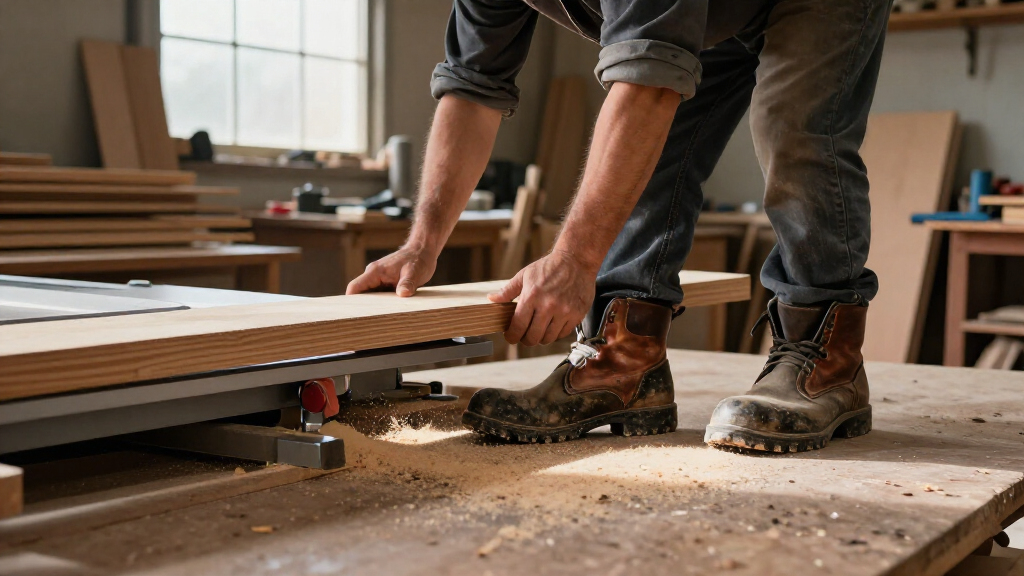
Boots for saw work must match the hazard at the front, sides, and top of the foot: a steel safety toe handles impact and compression at the toe, but it does not protect the instep, sides, or lower leg from a moving chain. Those are separate jobs for purpose-designed chainsaw footwear and the rest of your protective equipment.
That difference is easy to miss when two boots look equally tough on a shelf. A heavy leather upper and a reinforced toe can feel reassuring, but appearance doesn’t tell you whether the boot has tested saw protection or which areas it covers. For chainsaw and other saw work, read the boot’s marking and its manufacturer documentation, not just the product name.
Chainsaw-protective designs can use layers of fibers intended to clog or slow a moving chain, plus protective panels around vulnerable areas. Coverage varies by model. If your planned work involves cutting low branches near your boots, check whether the documentation says the relevant area is covered; don’t assume the whole boot is protected because one panel is rated.
Say you’re clearing a fallen maple from a driveway. A log can roll toward your foot while your saw creates a different hazard nearby. The toe rating helps with the rolling log; it does not make contact with the chain safe. Cut protection reduces risk, not eliminates it, so safe saw technique and required PPE still matter.
Popular right now

Breville Barista Express Espresso Machine with Built-In Grinder, Brushed Stainless Steel

Ninja Luxe Café Mini Espresso and Drip Coffee Machine, Stainless Steel, ES301

Dreame D30 Ultra CE Robot Vacuum and Mop
As an affiliate, we earn on qualifying purchases.
How to read a chainsaw boot rating without overtrusting it
Boots for saw work should carry the applicable saw-protection marking for your country and task; a general safety-toe label is not a substitute. In the United States, chainsaw footwear may be certified under ASTM F1818. In Europe and other markets, check for the applicable EN ISO 17249 requirements and the stated protection class.
A class or chain-speed rating describes a defined test category. It does not mean the boot can safely stop every saw, at every speed, angle, or point of contact. Treat the rating like a boundary on a map: useful for choosing equipment, but not permission to wander beyond the conditions the manufacturer specifies.
General workplace footwear standards cover a different question. ASTM F2413 in the U.S. and EN ISO 20345 in Europe address safety footwear requirements, including areas such as toe protection. Those markings do not, by themselves, establish chainsaw cut protection. Check the exact marking, certification, intended use, and coverage in the current documentation.
For example, if you maintain a small wooded lot and use a saw only after storms, your employer or local rules may still specify a particular class. A professional arborist working around frequent cuts and changing positions may face different requirements. In both cases, compare the required class with the saw and task, and ask a qualified safety supplier if the markings are unclear.
A rating is evidence of a defined test, not a promise of invulnerability. Match it to the job and follow the manufacturer’s instructions.
Which boot features matter for cuts, impact, and grip?
Boots for saw work balance three distinct protections: cut-resistant construction for saw exposure, a safety toe for impact and compression, and an outsole suited to the ground beneath you. One feature does not stand in for another. A boot can have a protective toe and poor grip, or strong tread and no chainsaw rating.
Look for the certification and protection class first, then read what the maker says about protected areas. Check toe protection separately. Finally, consider sole pattern, heel stability, waterproofing, weight, insulation, and breathability for the conditions you face. The right mix for a muddy acreage in November may feel clumsy on hard, dry ground in summer.
Newer models may use lighter cut-resistant fibers, composite safety toes, waterproof membranes, or more ergonomic lasts. Those features can help with weight or comfort, but a material name or marketing phrase is not a safety rating. The useful evidence remains the certification, class, coverage, and care instructions for that specific model.
Imagine a day spent moving between a wet lawn, a gravel drive, and a woodpile. A deep lug may bite well in soft mud, while a more adaptable tread may feel steadier on hard or mixed surfaces. Check the outsole description against your real terrain, and remember that no tread is slip-proof. Choose for the surface you’ll work on, not for a generic “heavy-duty” label.
Match tread and support to the ground under your feet
Grip is part of saw safety because a protective upper can’t help much if you lose your footing while handling a running saw. Wet grass, mud, loose bark, sawdust, rocks, slopes, and oily surfaces each challenge a sole differently. Choose tread and heel shape for the ground you actually work on, and keep the outsole clean enough to do its job.
Deep lugs often help in soft ground because they can bite into mud and loose soil. On hard or mixed surfaces, a lug pattern that feels secure on a trail may feel awkward or unstable. There isn’t one best pattern for every site. If your property has a muddy orchard and a paved approach, make the compromise deliberately and test the boots on safe ground before a demanding shift.
A stable heel and secure ankle support matter when you step over a branch or work on a gentle slope. But stiff support that restricts movement can make climbing, kneeling, or changing direction harder. For instance, if you’re cutting a storm-fallen limb across a sloping ditch, a boot that grips and flexes predictably helps you keep your balance while you reposition.
Inspect the soles before work, brush away packed mud and sawdust, and replace boots when the tread wears smooth or the heel becomes unstable. “Slip-resistant” is not a guarantee across every surface. Clean, unworn tread matched to the terrain is a more useful safety check than a label alone.
Use this four-step check before you buy or wear a pair
Boots for saw work should pass four checks before you trust them on the job: task and rules, verified protection, terrain and features, then fit and condition. This order keeps comfort or a reassuringly chunky look from distracting you from the actual protection requirement.
- Define the work. Note the saw, the kind of cuts, the ground, and whether the task is occasional property maintenance, forestry, logging, or professional arboriculture. Check local rules, employer policy, and equipment instructions.
- Verify markings and coverage. Look for the applicable chainsaw footwear standard and class, then confirm which parts of the boot it protects. Check any toe rating separately.
- Match the boot to the site. Compare tread and heel design with mud, bark, slopes, rocks, or hard surfaces. Consider weight, waterproofing, insulation, and breathability alongside protection.
- Check fit and condition. Try the boots with your work socks. Confirm heel hold, toe room, and comfortable ankle movement. Inspect the sole, seams, and upper before work.
For example, a landowner cutting a few storm-damaged limbs may have different exposure and workplace rules from a logging crew working all day on uneven ground. Neither should guess: both should check what the task and local requirements call for, then choose from boots that meet those requirements.
If your work calls for gaiters or other protective gear, check that the pieces work together as the manufacturers intend. Don’t cut, glue, or add parts to protective footwear unless the maker explicitly allows it. Fit, certification, and job match should all check out before the first cut.
Get a secure fit that won’t distract you halfway through a cut
A safe fit holds the heel, leaves toe room, and lets you move without pain or numbness. A boot that shifts underfoot can throw off a step; one that pinches can turn discomfort into a distraction. Since saw work often means hours on uneven ground, comfort is a working feature, not a luxury.
Try boots on with the socks you plan to wear. Walk, bend your knees, and check that your heel stays put while your toes have room to move. If your feet swell as the day goes on, try them later in the day too. A boot that feels fine for five minutes in a shop may feel very different after a long spell cutting and carrying wood.
Weight and flexibility affect fatigue, while insulation and waterproofing change how warm or dry your feet stay. Tradeoffs are real: waterproof footwear may feel hotter in mild weather, and a lighter boot may not suit every job or protection requirement. A worker crossing a damp field for several hours may value a waterproof membrane; someone working in warm weather may care more about breathability, if the required protection remains suitable.
Break in new boots before demanding work, following the maker’s guidance. A short walk around the property can expose rubbing before you’re carrying a saw. Keep an eye out for hot spots, pressure across the toes, or ankle movement that feels restricted. Comfort that supports steady movement helps you keep your attention on the work.
Know when your boots need care or retirement
Replace saw-work boots when the sole, upper, seams, fit, or protective structure deteriorates, or when the manufacturer’s retirement guidance says to. A boot can look serviceable from a few feet away while its tread has worn smooth or its fit has changed. Damage may not always show clearly on the outside.
Before work, check the tread for worn lugs and packed debris, the seams for separation, and the upper for cuts, tears, or damage to protective areas. Also notice whether the heel still holds securely and the boot feels the same on both feet. After a day cutting brush near a stone wall, for example, inspect for scuffs and punctures that could hide a deeper problem.
Follow the maker’s cleaning and storage directions. Waterproofing can wear down and may need maintenance; harsh cleaning or an unapproved repair can affect materials. Don’t add aftermarket toe caps or cut-resistant inserts unless the boot manufacturer explicitly approves them for that model and use. Add-ons can interfere with fit, coverage, or certification.
If a boot has taken a hard hit or the protective layers look damaged, ask the manufacturer or a qualified safety supplier how to assess it. When its protective structure is in doubt, don’t treat it as ready for another shift. Retire questionable footwear before it becomes the weak link in a set of protective equipment.
Pair your boots with the rest of your saw PPE
Boots are one part of saw PPE; the rest depends on the task, workplace rules, equipment instructions, and local requirements. Depending on the work, that may include chainsaw-protective trousers or chaps, gloves, eye and face protection, hearing protection, and a helmet. Boots cannot protect your legs, eyes, or hearing on their own.
Think through a typical property job: you’re cutting a fallen limb at knee height while chips fly and the wood shifts as you release tension. Your footwear addresses hazards at the feet, but you still need the protective gear required for the saw and work conditions. Follow your training and the saw manual, and make sure the equipment fits and works together as intended.
Some workplaces require boots to integrate with gaiters or other protective gear. Check compatibility before the workday, and don’t modify boots or other protective equipment unless the maker permits it. A small adjustment made for comfort can change coverage or interfere with a certified design.
For roof, electrical, gas, or structural work around a property, use licensed professionals where required and follow relevant code and permit rules; saw boots don’t make those jobs safe to tackle without the right qualifications. For ordinary ground-level saw work, the practical habit is simpler: check the whole kit before starting, from footwear and leg protection to eye and hearing protection. Reliable PPE works as a system, with training and safe work practices behind it.
Frequently Asked Questions
Are steel-toe boots enough for chainsaw work?
No. A steel toe protects the front of the foot from impact and compression, but it does not provide chainsaw cut protection. Check for the applicable saw-footwear certification and stated coverage, along with any required toe rating.
Do chainsaw boots stop a chainsaw?
They are designed to reduce injury risk under specified test conditions, not to guarantee that every chain contact will be harmless. Protection depends on the boot’s model, coverage, condition, and the circumstances of contact. Follow the manufacturer’s instructions and safe work practices.
What chainsaw boot rating do I need?
Use the class required by your local rules or employer and match it to the saw and task. ASTM F1818 may apply in the United States; in Europe and other markets, check the applicable EN ISO 17249 requirements. A class describes a test category, not universal protection at every chain speed or angle.
Are chainsaw-protective boots waterproof?
Some models are waterproof, while others give more weight to breathability or a lighter feel. Check the product documentation and care directions. Waterproofing can wear down and may need maintenance.
How should chainsaw boots fit?
They should hold your heel securely, leave suitable room at the toes, and feel comfortable with the socks you wear for work. Walk and bend in them to check movement, and try them later in the day if your feet swell during activity.
When should I replace saw-work boots?
Replace them when the sole is worn, the upper or protective areas are damaged, seams fail, the fit changes, or the manufacturer’s retirement guidance calls for it. If damage is hard to judge, ask the manufacturer or a qualified safety supplier.
Can I add aftermarket toe caps or cut-resistant inserts?
Only if the boot manufacturer explicitly approves the accessory for that model and use. An add-on can affect fit, coverage, or certification, so check the manufacturer’s documentation before modifying protective footwear.
Conclusion
Before your next saw job, check the required saw-protection marking and coverage, match the tread to your ground, and walk in the boots with your work socks. A steel toe can help with a dropped piece of timber, but it cannot make an unrated boot chainsaw protective.
Choose by verified protection, grip, fit, and condition. Then let your boots do their part while training, sound technique, and the rest of your PPE cover the hazards they can’t.