
TL;DR

Get business pricing on tools and workshop supplies
- Business-only prices and quantity discounts
- Tax-exempt purchasing
- Multiple users, one account, clear invoices
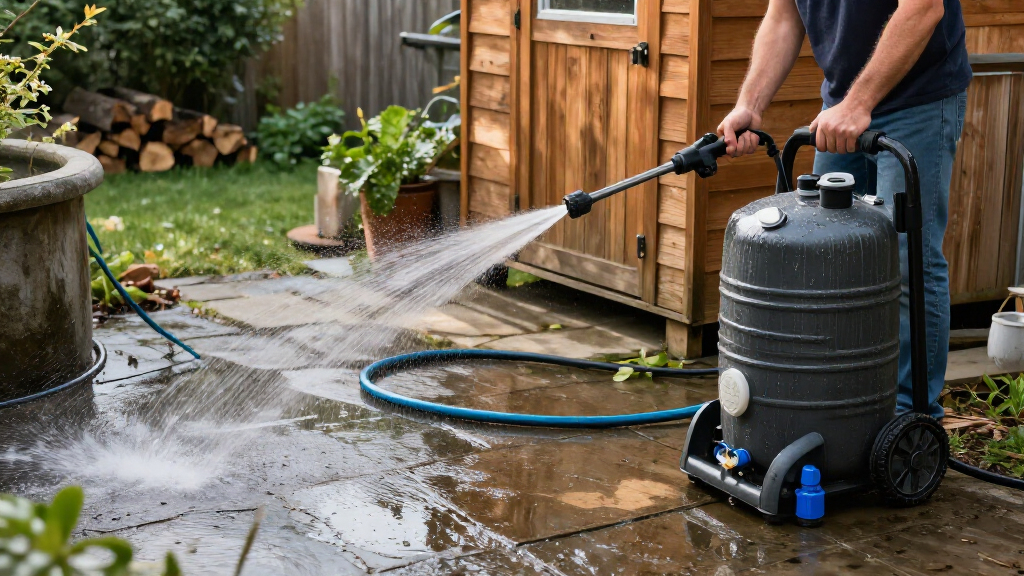
To run a pressure washer from a tank or well, compare the washer’s required inlet flow with the water the source can sustain under working conditions. A buffer tank can bridge a temporary flow shortfall if the washer permits that feed and the tank has enough usable water; size it from the shortfall and planned runtime, then follow the machine manual and local plumbing rules.
A pressure washer can have plenty of PSI and still run short of water. When the inlet supply falls behind the pump, the spray may pulse, the motor may sound strained, and the machine can suffer damage. The number that matters first is steady inlet flow, measured in gallons per minute, not the pressure printed on the wand or product label.
This guide shows you how to check a tap or well, calculate a tank’s working reserve, and tell when gravity feed or a transfer pump is allowed. You’ll also see why a buffer tank is a bridge between supply and demand, not a water source that never runs dry. That distinction matters on a long driveway, a remote barn, or any acreage where a garden tap cannot keep pace.
Use the washer’s rated inlet GPM as your starting point; PSI does not show whether the source supplies enough water.
Measure a tap or well with a timed volume test under realistic household and hose conditions.
Estimate usable buffer volume as (washer GPM minus source refill GPM) multiplied by planned continuous minutes, then add reserve.
Gravity feed and transfer pumps are acceptable only when the washer manufacturer permits the arrangement and inlet limits are respected.
Stop if pressure pulses, flow drops, or a well pump cycles rapidly; check the supply before continuing.
Running a Pressure Washer From a Tank or Well
A buffer can bridge the gap between source flow and washer demand. Size it by gallons per minute and working time: pressure on the label cannot tell you whether the pump is getting enough water.
Match inlet flow before chasing pressure
Use the rated inlet flow and manual limits as your starting point. Build in a little margin for real hoses, fittings, filters, and other water use.
Find rated GPM
Check the manual or machine label for inlet flow in GPM or L/min. The washer needs that flow continuously while operating.
Read inlet requirements
Confirm minimum and maximum inlet pressure, allowed water temperature, filtration needs, and whether tank feeding is approved.
Allow for losses
A long or narrow hose, restrictive fittings, a clogged screen, or simultaneous household use can reduce the flow that reaches the pump.
Pulsing pressure, falling flow, a strained sound, or rapid well-pump cycling can signal water starvation. Release the trigger and check the source before continuing; low inlet flow can overheat or wear the pump.
Test under working conditions
Static pressure and a pump label do not prove sustainable flow. Measure water delivered over time using the hose, filter, and fittings you plan to use.
Bucket ÷ minutes = GPM
Collect a known volume for a measured interval, such as 30 seconds. Five gallons in 30 seconds equals 10 GPM. Repeat if results vary.
Include real household demand
Test with typical uses in mind. Watch for pressure drops or rapid cycling. Repeated short cycling or a falling water level needs attention from a qualified well professional.
Illustrative example: the washer draws 1.5 gallons per minute more than the source refills. The tank covers that temporary difference.
A tank is a bridge, not a new water source
Calculate usable volume for the planned continuous run. Add a reserve because the full nameplate capacity may not be available at the outlet.
22.5 gallons before reserve
Shortfall: 4 − 2.5 = 1.5 GPM. For 15 minutes, 1.5 × 15 = 22.5 gallons of usable water, plus a practical margin.
30 usable gallons buys about 20 minutes
At a 1.5 GPM shortfall, 30 ÷ 1.5 = 20 minutes, assuming the source refill rate holds and the tank outlet can supply the washer.
Short wash passes with refill pauses may reduce the needed reserve. A long uninterrupted run uses the buffer faster. A large tank can still empty if demand exceeds refill for long enough.
Gravity or transfer pump? Follow the manual.
Machines differ. Confirm the manufacturer allows the setup and keep inlet pressure within the stated limits.
| Feed arrangement | Can help when | Check before connecting | Watch for |
|---|---|---|---|
| Tap or well direct | ✓ Sustained source flow meets demand | Timed flow test, hose losses, household use | Pressure drop or rapid well cycling |
| Gravity-fed tank | ~ Manual permits a flooded or gravity inlet | Minimum inlet pressure, outlet size, usable volume | Height alone may not provide reliable flow |
| Transfer pump + tank | ~ Approved pump can meet inlet flow | Compatibility, flow, electrical supply, max pressure | ✗ Excess pressure can exceed machine limits |
Use a simple, generous supply line
Keep the hose short and large enough. Avoid tight bends, restrictive valves, undersized fittings, and clogged or overly restrictive filters.
Keep the tank clean and covered
Screen debris as the washer maker requires. Prevent contamination and freezing, and use the backflow arrangement required by local plumbing rules.
From source check to safe run
Measure, calculate, confirm compatibility, then monitor the system while washing.
Find demand
Read the required inlet GPM in the manual.
Measure refill
Run a timed volume test in realistic conditions.
Subtract
Demand minus refill gives the drawdown rate.
Multiply
Drawdown × continuous runtime estimates the shortfall.
Add reserve
Allow for unusable volume and variable conditions.
Match the washer’s water demand before you chase PSI
Running a pressure washer from a tank or well works when the inlet can supply the machine’s rated flow continuously, with a little margin for real-world losses. Find the required inlet rate in the manual or on the machine, usually listed in GPM or litres per minute. Output PSI describes cleaning pressure; it does not tell you whether the pump is receiving enough water.
Say your washer is rated for 2.5 GPM. A tap that delivers 2.5 GPM in a quick bucket test may be marginal once you add a long hose, a filter, elbows, or other household use. The washer does not care that the pressure gauge looked healthy before you pulled the trigger. It needs water at or above its specified inlet flow while it is operating.
Read the manual for minimum inlet pressure, maximum inlet pressure, allowed inlet temperature, and whether the maker approves a tank feed. Some machines need positive pressure at the inlet; others allow a flooded supply. Do not assume the pump can draw water like a garden transfer pump. If the manual is unclear, ask the manufacturer before connecting a tank.
For example, you might be cleaning a muddy 200-foot farm lane with a gas washer that runs at 3 GPM. A low-flow tap may appear fine while you rinse a small patio, then falter during a longer, uninterrupted pass. Plan around the machine’s demand and your longest work interval, rather than the brief moment when the hose first fills.
Popular right now

Dreame L40 Ultra Gen 2 Robot Vacuum and Mop

Dreame L50 Ultra Robot Vacuum and Mop

Philips 3300 Series Fully Automatic Espresso Machine with LatteGo Milk System
As an affiliate, we earn on qualifying purchases.
Measure the tap or well while the washer would be working
To check a water source, measure the volume it delivers during a timed interval under realistic conditions, then compare that flow with the washer’s inlet requirement. Static pressure and a well-pump label cannot prove that a source can maintain flow during washing. A timed bucket test gives you a practical first reading.
Put a container with known volume under the hose or tap and run water for a measured time, such as 30 seconds. If you collect 5 gallons in 30 seconds, the rate is 10 GPM: gallons collected divided by minutes elapsed. Repeat the test if the result varies, and test the same hose, filter, and fittings you expect to use at the washer.
For a well, include the pressure tank and household demand in the picture. A test with no one using water may look strong, then drop when a shower starts or an irrigation zone opens. If you can, test while typical household uses are running and observe whether pressure falls or the pump cycles rapidly. A falling well level or repeated short cycling calls for attention from a qualified well professional.
Picture a rural property where the tap fills a 5-gallon pail in 90 seconds. That is about 3.3 GPM, before hose losses. A 4 GPM washer would outdraw it by roughly 0.7 GPM, so a buffer could help during a short wash. If the source is a well that already struggles to recover, a tank only buys time; it does not fix the well’s sustainable yield.
Size a buffer tank from the shortfall and runtime
A buffer tank should hold the water your washer uses above the source’s refill rate during the planned run, plus a reserve. Calculate the shortfall as washer demand minus incoming refill flow, then multiply by the intended continuous runtime. This estimates usable water, not the tank’s nameplate capacity.
Here’s a worked example: the washer uses 4 GPM, the source refills at 2.5 GPM, and you want 15 minutes of uninterrupted washing. The shortfall is 1.5 GPM; over 15 minutes, that is 22.5 gallons. Add a practical reserve because not every gallon in a tank is necessarily available at the outlet, and because measured flows and work patterns vary. A tank with 30 gallons of usable water would cover about 20 minutes at that shortfall, assuming the refill rate holds.
Use this simple sequence to estimate your setup:
- Find demand: use the washer’s rated inlet GPM.
- Measure refill: test the source under expected conditions.
- Subtract: demand minus refill gives the drawdown rate.
- Multiply: drawdown rate times continuous runtime gives the shortfall volume.
- Add reserve: account for unusable volume and a sensible margin.
Suppose you’re rinsing a long fence in 10-minute passes, then stopping to move hoses and inspect the work. Your real duty cycle may let the source refill between passes. But if you plan to hold the trigger for 30 minutes, size for that longer run. A large tank can still empty if the washer draws faster than the source replenishes it.
Choose gravity feed or a transfer pump by the manual
Gravity feed is suitable only when the washer maker permits it and the tank can deliver the required inlet flow and pressure. A raised tank may create some inlet pressure, but it cannot guarantee that a particular washer will operate reliably. Check the manual for a permitted flooded or gravity-fed inlet and any minimum pressure requirement before plumbing the setup.
A basic gravity arrangement places a clean, covered tank above or near the washer, with a generously sized outlet and a short, large-diameter supply hose. Keep the route simple: tight bends, undersized fittings, a restrictive valve, or a clogged screen can choke flow. The tank’s outlet needs to supply the washer, while a float valve or refill connection restores water as the washer draws it.
A compatible transfer pump can help when gravity cannot provide the inlet pressure or flow the machine requires. It must be approved for the arrangement, match the needed flow, and stay below the washer’s maximum inlet-pressure limit. More pressure is not automatically better. A pump that pushes too hard can exceed the machine’s limit, while an undersized one can still leave the pressure washer starved.
For instance, a crew washing equipment beside a barn might use a ground-level tank and find gravity feed unreliable. A manufacturer-approved transfer pump may solve the inlet problem, provided its electrical supply and protection suit the location. Keep electrical connections dry and protected, and have a licensed electrician handle new wiring or fixed electrical work. A diagram on a forum cannot replace the washer manual or local plumbing requirements.
Gravity-fed concept: covered tank → outlet valve and screen → short, adequately sized hose → washer inlet. Pumped concept: covered tank → compatible transfer pump → required filtration and controls → washer inlet. These are conceptual paths, not universal plumbing plans; use the machine’s specified inlet fittings and any required backflow arrangement.
Protect the pump from air, grit, heat, and restricted hoses
A washer pump needs a steady supply of water at or above its specified inlet flow; starvation can cause erratic pressure, overheating, cavitation, and premature wear. If the spray surges or pressure drops while the trigger is held, release the trigger and stop to find the cause. Continuing to run a pump without adequate water can turn a simple supply problem into an expensive repair.
Keep the tank clean and covered so leaves, insects, and grit do not reach the inlet. Use the inlet filter the manufacturer calls for, but do not add a fine or undersized filter that restricts flow. A dirty screen can be the hidden bottleneck: the hose looks full, yet the pump receives less water than it needs.
Choose a short supply hose with enough diameter for the machine and route it without kinks. Check the tank outlet, valves, quick-connects, and any float hardware too. Every fitting adds resistance. On a hot day, a long hose lying in the sun can warm its contents; stay within the washer’s stated inlet-temperature limit rather than assuming warm water is harmless.
Imagine the washer pulsing while you clean a stone wall. First check whether the tank level has fallen near the outlet, then inspect the screen and hose for a kink or blockage. If the source is a well, watch for rapid pump cycling or a sustained pressure drop. Those signs mean pause the wash and investigate; they are not a cue to keep squeezing the trigger harder.
Protect water quality and the plumbing, too. Prevent stored water from freezing, and use an appropriate backflow arrangement where local rules require one. A covered tank protects water from debris, but it does not by itself make a connection safe from contamination. Follow local plumbing requirements and the equipment maker’s instructions.
Use a tank when the shortfall is temporary, not endless
A buffer tank is useful when the supply is slower than the washer for a limited working period, because stored water covers the difference while the source refills it. It cannot produce water or make an inadequate source sustainable for an unlimited shift. You need to know both the available usable volume and the refill rate.
That distinction matters on a property with several acres to clean. If a 3 GPM source feeds a 4 GPM washer, the tank loses about 1 gallon each minute of continuous use. A 25-gallon usable reserve provides roughly 25 minutes before accounting for a safety reserve or variation in actual flow. With trigger-off breaks, the tank may recover; with nonstop washing, it will not.
Battery and gas machines face the same basic inlet-flow requirement. A battery model may have shorter working intervals or lower output, while a gas unit may keep running through longer passes. Neither power source changes how much water the pump needs at its rated flow. Match the supply to the actual washer, then plan the refill around your runtime and duty cycle.
For a practical job plan, group work into manageable passes. Wash one section of siding, release the trigger while you reposition the ladder or hose, and let the tank recover if its inflow allows it. If the task demands continuous operation beyond the tank’s reserve, improve the source or choose an approved setup that can sustain the demand. Do not solve a long-term water shortage by buying a larger tank without checking how quickly it will refill.
Frequently Asked Questions
Can I run a pressure washer from a water tank?
Often, if the washer manual allows tank feeding and the setup supplies the required inlet flow and pressure. Use a clean, covered tank and a hose and outlet that do not restrict flow. A tank can buffer a shortfall, but it will empty if demand exceeds refill for long enough.
How big should a pressure washer buffer tank be?
Size it from the difference between washer demand and source refill, multiplied by the planned continuous runtime, then add reserve for unusable volume and variation. For example, a 4 GPM washer supplied by a 2.5 GPM source draws down 1.5 gallons each minute. Fifteen minutes of continuous work needs 22.5 gallons of usable reserve before you add a margin.
Can I gravity-feed a pressure washer?
Some washers allow a gravity or flooded inlet, while others need positive inlet pressure and cannot reliably draw from an unpressurized tank. Check the manual for minimum inlet pressure and approved feed methods. Do not assume the pressure washer pump is a suction pump.
Can a domestic well run a pressure washer?
Yes, if the well system can sustain the washer’s flow alongside normal household uses. Measure delivered flow during realistic conditions and watch for pressure loss, rapid pump cycling, or a falling water level. If those signs appear, stop and have the well system checked.
Do I need a transfer pump between the tank and washer?
Only when the washer permits that arrangement and gravity cannot meet its inlet needs. Choose a pump that supplies the required flow without exceeding the washer’s maximum inlet pressure. Keep electrical equipment dry and protected; use a licensed electrician for fixed wiring or electrical changes.
What happens if the water supply is too small?
The washer may pulse, lose pressure, or run its pump hot, and continued starvation can cause damage. Release the trigger and correct the supply issue before resuming. Check the tank level, hose, fittings, inlet screen, and source flow.
Conclusion
Before you wash, compare the machine’s inlet GPM with the flow your tap or well can actually sustain. If the source falls short, size a clean buffer tank for the measured difference and the runtime you expect, then confirm the feed method with the manual. Water volume over time is the number that saves pumps.
Test the supply before the driveway or siding is half wet. A few minutes with a bucket and a timer can keep the washer humming steadily instead of coughing through a dry, expensive afternoon.