TL;DR

Get business pricing on tools and workshop supplies
- Business-only prices and quantity discounts
- Tax-exempt purchasing
- Multiple users, one account, clear invoices
Corded electric yard tools draw a startup surge 1.5–3 times their running wattage, so a power station must have a surge (peak) rating above that spike or it will shut down. Match each tool’s startup surge against the station’s peak rating, add a 20–25% buffer, and prefer modern inverter-based units for cleaner surge handling.
Your electric chainsaw runs at 1,800 watts. Your power station is rated 2,000 watts continuous. On paper, that’s a match. In the yard, the station trips offline the second you pull the trigger. That’s not a defect — that’s surge current doing exactly what it always does.
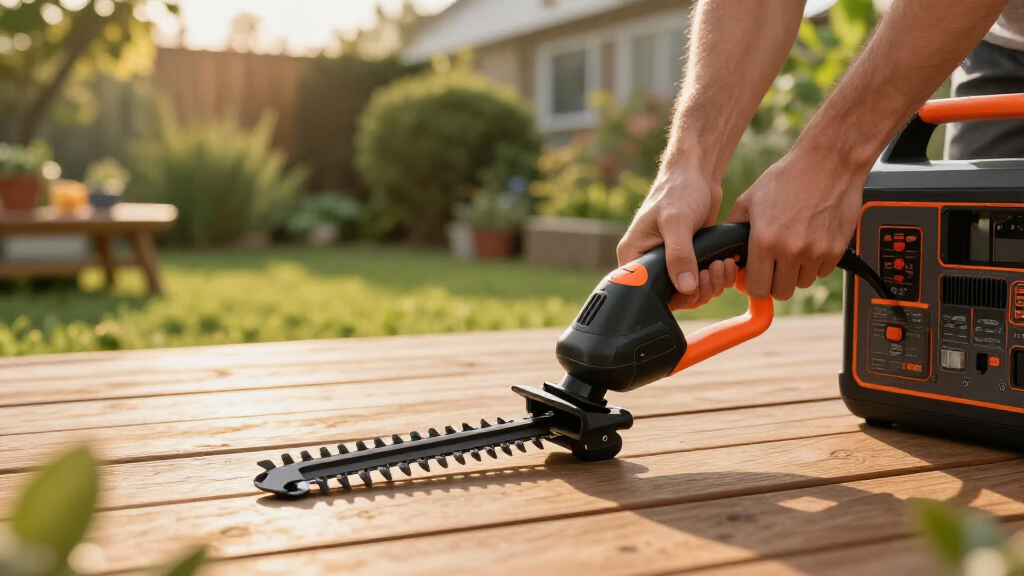
Electric motors don’t ramp up politely. They gulp. A cold chainsaw motor can demand 2–3 times its running current for the first fraction of a second, and if your power station can’t deliver that spike, it shuts down to protect itself. Understanding surge limits is the difference between a productive afternoon and a very expensive paperweight on wheels.
In this guide, you’ll learn how to read the specs that actually matter, do the startup-surge math for your own tools, and pick a power station that keeps running when the trigger gets pulled. No fluff — just the numbers and the habits that keep everything working.
Surge ratings beat continuous ratings for motor tools: electric chainsaws spike 2–3x running current, hedge trimmers 1.5–2x, and corded mowers about 1.5x at st…
Keep tool running watts at or below 75–80% of the station’s continuous rating, and tool surge below its peak rating with at least 10% cushion.
Start tools in free air before engaging wood or grass — starting under load adds surge penalty that trips marginal setups.
Battery state of charge reduces effective surge delivery; do heavy chainsaw work early in the discharge cycle, not at 25%.
Choose pure sine wave inverters only; modified sine wave makes motors run hotter and effectively increases surge demand.
Powering Corded Electric Yard Tools From a Power Station: Surge Limits
Electric motors don’t ramp up politely — they gulp. A cold chainsaw motor can demand 2–3 times its running current for the first fraction of a second. If your power station can’t deliver that spike, it shuts down to protect itself. Understanding surge limits is the difference between a productive afternoon and a very expensive paperweight on wheels.
“1,800W saw. 2,000W station. On paper, a match. In the yard, it trips the second you pull the trigger.”
That’s not a defect — that’s surge current doing exactly what it always does.What a Surge Limit Actually Is
A surge limit is the maximum power spike a power station can deliver for a short burst — usually under a second — before its inverter cuts out. Think of a bucket brigade: the continuous rating is how fast the crew can pass water all day; the surge rating is how much they can heave at once when a fire flares up. Motors start fires.
Continuous Rating
What the inverter sustains indefinitely, set conservatively by thermal limits. Running near the ceiling is a slow-motion bake of components that fail months early — on a hot day, mid-job.
Surge (Peak) Rating
How much the electronics can heave at once. Exceed it even for 100 milliseconds and the station trips — or worse, cooks components over repeated abuse. Usually a multiple of continuous, not an independent figure.
Inverter Type
Pure sine wave only. Modified sine wave makes motors run hotter, effectively increasing surge demand. Modern inverter-based units deliver cleaner surge handling and smarter load adaptation.
How Much Surge Your Yard Tools Really Draw
Universal brushed motors surge hardest; induction motors surge softer. Startup surge is the current a motor draws while accelerating a stopped rotor — the load attached during those first milliseconds sets the multiplier.
| Tool | Running Draw | Surge Multiplier | Realistic Peak Demand | Peak vs. 2,000W Station |
|---|---|---|---|---|
| 🔌 Electric chainsaw (14–16 in.) | 1,400–1,800W | 2–3× | 2,800–5,400W | |
| 🌿 Hedge trimmer | 400–600W | 1.5–2× | 600–1,200W | |
| 🌱 Corded lawn mower (13–14 in.) | 1,200–1,500W | ~1.5× | 1,800–2,250W | |
| ✂️ String trimmer | 600–900W | 1.5–2× | 900–1,800W | |
| 🍃 Leaf blower | 500–800W | 1.5–2× | 750–1,600W |
The chainsaw is the problem child. A dull chain that hasn’t been filed since last season can draw 15–20% more across the board — a setup that worked in spring can start tripping in August purely from maintenance drift. Sharp tools aren’t just safer; they’re surge-capacity insurance.
The Typical Case: Six Shutdowns in Ten Minutes
1,500W Station vs. 12-Amp Chainsaw
A reader with a 1,500W continuous station tried to run a 12-amp electric chainsaw. The saw’s plate said 1,440W running. Should’ve worked. The startup surge blew past the station’s peak and the unit shut down six times in ten minutes. The saw was fine. His patience was not.
Match Tool to Station in 5 Steps
The exact process to run before plugging anything with a motor into a battery station. No fluff — just the numbers and the habits that keep everything working.
Read the tool’s plate
Find running watts on the nameplate or manual (amps × 120 = watts).
Apply the surge multiplier
Chainsaw 2–3×, hedge trimmer 1.5–2×, mower ~1.5× running draw.
Compare to station peak
Tool surge must sit below the peak rating with at least a 10% cushion.
Check continuous headroom
Keep running watts at or below 75–80% of continuous output.
Verify pure sine wave
Modified sine wave runs motors hotter and inflates surge demand.
Operating Discipline, Visualized
Where your tool’s demand should sit relative to station ratings — and the habits that effectively move your tool one multiplier tier down.
Running load vs. continuous rating
TARGET ≤ 75–80%Tool surge vs. peak rating
KEEP 10% CUSHIONFree-air start vs. under-load start
≈ ONE TIER LOWERBattery state of charge → surge delivery
DO HEAVY WORK EARLYKeep It Running When the Trigger Gets Pulled
Start tools in free air
Spin up before engaging wood or grass. Starting under load adds a surge penalty that trips marginal setups — free-air starts are the cheapest surge management you’ll ever do.
Work early in the discharge cycle
Battery state of charge reduces effective surge delivery. Do heavy chainsaw work near full charge, not at 25% remaining.
Keep blades sharp
Dull blades and binding bearings raise running load — and surge. A stale chain adds 15–20% across the board. Sharpness is surge insurance.
Never buy on continuous watts alone
That’s like buying a truck on horsepower and never asking about towing capacity. The surge rating must exceed the tool’s startup spike — everything else is details.
Never run at 100% of continuous
A 1,500W mower on a 1,500W station is technically legal and practically foolish — a slow-motion bake of the inverter’s transistors.
Beware big surge-ratio claims
Units pushing 3–4× peak typically over-specify the inverter stage — costing money, weight, or both. Judge whether the surge claim is engineering or marketing.
What a Surge Limit Actually Is (In Plain English)
A surge limit is the maximum power spike a power station can deliver for a short burst — usually under a second — before its inverter cuts out. Think of it like a bucket brigade: your station’s continuous rating is how fast the crew can pass water all day; the surge rating is how much they can heave at once when a fire flares up. Motors start fires. Your brigade has to handle the flare.
Every power station lists two numbers. A 2,000W unit might carry a 4,000W surge rating, meaning it can briefly deliver double its continuous output. Manufacturers set that ceiling based on the inverter’s electronics and thermal limits. Exceed it, even for 100 milliseconds, and the station trips — or worse, cooks components over repeated abuse.
Here’s where people get burned: they buy based on continuous watts alone. A reader I’ll call the typical case — a guy with two acres and a 1,500W continuous station — tried to run a 12-amp electric chainsaw. The saw’s plate said 1,440W running. Should’ve worked. But the startup surge hit roughly 3,600W, blew past the station’s 3,000W peak, and the unit shut down six times in ten minutes. The saw was fine. His patience was not.
Why does this matter beyond the annoyance factor? Because the two ratings protect different things, and that shapes how you shop. The continuous rating is limited by heat: sustain too many watts and the inverter’s transistors and cooling system can’t keep up, so the number is set conservatively. The surge rating is limited by the electronics’ ability to tolerate instantaneous stress — brief overdeliveries the components can absorb before temperatures climb. That’s why the surge number is a multiple of continuous rather than an independent figure, and why a bigger surge ratio isn’t free: units that push 3–4x peak ratings typically do it by over-specifying the inverter stage, which costs money, weight, or both. There’s a tradeoff hiding in every spec sheet, and knowing it lets you judge whether a station’s surge claim is engineering or marketing.
The rule is dead simple: the station’s surge rating must exceed the tool’s startup spike, not just its running draw. Everything else in this article is just how you find those two numbers and compare them.
pure sine wave inverter for electric yard tools
As an affiliate, we earn on qualifying purchases.
As an affiliate, we earn on qualifying purchases.
How Much Surge Your Yard Tools Really Draw
Powering corded electric yard tools from a power station starts with one honest question: how big is the startup spike? Every tool family behaves differently, and the numbers below come from typical motor behavior — universal brushed motors surge hardest, induction motors surge softer. Here’s what you’re realistically dealing with [1]:
| Tool | Typical Running Draw | Startup Surge Multiplier | Realistic Peak Demand |
|---|---|---|---|
| Electric chainsaw (14–16 in.) | 1,400–1,800W | 2–3x | 2,800–5,400W |
| Hedge trimmer | 400–600W | 1.5–2x | 600–1,200W |
| Corded lawn mower (13–14 in.) | 1,200–1,500W | ~1.5x | 1,800–2,250W |
| String trimmer | 600–900W | 1.5–2x | 900–1,800W |
| Leaf blower | 500–800W | 1.5–2x | 750–1,600W |
Notice the chainsaw. It’s the problem child of the group. That 2–3x multiplier on an already-hungry motor means a modest saw can briefly demand more than 4,000 watts — territory where you need a serious station, not a lunchbox-sized unit.
Why the multipliers differ matters as much as the numbers themselves. A motor’s startup surge is essentially the current it draws while trying to accelerate a stopped rotor to full speed — and the load attached to that rotor during those first milliseconds is what sets the multiplier. Chainsaws use universal brushed motors that start under load the instant the chain bites wood, so they spike hardest: the motor is fighting both its own inertia and resistance from the workpiece simultaneously. Mowers spin up before the blade meets grass — there’s a built-in runway between trigger pull and cutting — so their surge stays gentler at around 1.5x. Hedge trimmers and blowers have lightweight rotors with little inertia to overcome, which is why modest stations run them all day without complaint. The implication is practical: if your tool has a runway, use it. Always start tools in free air, then engage the work. It’s the cheapest surge management you’ll ever do, and it effectively moves your tool one multiplier tier down.
One more wrinkle that compounds over time: dull blades and binding bearings increase running load, which increases surge too. A chainsaw with a chain that hasn’t been filed since last season can draw 15–20% more across the board — which means a setup that worked in spring can start tripping in August purely from maintenance drift. Sharp tools aren’t just safer — they’re easier on your power station, and keeping them sharp is really a form of surge-capacity insurance [1].
portable power station for electric chainsaw
As an affiliate, we earn on qualifying purchases.
As an affiliate, we earn on qualifying purchases.
Read Your Power Station’s Specs Like a Pro
A power station is suitable for a given tool only when three specs line up: continuous watts, surge watts, and inverter type. Most people check the first and ignore the other two — which is like buying a truck based on horsepower and never asking about towing capacity. Here’s how to read the label properly, and why each spec earns its place.
Continuous rating: what the inverter sustains indefinitely. This has to clear your tool’s running draw with headroom to spare — I want at least 20–25% margin, and the reason is thermal, not superstition. Inverters running near their ceiling generate heat continuously, and heat is the primary lifespan killer of power electronics. Running a 1,500W mower on a 1,500W station is technically legal and practically foolish: it’s a slow-motion bake of components that will fail months early, on a hot day, mid-job.
Surge (peak) rating: the short-burst ceiling, typically 2x continuous on quality units. Newer models push this further — some manufacturers now offer surge ratings of 3–4 times continuous output specifically to handle motor-start loads [1]. That’s a genuine advantage if chainsaws are in your plan, but it comes with a caveat worth understanding: a higher surge ratio only helps if the duration spec backs it up. How long does the station hold peak? Some units hold it for 500 milliseconds, others for two full seconds. Motor startup usually finishes in under 200 ms, so a healthy tool on a well-matched station works either way — but marginal setups live or die on that duration figure. A unit that advertises 4,000W peak for 100 ms may actually deliver less usable surge headroom than one holding 3,500W for two seconds. Read the fine print like it’s a contract, because it is.
Inverter type: pure sine wave, always, for anything with a motor. This isn’t an audiophile preference — it’s physics. Modified sine wave inverters deliver a choppy approximation of AC that motors can’t convert to rotation as cleanly, so they run hotter, noisier, and less efficiently. The hidden cost is that those efficiency losses show up as higher effective surge demand: a tool that spikes at 3,000W on clean power might demand 3,300W on dirty power, silently eating your headroom. Modern pure-sine units with smart inverters can even detect a load surge and adapt delivery, which smooths out tool starts noticeably [1] — the difference between a hiccup and a trip.
Real-world check: a 2,000W continuous / 4,000W surge station handles trimmers, blowers, and hedge tools all day. A 14-inch chainsaw sits right at the edge — it’ll usually start, but bogging into hardwood spikes the draw mid-cut, not just at startup, and that’s what trips marginal setups. Match the station to your worst-case tool, not your average one, because the station doesn’t care what your average session looks like — it only remembers its worst moment.
As an affiliate, we earn on qualifying purchases.
Match Tool to Station in 5 Steps
Here’s the exact process I use before plugging anything with a motor into a battery station. Takes five minutes and prevents ninety percent of shutdown headaches — and more importantly, it tells you before you buy whether a setup will work, which is the whole point.
- Find your tool’s running watts. Check the nameplate or manual. If it lists amps instead, multiply amps × 120 (volts) — a 12-amp saw is roughly 1,440W. Note that nameplate ratings usually assume a standard wall circuit, so they’re a fair proxy for what the tool will ask of your station.
- Apply the surge multiplier for that tool type. Chainsaw: 2–3x. Hedge trimmer or trimmer: 1.5–2x. Mower: 1.5x. When in doubt, use the higher figure — the cost of overestimating is buying slightly more station than you need; the cost of underestimating is a tool that won’t start. That asymmetry makes pessimism the cheap option.
- Compare against the station’s surge rating. Your calculated peak must sit below it. If the numbers are within 10% of each other, you’re gambling, not planning — because real-world surge varies with temperature, battery state, and blade condition, and a 10% margin evaporates under any one of those.
- Check continuous headroom. Running watts should be no more than 75–80% of continuous rating. That margin isn’t padding for padding’s sake — it absorbs inverter heat, battery sag, and the dull-blade penalty that creeps in over a season. Every one of those factors pushes your real draw upward over time, so this buffer is what keeps a summer-long setup working in September.
- Test in controlled conditions first. Fire the tool in free air, on a full battery charge, near the house — not forty minutes into the back forty with the battery at 15%. A controlled test isolates the surge question; a field test confounds it with every other variable at once, and you won’t know which one failed.
Worked example: a 13-amp electric mower. Running: 13 × 120 = 1,560W. Surge at 1.5x = 2,340W. So you need a station with at least 2,400W surge and ideally 2,000W continuous. A typical 2,000W/4,000W unit clears both numbers comfortably. A 1,000W/2,000W unit fails on surge and would trip at every start — and no habit or trick fixes a mismatch that fundamental.
Battery state of charge matters more than people expect, and the reason is worth understanding. As lithium packs drain, voltage sags slightly, and the inverter’s effective surge delivery drops with it — because peak output is ultimately bounded by the voltage and current the battery can supply at that moment, not just by the inverter’s rating. A station that starts your chainsaw at 100% can refuse it at 25%. The implication is simple but easy to forget in the field: plan your heavy cutting early in the discharge cycle, and treat a late-cycle refusal as a battery problem, not a tool problem.
battery inverter for outdoor power tools
As an affiliate, we earn on qualifying purchases.
As an affiliate, we earn on qualifying purchases.
What Happens When You Blow Past the Limit
Exceed the surge limit and the station does one of three things, none of them good. Best case: the inverter trips instantly and shuts down. You reset it, you move on. Annoying but harmless. Middle case: repeated trips stress the inverter’s capacitors and shorten the station’s lifespan — death by a thousand surges, where each trip is a small thermal shock the components absorb until they don’t. Worst case on cheaply built units: sustained overload damages components and creates a genuine safety hazard [1]. The progression matters: you don’t jump from nuisance trips to danger in one afternoon, but every trip past the design limit moves you further along that path.
Here’s the part that surprises people: repeated hard shutdowns are a symptom, not the disease. The disease is a mismatched setup. If your station trips more than once or twice per session, stop resetting it and start re-doing the math. Every trip is the electronics screaming that you’re over the line — and the reset button is designed to recover you from an occasional anomaly, not to be part of your regular workflow. Normalizing frequent trips is how a five-year station becomes a two-year station.
Some stations handle overload more gracefully with pass-through or UPS-style behavior — they’ll run the tool while pulling from wall or solar input simultaneously, effectively increasing available watts. Clever feature, but understand the tradeoff before leaning on it: pass-through puts the battery through continuous charge-discharge cycling, which adds heat and wear, and it ties you to a power source that defeats the portability you bought the station for. It’s a bandage for a sizing problem, not a fix — useful in a pinch, expensive as a habit.
Repeated overload trips aren’t bad luck — they’re a spec mismatch. Fix the matchup, not the symptom.
And a safety note that matters: yard tools near a power station mean cords on grass, possible moisture, and metal blades — a combination where the consequences of a fault scale up fast. Use a GFCI-protected outlet (most quality stations include one), keep the station up off wet ground, and inspect extension cords for nicks before every session. Long cords add another hidden cost beyond safety: voltage drop over distance effectively reduces available power at the tool, which pushes a marginal setup over its surge limit. Keep cords short and heavy-gauge. Any repair work involving the station’s internal wiring or AC circuits at home is licensed-electrician territory — this is outdoor power, and electricity plus damp grass doesn’t negotiate.
Battery Station vs. Gas Inverter Generator: Who Handles Surge Better?
Both options can run corded yard tools, but they handle startup surge differently — and the difference comes down to where the surge energy comes from. A gas inverter generator has an engine that can be momentarily pushed above its rated output, and fuel in the tank means the surge is always available. A battery station’s surge is bounded by its inverter electronics and battery state of charge — finite, but instantaneous and repeatable. Fuel-powered inverter generators typically deliver higher surge capacity per dollar and offer unlimited runtime (as long as you keep filling the tank), which makes them the safer bet for sustained chainsaw or mower work. Battery power stations counter with silent operation, zero fumes, no maintenance, and indoor-safe storage — and modern inverter-based stations with 3–4x surge ratings are closing the gap fast.
| Factor | Battery Power Station | Gas Inverter Generator |
|---|---|---|
| Surge capacity | 2–4x continuous (model-dependent) | Typically strong, often higher per dollar |
| Runtime | Limited by battery capacity | Unlimited with fuel |
| Noise & fumes | Silent, zero fumes | Noisy, exhaust |
| Maintenance | None | Oil, fuel stabilizer, spark plugs |
| Best for | Trimmers, blowers, hedge tools, occasional chainsaw | Sustained chainsaw/mower work |
The honest way to read this table is as a set of tradeoffs, not a scoreboard. Gas wins on raw surge economics and refuel-and-continue convenience, but you pay for it in noise, exhaust, carburetor maintenance, and the fact that many communities restrict generator hours or prohibit them entirely. Battery stations cost more per watt and their capacity ceiling is real — when the pack is empty, you’re done until it recharges — but the silence isn’t a luxury: it means early-morning trimming that doesn’t wake the neighborhood, indoor-safe storage through winter, and zero maintenance between seasons. The gap is also narrowing from one side only: battery technology keeps improving surge handling while gas generators are, essentially, a mature technology.
The practical verdict: for occasional trimming and blowing, a mid-size battery station with a strong surge rating handles everything quietly and cleanly, and the gas generator’s advantages are wasted on jobs that light. For heavy, sustained chainsaw work far from the house, gas surge headroom and refueling convenience are hard to beat — unless you’ve invested in a large-capacity station with a high peak rating. A useful tiebreaker: if your work sessions are short but frequent, battery’s zero-maintenance convenience compounds in your favor; if they’re long but occasional, gas refueling wins. Size the tool list first, then let the duty cycle pick the technology.
Frequently Asked Questions
How do I know if my power station can handle my yard tool’s surge current?
Find the tool’s running watts (amps × 120), multiply by its surge factor — 2–3x for chainsaws, 1.5–2x for trimmers, ~1.5x for mowers — and compare the result to the station’s peak/surge rating. If the calculated surge is within 10% of the station’s peak, assume it will trip occasionally and size up.
What happens if I exceed my power station’s surge limit?
The inverter trips and shuts down — that’s the protective best case. Repeated overloads degrade the inverter’s components over time, and on poorly built units, sustained overload can cause damage or safety hazards. If your station trips more than once or twice per session, the setup is mismatched; fix the pairing instead of resetting repeatedly [1].
Can a portable power station run an electric chainsaw?
Yes, if the surge math works. A typical 14–16 inch electric chainsaw draws 1,400–1,800W running but can spike to 3,000–5,000W at startup. You generally want a station with at least 3,500–4,000W surge rating and 2,000W continuous, plus a full battery charge and a sharp chain to keep surge demand down.
Are inverter generators better than battery power stations for yard tools?
Fuel-powered inverter generators typically carry higher surge capacity and unlimited runtime for a given budget, which favors heavy tools like chainsaws and mowers. Battery stations win on noise, zero fumes, and indoor-safe storage. For occasional trimmer and blower work, a mid-size battery station handles everything; for sustained chainsaw work, gas surge headroom is hard to beat.
Does a low battery reduce my power station’s surge capacity?
Yes. As lithium batteries discharge, voltage sags and the inverter’s effective peak delivery drops with it. A station that starts your mower at 100% charge may refuse it at 25%. Schedule heavy motor-start work early in the discharge cycle, and treat repeated late-cycle trips as a signal to recharge rather than a station fault.
Conclusion
Before you plug a single corded tool into a power station, do the 5-minute math: running watts, surge multiplier, station peak rating. If the numbers clear with margin, you’ll forget surge limits exist. If they don’t, no amount of resetting and hoping will save your afternoon — size up or swap tools.
The quiet battery station keeping a chainsaw humming at the far end of ten acres is a genuinely great thing. Just make sure the bucket brigade can handle the flare-up before the fire starts.
Halloween Picks
halloween
As an affiliate, we earn on qualifying purchases.