
TL;DR

Get business pricing on tools and workshop supplies
- Business-only prices and quantity discounts
- Tax-exempt purchasing
- Multiple users, one account, clear invoices
Charging cordless tool batteries from a power station in the field works well when the station has at least 25% more continuous output than your chargers require and 25–40% more energy than your batteries will store. Size the inverter in watts, calculate daily battery demand in watt-hours, and keep every pack dry, cool, ventilated, and within its approved charging temperature.
A dead tool battery can turn a quiet back forty into a very expensive waiting room. Your saw stops halfway through a fallen limb, the charger sits miles from the nearest outlet, and the remaining daylight starts shrinking. A properly sized portable power station keeps that interruption short, clean, and nearly silent.
You will learn how to match charger watts to inverter output, convert battery labels into watt-hours, and estimate how many complete charges you can expect. You will also see why a large capacity number does not automatically mean fast charging. The charger sets the pace; the station supplies the runway.
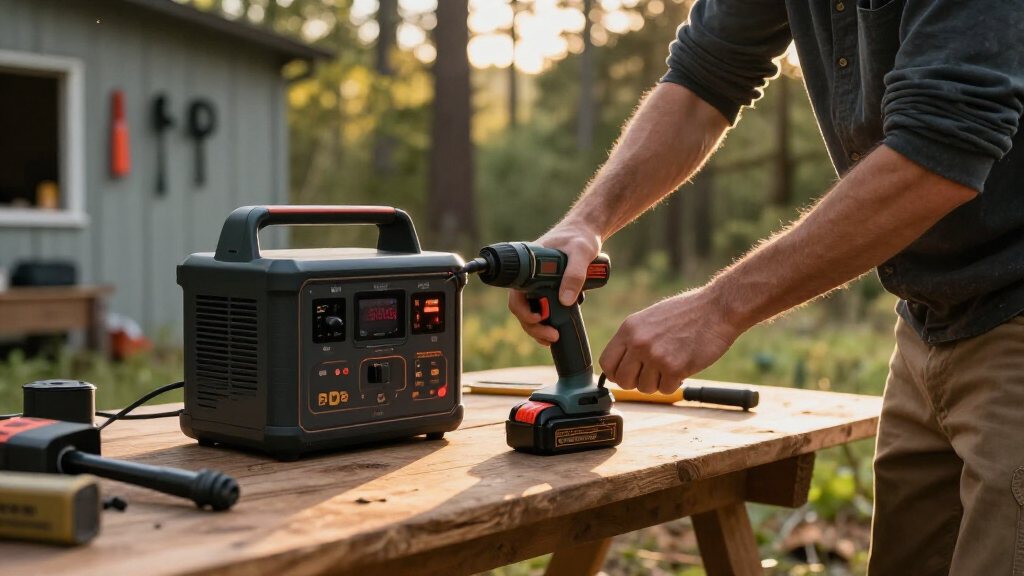
This guide uses a common field setup as its running example: an acreage owner clearing storm debris with an 18 V chainsaw, two 5 Ah packs, a rapid charger, and a 1,000 Wh station in the truck bed. Along the way, you will get practical rules for solar input, cold-weather charging, extension cords, and multi-charger use. The goal is simple: enough energy to finish the work without cooking a battery, tripping an inverter, or trusting a glossy capacity number that never reaches your charger.
Read each charger’s input label and choose an inverter with at least 25% more continuous output than the combined charger demand.
Calculate tool-battery energy by multiplying nominal volts by amp-hours; an 18 V, 5 Ah pack stores about 90 Wh.
Budget 20–40% extra energy for inverter, charger, wiring, temperature, and reserve losses.
Keep batteries dry, shaded, ventilated, and above freezing unless the approved charging system specifically supports cold charging.
Treat solar as variable energy replacement and verify input voltage, current, wattage, polarity, and pass-through behavior before field use.
Charging Cordless Tool Batteries From a Power Station in the Field
Match charger watts to inverter output, convert battery labels into watt-hours, and plan enough usable energy to finish the work. The charger sets the pace; the power station supplies the runway.
Use the combined charger input and choose at least 25% more continuous inverter output.
Budget for inverter, charger, wiring, temperature, cooling, and reserve losses.
Planning estimate for an 18 V, 5 Ah pack when about 80% of station energy is usable.
Above charger input
Beyond stored battery energy
18 V × 5 Ah
From a 1,000 Wh station
Size the inverter before counting charges
Watts answer “Can it run?” Watt-hours answer “How many times?” Read the charger’s input label rather than estimating from the battery voltage.
Find charger input watts
An 18 V platform may use a 70 W standard charger or a rapid charger drawing 250 W or more. The pack badge does not reveal AC demand.
Total every active load
Include simultaneous charger ports, lights, laptops, and other devices. Sequential multi-port chargers may draw less at any one moment.
Add continuous headroom
Multiply total charger demand by 1.25. Favor pure-sine-wave output for modern electronic chargers and stable operation.
Turn pack labels into a realistic energy budget
A station’s advertised capacity is not the amount that reaches the tool battery. Conversion, cooling, wiring, and shutdown reserve all take a share.
Battery energy
A pack sold as “20V Max” commonly uses an 18 V nominal rating for energy calculations. For conservative planning, one 90 Wh recharge may consume roughly 110–125 Wh from the station.
Smaller packs stretch the runway
What a 1,000 Wh station can deliver
These estimates assume roughly 800 Wh of usable AC energy. Battery condition, temperature, charger efficiency, and other loads will change the result.
| Tool battery | Pack calculation | Approximate energy | Estimated full charges | Field fit |
|---|---|---|---|---|
| 12 V, 2 Ah | 12 × 2 | 24 Wh | 25–30 | ✓ High cycle count |
| 18 V, 5 Ah | 18 × 5 | 90 Wh | 8–9 | ✓ Strong all-day fit |
| 18 V, 8 Ah | 18 × 8 | 144 Wh | 5–6 | ~ Plan pack rotation |
| 36 V, 6 Ah | 36 × 6 | 216 Wh | 3–4 | ~ Reserve becomes important |
| 40 V, 6 Ah | 40 × 6 | 240 Wh | About 3 | ~ Best with energy discipline |
Planning formula: full charges ≈ station capacity × usable fraction ÷ tool-battery watt-hours.
A five-step field routine
Keep the entire charging chain visible, dry, shaded, ventilated, and within the manufacturer’s approved temperature range.
Inspect
Reject swollen, cracked, wet, damaged, or unusually hot packs.
Position
Set station and charger on a dry, stable surface away from debris.
Verify
Check charger watts, inverter rating, waveform, and cable condition.
Charge
Allow ventilation and watch the first cycle for heat or error lights.
Rotate
Cool used packs before charging and preserve station reserve.
Do not charge lithium-ion batteries below freezing unless the battery or approved charging system explicitly supports cold charging. Warm the pack naturally in a dry environment; never apply direct heat.
Choose the charging route that fits the job
A larger station adds cycles, not speed. Turnaround is governed mainly by the charger and the battery’s thermal and electrical limits.
Standard AC
Best for smaller stations, overnight work, lower heat, and tools with modest daily energy use.
Rapid AC
Reduces worker downtime but demands more inverter capacity, produces more heat, and consumes energy faster.
Approved DC
Vehicle or USB-C PD charging may avoid inverter losses when the manufacturer supports the voltage, current, cable, and protocol.
Solar input
Treat solar as changing energy replacement. Verify voltage, current, wattage, polarity, connectors, and pass-through behavior.
The storm-cleanup example
An acreage owner runs an 18 V chainsaw with two 5 Ah packs, a rapid charger, and a 1,000 Wh station positioned safely in the truck bed.
540 Wh
Two 90 Wh packs cycled three times equal 540 Wh ultimately stored in tool batteries.
≈650–750 Wh
Losses and reserve raise the real draw well above the batteries’ nominal stored energy.
Thin but useful
The remaining capacity may support a dusk work light and one partial charge, provided no large extra loads are added.
Match Charger Watts to the Station Without Guesswork
Charging cordless tool batteries from a power station in the field starts with one number: the charger’s input wattage. Your station’s continuous AC output must exceed that demand, and a margin of roughly 20–30% gives you room for heat, rating tolerances, and another small load.
Read the charger label near its cord or underside. Do not estimate demand from the battery voltage. An 18 V charger may draw 70 W, while a rapid model for the same battery platform may pull 250 W or more; the battery badge tells you almost nothing about AC demand.
Suppose your rapid charger lists a 240 W input. A 300 W station may run it on a cool morning, but that pairing leaves only 60 W of headroom. Add a work light, let the station heat up in the sun, or encounter brief input variation, and the inverter may shut off with a sharp beep just as the charger fan starts singing.
Field rule: multiply the combined charger input by 1.25. Two 200 W chargers call for at least a 500 W continuous inverter, not a 400 W unit balanced on its rating limit.
Waveform matters too. A pure-sine-wave inverter gives modern electronic chargers the clean AC power they expect. Modified-sine-wave output can produce buzzing, added heat, error lights, or failed charging, much like feeding a precision spray nozzle with pulsing, dirty water instead of steady PSI.
Multi-port chargers need another label check. Some charge one pack after another, so their demand stays modest; others charge every port at once and can pull several hundred watts. In the storm-cleanup example, a sequential four-port charger may take all afternoon, while a simultaneous model finishes sooner but requires a larger inverter and empties the station faster.
portable power station for cordless tool charging
As an affiliate, we earn on qualifying purchases.
As an affiliate, we earn on qualifying purchases.
Calculate How Many Full Battery Charges You Really Have
Charging cordless tool batteries from a power station in the field depends on watt-hours, not inverter watts alone. Multiply a pack’s nominal voltage by its amp-hour rating, then divide the station’s usable energy by that result. This tells you how many full battery charges the station can support.
An 18 V, 5 Ah pack stores about 90 Wh: 18 × 5 = 90. A battery sold as “20V Max” commonly uses an 18 V nominal rating for energy calculations. According to Outdoor Pro Masters’ field-planning guidance, a 1,000 Wh station often delivers roughly 800 Wh of usable AC energy after reserves and conversion losses [1].
| Tool battery | Approximate pack energy | Full charges from 1,000 Wh station |
|---|---|---|
| 12 V, 2 Ah | 24 Wh | 25–30 |
| 18 V, 5 Ah | 90 Wh | 8–9 |
| 18 V, 8 Ah | 144 Wh | 5–6 |
| 36 V, 6 Ah | 216 Wh | 3–4 |
| 40 V, 6 Ah | 240 Wh | About 3 |
The gap between advertised and usable capacity comes from the AC inverter, charger electronics, wiring, cooling fans, and the station’s low-charge reserve. Those losses commonly require about 15–35% more energy than the tool battery finally stores [1]. Think of the system like moving water through several hoses and fittings: each connection takes a little pressure away.
For conservative planning, multiply each tool battery’s watt-hours by 1.2 to 1.4. Recharging one 90 Wh pack may consume roughly 110–125 Wh from the station. If the crew expects to empty six of those packs, budget 660–750 Wh before adding lights, phones, or a laptop.
Now return to the acreage cleanup. Two 90 Wh packs cycled three times represent 540 Wh stored in tool batteries. After losses, that work can consume around 650–750 Wh, leaving a 1,000 Wh station with a thin but useful reserve for a dusk work light and one partial charge.
1000Wh solar generator for field work
As an affiliate, we earn on qualifying purchases.
As an affiliate, we earn on qualifying purchases.
Get Faster Turnaround Without Buying an Oversized Station
Charging cordless tool batteries from a power station in the field does not become faster merely because the station has more capacity. Charging speed comes mainly from the tool charger and the battery’s limits. A bigger station provides more charging cycles, much like a larger fuel tank extends range without making an engine rev faster.
A rough time estimate divides battery watt-hours by the charger’s output watts. A 90 Wh pack paired with a 90 W output would suggest about one hour, but actual charging takes longer because lithium-ion packs reduce current near full charge and react to heat. The manufacturer’s published charge time remains the better planning number.
A rapid charger earns its keep when downtime costs more than stored energy. Imagine a fencing crew using an impact driver and an angle grinder across 20 acres. A 35-minute rapid charge can keep two packs rotating, but the charger may pull three or four times the power of a standard unit and throw a steady stream of warm air across the tailgate.
Standard chargers suit overnight work, low-demand tools, and smaller stations. Rapid chargers suit crews burning through packs before lunch. Simultaneous multi-port chargers save time when several operators share a platform, though their combined draw can turn a modest station into an undersized one within seconds.
- Choose standard charging when energy capacity, low heat, and quiet fan operation matter more than turnaround.
- Choose rapid charging when one idle worker costs more than the extra watt-hours and inverter capacity.
- Choose sequential multi-port charging when you want unattended pack rotation without a large power spike.
- Choose simultaneous charging only after adding every port’s demand and checking the station’s continuous rating.
USB-C Power Delivery or a manufacturer-approved DC vehicle charger can reduce conversion losses by skipping the AC inverter. Compatibility sets the boundary. Never wire a tool battery directly to a station’s DC socket; the approved charger provides the voltage control, temperature monitoring, and communication that raw cables cannot.
high capacity inverter for power tools
As an affiliate, we earn on qualifying purchases.
As an affiliate, we earn on qualifying purchases.
Use This Five-Step Routine for Safer Field Charging
A safe field setup keeps the power station and charger dry, shaded, ventilated, and visible. Inspect every pack before connecting it, confirm the charger demand, and watch the first few minutes of operation. A battery-management system adds protection, but it cannot repair cracked housings, water intrusion, counterfeit cells, or extreme heat.
- Inspect the pack. Stop if you find swelling, cracks, wet terminals, deformation, leaking material, or an odd chemical smell.
- Let hot batteries cool. Set a hard-worked pack in open shade rather than dropping it straight from a saw into a rapid charger.
- Build an open charging area. Place the station and charger on a stable, dry surface away from fuel, dry grass, sawdust, and covered toolboxes.
- Connect and observe. Check the station display for expected wattage, then watch for fault lights, cycling, smoke, or abnormal heat.
- Pack up only after cooling. Disconnect charged batteries and let warm equipment shed heat before closing the truck or case.
Here is what that looks like beside a brush line. You finish a long cut, hear the saw slow, and remove a pack that feels hot through your glove. Set it beneath the open tailgate for 15–20 minutes, brush loose chips away, then charge it where moving air can carry off the fan’s warm breath.
Cold brings a different problem. Avoid charging lithium-ion packs below 32°F or 0°C unless the battery or charging system specifically supports it [2]. A pack can feel merely chilly in your hand while its internal cells remain cold enough for charging damage, so let it warm naturally in a dry, moderate space.
If you need an extension cord, use a short, outdoor-rated cord with enough conductor size for the load. Uncoil it fully, protect the plugs from mud and puddles, and keep connections where you can see them. Turn equipment off before inspecting a damaged cord, wear suitable eye and hand protection, and have a licensed electrician handle damaged outlets, grounding questions, or jobsite wiring covered by electrical codes.
Stop charging immediately if you notice smoke, hissing, swelling, persistent fault lights, unusual odor, or abnormal heat. Move people away and follow the battery and station manufacturers’ emergency guidance.
cordless tool battery charger for outdoor use
As an affiliate, we earn on qualifying purchases.
As an affiliate, we earn on qualifying purchases.
Make Solar Input Work Beyond the Brochure Numbers
Solar panels can extend field runtime when their daily energy production keeps pace with your charging load, but panel wattage alone does not settle the question. Shade, hot cells, poor angle, clouds, cable loss, and the station’s solar-input ceiling all reduce the energy reaching your tool batteries.
A 200 W panel does not feed the station at 200 W from dawn to dusk. Under clear midday sun, clean panels aimed well may approach their rating; under thin cloud or a crooked morning angle, output can fall hard. The station display may show 135 W, then 70 W when a narrow oak shadow crosses one corner like a dark stripe.
One 18 V, 5 Ah battery may require about 110–125 Wh from the power station after losses. In favorable sunlight, a 200 W panel can replace that energy during a useful part of the day, but rarely in a perfect 30-minute block. Real output rises, dips, and moves with the sky while charger demand remains comparatively steady.
Before connecting panels, check the station’s maximum solar wattage, accepted voltage range, current limit, connector type, and polarity. Exceeding an input voltage limit can damage equipment even when panel wattage appears acceptable. Use the cable arrangement approved by the station manufacturer, and keep connectors dry and clear of grit.
Pass-through operation also varies. Some portable power stations can supply AC while taking solar or vehicle input; others reduce output, disable ports, cycle the inverter, or build extra heat. In the acreage example, a station receiving 120 W of afternoon solar while a charger draws 200 W still loses stored energy at roughly 80 W plus conversion losses.
Treat solar as a moving refill stream, not an endless outlet. It works best for intermittent loads: charge a pack, pause while you cut or drill, and let the panel push energy back into the station. By late afternoon, that rhythm can add one or two useful battery cycles without the growl, hot exhaust, and fuel smell of a generator.
Know When a Power Station Fits the Job—and When It Does Not
A power station fits best when your field loads are intermittent and moderate: battery chargers, LED lights, laptops, radios, and small electronics. It produces no exhaust at the point of use and stays nearly silent. High-draw saws, compressors, heaters, welders, and dust extractors can demand a generator or larger modular system.
For a one-person trail-clearing job, a 1,000 Wh unit can sit under a canopy while you rotate two saw batteries. You hear birds and the soft charger fan, not an engine hammering all afternoon. Move to a framing crew running several rapid chargers, a dust extractor, and a corded saw, and the same station may trip or drain before lunch.
Motor-driven tools add startup surges far above their running watts. Battery chargers usually start more gently, which makes portable power stations particularly well suited to charging cordless tool batteries at remote sites. Still, every light, fan, laptop, and second charger counts against the same continuous-output rating.
Newer stations increasingly use LiFePO₄ cells, which generally offer longer cycle life and better thermal stability than many older nickel-manganese-cobalt designs. The tradeoff is often extra weight for a given capacity. A 60-pound station may look compact online, then feel like wet concrete when you carry it across a rutted pasture.
Expandable batteries help crews match storage to a full workday, while higher solar-input limits help replace energy between jobs. Smarter displays can show live input, output, temperature, and estimated runtime. Those features help planning, but the basic arithmetic remains the same: total every charger’s watts, total every pack’s watt-hours, then add 25% output margin and 25–40% energy reserve.
Gas still wins when you need continuous heavy power, quick refueling, or multi-day operation with poor sun and no grid access. Battery stations win around homes, livestock, camps, and emergency sites where silence, low maintenance, and zero local exhaust matter. Never run a fuel-burning generator in a vehicle, shed, garage, or other enclosed area; place it outdoors at the manufacturer’s required distance and use working carbon-monoxide alarms.
Build a Workday Energy Plan That Leaves a Real Reserve
A dependable workday plan adds the watt-hours of every expected recharge, applies conversion losses, and reserves energy for delays, cold, battery aging, and support gear. Select at least 25–40% more capacity than your calculated need. That buffer keeps one surprise pack from ending the job.
Start with the tools, not the station brochure. A grounds crew might expect four full charges of a 90 Wh saw pack, three charges of a 72 Wh trimmer pack, and two charges of a 108 Wh blower pack. That adds up to 792 Wh stored in tool batteries before any loss reaches the ledger.
Multiply that figure by 1.3 and the planned station demand becomes roughly 1,030 Wh. Add 150 Wh for lights, phones, and a laptop, and a 1,000 Wh station is plainly too small for the whole day. A station around 1,500 Wh provides a more honest working margin, assuming its inverter can handle all chargers running together.
Work pattern matters as much as totals. If every operator returns for lunch with an empty pack, three rapid chargers may switch on at once and create a 600–900 W demand spike. Staggered charging smooths that load, reduces heat around the station, and may let you use a smaller inverter without slowing the crew.
- List every battery by nominal voltage and amp-hours.
- Multiply volts by amp-hours to calculate each pack’s watt-hours.
- Count expected full or partial charges during the shift.
- Multiply the battery total by 1.25–1.4 for conversion losses and reserve.
- Add support loads such as lighting, communications, computers, and pumps.
- Compare simultaneous charger watts with the station’s continuous AC rating.
Also check weight, weather rating, operating temperature, cycle-life specification, warranty, low-load shutdown behavior, and replacement options. A station that can reliably recharge tool batteries at the barn may still be wrong for an exposed fence line if dust or rain can enter its vents. Keep a simple energy log for the first three workdays; actual remaining capacity at quitting time will sharpen every future estimate.
Frequently Asked Questions
Can any portable power station charge cordless-tool batteries?
Most standard tool chargers work from a station with compatible AC voltage and frequency, a pure-sine-wave inverter, and enough continuous wattage. Check the charger’s input label and the station manual before connecting them; matching the outlet shape alone does not prove electrical compatibility.
Will a 300 W power station run a 300 W battery charger?
It may run briefly, but the pairing leaves no useful headroom for rating tolerances, heat-related derating, or another load. For a 300 W charger, choose roughly 375 W or more of continuous inverter output and check whether the manufacturer sets a higher requirement.
Does a bigger power station charge tool batteries faster?
No. A larger station gives you more available charging cycles, while the charger and battery control the speed. A 2,000 Wh station will not make a standard 90-minute charger behave like a 35-minute rapid charger.
Can I charge several tool batteries at the same time?
Yes, when the chargers’ combined input wattage stays below the station’s continuous AC limit with a sensible margin. Check whether a multi-port unit charges simultaneously or sequentially; four occupied slots do not always mean four chargers are drawing full power together.
Can I charge batteries while the power station receives solar power?
Many stations support this form of pass-through use, but model behavior varies. Confirm allowed solar voltage, current, wattage, and simultaneous charge-discharge rules; watch temperature because receiving solar energy while powering a rapid charger can create extra internal heat.
Is DC charging more efficient than using the AC outlet?
A compatible DC or USB-C charging method can use less conversion energy because it may bypass the AC inverter. Use only a manufacturer-approved, properly regulated charger or adapter, and never connect a tool battery directly to a station’s DC output.
Can I charge a cordless-tool battery inside my truck?
Only when the vehicle stays cool, dry, and well ventilated. A closed cab can heat quickly in direct sun, so move the equipment to shade and monitor it; never leave a hot, damaged, or actively charging lithium-ion pack sealed in the vehicle.
Conclusion
Your best field setup is not the station with the loudest number on its box. It is the one whose continuous watts clear your charger load, whose usable watt-hours cover the day, and whose reserve survives cold air, hot packs, and one extra cutting cycle. Do the battery math before you leave the outlet, then give yourself 25–40% breathing room.
Set the station in dry shade, let hard-worked packs cool, and watch the first minutes of every charging session. When the last limb drops and the saw still has a green fuel gauge, the arithmetic has done exactly what good field gear should do: disappear into the background while you finish the job.
Fall yard work Picks
leaf blowers
As an affiliate, we earn on qualifying purchases.