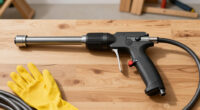
TL;DR

Get business pricing on tools and workshop supplies
- Business-only prices and quantity discounts
- Tax-exempt purchasing
- Multiple users, one account, clear invoices
A string trimmer or brushcutter is typically used for 1–4 hours per session, so small fit errors compound into real back, shoulder, and wrist pain. The three fixes: a hip-belt harness that lets the machine float, a suspension hook set exactly at the balance point, and — for users over 185 cm (6 ft 1 in) — the longest straight shaft you can buy. Get those right and a 9 kg brushcutter feels like half its weight.
You can own the strongest trimmer on the dealer’s shelf and still dread using it. Twenty minutes in, your lower back tightens, your lead wrist aches, and you’re hunched over the shaft like you’re apologizing to the grass. That’s not a fitness problem — it’s a fit problem.
Here’s the reality most owners never hear: a string trimmer or brushcutter is typically used for 1–4 hours per session, and over a season that compounds into days of sustained load on your spine, shoulders, and wrists. The fix usually isn’t a new machine. It’s a properly adjusted harness, a suspension hook set at the true balance point, and a shaft length that matches your frame.
This guide walks you through all three, with the numbers that matter — machine weights, vibration standards, and the height where standard shafts start punishing tall users. Fifteen minutes of setup now buys you a season of pain-free trimming, and most of it costs nothing but a screwdriver and some patience.
If your machine weighs more than about 4–5 kg, or you trim longer than 30 minutes at a stretch, use a double-shoulder harness with a padded hip belt — it shift…
A heavy but well-balanced machine tires you less than a light, nose-heavy one. Set the suspension hook exactly at the balance point, near the handle, and re-ch…
Over 185 cm (6 ft 1 in)? Buy the longest straight-shaft variant available, with a handle that repositions along the shaft — and adjust the harness hang length…
Test the harness quick-release before every session with power off; EN ISO 11806-2 mandates it because blade snags and kickbacks happen fast.
Compare declared vibration values (ISO 22867) when shopping — the m/s² numbers are a long-term health metric, not marketing filler.
Trimmer Ergonomics
Harnesses, balance points and shaft length — the fit fixes that make a 9 kg brushcutter feel like half its weight.
Back tight after twenty minutes? Lead wrist aching? That is not a fitness problem — it is a fit problem. A trimmer runs 1–4 hours per session, and small setup errors compound into real back, shoulder and wrist pain. Three fixes solve most of it: a hip-belt harness, a hook set at the true balance point, and a shaft that matches your frame.
The Harness Decides Who Carries the Load
A good harness transfers the machine’s weight to your hips and torso, so your arms only steer. Above roughly 4–5 kg — or any session past 30 minutes — a hip belt stops being optional.
Single Shoulder Strap
Fine for a 3 kg battery trimmer doing 15 minutes of lawn edges. Anything heavier or longer and the strap carves a groove into one shoulder.
Load path: one shoulder
Double-Shoulder Harness
Spreads weight across both shoulders. The sensible minimum for regular weekend work on bigger lots and mid-weight machines.
Load path: both shoulders
Hip-Belt Harness
The real upgrade. Works like a backpacking pack’s hip belt, shifting most load from shoulders to hips. Add a chest plate and back pad, and an all-day machine becomes an all-day tool.
Load path: hips & torso
The Float Test: correctly adjusted, the trimmer hangs suspended at working height, cutting head parallel to the ground, with zero upward lift from your hands. You guide — you don’t carry.
The Balance Point Trick That Saves Your Wrists
The balance point is where the shaft hangs perfectly level when suspended — usually near the handle. Clip the harness hook in at or very near this point. Get it wrong in either direction and you pay by the minute.
Nose-Heavy — Head Drops
Forces your trailing hand to lift constantly. Common after swapping a line head for a steel brush blade (~400 g at the head). Two hours of this and you will feel it the next morning.
Tail-Heavy — Head Drifts Up
Common with rear-mounted batteries. The cutting head floats upward and your lead wrist grinds holding it down for the whole session.
Key insight: a heavy but well-balanced machine tires you less than a light, nose-heavy one — weight rides on the harness, imbalance rides on your wrists. Re-check balance every time the cutting attachment changes. No exceptions.
The Numbers on the Spec Sheet Are a Health Metric
Hand-arm vibration is the invisible load. Long-term exposure leads to HAVS — numb fingers, blanching, reduced grip strength. Compare declared m/s² values before you buy; they are not marketing filler.
Harness & Quick-Release
Covers hand-held brushcutters and mandates release behavior on professional machines — because blade snags and kickbacks happen fast.
Declared Vibration Values
The test standard behind the m/s² figures manufacturers publish. Lower declared values mean lower long-term exposure at equal work time.
Exposure Risk Assessment
The framework hand-arm vibration exposure is measured against — the link between machine spec sheets and operator health.
Pre-Session Ritual · Every Session
Test the quick-release with the engine off or battery out: clip in, hit the release, confirm the machine drops away cleanly. Ten seconds. If the blade snags buried wire or kicks back off a hidden stump, you need to shed the machine instantly. Do it until it is muscle memory.
Standing Upright Is Not a Luxury
Over roughly 185 cm (6 ft 1 in), a standard curved-shaft trimmer has you hunching within minutes — flexing the lumbar spine, vibrating, for hours. The posture target: stand fully upright, elbows near your body, cutting head at hip-to-lower-thigh height, parallel to the ground.
| Factor | Straight Shaft | Curved Shaft |
|---|---|---|
| Reach | 15–25 cm longer than curved equivalents; long-shaft pro variants exist | Head sits closer to the operator — shorter effective reach |
| Tall-User Posture | ✓ Upright stance, head at hip-to-thigh height | ✗ Forces hunching over ~185 cm |
| Best Use | Large-area clearing, brushcutting, tall operators | Light edging, precision work, shorter users |
| Handle Style | Bike handles: wide, upright “scything” stance; repositionable along shaft | ~ Loop handles suit precision trimming |
| Adjustability Caveat | ~ Most pro machines are fixed-length — buy the right length up front | ~ Telescoping shafts exist mainly on consumer/pole tools |
The 15-Minute Fit Check
Most of this costs nothing but a screwdriver and some patience. Run the sequence once per season — and re-check the balance point every time the cutting attachment changes.
Clip In & Set Hip Belt
Buckle the hip belt so it rides on your hip bones, not your waist. Shoulders carry steering, hips carry load.
Find the Balance Point
Suspend the machine and find where the shaft hangs perfectly level — usually close to the handle.
Set Hook at Balance
Slide the harness hook along the shaft until the machine floats level with no lift from your arms.
Adjust Hang Length
Stand upright, elbows in. Head at hip-to-thigh height, parallel to ground. Bend forward? Shorten the hang.
Test Quick-Release
Power off. Clip in, hit release, machine drops cleanly. Repeat until it is muscle memory.
How the Fixes Chain Together
Harness
Hip belt moves load from shoulders to hips — the machine floats.
Balance
Hook at the true balance point — wrists stop lifting and holding.
Shaft Length
Reach matches your frame — no forward bend to reach the grass.
Posture
Fully upright, elbows in, head parallel at hip-to-thigh height.
Result
A 9 kg machine feels like half its weight — a pain-free season.
Why Your Back Aches After 30 Minutes of Trimming
Your back aches because a poorly fitted trimmer turns every minute of work into a slow-motion deadlift. When the shaft runs short or the harness hangs low, you flex your lower spine to reach the grass — and you hold that bend, vibrating, for the whole session.
The numbers explain the soreness. A professional gas brushcutter weighs 7–11 kg fueled, and even a consumer battery trimmer tips the scales at 3–5 kg. Swing that mass from your arms for two hours and something has to give. Usually it’s your lumbar spine, your trailing shoulder, or your lead wrist.
Then there’s the invisible load: hand-arm vibration. Long-term exposure can lead to hand-arm vibration syndrome (HAVS) — numb fingers, blanching, reduced grip strength. Exposure risk is measured against ISO 5349 [2], and manufacturers declare vibration values tested under ISO 22867 [3]. Those m/s² figures on the spec sheet are not marketing filler; they’re a health metric worth comparing before you buy.
Say you’re clearing fence lines on a half-acre rural lot — three hours with a 9 kg machine hanging off one thin shoulder strap. By the second tank of fuel you’re not guiding the trimmer anymore; you’re wrestling it, and your cuts get ragged. Sloppy technique near a spinning blade is how ankles and shins get hurt.
The good news: most of this wear-and-tear is fixable with fit, not money.
string trimmer harness with hip belt
As an affiliate, we earn on qualifying purchases.
As an affiliate, we earn on qualifying purchases.
How the Right Harness Makes Heavy Machines Feel Light
Trimmer ergonomics — harnesses, balance points and shaft length for tall users — starts at the harness, because it decides who carries the load: your skeleton or your muscles. A good harness transfers the machine’s weight to your hips and torso, so your arms only steer.
You’ll meet three basic types in the field:
- Single shoulder strap — fine for a 3 kg battery trimmer doing 15 minutes of lawn edges. Anything heavier or longer and the strap carves a groove into one shoulder.
- Double-shoulder harness — spreads weight across both shoulders; the sensible minimum for regular weekend work on bigger lots.
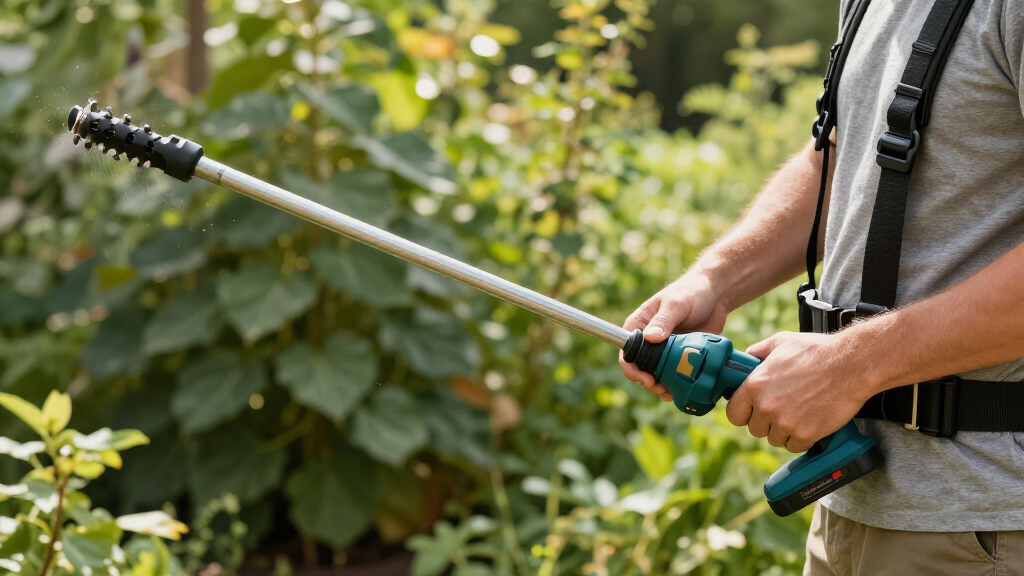
- Professional harness with a padded hip belt — the real upgrade. It works exactly like a backpacking pack’s hip belt, shifting most of the load from shoulders to hips. Add a chest plate and back pad, and an all-day machine becomes an all-day tool.
The setup principle is simple: the machine should float. With everything adjusted right, the trimmer hangs suspended at working height, cutting head parallel to the ground, and your hands apply zero upward lift. You guide; you don’t carry. Outdoor Pro Masters treats this float test as the single best indicator of a correct fit.
One safety point that gets skipped far too often: the quick-release. Professional machines fall under EN ISO 11806-2 [1], which mandates release behavior — if the blade snags buried wire or kicks back off a hidden stump, you need to shed the machine instantly.
Test the quick-release before every session, with the engine off or the battery out. Clip in, hit the release, and confirm the machine drops away cleanly. Ten seconds. Do it until it’s muscle memory.
Above roughly 4–5 kg, or any time you’re out for more than half an hour, a hip-belt harness stops being optional.
adjustable straight shaft brushcutter
As an affiliate, we earn on qualifying purchases.
As an affiliate, we earn on qualifying purchases.
The Balance Point Trick That Saves Your Wrists
The balance point is your trimmer’s center of gravity — the spot on the shaft where it hangs perfectly level when suspended. Your harness hook should clip in at or very near this point, usually close to the handle, so the machine floats level with no lift from your arms.
Get it wrong in either direction and you pay by the minute. A nose-heavy machine — head dropping toward the dirt — forces your trailing hand to lift constantly. A tail-heavy one, common with rear-mounted batteries, makes the cutting head drift up and grinds your lead wrist holding it down. Two hours of either and you’ll feel it the next morning.
Here’s the counterintuitive part: a heavy but well-balanced machine is less fatiguing than a light, nose-heavy one. Weight rides on the harness; imbalance rides on your wrists. Balance is the most underrated variable in this whole setup — more important than a kilogram or two on the spec sheet.
Tuning it takes minutes:
- Slide the harness hook along the shaft until the machine hangs level on its own.
- Reposition the loop or bike handle so your grip lands naturally — most modern machines adjust tool-free.
- Account for the cutting attachment. A metal brush blade, a line head, and different guards each shift the center of gravity.
Real scenario: you swap a line head for a steel brush blade to attack blackberry canes along the back fence. The blade adds maybe 400 g out at the head, and suddenly your perfect setup pulls nose-down like a fishing rod with a strike on. Re-check the balance every time the attachment changes — no exceptions.
As an affiliate, we earn on qualifying purchases.
Straight vs. Curved Shaft: What Tall Users Actually Need
Shaft length for tall users is not a comfort luxury — it’s the difference between standing upright for three hours and spending those hours folded at the waist. If you’re over roughly 185 cm (about 6 ft 1 in), a standard curved-shaft trimmer will have you hunching within minutes.
The posture target is simple: stand fully upright, elbows near your body, cutting head working at hip-to-lower-thigh height and parallel to the ground. If you have to bend forward to reach the grass, either the shaft is too short or the harness hangs the machine too low. Surprisingly often it’s the harness hang length, not the machine — lengthen the straps before you blame the tool.
| Feature | Straight shaft | Curved shaft |
|---|---|---|
| Reach | Typically 15–25 cm longer | Shorter; head sits close to your feet |
| Working posture | Upright, head at a natural distance | Forward hunch for tall users |
| Best for | Tall operators, brushcutting, large areas | Shorter users, light edging, tight spaces |
| Drive system | Handles metal blades and heavy line | Usually lighter duty, line only |
| Verdict for 185 cm+ | The standard recommendation | Avoid for extended sessions |
Handle style matters too. Bike (two-handed) handles promote a wide, upright scything stance — ideal for tall users clearing large areas, since the swing comes from your hips, not your spine. Loop handles suit precision trimming around beds, posts, and paths.
One buying caveat: genuinely telescoping shafts exist mainly on consumer models and pole tools, and their durability lags fixed shafts. Most professional machines come fixed-length, so buy the right length up front — long-shaft variants exist, and a handle that slides along the shaft lets you fine-tune the last few centimeters.
ergonomic brushcutter for tall users
As an affiliate, we earn on qualifying purchases.
As an affiliate, we earn on qualifying purchases.
Dial In Your Setup in 15 Minutes: A Step-by-Step Fit Check
Trimmer ergonomics — harnesses, balance points and shaft length for tall users — isn’t theory. You can dial in the whole setup in about 15 minutes, with no tools beyond what shipped with the machine. Do it once, and every session after that starts comfortable.
- Fit the harness to your body first. Snug the hip belt over your hip bones, then set the shoulder straps so the back pad sits flat. The belt carries the load; the straps only stabilize.
- Clip the hook at the balance point. With the engine off or the battery removed, suspend the machine and slide the carabiner along the shaft until the trimmer hangs level.
- Check the float. The cutting head should hover parallel to the ground at working height with your hands off. If the head dips or climbs, move the hook and try again.
- Set the handle at natural arm’s length. Loosen, slide, retighten. Your elbows should stay near your body with forearms roughly level.
- Do a posture pass. Stand upright, head working at hip-to-thigh height. Catching yourself bending forward? Lengthen the harness hang or slide the handle back.
- Test the quick-release. Clip in, release, and confirm the machine falls away clean. Repeat until the motion is reflex.
- Re-check after every attachment swap. Blades, line heads, and guards all move the balance point.
Run this checklist the first time you use a new machine, after any repair, and any time a different operator picks it up. Fit is personal — your settings won’t suit your neighbor, and theirs won’t suit you. Wear your PPE (eye protection, hearing protection, boots, long pants) while you test under power.
Battery vs. Gas: The Comfort Tradeoffs Nobody Warns You About
Trimmer ergonomics — harnesses, balance points and shaft length for tall users — changed fast when battery platforms arrived. Which power source treats your body better? For short sessions, battery wins on weight and vibration; for all-day acreage work, gas on a hip-belt harness or a backpack-battery setup usually wins.
Brushless battery trimmers cut vibration and noise dramatically, and at 3–5 kg they’re far lighter than a fueled pro brushcutter at 7–11 kg. For a 30-minute suburban trim, the lighter machine is the obvious pick.
But rear-mounted batteries shift the balance point backward. Some battery models are effectively nose-light, so the cutting head wants to float up and your lead wrist spends the whole session pressing down. Lighter machine, new imbalance — balance adjustment matters more now, not less.
Gas machines carry their mass mid-shaft around the engine, which is why a 9 kg brushcutter can feel oddly natural on a good harness. The tradeoffs: more vibration, more noise, hot exhaust near your arm, and fuel stops. Anti-vibration systems — decoupled handles, rubber isolators — close some of that gap, and declared vibration values under ISO 22867 [3] let you compare models honestly before buying.
For professional all-day work, there’s a third path: backpack batteries like the Stihl AR series or Husqvarna BLi-X. They move 5–10 kg of battery off the machine and onto your hips, cutting hand-arm load hard while keeping runtime measured in hours. The catch: your harness hook and hang point need a fresh setup, since the machine itself gets nose-biased without the battery’s rear weight.
Match the power source to your acreage and session length, then fit the harness and balance to whichever you choose. There’s no universally right answer — there’s a right answer for your lot and your back.
Frequently Asked Questions
I’m 6 ft 3 in — what shaft length or model should I buy?
Go straight-shaft, and choose the longest variant the brand offers — typically 15–25 cm more reach than a curved-shaft equivalent. Make sure the handle slides along the shaft so your grip lands at a natural arm’s length. If you can, hold a demo machine in the dealer’s yard: upright stance, elbows in, cutting head floating at hip height. Ten minutes of holding it tells you more than any spec sheet.
Do harnesses work with lightweight battery trimmers, or are they only for heavy gas brushcutters?
They work with both — many battery trimmers include harness attachment points, and the float principle applies at 4 kg just as it does at 9 kg. For a 3 kg machine doing 15 minutes of edging, a single strap is enough. Clip into a double-shoulder harness once sessions stretch past 30 minutes, whatever the power source.
Where exactly should the balance point be — at the handle, in front of it, or behind it?
The suspension hook should attach at or very near the balance point itself — and on most machines that lands close to the handle. Fine-tune by sliding the hook until the trimmer hangs level with the cutting head parallel to the ground. Swapping a line head for a metal blade shifts the balance point forward, so re-check after every attachment change.
Is the quick-release on a harness a real safety feature or a gimmick — and how do I test it?
It’s real, and it’s mandated for professional machines under EN ISO 11806-2 [1]. If a blade snags buried wire or kicks back, you need to shed the machine in under a second. Test it with the engine off or battery out: clip in, trigger the release, and confirm the machine drops away cleanly. Repeat until the motion is automatic.
Can I extend or modify my existing trimmer shaft for more length?
Generally no — drive shafts, cables, and throttle wiring are engineered for a specific length, and cutting into them risks failure at full throttle. Telescoping designs exist on some consumer models and pole tools, but durability lags fixed shafts. The safer fix is adjusting harness hang length and handle position, or buying a long-shaft variant if you’re genuinely too tall for the standard frame.
My back hurts after 30 minutes of trimming — is it the machine length, the harness, or my technique?
Most often it’s the harness hang length, not the machine. If the trimmer hangs too low, you hunch to reach the grass — lengthen the straps until the head floats at hip height while you stand upright. Next, check the hook position and balance; a nose-heavy machine forces constant lifting. If pain persists after a full setup pass, shorten sessions, alternate tasks, and consider a lighter machine or a backpack battery for your acreage.
Conclusion
Trimming shouldn’t end with you straightening up like an old deck chair. If your back barks after 30 minutes, the machine is telling you something: the harness hangs wrong, the hook sits off the balance point, or the shaft runs short for your frame. Fix the fit before you blame your fitness.
So before your next session, run the 15-minute setup: hip belt snug, hook at the balance point, cutting head floating level, quick-release tested. Your grass gets a cleaner cut — and you get to stand up straight when the work’s done.
Halloween Picks
halloween
As an affiliate, we earn on qualifying purchases.