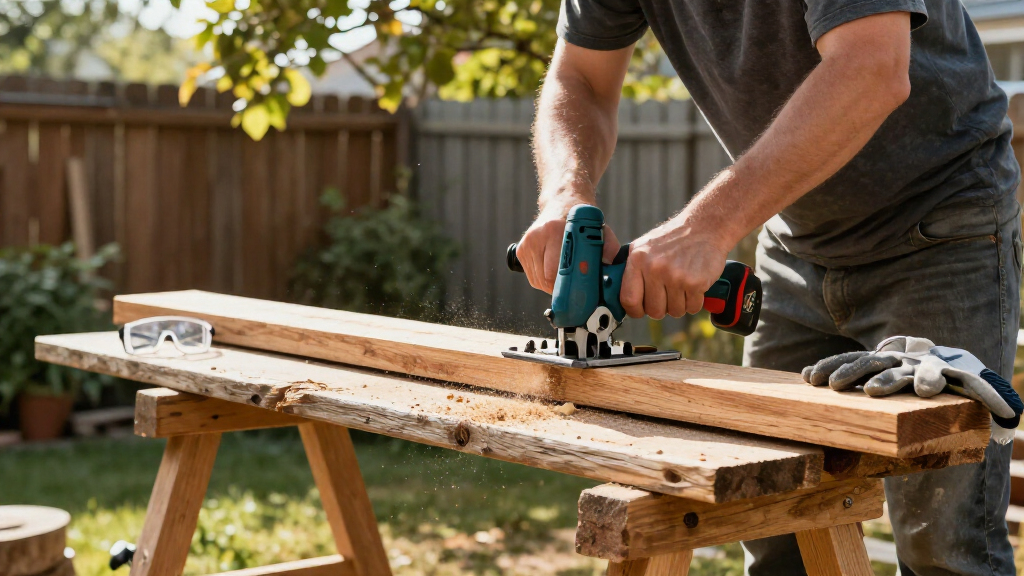

Choosing a cordless reciprocating saw is less about finding the most powerful tool and more about matching its size to the work. Compact models are shorter and lighter, so they are easier to maneuver overhead, between studs, or in other awkward spots. Full-size models provide more reach and often handle thick material or repeated cuts with less strain on the tool.

Get business pricing on tools and workshop supplies
- Business-only prices and quantity discounts
- Tax-exempt purchasing
- Multiple users, one account, clear invoices

FULLYEA Cordless Reciprocating Saw, 3500 SPM Variable Speed, 2 Batteries
- ✔ Model: FSS103-006A
- ✔ Voltage: 21 V
- ✔ Maximum speed: 3500 SPM

SEESII Cordless Reciprocating Saw with Two Batteries and Six Blades
- ✔ Motor: 200W brushless
- ✔ Voltage: 21V
- ✔ Maximum speed: 3,500 RPM

BLACK+DECKER 20V MAX Cordless Reciprocating Saw Kit (BDCR20C)
- ✔ Model: BDCR20C
- ✔ Voltage: 20 volts
- ✔ Listed motor speed: 3000 SPM
The tradeoff is practical: a compact saw can save effort and improve access, but may cut more slowly or require more battery changes during demanding work. A full-size saw is a stronger choice for demolition and regular heavy use, but its extra length and weight can make close quarters tiring. Choose compact for portability and controlled, occasional cuts; choose full-size for frequent, demanding cutting where capacity matters.
At a Glance
| Criteria | Compact cordless reciprocating saws | Full-size cordless reciprocating saws | Winner |
|---|---|---|---|
| Handling and access | Shorter and lighter; easier to use in tight or overhead positions | Longer and heavier; can be tiring in awkward positions | A |
| Cutting capacity | Best suited to small and medium stock; capacity varies by model | Generally better suited to larger stock and demolition tasks | B |
| Speed on demanding cuts | Can be slower in thick, hard, or repeated cuts | Usually maintains pace better during demanding, repeated cuts | B |
| Control and precision | Compact body is easier to guide in confined spaces | More room to brace and guide the tool in open work areas | Depends |
| Runtime and battery demand | Often draws less power per cut, but heavy work can drain batteries quickly | High-output cutting may consume battery charge quickly | Depends |
| Blade reach and stroke | Shorter nose can fit into restricted spaces, with less reach | More reach and typically a longer stroke, depending on model | B |
| Price and value | Often a lower-cost way to add a saw for light or occasional work | Higher cost can pay off for regular heavy use | Depends |
FULLYEA Cordless Reciprocating Saw, 3500 SPM Variable Speed, 2 Batteries
The 28 mm stroke is the FULLYEA’s clearest advantage in this group: it gives the blade a longer travel than SEESII’s stated 15 mm stroke. That makes this the most compelling starting point for buyers comparing cutting motion, though stroke length alone cannot tell us how quickly it will cut a particular material. Its trigger-controlled speed reaches a stated 3500 SPM, and the lever-actuated, tool-free blade change helps when moving among the included four blades.Its kit is more practical than the BLACK+DECKER package for work that benefits from a spare battery: FULLYEA includes two 2.0 Ah packs, a fast charger, and a tool box. The tradeoff is capacity. SEESII’s two listed 4.0 Ah batteries have twice the stated capacity per pack, so buyers who prioritize longer intervals between charging may prefer that bundle. FULLYEA lists wood, metal, and plastic as cutting materials, a conventional range that does not suggest a specialized application. The LED light and ergonomic handle are convenient, but the provided specifications do not quantify weight.We rank FULLYEA first because its stroke length, variable trigger, and two-battery package make a clear all-round combination on paper. Still, the 2.0 Ah battery rating and four-blade set limit its advantage over SEESII for sustained or varied work. Buyers should choose it for the longer stated stroke and balanced kit, not assume its SPM figure proves it will outperform the others in every cut.
Pros:
- Longest stated stroke among these three at 28 mm
- Two 2.0 Ah batteries and a fast charger included
- Trigger-controlled variable speed up to a stated 3500 SPM
- Lever-actuated tool-free blade changes, LED light, and tool box
Cons:
- Each included battery is rated at 2.0 Ah, below SEESII’s listed 4.0 Ah packs
- Includes four blades, fewer than the SEESII kit
- Listed cutting materials are wood, metal, and plastic
Best for: Buyers who want the longest stated stroke in this comparison, variable trigger control, and two batteries in one kit.
Not ideal for: People prioritizing the highest listed battery capacity per pack or a larger included blade assortment.
Bottom line: We recommend the FULLYEA as the most balanced pick here for its 28 mm stroke and two-battery kit, with the caveat that its battery capacity per pack is modest.
“We recommend the FULLYEA as the most balanced pick here for its 28 mm stroke and two-battery kit, with the caveat that its battery capacity per pack is modest.”
SEESII Cordless Reciprocating Saw with Two Batteries and Six Blades
SEESII makes the strongest case for buyers who want more included capacity and accessories up front. Its two 21V 4.0 Ah batteries have twice the stated capacity per pack of FULLYEA’s, and the kit adds a fast charger, six blades, a storage box, gloves, and safety glasses. That more complete bundle can reduce the need to source basic accessories separately. Both SEESII and FULLYEA include two batteries and variable speed, but FULLYEA has the longer stated stroke: 28 mm versus SEESII’s 15 mm.The listed 200W brushless motor and speed range up to 3,500 RPM are promising specifications, but RPM and SPM are different ways of expressing motion and should not be compared as if they were identical. SEESII also lists a 15 mm stroke, so buyers should not assume its top speed makes it the faster cutter. Tool-free blade changes, an LED work light, and a safety lock add practical convenience. The listed weight deserves particular caution: it is 3.48 kg, although the description separately calls the saw 2.0 lb. That substantial inconsistency makes it difficult to judge portability from the supplied information.Compared with the BLACK+DECKER, SEESII supplies a much broader kit and two batteries, while BLACK+DECKER emphasizes a pivoting shoe and electric brake. We place SEESII second because its battery capacity and accessories are compelling, but the shorter stroke than FULLYEA and conflicting weight information keep it from taking the top position. It makes sense for buyers who value the bundle and can verify the weight; it is a weaker fit for those choosing chiefly by compactness or clear, consistent specifications.
Pros:
- Two listed 21V 4.0 Ah batteries and a fast charger
- Includes six blades, storage box, gloves, and safety glasses
- Brushless motor with variable speed up to a stated 3,500 RPM
- Tool-free blade changes, LED light, and safety lock
Cons:
- Its stated 15 mm stroke is shorter than FULLYEA’s 28 mm
- Listed weight of 3.48 kg conflicts with the description’s 2.0 lb claim
- Included blades may not suit every material or task
Best for: Buyers who value two higher-capacity batteries, a six-blade set, and useful accessories in one package.
Not ideal for: Anyone who needs a confidently stated tool weight or is selecting primarily for a longer stroke.
Bottom line: We favor SEESII when battery capacity and kit contents lead the decision, provided buyers confirm its weight and accept the shorter stated stroke.
“We favor SEESII when battery capacity and kit contents lead the decision, provided buyers confirm its weight and accept the shorter stated stroke.”
BLACK+DECKER 20V MAX Cordless Reciprocating Saw Kit (BDCR20C)
The BLACK+DECKER BDCR20C earns its place through cutting control features rather than a large kit. Its adjustable pivoting shoe can help maintain contact as the cut angle changes, while the electric brake gives the operator a way to stop blade motion after releasing the trigger. Those details distinguish it from FULLYEA and SEESII, which list LED lights and two batteries but do not specify an adjustable shoe or brake. A variable-speed trigger and tool-free blade changes round out the controls.The kit is leaner: it includes one battery, a charger, and one reciprocating blade. By comparison, both other options include two batteries and several blades, making them better equipped for longer sessions or switching among tasks without buying extras. BLACK+DECKER states a 3000 SPM motor speed but also lists 4500 rpm; because those figures use different units and are not reconciled in the supplied details, we would not use them to rank cutting speed. The stated 4.5 lb weight gives a useful reference point, unlike SEESII’s inconsistent weight information, though weight alone does not establish balance or comfort.We place this model third for buyers comparing complete cordless kits, since its single battery and blade leave it behind the other two on included equipment. It remains a sensible fit if the pivoting shoe and brake are the features you value most or if you already have compatible batteries. Choose FULLYEA for a longer stated stroke and two included batteries, or SEESII for higher listed battery capacity and a fuller accessory set.
Pros:
- Adjustable pivoting shoe
- Electric brake and variable-speed trigger
- Tool-free blade changes
- Battery, charger, and reciprocating blade included
Cons:
- Includes one battery compared with two in both other kits
- Only one blade is included
- Speed listings of 3000 SPM and 4500 rpm are not reconciled
Best for: Buyers who prioritize an adjustable pivoting shoe and electric brake, or already have compatible batteries.
Not ideal for: People seeking a multi-battery kit with several included blades for varied or extended cutting.
Bottom line: We would choose the BLACK+DECKER for its shoe adjustment and brake, while buyers seeking the fullest out-of-box kit should look to FULLYEA or SEESII.
“We would choose the BLACK+DECKER for its shoe adjustment and brake, while buyers seeking the fullest out-of-box kit should look to FULLYEA or SEESII.”
As an Amazon Associate we earn from qualifying purchases.
Key Differences
The biggest difference appears when access and cutting load pull in opposite directions. A compact saw is easier to position where a long tool body would bump into framing, a pipe, or a nearby surface. Its smaller size can also reduce fatigue during overhead work. But compact size does not mean every model is weak: brushless motors, battery voltage, stroke length, and blade choice all affect performance. For thick lumber, metal pipe, or repeated demolition cuts, model specifications and battery capacity matter as much as the label “compact.”
A full-size saw is the safer general choice when cutting speed, reach, and sustained work matter more than maneuverability. It is usually more comfortable to brace against larger material and can be more productive on heavier jobs. That advantage has a cost in weight, price, and bulk. If most cuts are short, occasional, or made in restricted spaces, the extra capacity may sit unused. Pay more for full-size when the saw will earn its place through regular demanding work; for light repairs, compact can deliver better value.
Detailed Comparison
Handling and access (Compact cordless reciprocating saws wins — major)
Compact saws win by a clear margin in tight spaces: their shorter bodies are easier to turn and position between obstacles, and their lower weight helps during overhead cuts. This is a moderate to major practical advantage for plumbing, electrical, and repair work. Full-size saws are easier to brace in open areas, but their length can make awkward cuts harder.
Cutting capacity (Full-size cordless reciprocating saws wins — moderate)
Full-size saws generally accommodate more demanding cuts and are better suited to thick material or demolition. The gap is moderate, though it depends on the specific motor, stroke, blade, and battery. Compact models can handle substantial work, but users should check the stated capacity and avoid assuming all compact tools perform alike.
Speed on demanding cuts (Full-size cordless reciprocating saws wins — moderate)
Full-size models usually have the edge when cuts are thick, repeated, or made in tough material, so they can reduce time on a demolition job. The advantage is moderate for occasional cuts and major for sustained work, but it is not guaranteed by size alone. A high-output compact model may outperform a basic full-size tool.
Control and precision (minor difference)
Compact saws are easier to guide close to surrounding surfaces and through confined cut lines. Full-size tools can be steadier when braced against large stock and used with two hands. Neither format wins every kind of precision task, so the difference is minor overall and depends on access and how the cut can be supported.
Runtime and battery demand (moderate difference)
Compact saws may use less energy on comparable light cuts, but a small battery can limit total work, and straining the tool through heavy material can reduce runtime. Full-size saws can draw more power under load, yet may finish demanding cuts faster. The practical winner depends on battery capacity, motor efficiency, and workload.
Reach and blade stroke (Full-size cordless reciprocating saws wins — moderate)
Full-size saws usually offer more reach and often a longer stroke, which helps in open work and can move through material more quickly. Compact models trade reach for access and fit into cramped positions. This is a moderate advantage for full-size users working on large material, but compact length can be the deciding benefit in tight spaces.
Price and value (moderate difference)
Compact models often cost less, making them attractive for homeowners or tradespeople who need a portable saw for occasional cuts. Full-size tools justify a higher price when repeated heavy work saves meaningful time. The gap in value is not universal: compare bare-tool and kit prices, battery compatibility, and included batteries before deciding.
Compact cordless reciprocating saws: Pros and Cons
Pros:
- Easier to carry, position, and use overhead
- Fits into confined spaces more readily
- Often offers strong value for occasional cutting
Cons:
- Less reach for open or deep cuts
- May take longer on thick or repeated cuts
- Small batteries may limit demanding work sessions
Full-size cordless reciprocating saws: Pros and Cons
Pros:
- Generally better for thick material and demolition
- More reach and often a longer stroke
- A stronger choice for frequent, sustained cutting
Cons:
- More weight can increase fatigue
- Long body is less convenient in tight spaces
- Higher purchase cost may not pay off for occasional use
Who Should Choose What
Choose Compact cordless reciprocating saws if:
- You make occasional cuts during home repairs or light renovation.
- You often work overhead, between framing, or near obstacles.
- Portability and low fatigue matter more than maximum cutting speed.
Choose Full-size cordless reciprocating saws if:
- You regularly cut thick lumber, metal pipe, or demolition material.
- You need reach and consistent performance through repeated cuts.
- The tool will see enough heavy use to justify its added cost and weight.
Skip both if: You need clean, highly accurate finish cuts; a circular saw, jigsaw, or dedicated metal-cutting tool may suit that work better.
Value for Money
Compact is usually the better value when the saw is a backup or a tool for occasional repairs. Its lower weight and easier access are benefits you notice on every awkward cut, while the extra capacity of a full-size model may rarely be used. For regular demolition or repeated cuts through thick stock, paying more for a full-size saw can be worthwhile because faster progress and greater capacity matter more than carrying weight.
Compare models within the same battery platform and look at kit prices as well as bare-tool prices. A compact saw paired with a small battery may be a poor buy for heavy work, while a full-size kit with a suitable high-capacity battery can make more sense. No format guarantees better runtime or speed without considering the motor, battery, blade, and material.
Final Verdict
For most occasional users and anyone who often works in tight spaces, choose a compact cordless reciprocating saw. It is easier to handle, easier to carry, and capable of a wide range of repair cuts. Choose a full-size model if you regularly tackle demolition, thick material, or repeated demanding cuts; its extra reach and capacity are worth the higher price when that work is routine. The deciding factor is whether your typical job rewards access and low fatigue or sustained cutting performance.
Frequently Asked Questions
Is a compact cordless reciprocating saw powerful enough for demolition?
Some compact models can handle light demolition, but performance varies widely. Check the manufacturer’s capacity, motor, stroke, and recommended battery, then match the blade to the material. For frequent heavy demolition, a full-size model is the more dependable choice.
Does a full-size reciprocating saw always cut faster?
No. Size alone does not determine speed. Motor output, stroke rate and length, battery condition, blade, and material all affect the result. Full-size models generally suit demanding cuts better, but compare specifications and intended use.
Which type is easier to use overhead?
Compact saws are usually easier overhead because they weigh less and are simpler to position. Check the tool’s weight with the battery installed, since that is what you will hold during a job.
Should I pay more for a full-size model?
Pay more if you expect regular work in thick material, demolition, or repeated cuts where greater capacity can save time. For occasional repairs and close-quarters work, a compact saw is usually the better value.