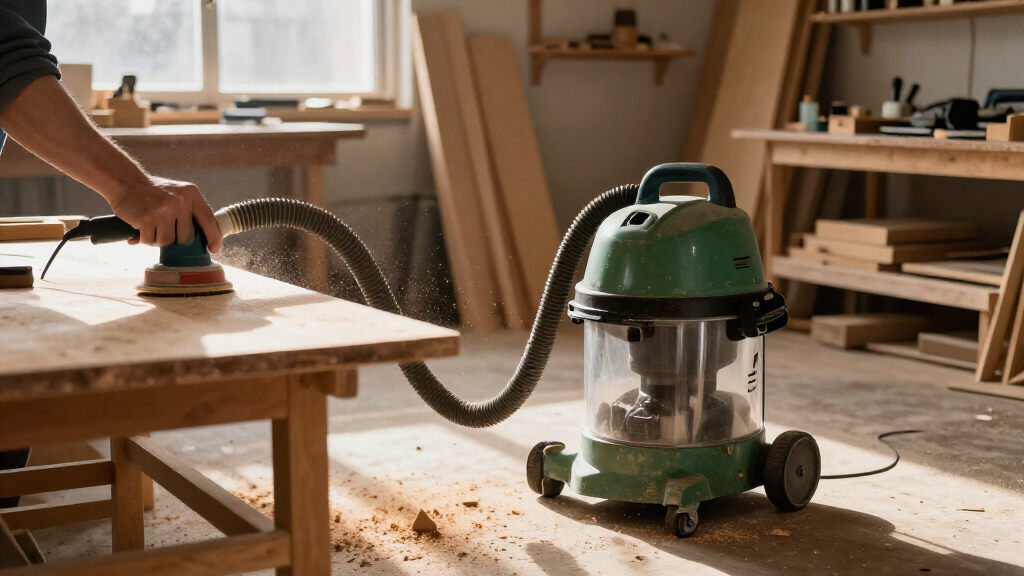

For most woodworking shops, I’d start with the Vacmaster Professional Beast Series 5-Gallon Wet/Dry Vac for its balance of workshop-friendly capacity and manageable size. The PEMEDOR 9-Gallon Dust Extractor stands out for buyers who want a dual-cyclone pre-separator, while the DEWALT STEALTHSONIC 5-Gallon suits noise-conscious makers. The main tradeoffs are dust-control features versus general cleanup power, and larger capacity versus the space and effort needed to move a vac around. A shop vacuum can collect chips and debris, but fine sanding dust calls for suitable filtration and a compatible tool connection. Read on for my full comparison and recommendations by shop size and task.

Get business pricing on tools and workshop supplies
- Business-only prices and quantity discounts
- Tax-exempt purchasing
- Multiple users, one account, clear invoices
Complete the kit



Key Takeaways
- The 5-gallon options are the lineup’s middle ground: the Vacmaster Beast and DEWALT STEALTHSONIC 5-Gallon offer more capacity than compact cleanup models without stepping up to a large drum-style vacuum.
- Dust separation is a distinct advantage, not a substitute for filtration: the PEMEDOR’s dual-cyclone pre-separator can reduce how much debris reaches the filter, while the ECOMAX explicitly brings HEPA filtration into the comparison.
- Large capacity favors fixed or high-volume work: the 16-gallon CRAFTSMAN and 9-gallon DEWALT are better matches for extended cleanup than small benchtop shops, where their size can be a drawback.
- Noise and convenience separate the DEWALT STEALTHSONIC picks: the 5-gallon model prioritizes a quieter-workshop angle; the 6-gallon version offers more capacity and a higher stated peak horsepower.
- Compact models trade runtime for easy handling: the Shop-Vac 3-Gallon and CRAFTSMAN 2.5-Gallon are easier to store and reposition, but need more frequent emptying than the 6- to 16-gallon choices.


| shop vacuums for woodworking | Capacity | Noise level | Hose length | Motor power |
|---|---|---|---|---|
| Shop-Vac 3-Gallon Wet/Dry Vacu | — | — | 6 feet | — |
| Vacmaster Professional Beast S | 5 gallons | — | 7 feet | 320 air watts |
| CRAFTSMAN 16-Gallon 6.5 Peak H | 16 gallons | 77 dB | — | 6.5 peak HP |
| Amazon Basics 4-Gallon Wet/Dry | 4 gallons | — | 72 inches | 3 HP |
| Stanley SL18116P Wet/Dry Vacuu | — | — | 6 feet | — |
| PEMEDOR 9-Gallon Wet/Dry Dust | 9 gallons | — | — | 1400W |
| DEWALT STEALTHSONIC 5-Gallon W | 5 gallons | 65 dB | — | — |
| YOWMOFT 8-Gallon Wet/Dry Dust | 8 gallons | 78 dB | — | 1000W |
| CRAFTSMAN 2.5-Gallon Wet/Dry S | 2.5 gallons | 72 dB | — | — |
| ECOMAX 8-Gallon HEPA Shop Vacu | — | 75 dB | — | 6.5 HP |
| DEWALT 9-Gallon Wet/Dry Shop V | — | 78 dB | 7 feet | — |
| DEWALT STEALTHSONIC 6-Gallon W | 6 gallons | 65 dB | 7 feet | — |
More Details on Our Top Picks
Shop-Vac 3-Gallon Wet/Dry Vacuum with Blower
For a woodworking space where floor area and quick cleanup matter more than drum capacity, I’d put this 3-gallon Shop-Vac ahead of larger, harder-to-store options. Its 4.0 peak HP motor, included cartridge filter and filter bag, and blower function cover bench debris, small spills, and clearing dust from areas a nozzle cannot easily reach. The casters, foldable handle, and stored tools make it easier to move between a bench and a vehicle than the larger CRAFTSMAN 16-Gallon model. That compact size is also the tradeoff: a session involving substantial sawdust or repeated cleanup can mean frequent emptying. I’d choose it for spot work and small shops, not as my main collector for long milling or sanding sessions.
Pros:- Compact stainless steel tank and foldable handle suit storage in a crowded shop.
- Blower function adds a way to clear debris from hard-to-reach areas.
- Casters, onboard tool storage, and a 13¼-foot cord support convenient repositioning.
- Includes a cartridge filter, filter bag, foam sleeve, and multiple nozzles.
Cons:- Three-gallon capacity can mean frequent stops during larger woodworking cleanups.
- Replacement dust bags are sold separately.
- The six-foot hose is shorter than the Vacmaster’s seven-foot hose.
Best for: Woodworkers in a small shop who need a movable vacuum for bench cleanup, tool-area debris, and occasional wet messes.
Not ideal for: People cleaning a large workshop or collecting heavy sawdust for extended sessions; the 3-gallon tank fills sooner than the Vacmaster 5-Gallon or Stanley 6-Gallon.
- Tank capacity:3 gallons
- Peak horsepower:4.0 HP
- Power source:Corded electric, 120 volts
- Hose length:6 feet
- Power cord length:13¼ feet
- Tank material:Stainless steel
- Filter type:Cartridge
- Dimensions:12 × 15.25 × 13 inches
Our verdict“Choose this compact Shop-Vac for mobile, occasional woodworking cleanup, but pick a larger model for sustained dust collection.”
Vacmaster Professional Beast Series 5-Gallon Wet/Dry Vac
Among these compact shop vacuums, I’d favor the Vacmaster Beast Series when fine-particle handling matters more than a blower or a huge tank. Its cartridge filter and dust bag capture particles down to 1 micron, a useful pairing for tidying up after woodworking tasks that leave fine debris. The 25-foot cleaning reach and kink-resistant hose also make it easier to work around a bench without moving the vacuum as often as the Shop-Vac 3-Gallon. Its five-gallon capacity gives it more room for debris, though it still falls short of the CRAFTSMAN 16-Gallon for large cleanup jobs. The limitation is control: it has just one speed, and its seven-foot hose may feel restrictive when a workpiece or machine is awkwardly positioned.
Pros:- Cartridge filter and dust bag are specified to capture particles down to 1 micron.
- Twenty-five-foot cleaning reach helps cover a work area with fewer outlet changes.
- Kink-resistant hose and onboard storage help keep the setup organized.
- Nine included accessories support varied cleanup tasks.
Cons:- One speed offers no way to adjust suction for different tasks.
- Seven-foot hose can limit maneuvering around equipment or large workpieces.
- Five-gallon capacity is smaller than the CRAFTSMAN 16-Gallon.
Best for: Woodworkers who want a mid-size wet/dry vacuum with a dust bag and fine-particle filtration for routine shop cleanup.
Not ideal for: Buyers who need variable suction, a blower function, or enough capacity for large-scale workshop cleanup.
- Capacity:5 gallons
- Motor power:320 air watts
- Maximum suction:20 kPa
- Fine-dust capture:Down to 1 micron
- Hose length:7 feet
- Cleaning reach:25 feet
- Wattage and voltage:1320 watts, 120 volts
- Weight:15.4 pounds
Our verdict“Pick the Vacmaster for fine-dust-focused cleanup in a mid-size shop, unless you need variable suction or greater capacity.”
CRAFTSMAN 16-Gallon 6.5 Peak HP Wet/Dry Shop Vacuum
When woodworking cleanup means a lot of debris at once, I’d rank the CRAFTSMAN 16-Gallon above smaller vacuums for its capacity and large-diameter hose. The 2.5-inch Dual-Flex hose resists kinking and allows movement at both ends, which is useful when cleaning around machines or shifting between floor and bench areas. Its oversized drain also makes liquid cleanup less awkward than lifting and tipping a smaller tank. The blower port adds a separate way to move leaves or clippings, though it does not replace dust collection at a tool. Compared with the Vacmaster 5-Gallon, this model is built for bigger jobs, not compact storage or fine-dust filtration claims. Its 16-gallon drum takes up substantial room, and the cord keeps it tethered to an outlet.
Pros:- Sixteen-gallon capacity reduces interruptions for emptying during large cleanups.
- Six-and-a-half peak HP motor is suited to demanding general cleanup.
- Dual-Flex hose resists kinking and provides movement at both ends.
- Oversized drain and onboard storage simplify emptying and tool organization.
Cons:- Large drum needs considerable storage space.
- Corded power limits mobility around a large shop.
- Its capacity and blower function do not by themselves provide fine-dust extraction at woodworking tools.
Best for: Woodworkers with a spacious garage or shop who need high capacity for broad floor cleanup and occasional wet messes.
Not ideal for: Small-shop owners who need a compact, easy-to-store vacuum or buyers prioritizing fine-dust capture at the source.
- Capacity:16 gallons
- Motor power:6.5 peak HP
- Maximum suction:46 inches
- Hose diameter and length:2.5 inches; 7 feet
- Power:Corded electric, 120 volts, 1440 watts, 12 A
- Filter type:Cartridge
- Noise level:77 dB
- Warranty:3-year limited warranty
Our verdict“Choose the CRAFTSMAN when high-volume shop cleanup matters more than compact storage or fine-dust-focused extraction.”
Amazon Basics 4-Gallon Wet/Dry Shop Vacuum, 3 HP, Stainless Steel
I’d assign the Amazon Basics 4-Gallon to woodworkers who want a straightforward wet/dry vacuum with a stainless steel tank and supplied filters, without stepping up to a heavier-duty large-capacity model. Its reusable cloth filter and foam wet filter support dry and liquid cleanup, while onboard storage and wheels make it practical for moving between a workbench and garage floor. Compared with the Shop-Vac 3-Gallon, the extra gallon offers a little more room before emptying, but the Shop-Vac includes a blower and a longer power cord. The Amazon Basics model’s stated 3 HP and single power level suit general cleanup better than demanding, prolonged extraction from woodworking machinery. Its corded design also means the work area must stay within reach of an outlet.
Pros:- Four-gallon stainless steel tank handles routine shop debris and wet cleanup.
- Includes reusable cloth and foam wet filters.
- Onboard accessory storage keeps nozzles and wands together.
- Wheels and a relatively light listed weight support moving it around a home shop.
Cons:- Single power level provides no suction adjustment.
- Corded operation limits reach to areas near an outlet.
- No blower function is listed, unlike the Shop-Vac 3-Gallon and CRAFTSMAN 16-Gallon.
Best for: Home woodworkers who need a basic stainless-steel wet/dry vacuum for occasional bench and garage cleanup.
Not ideal for: Woodworkers seeking a blower, variable suction, or a vacuum for extended collection from multiple machines.
- Model:VO407S
- Capacity:4 gallons
- Motor power:3 HP
- Tank material:Stainless steel
- Power:Corded electric, 120 volts, 960 watts
- Hose length:72 inches
- Dimensions:15.8 × 15.8 × 18.2 inches
- Included filters:Reusable cloth filter and foam wet filter
Our verdict“Choose this model for uncomplicated, occasional cleanup and a stainless tank, but look elsewhere for blower use or more demanding extraction.”
Stanley SL18116P Wet/Dry Vacuum, 6 Gallon, 4 Peak HP
The Stanley SL18116P sits between compact cleanup vacuums and the oversized CRAFTSMAN 16-Gallon: its six-gallon tank gives woodworkers more room for debris without committing to a large drum. Its 85 CFM airflow, 4 peak HP motor, and blower port make it a versatile choice for workshop floors, vehicle cleanup, and occasional liquid spills. Four swivel casters and a stated reach of over 16 feet help it follow work around a small shop. Compared with the Vacmaster 5-Gallon, it offers a blower and a larger tank, while the Vacmaster supplies a specific 1-micron fine-dust capture claim and a longer 25-foot reach. The Stanley’s 10-foot power cord and 80 dB noise level are tradeoffs, and the wheels arrive uninstalled.
Pros:- Six-gallon tank offers more capacity than the Shop-Vac 3-Gallon without a 16-gallon footprint.
- Blower port adds flexibility for clearing leaves and loose debris.
- Four swivel casters and over 16 feet of stated reach aid movement around a shop.
- Listed 85 CFM airflow and 4 peak HP motor support general cleanup.
Cons:- A 10-foot power cord can require outlet changes in a larger workshop.
- Wheels need to be installed after delivery.
- The listed 80 dB noise level may be unwelcome during longer cleanup sessions.
Best for: Woodworkers who want a movable, mid-size vacuum for general shop cleanup, wet spills, and occasional blowing tasks.
Not ideal for: Buyers focused on fine-dust filtration or maximum reach; the Vacmaster specifies 1-micron capture and a 25-foot cleaning reach.
- Tank capacity:6 gallons
- Motor:4 peak HP
- Airflow:85 CFM
- Maximum suction:85 inches
- Hose length:6 feet
- Power cord length:10 feet
- Cleaning reach:Over 16 feet
- Weight:13.4 pounds
Our verdict“Pick the Stanley for mid-size wet/dry cleanup and blower versatility, but choose the Vacmaster if fine-dust capture is the priority.”
PEMEDOR 9-Gallon Wet/Dry Dust Extractor with Dual-Cyclone Pre-Separator
The dual-cyclone pre-separator gives this PEMEDOR a specific advantage for woodworking: it catches larger chips and shavings before they reach the HEPA filter, which can help slow filter loading during extended cleanup. Its 9-gallon tank also offers more capacity than the DEWALT STEALTHSONIC 5-Gallon, making it a better fit for clearing a busy work area without frequent emptying. At up to 19 KPA suction, it is positioned for workshop debris as well as common non-corrosive liquid spills. The tradeoff is portability: at 35.5 pounds, it is heavier than the DEWALT, and the listed included components specify only the vacuum body. I’d choose it for debris-heavy shop cleanup, not as a ready-to-go tool-connection package.
Pros:- Dual-cyclone separator catches larger debris before it reaches the HEPA filter.
- 9-gallon capacity reduces interruptions to empty the tank.
- Handles dry debris and common non-corrosive liquid spills.
- 8.2-foot anti-static hose is suited to workshop cleanup.
Cons:- At 35.5 pounds, it is relatively heavy to move around a shop.
- Included components list specifies the vacuum body, so accessory coverage is unclear.
Best for: Woodworkers who regularly collect chips and shavings and want pre-separation to help protect the filter during longer cleanup sessions.
Not ideal for: Anyone who needs a lightweight, accessory-ready vacuum or wants a clearly specified set of attachments included.
- Capacity:9 gallons
- Motor power:1400W
- Suction:Up to 19 KPA
- Filtration:HEPA filter
- Separation:Dual-cyclone pre-separator
- Hose:8.2 ft anti-static hose
- Weight:35.5 pounds
- Dimensions:20.8 × 15 × 25.4 inches
Our verdict“Choose the PEMEDOR if filter-protecting pre-separation and a large tank matter more than low weight or a documented accessory kit.”
DEWALT STEALTHSONIC 5-Gallon Wet/Dry Shop Vacuum, 4 Peak HP, DXV05S-QT
For a small woodworking space where noise is a concern, the 65 dB operation is the DEWALT STEALTHSONIC 5-Gallon’s clearest distinction. It is also lighter and more compact than the 9-gallon PEMEDOR, so moving it between a bench and a cleanup area is less of a commitment. The included 17-foot cleaning reach, extension wands, and several nozzles make it more immediately useful for general shop cleanup than the PEMEDOR, whose listed components specify only the vacuum body. A washable cartridge filter, disposable dust bag, and foam filter add flexibility for dry and wet jobs. The compromises are its 5-gallon capacity and single power level: it is less suited to long sessions collecting substantial sawdust or chips, and it still needs an outlet.
Pros:- 65 dB noise rating is lower than the listed 75–78 dB ratings of the ECOMAX and YOWMOFT.
- 17-foot reach combines the cord, hose, and extension wands for broader cleanup access.
- Includes wet- and dry-cleaning filters, a dust bag, and multiple nozzles.
- At 16.9 pounds, it is easier to reposition than the PEMEDOR.
Cons:- 5-gallon tank needs more frequent emptying than the 8- and 9-gallon options.
- Single power level offers no adjustment for different cleanup tasks.
- Corded operation limits use to areas with an accessible outlet.
Best for: Woodworkers in shared or compact shops who want lower stated noise, a manageable vacuum, and included attachments for varied cleanup.
Not ideal for: Shops that produce heavy volumes of sawdust or chips and need a larger tank or dedicated tool-triggered extraction.
- Capacity:5 gallons
- Motor:4 peak HP
- Noise level:65 dB
- Cleaning reach:17 feet
- Power cord:10 feet
- Hose:7 feet
- Weight:16.9 pounds
- Filter type:Cartridge
- Included accessories:Two extension wands, washable cartridge filter, disposable dust bag, foam filter, floor brush, utility nozzle, crevice nozzle, tool adaptor, and accessory bag
Our verdict“Pick this DEWALT for quieter, portable cleanup in a smaller shop, but choose a larger extractor for sustained dust collection.”
YOWMOFT 8-Gallon Wet/Dry Dust Extractor with Remote Control
The YOWMOFT’s remote control is its defining woodworking convenience: it lets a user start or stop the vacuum from a distance, rather than walking back to the unit during cleanup. Its 8-gallon tank gives it much more capacity than the DEWALT STEALTHSONIC 5-Gallon, while wet, dry, and blowing modes cover a wider range of shop and garage tasks. The 11.5-foot hose and included HEPA filter and paper bag add useful reach and dust containment. This is a flexible general-purpose option, but its listed 1000W motor and lack of an automatic tool-activation feature make it less directly tailored to power-tool extraction than the ECOMAX. The 78 dB noise rating is also higher than the DEWALT’s stated 65 dB, and corded power remains necessary.
Pros:- Remote control allows operation from a distance.
- 8-gallon tank holds more debris than the DEWALT STEALTHSONIC 5-Gallon.
- Supports wet vacuuming, dry vacuuming, and blowing.
- Includes a HEPA filter and paper dust bag for dust containment.
Cons:- 78 dB noise rating is higher than the DEWALT STEALTHSONIC 5-Gallon’s 65 dB.
- No listed automatic power-tool activation, unlike the ECOMAX.
- Requires a corded electrical connection.
Best for: Woodworkers who want to operate a mid-capacity wet/dry vacuum remotely for cleanup around a bench, garage, or work area.
Not ideal for: Buyers who prioritize quieter operation or want a vacuum that starts automatically with a connected power tool.
- Capacity:8 gallons
- Motor power:1000W
- Peak power:5.5 HP
- Airflow:85 CFM
- Filter:HEPA
- Functions:Wet vacuuming, dry vacuuming, and blowing
- Hose:11.5 ft
- Noise level:78 dB
- Weight:18.4 pounds
Our verdict“Choose the YOWMOFT for remote operation and versatile cleanup modes, not for quiet running or automatic tool-triggered extraction.”
CRAFTSMAN 2.5-Gallon Wet/Dry Shop Vacuum, 2.5 Peak HP
When woodworking cleanup means a few scattered chips, bench dust, or debris in a vehicle rather than a full shop floor, the compact 2.5-gallon CRAFTSMAN is easier to store and carry than the larger YOWMOFT or PEMEDOR. Its handle, cord wrap, crevice tool, and utility nozzle suit short, targeted jobs; it can also operate as a blower. The listed 1450W draw and 50-inch maximum suction describe a small cleanup tool, not a substitute for an extractor connected to a table saw or other dust-producing machine. Compared with the DEWALT STEALTHSONIC 5-Gallon, it trades capacity and longer reach for a smaller drum and a simpler carry-around form. That small tank fills quickly with shop debris, and the 5-foot hose limits how far it can reach without moving the unit.
Pros:- Compact drum and carry handle make it easier to store and transport than larger shop vacuums.
- Blower function adds flexibility for clearing loose debris.
- Crevice and utility nozzles target narrow spaces and general cleanup.
- Includes a 3-year limited warranty.
Cons:- 2.5-gallon capacity is likely to require frequent emptying in a woodworking shop.
- 5-foot hose restricts reach compared with the DEWALT and YOWMOFT options.
- Corded operation requires access to an outlet.
Best for: Woodworkers who need a compact vacuum for occasional bench cleanup, vehicle interiors, or small messes in a home garage.
Not ideal for: Anyone collecting dust continuously from power tools or cleaning large shop areas; the small tank and short hose are limiting.
- Capacity:2.5 gallons
- Motor:2.5 peak HP
- Maximum suction:50 inches
- Power:1450 watts, 3 A, 120 volts
- Hose:5 feet
- Noise level:72 dB
- Included accessories:Friction-fit hose, crevice tool, utility nozzle, and filter bag
- Warranty:3-year limited warranty
Our verdict“Choose the CRAFTSMAN for small, occasional cleanup where compact storage matters more than capacity or tool dust extraction.”
ECOMAX 8-Gallon HEPA Shop Vacuum and Dust Extractor
The ECOMAX is the most workshop-focused pick here because it can switch between general vacuuming and power-tool dust extraction, with automatic activation when a connected tool starts. That feature makes it a more direct choice for controlling dust at the source than the YOWMOFT, whose remote control operates the vacuum but does not list tool-triggered startup. Its semi-automatic filter cleaning, dust-full indicator, HEPA filter, and anti-static hose are aimed at managing ongoing extraction rather than occasional cleanup alone. An 8-gallon polymer tank with a drain port also gives it practical capacity for shop debris and liquid cleanup. The tradeoffs are its 75 dB noise rating and indoor-use design; it is also corded, like the other extractors in this group. I’d favor it for connected-tool work over the quieter, more portable DEWALT.
Pros:- Automatically starts when a connected power tool is turned on.
- Switches between general vacuuming and power-tool dust extraction.
- Semi-automatic filter cleaning and a dust-full indicator support ongoing shop use.
- HEPA filter, anti-static hose, and tank drain port suit workshop cleanup.
Cons:- 75 dB noise rating is higher than the DEWALT STEALTHSONIC 5-Gallon’s 65 dB.
- Designed for indoor use, limiting its fit for outdoor cleanup.
- Corded operation requires an electrical connection near the work area.
Best for: Woodworkers who want automatic vacuum startup with a connected power tool and filter-maintenance features for recurring indoor extraction.
Not ideal for: Buyers who need a quiet vacuum, cordless portability, or a unit intended for outdoor use.
- Tank capacity:8 gallons
- Motor power:6.5 HP
- Filter:HEPA
- Power:120 volts, 15 A
- Hose:10 feet
- Noise level:75 dB
- Power levels:2
- Tank material:Polymer
- Dimensions:15.7 × 15.2 × 22 inches
Our verdict“Choose the ECOMAX for indoor woodworking where automatic tool activation and filter-management features matter more than quiet or cordless operation.”
DEWALT 9-Gallon Wet/Dry Shop Vacuum with Blower Function, 5 Peak HP, DXV09PA
The DXV09PA earns its place for woodworkers who want one shop vac for sawdust pickup, wet messes, and occasional blowing tasks. Its 9-gallon tank offers more room than the 6-gallon DEWALT STEALTHSONIC DXV06P-QT, which can mean fewer stops when cleaning a larger shop. The blower port, inflator kit, and adapters add uses beyond vacuuming, while the built-in drain makes liquid cleanup less awkward. Four casters and onboard accessory storage also help keep a mobile cleanup setup together.
The tradeoff is that this model does not prioritize quiet operation: its listed 78 dB is substantially higher than the STEALTHSONIC’s 65 dB. It is also corded, and its 7-foot hose may call for repositioning around larger work areas. I’d choose it for capacity and versatility, not as a substitute for a dedicated fine-dust extractor.
Pros:- 9-gallon tank provides more cleanup capacity than the 6-gallon DEWALT STEALTHSONIC DXV06P-QT.
- Blower port and included inflator kit extend its usefulness beyond vacuum cleanup.
- Built-in tank drain simplifies emptying collected liquid.
- Four casters and onboard accessory storage support easier movement and tool organization.
Cons:- Listed 78 dB noise level is much higher than the quieter DEWALT STEALTHSONIC DXV06P-QT.
- Corded operation requires access to an outlet and can restrict movement around the shop.
- A 7-foot hose may require moving the unit when cleaning a broad work area.
Best for: Woodworkers who clean a mid-size shop, handle both wet and dry messes, and want a blower and inflator kit for occasional secondary tasks.
Not ideal for: Woodworkers who work near others or prioritize a quieter cleanup session, or those who need a dedicated fine-dust extraction setup for tools.
- Tank capacity:9 gallons
- Peak horsepower:5 HP
- Maximum suction:85 inches
- Hose length:7 feet
- Power cord length:10 feet
- Noise level:78 dB
- Filter type:Cartridge
- Warranty:3 years
Our verdict“Choose this DEWALT if you value a larger tank and blower versatility more than quieter operation or longer hose reach.”
DEWALT STEALTHSONIC 6-Gallon Wet/Dry Shop Vacuum, 5 HP, DXV06P-QT
For woodworking shops where vacuum noise is a regular annoyance, the STEALTHSONIC DXV06P-QT stands apart with a listed 65 dB noise level. That makes it the quieter choice beside the 9-gallon DEWALT DXV09PA, which offers more capacity and a blower but is listed at 78 dB. The STEALTHSONIC has a 6-gallon tank for routine wet and dry cleanup, plus a washable cartridge filter, disposable dust bag, foam filter, and several nozzles. Its stated reach of over 17 feet combines the 7-foot hose and 10-foot cord, helping cover a work area without moving the vac as often.
Capacity is the compromise: it holds less than the DXV09PA, so larger cleanups may mean more frequent emptying. The hose itself is only 7 feet, and the cord still ties it to an outlet. I’d pick it for quieter general shop cleanup, not as a dedicated dust extractor for tool-connected fine-dust control.
Pros:- Listed 65 dB noise level makes it quieter than the DEWALT DXV09PA.
- Over 17 feet of stated reach combines the hose and power cord to reduce repositioning.
- Includes washable cartridge and foam filters, a disposable dust bag, and multiple cleaning attachments.
- Four wheels and an 18.2-pound listed weight support moving it around the shop.
Cons:- 6-gallon capacity is smaller than the DEWALT DXV09PA’s 9-gallon tank.
- The 7-foot hose can limit access unless the unit is repositioned or the extension wands are used.
- Corded operation restricts use to areas within reach of an outlet.
Best for: Woodworkers who regularly vacuum in a shared or noise-sensitive workspace and want a quieter wet/dry vac with a useful set of filters and attachments.
Not ideal for: Woodworkers cleaning large shops or frequent heavy debris loads who would benefit more from the 9-gallon DEWALT DXV09PA’s larger tank and blower function.
- Capacity:6 gallons
- Motor:5 HP
- Noise level:65 dB
- Hose length:7 feet
- Power cord length:10 feet
- Cleaning reach:Over 17 feet
- Item weight:18.2 pounds
- Filter type:Cartridge
Our verdict“Pick the STEALTHSONIC if quieter routine cleanup matters more to you than the larger tank and blower features of the DEWALT DXV09PA.”
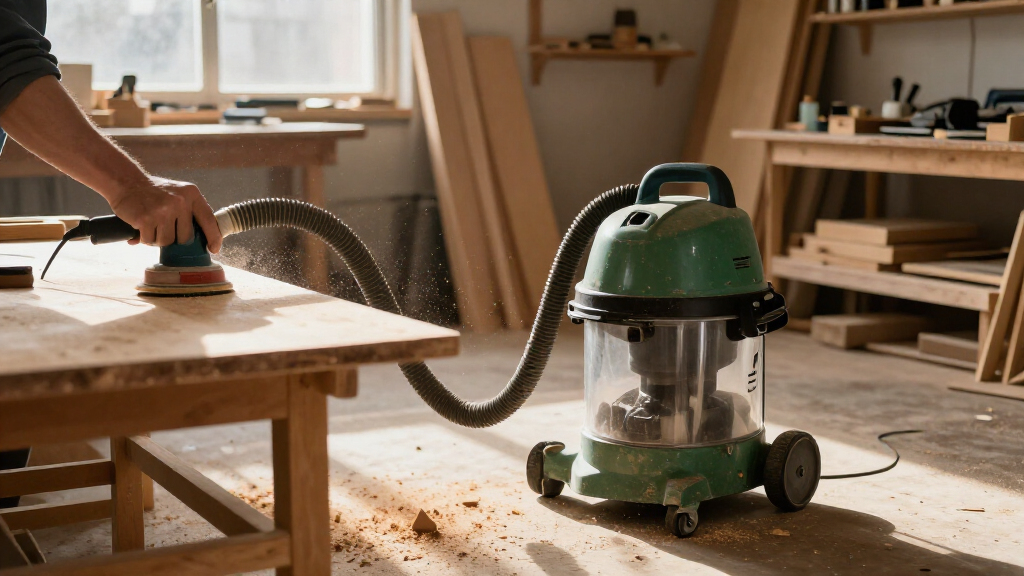
How We Picked
I ranked these shop vacuums for woodworking around the jobs that shape a real buying decision: collecting chips and sawdust, connecting to shop tools, moving around a workspace, managing filter loading, and handling cleanup without becoming a storage burden. I gave added weight to features that address woodworking needs directly, including dust-extraction positioning, HEPA filtration, pre-separation, quieter operation, and blower functions. Capacity and stated motor ratings matter, but neither tells the whole story: a larger tank can be awkward in a small shop, and peak horsepower alone does not establish fine-dust performance.
The order reflects workshop usefulness and role clarity, not a claim that one vacuum suits every task. Models with a more balanced capacity and shop-friendly feature set rank ahead of options aimed at a narrower use, while compact, high-capacity, and specialized models remain useful for the right buyer. Since product names and listed features do not establish airflow, filtration efficiency, tool-trigger behavior, or included adapter compatibility, I avoid treating those details as proven. Buyers should confirm the filter and accessory setup for their particular tools and dust-control needs.
Factors to Consider When Choosing Shop Vacuums For Woodworking
Choosing a woodworking vacuum starts with matching the dust it will collect to the way your shop runs. I’d decide how it will connect to tools, where fine dust goes, and how often you can empty and maintain it before comparing tank size or motor labels.
Match Dust Control to the Work
Woodworking produces both heavy chips and fine airborne dust, and a general wet/dry vacuum may handle those materials differently. A vac’s tank and motor rating do not confirm that its filter captures fine particles well enough for your work. Check the filter type, whether the maker specifies fine-dust use, and whether replacement filters are easy to obtain. A pre-separator can collect larger debris before it reaches the vacuum filter, which may slow filter loading during planing or routing. It does not replace appropriate filtration for the fine dust that passes through. For repeated sanding, prioritize a suitable extractor and filter arrangement over simply buying the largest motor rating.
Plan the Tool Connection Before Buying
A vacuum that cannot connect cleanly to a sander, track saw, or router may spend more time on floor cleanup than source capture. Measure the tool’s dust port and compare it with the hose diameter and adapters supplied or available for the vacuum. Universal-looking fittings may still leave gaps, reduce airflow, or pull loose during use. Tool-trigger outlets can be useful, but do not assume every model in this roundup has one; check the specifications for that exact version. If you use several brands of tools, budget space for adapters and consider whether changing them will become a daily nuisance. A snug connection often matters more to dust collection than a small difference in peak horsepower.
Choose Capacity for Your Emptying Routine
Tank capacity sets how long you can collect debris before stopping to empty the vacuum, but bigger is not always better. A compact 2.5- or 3-gallon unit is easier to tuck under a bench and carry between small work areas, though it fills sooner. Mid-size models can be a practical compromise for mixed tool use and routine cleanup. Large 9- or 16-gallon vacuums suit high-volume work or a mostly fixed location, but take more room and can be cumbersome when full. Think about the bulk of your typical waste, not just how often you hope to empty it. Fine dust can load a filter before the tank is full, so capacity alone does not predict uninterrupted use.
Treat Noise and Placement as Shop Constraints
Noise affects whether you can run dust collection while cutting, sanding, or working near other people. A quieter design may make longer sessions more tolerable, but it does not automatically mean better fine-dust capture or stronger tool suction. If the vacuum stays in a corner, hose length and access may matter more than how compact the body is. If it moves from tool to tool, consider handle placement, wheel layout, cord storage, and whether the body is easy to lift over a hose or threshold. A remote control can reduce trips to the vacuum, but only if its controls fit your workflow and remain dependable. Plan where the vac will sit before choosing a model based on a single convenience feature.
Compare Filtration, Separation, and Maintenance
Filters need regular cleaning and eventual replacement, so maintenance is part of the purchase decision rather than an afterthought. A pre-separator can keep larger chips and dust out of the main tank and reduce the debris reaching the filter, but it adds another vessel and more parts to empty. HEPA labeling is relevant for buyers focused on fine-particle capture, yet the full setup still matters: seals, filter fit, and dust disposal can affect how cleanly the system operates. Check the availability and cost of compatible replacement filters before settling on a model. Also find out whether the filter is suitable for both dry debris and any wet pickup you intend to do; wet use can call for a different filter setup. A simple system may be easier to maintain than a more elaborate one you rarely clean properly.
Know When to Pay for a Dedicated Extractor
A basic wet/dry vacuum can be a sensible choice for sweeping chips, cleaning a vehicle, and occasional tool use. Regular sanding or work that creates substantial fine dust may justify a dedicated dust extractor with filtration and connections designed for that job. The added expense and complexity only help if the extractor matches your tools and you maintain it. Do not pay extra for a feature you cannot use: a blower function, for example, may help clear a driveway but does not improve dust capture at a sander. Conversely, choosing only by tank size can leave a frequent fine-dust user with a poor fit. Put your most common woodworking task first, then treat general cleanup features as a bonus.
Frequently Asked Questions
Can I use a regular shop vacuum for sanding dust?
Often, but the vacuum needs a filter suited to fine dust and a reliable connection to the sander. A general-purpose wet/dry vac may collect debris while allowing very fine particles to load its filter or escape, depending on its filtration setup. Check the manufacturer’s stated filter use and confirm that the hose fits your tool’s dust port. For frequent sanding, a dust extractor or a vacuum with clearly specified fine-dust filtration is a more fitting starting point. Use appropriate respiratory protection and follow the tool and vacuum makers’ instructions.
Is a dual-cyclone pre-separator better than HEPA filtration?
They address different parts of dust collection, so one does not replace the other. A cyclone separator can catch a portion of larger debris before it reaches the vacuum, helping reduce how quickly the main filter loads. HEPA filtration concerns the filter’s ability to capture fine particles when the system is properly sealed and used as directed. For woodworking, a separator paired with suitable filtration may be useful, but a separator alone does not make a vacuum a fine-dust extractor. Choose based on the dust you produce, and check the complete system rather than a single feature label.
Should I choose more peak horsepower or a larger tank?
Neither specification answers the most important question by itself: whether the vacuum collects dust effectively at your tool. Peak horsepower is not a direct measure of airflow at the hose, while tank capacity mainly affects how often you stop to empty debris. For a small shop with limited storage, a smaller tank may be the better fit even if it needs more frequent emptying. For high-volume chip collection, extra capacity can reduce interruptions. Compare filtration, hose and port compatibility, and the kind of waste you produce alongside both numbers.
Is a quieter vacuum worth choosing for a small woodworking shop?
It can be, especially if the vacuum runs for long periods or your shop shares walls with living or working spaces. Lower operating noise may make routine dust collection less tiring, but it does not guarantee stronger suction or better filtration. Check the manufacturer’s noise information where available, since product names alone do not give a measured sound level. Also consider whether the vacuum’s capacity and tool connections fit your work; a quiet model that does not connect well to your sander may still disappoint. Hearing protection remains sensible when using loud woodworking tools.
When should I move from a compact shop vac to a dust extractor?
Consider a dust extractor when fine-dust-producing tools such as sanders are used often, when your current setup clogs quickly, or when dust escapes around tool connections. A compact shop vac can still be useful for bench cleanup and occasional jobs, but frequent source capture calls for attention to filtration, airflow, and a secure tool connection. A pre-separator may help when large volumes of chips fill the vacuum, though it does not solve inadequate fine-particle filtration. Before upgrading, check whether a compatible filter and hose adapter would improve your current setup. If you work with multiple tools, compare connection options and maintenance needs before choosing a dedicated extractor.
Conclusion
My best overall pick is the Vacmaster Professional Beast Series 5-Gallon for a balanced capacity and workshop-focused role. For best value, I’d look first at the Amazon Basics 4-Gallon or Stanley 6-Gallon, choosing the smaller unit for limited storage and the larger one for longer cleanup sessions; confirm their filter and tool-connection fit before relying on them for fine dust. The best premium-leaning choice for dust separation is the PEMEDOR 9-Gallon, while the ECOMAX is the more direct option for buyers prioritizing stated HEPA filtration. Beginners with a small workspace may find the CRAFTSMAN 2.5-Gallon easier to store and handle. For specific needs, choose the DEWALT STEALTHSONIC 5-Gallon when quieter operation is a priority, the 16-gallon CRAFTSMAN for high-volume cleanup, or the Shop-Vac 3-Gallon when portability and blower use matter more than capacity. Match your final choice to your tools, filter requirements, and available space—not just the largest tank or peak horsepower figure.
Evergreen bestsellers Picks

Breville Barista Pro Espresso Machine with Built-In Grinder, Brushed Stainless Steel

Roborock Qrevo S Pro Robot Vacuum and Mop with 18,500 Pa Suction

KitchenAid Artisan 5-Quart Tilt-Head Stand Mixer, Milkshake
As an affiliate, we earn on qualifying purchases.