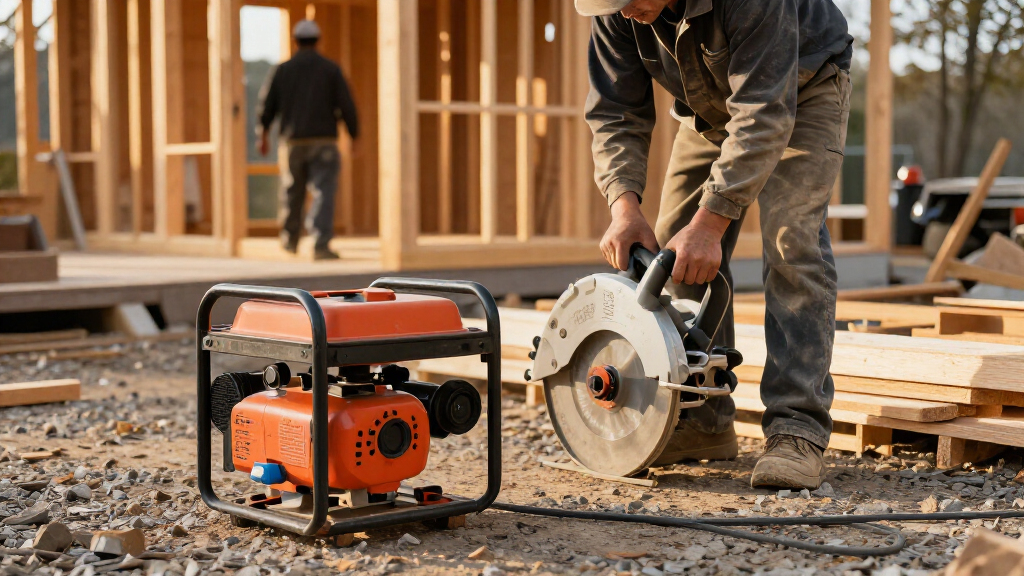
For most crews, I’d start with the DuroMax XP11000iH, a dual-fuel inverter option that pairs substantial output with a quieter, cleaner-power design than conventional open-frame units. The Firman T09275 stands out for crews that want three fuel choices, while the Generac XD5000E offers a diesel alternative for buyers who value jobsite-oriented construction. The main tradeoff is between high starting capacity and the weight, noise, and fuel use that can come with larger generators; inverter models can be quieter but may offer fewer watts for the size. I compare all 15 picks by jobsite usefulness, power needs, fuel flexibility, and handling. Read on for the full breakdown and help matching a generator to your tools and crew.

Get business pricing on tools and workshop supplies
- Business-only prices and quantity discounts
- Tax-exempt purchasing
- Multiple users, one account, clear invoices
Complete the kit


Key Takeaways
- The DuroMax XP11000iH is the strongest all-around fit in this lineup for crews seeking a high-output dual-fuel inverter generator rather than a basic open-frame unit.
- The Firman T09275’s tri-fuel capability is its defining advantage; it gives buyers more fuel choices than the dual-fuel models, though the right setup still depends on fuel availability and connection requirements.
- Several 4,300–4,500-watt inverter models target lighter, more mobile work, while the 9,500-watt-and-up conventional generators suit heavier loads but demand more room and handling effort.
- The Generac XD5000E is the lineup’s diesel pick, a distinct option for buyers who prefer diesel over the gas and propane choices offered by most other models.
- Honda’s EB6500 and EB10000 serve different jobsite scales: the EB6500 is the more moderate-capacity choice, while the EB10000 is aimed at crews that need substantially more available output.
| DuroMax XP11000iH 11,000-Watt Dual-Fuel Portable Inverter Generator |  | Best for High-Demand Job Sites | Fuel: Gasoline and propane | Peak output: 11,000 watts | Running output: 9,000 watts | VIEW LATEST PRICE | See Our Full Breakdown |
| Cummins Onan P9500df Dual-Fuel Portable Generator, 9500W |  | Best for Long Shifts | Fuel: Gasoline and propane | Peak output: 9,500 watts | Running output: 7,500 watts on gasoline | VIEW LATEST PRICE | See Our Full Breakdown |
| Firman T09275 Tri-Fuel Portable Generator, 120/240V Electric Start |  | Best for Fuel Flexibility | Fuel: Gasoline, propane, and natural gas | Starting output: 11,400 watts on gasoline | Running output: 9,200 watts gasoline; 8,300 watts propane; 6,900 watts natural gas | VIEW LATEST PRICE | See Our Full Breakdown |
| All Power America 3300W Portable Inverter Generator with RV Outlet and CO Sensor |  | Best Compact Pick | Fuel: Gasoline | Peak output: 3,300 watts | Voltage: 120 volts | VIEW LATEST PRICE | See Our Full Breakdown |
| Genkins 4500W Gas Inverter Generator with 30A Outlet |  | Best Mid-Size Tool-and-Electronics Balance | Fuel: Gasoline | Peak output: 4,500 watts | Running output: 3,700 watts | VIEW LATEST PRICE | See Our Full Breakdown |
| WEN GN5600 5600-Watt Portable Gas Generator |  | Best Straightforward 120V Jobsite Pick | Starting wattage: 5,600 watts | Running wattage: 4,500 watts | Fuel: Gasoline | VIEW LATEST PRICE | See Our Full Breakdown |
| WEN 5,600-Watt Dual-Fuel Portable Generator with Electric Start and CO Sensor (DF5600X) |  | Best for Fuel Flexibility and Easier Starts | Gasoline output: 5,600 surge watts; 4,500 rated watts | Propane output: 5,000 surge watts; 4,050 rated watts | Fuel types: Gasoline and propane | VIEW LATEST PRICE | See Our Full Breakdown |
| PowerSmart 4300-Watt Portable Inverter Generator |  | Best for Sensitive Electronics | Starting wattage: 4,300 watts | Running wattage: 3,500 watts | Fuel: Gasoline | VIEW LATEST PRICE | See Our Full Breakdown |
| Westinghouse WGen9500DF Dual Fuel Portable Generator, 12,500 Peak Watts |  | Best for High-Demand Jobsite Loads | Peak output: 12,500 watts on gasoline; 11,200 watts on propane | Running output: 9,500 watts on gasoline; 8,500 watts on propane | Fuel: Gasoline or propane | VIEW LATEST PRICE | See Our Full Breakdown |
| Oxseryn 4400-Watt Gasoline Inverter Generator |  | Best Lightweight Pick for Short Site Tasks | Starting wattage: 4,400 watts | Running wattage: 3,400 watts | Fuel: Gasoline | VIEW LATEST PRICE | See Our Full Breakdown |
| AMERISUN 4500W Open-Frame Gas Inverter Generator with CO Sensor |  | Best Compact Inverter for Light-Duty Sites | Fuel: Gasoline | Starting watts: 4,500 watts | Running watts: 3,800 watts | VIEW LATEST PRICE | See Our Full Breakdown |
| Generac XD5000E 5,500-Watt Diesel Portable Generator |  | Best for Extended Commercial Runtime | Fuel: Diesel | Starting watts: 5,500 watts | Running watts: 5,000 watts | VIEW LATEST PRICE | See Our Full Breakdown |
| Honda EB6500 6500-Watt Portable Generator |  | Best Balanced Power for Contractor Crews | Fuel: Gasoline | Running watts: 6,500 watts | Starting watts: 7,000 watts | VIEW LATEST PRICE | See Our Full Breakdown |
| Honda EB10000 10,000-Watt Portable Gas Generator with Electric Start |  | Best Premium High-Output Job-Site Pick | Fuel: Gasoline | Starting watts: 10,000 watts | Running watts: 10,000 watts | VIEW LATEST PRICE | See Our Full Breakdown |
| DuroMax XP13000EH 13,000-Watt Dual-Fuel Portable Generator |  | Best Dual-Fuel Option for High-Demand Sites | Fuel: Gasoline or propane | Peak watts: 13,000 watts | Running watts: 10,500 watts | VIEW LATEST PRICE | See Our Full Breakdown |
| portable generators for job site | Fuel | Engine | Runtime | Weight |
|---|---|---|---|---|
| DuroMax XP11000iH 11,000-Watt | Gasoline and propane | 459 cc, 4-stroke | — | 216 pounds |
| Cummins Onan P9500df Dual-Fuel | Gasoline and propane | 420 cc, 4-stroke | — | — |
| Firman T09275 Tri-Fuel Portabl | Gasoline, propane, and natural gas | 459 cc | — | 217.5 pounds |
| All Power America 3300W Portab | Gasoline | 143 cc, 4-stroke | Up to 8 hours at 50% load | 39.7 pounds |
| Genkins 4500W Gas Inverter Gen | Gasoline | 212 cc, 4-stroke OHV | Up to 8 hours at half load | 56 pounds |
| WEN GN5600 5600-Watt Portable | Gasoline | 224 cc, 4-stroke | Up to 12.5 hours at half load | 112.4 pounds |
| WEN 5,600-Watt Dual-Fuel Porta | — | 224 cc | — | — |
| PowerSmart 4300-Watt Portable | Gasoline | 223 cc, 4-stroke | Up to 12 hours at 25% load | 68 pounds |
| Westinghouse WGen9500DF Dual F | Gasoline or propane | 457 cc, 4-stroke OHV | Up to 12 hours | — |
| Oxseryn 4400-Watt Gasoline Inv | Gasoline | 208 cc, 4-stroke | Up to 14 hours at 25% load with ECO mode | 56 pounds |
| AMERISUN 4500W Open-Frame Gas | Gasoline | 223 cc, 4-stroke | Up to 6.5 hours at 50% load | 68 lbs |
| Generac XD5000E 5,500-Watt Die | Diesel | Yanmar LW Series, 435 cc, air-cooled direct-injection diesel (engine-cycle listing conflicts) | 32.4 hours at 50% load | — |
| Honda EB6500 6500-Watt Portabl | Gasoline | 389 cc, 4-stroke | 6.4 to 9.8 hours per tank | — |
| Honda EB10000 10,000-Watt Port | Gasoline | — | 5.4 to 7.9 hours | 443 lbs |
| DuroMax XP13000EH 13,000-Watt | Gasoline or propane | 500 cc, four-stroke OHV | 3 hours (as listed) | 234 lbs |
More Details on Our Top Picks
DuroMax XP11000iH 11,000-Watt Dual-Fuel Portable Inverter Generator
For crews that need substantial 120/240V capacity and cleaner inverter power, the XP11000iH is the strongest all-round fit in this group. Its 9,000 running watts can support a heavier mix of job-site equipment than the smaller All Power America APG3900iS or Genkins 4500W, while inverter technology is a useful match for sensitive electronics. Gasoline and propane give buyers a second fuel option, and remote electric start cuts down on setup effort. The tradeoff is mobility: at 216 pounds, this is a wheeled or vehicle-transport unit, not something to carry between work areas. Its listed nine-hour runtime also trails the Cummins Onan P9500df’s 16-hour figure, so plan for refueling during longer shifts.
Pros:- 9,000 running watts and 240V output suit higher-demand tools and equipment.
- Gasoline and propane operation offers fuel flexibility.
- Inverter technology provides stable power for sensitive electronics.
- Remote electric start and automatic CO shutoff add convenience and a safety response.
Cons:- At 216 pounds, it is difficult to move without help or suitable loading equipment.
- The listed nine-hour runtime may require refueling during a long work shift.
- Its high output is more than many small crews need for basic tool charging.
Best for: Job-site crews needing high running output, 240V capability, and the flexibility to use gasoline or propane.
Not ideal for: Solo tradespeople who need to lift a generator into a truck bed or move it frequently; its 216-pound weight makes that impractical.
- Fuel:Gasoline and propane
- Peak output:11,000 watts
- Running output:9,000 watts
- Voltage:240 volts
- Engine:459 cc, 4-stroke
- Tank capacity:7.1 gallons
- Listed runtime:9 hours
- Weight:216 pounds
Our verdict“Choose the XP11000iH when your job site needs substantial 240V inverter power and you can accommodate a heavy generator.”
Cummins Onan P9500df Dual-Fuel Portable Generator, 9500W
The Onan P9500df stands out for crews that value fewer fuel stops over maximum output. Its listed 16-hour runtime is longer than the DuroMax XP11000iH’s nine-hour figure, while 7,500 running watts on gasoline still give a work crew room to operate several tools. Gasoline or propane operation adds flexibility, and electric start with a digital panel makes routine startup and monitoring more straightforward. The steel frame, folding handle, and never-flat wheels help with rolling it across a site, though its 420 cc engine and frame still make transport cumbersome. Unlike the DuroMax, the listed running-watt figure is specifically for gasoline; buyers planning to run on propane should not assume the same output.
Pros:- Listed 16-hour runtime can reduce refueling interruptions.
- Runs on gasoline or propane.
- Electric start and digital control panel simplify operation and monitoring.
- Never-flat wheels and a folding handle support rolling it around outdoor work areas.
Cons:- The 420 cc engine and steel-frame construction make it cumbersome to transport.
- The 7,500 running-watt rating is specified for gasoline, not propane.
- Its output is below the DuroMax XP11000iH’s 9,000 running watts.
Best for: Contractors working long shifts who want a dual-fuel generator with a long listed runtime and enough output for multiple tools.
Not ideal for: Crews that need confirmed high running output on propane or frequently lift their generator into a vehicle.
- Fuel:Gasoline and propane
- Peak output:9,500 watts
- Running output:7,500 watts on gasoline
- Engine:420 cc, 4-stroke
- Fuel tank capacity:6.6 gallons
- Listed runtime:16 hours
- Starting system:Electric start
- Outlets:RV-ready 30A, household, and USB ports
Our verdict“Pick the Onan P9500df if extended runtime and dual-fuel flexibility matter more than the DuroMax XP11000iH’s higher stated running output.”
Firman T09275 Tri-Fuel Portable Generator, 120/240V Electric Start
When a site may have access to different fuel supplies, the Firman T09275 offers a practical advantage: it runs on gasoline, propane, or natural gas. Its output changes by fuel—9,200 running watts on gasoline, 8,300 on propane, and 6,900 on natural gas—so crews can match expectations to the available supply rather than treating all three as equivalent. That gasoline rating is close to the DuroMax XP11000iH’s 9,000 running watts, but the Firman’s tri-fuel capability makes it more adaptable when gasoline storage or delivery is a constraint. Electric start has recoil backup, and low-oil shutoff adds a layer of engine protection. At 217.5 pounds, it shares the DuroMax’s major job-site drawback: moving it between locations takes planning. Its three-year warranty is also shorter than the DuroMax’s five years.
Pros:- Runs on gasoline, propane, or natural gas.
- Provides up to 9,200 running watts on gasoline and 120/240V output.
- Electric start includes recoil backup.
- Low-oil shutoff, CO sensor alert, and covered outlets support job-site operation.
Cons:- At 217.5 pounds, it is difficult to transport without wheels, help, or loading equipment.
- Running output falls to 6,900 watts on natural gas.
- Its three-year warranty is shorter than the DuroMax XP11000iH’s five-year warranty.
Best for: Crews with access to gasoline, propane, or natural gas who want fuel choice and 120/240V output from one generator.
Not ideal for: Workers who need a lightweight unit to reposition by hand, or buyers who expect the same output on every fuel.
- Fuel:Gasoline, propane, and natural gas
- Starting output:11,400 watts on gasoline
- Running output:9,200 watts gasoline; 8,300 watts propane; 6,900 watts natural gas
- Voltage:120/240V
- Engine:459 cc
- Tank volume:8 gallons
- Listed runtime:12 hours
- Weight:217.5 pounds
Our verdict“Choose the Firman T09275 when access to three fuel types matters more than light weight or uniform output across fuels.”
All Power America 3300W Portable Inverter Generator with RV Outlet and CO Sensor
For a small crew focused on chargers, lights, and lighter-duty tools, the APG3900iS is the easy-to-move choice in this set. At 39.7 pounds, it is far more manageable than the 216-pound DuroMax XP11000iH or 217.5-pound Firman T09275. Its 3,000-watt rated output and inverter power with less than 3% THD suit sensitive electronics, while Eco Mode can help stretch its listed runtime of up to eight hours at half load. An RV-ready 30A outlet adds flexibility, but it does not turn this compact unit into a heavy-tool workhorse: its 120V output and lower capacity limit what can run at once. Starting is by recoil, and buyers who later need more capacity must purchase the separate parallel kit.
Pros:- At 39.7 pounds, it is much easier to carry between work areas than the larger lineup options.
- Inverter output has less than 3% total harmonic distortion for sensitive electronics.
- Eco Mode and a listed eight-hour runtime at 50% load support longer lighter-duty use.
- Includes an RV-ready 30A outlet, USB ports, overload protection, and a CO sensor.
Cons:- Its 3,000-watt rated output is too limited for many combinations of heavy job-site tools.
- Recoil starting requires manual effort.
- Parallel operation requires a separately sold kit.
Best for: Mobile tradespeople who need portable 120V power for chargers, lighting, and modest tool loads, with clean output for electronics.
Not ideal for: Crews running multiple high-draw tools or 240V equipment; this generator is limited to 120V and 3,000 rated watts.
- Fuel:Gasoline
- Peak output:3,300 watts
- Voltage:120 volts
- Engine:143 cc, 4-stroke
- Tank capacity:1.72 gallons
- Runtime:Up to 8 hours at 50% load
- Weight:39.7 pounds
Our verdict“Pick the APG3900iS for light, mobile work where carrying ease and clean 120V power matter more than high tool capacity.”
Genkins 4500W Gas Inverter Generator with 30A Outlet
The Genkins lands between the compact All Power America APG3900iS and the much heavier high-output DuroMax XP11000iH. With 3,700 running watts, it offers more headroom than the All Power America’s 3,000 rated watts for a modest tool-and-charger setup, while its under-3% THD pure sine wave output suits sensitive electronics. The 30A outlet gives it more connection flexibility than a basic household-outlet-only unit, and its listed eight-hour runtime at half load can cover a workday at a moderate draw. The compromises are practical: this is a gasoline-only generator, it uses a manual pull start and choke, and its open-frame design is listed at 70 dB at seven meters. At 56 pounds, it is still portable, but not as easy to carry as the 39.7-pound All Power America.
Pros:- 3,700 running watts provide more headroom than the All Power America APG3900iS’s 3,000 rated watts.
- Pure sine wave output with less than 3% THD is suited to sensitive electronics.
- Includes both a 30A outlet and a household outlet.
- Listed runtime reaches eight hours at half load, with low-oil shutdown and overload protection.
Cons:- Manual pull-start and choke require hands-on starting.
- Open-frame construction is listed at 70 dB at seven meters.
- Gasoline-only operation offers less fuel flexibility than the DuroMax XP11000iH or Firman T09275.
Best for: Small crews seeking a middle-ground generator for moderate 120V tool loads and electronics without stepping up to a 200-plus-pound unit.
Not ideal for: Workers who need electric start, quieter enclosed operation, dual-fuel flexibility, or power for 240V equipment.
- Fuel:Gasoline
- Peak output:4,500 watts
- Running output:3,700 watts
- Engine:212 cc, 4-stroke OHV
- Fuel tank capacity:2.11 gallons
- Runtime:Up to 8 hours at half load
- Outlets:NEMA L5-30R and NEMA 5-20R
- Weight:56 pounds
- Noise level:70 dB at 7 meters
Our verdict“Choose the Genkins for moderate 120V work when you want more output than a compact inverter but do not need a large dual-fuel unit.”
WEN GN5600 5600-Watt Portable Gas Generator
The WEN GN5600 suits crews that need a practical amount of power for 120V tools without moving up to a much larger generator. Its 4,500 running watts and two 20A outlets can support several everyday loads, while the 30A outlets add a connection option for compatible equipment. The digital meter shows voltage, frequency, and runtime, making it easier to track operation during a workday. Compared with the WEN DF5600X, this model gives up propane operation, electric start, and a CO shutdown sensor, but keeps the setup simpler. Its 112.4-pound weight is a real handling drawback despite the wheel and handle kit, and 120V-only output rules it out for crews needing 240V tools. I’d choose it for basic, stationary jobsite power rather than frequent hauling or mixed-voltage demands.
Pros:- 4,500 running watts suit a range of common 120V jobsite loads.
- 30A TT-30R and L5-30R outlets broaden connection options for compatible gear.
- Digital meter displays voltage, frequency, and runtime.
- Wheel and handle kit helps with movement across a site.
Cons:- At 112.4 pounds, it is cumbersome to lift into a vehicle or carry over rough ground.
- 120V-only output does not support 240V tools.
- Gasoline-only operation offers less fuel flexibility than the WEN DF5600X.
Best for: Small crews running 120V tools and accessories at a site where the generator can stay in one work area.
Not ideal for: Crews needing 240V equipment, propane fuel flexibility, or frequent one-person loading and unloading.
- Starting wattage:5,600 watts
- Running wattage:4,500 watts
- Fuel:Gasoline
- Engine:224 cc, 4-stroke
- Fuel tank:4.3 gallons
- Runtime:Up to 12.5 hours at half load
- Outlets:Two 120V 20A 5-20R, one 120V 30A TT-30R, one 120V 30A L5-30R
- Weight:112.4 pounds
Our verdict“Choose the GN5600 for a worksite centered on 120V equipment where useful output and basic metering matter more than light weight or dual-fuel flexibility.”
WEN 5,600-Watt Dual-Fuel Portable Generator with Electric Start and CO Sensor (DF5600X)
The WEN DF5600X adds features that can make a workday less dependent on one fuel source or a pull-start routine. It runs on gasoline or propane, and its electric starter has a recoil backup if the battery or starting system is unavailable. The automatic CO shutdown sensor adds a layer of protection, though the generator still belongs outdoors, away from enclosed work areas. Its gasoline output matches the GN5600 at 4,500 rated watts, while propane output falls to 4,050 watts, so fuel flexibility comes with a power tradeoff. Compared with the simpler WEN GN5600, this model is a more adaptable choice for crews with propane on hand or workers who value push-button starting. It remains a heavy, conventional generator rather than a compact carry-around unit.
Pros:- Runs on gasoline or propane, giving crews another fuel option.
- Electric start is backed by a recoil starter.
- Automatic CO shutdown sensor adds a safety feature for outdoor operation.
- Wheel and handle kit supports rolling the unit between work areas.
Cons:- Propane output is lower than gasoline output at 4,050 rated watts.
- The listed 12.5-hour runtime applies to gasoline at half load, not every fuel and load condition.
- Its size makes it less convenient to transport than the 68-pound PowerSmart DB5041.
Best for: Contractors who want gasoline and propane options, electric starting, and a CO shutdown sensor for outdoor site use.
Not ideal for: Workers who need a lightweight generator, 240V output, or the full rated output while running on propane.
- Gasoline output:5,600 surge watts; 4,500 rated watts
- Propane output:5,000 surge watts; 4,050 rated watts
- Fuel types:Gasoline and propane
- Engine:224 cc
- Starting system:Electric start with recoil backup
- CO protection:Automatic shutdown sensor
- Fuel tank:4.3 gallons
- Outlets:Two 120V 20A 5-20R, one 120V 30A TT-30R, one 120V 30A L5-30R
Our verdict“Pick the DF5600X if fuel choice and electric starting matter more to your crew than minimizing weight or maintaining the same output on propane.”
PowerSmart 4300-Watt Portable Inverter Generator
For jobsites with laptops, diagnostic equipment, or other electronics alongside power tools, the PowerSmart DB5041 has a clearer advantage than the conventional WEN models: inverter output with less than 3% THD. Its 3,500 running watts are below the WEN GN5600’s 4,500, so this is a better fit for a moderate load mix than for running several demanding tools at once. At 68 pounds, it is also easier to reposition than either WEN, although still heavy enough that frequent solo lifting may be inconvenient. The 1.9-gallon tank supports up to 12 hours at 25% load, a light-load figure rather than a promise for a busy workday. Eco mode and a digital display help manage operation, but it offers 120V output only and must stay outdoors.
Pros:- Less than 3% THD suits sensitive electronics.
- 68-pound weight is lower than the WEN GN5600 and WEN DF5600X.
- Eco mode and digital display support more informed operation.
- Parallel-ready design can support added capacity with a compatible unit.
Cons:- 3,500 running watts provide less capacity than the WEN GN5600’s 4,500 watts.
- The 12-hour runtime is specified at only 25% load.
- 120V-only output does not serve 240V jobsite equipment.
Best for: Tradespeople who need clean power for electronics and a moderate 120V tool load, with a generator they can move between work areas.
Not ideal for: Crews running high-demand tools simultaneously, needing 240V, or expecting long runtime under heavy load.
- Starting wattage:4,300 watts
- Running wattage:3,500 watts
- Fuel:Gasoline
- Engine:223 cc, 4-stroke
- Fuel tank:1.9 gallons
- Runtime:Up to 12 hours at 25% load
- Total harmonic distortion:Less than 3%
- Weight:68 pounds
Our verdict“Choose the PowerSmart when clean inverter power and easier repositioning outweigh the need for the higher running wattage of the WEN GN5600.”
Westinghouse WGen9500DF Dual Fuel Portable Generator, 12,500 Peak Watts
The Westinghouse WGen9500DF is the capacity pick for jobsites where smaller 120V generators would force crews to stagger tool use. It delivers 9,500 running watts on gasoline and provides 120/240V output, making it more suitable for larger equipment than the WEN GN5600 or the inverter-style PowerSmart DB5041. Gasoline or propane operation adds fuel choice, while remote, electric, and recoil starting give crews several ways to get it running. Its 6.6-gallon tank is listed for up to 12 hours, but the supplied data does not specify the load for that figure. The tradeoff is scale: its 457 cc engine and large tank make transport and storage more demanding than with the smaller picks. It is the strongest fit here for sustained, higher-output work—not for a crew prioritizing easy carrying.
Pros:- 9,500 gasoline running watts provide the highest listed running output in this five-product group.
- 120/240V outlets support compatible higher-voltage equipment.
- Gasoline or propane operation gives crews fuel flexibility.
- Remote, electric, and recoil starting offer multiple start methods.
Cons:- The 457 cc engine and 6.6-gallon tank make it substantial to store and handle.
- Propane running output drops to 8,500 watts.
- The listed runtime does not specify the load condition.
Best for: Construction crews running multiple demanding loads or compatible 120/240V equipment at a site with room to store and position a large generator.
Not ideal for: Solo contractors who need to lift a generator in and out of a vehicle often or only power a few modest 120V tools.
- Peak output:12,500 watts on gasoline; 11,200 watts on propane
- Running output:9,500 watts on gasoline; 8,500 watts on propane
- Fuel:Gasoline or propane
- Engine:457 cc, 4-stroke OHV
- Fuel tank:6.6 gallons
- Runtime:Up to 12 hours
- Starting methods:Remote, electric, and recoil
- Outlets:Two 120V 5-20R 20A GFCI, one 120V L14-30R 30A, one 120/240V 14-50R 50A
Our verdict“Choose the WGen9500DF when high output and 120/240V capability outweigh the handling burden of a large, heavy generator.”
Oxseryn 4400-Watt Gasoline Inverter Generator
The Oxseryn EDOG10 is the lightest option in this group at 56 pounds, which makes it a more practical match for contractors who move a generator between small work areas. It provides 3,400 running watts and an RV port, while its ECO mode is rated for up to 14 hours at 25% load. That runtime is tied to a light load, and the modest two-gallon tank leaves less reserve for demanding work than the Westinghouse WGen9500DF’s 6.6-gallon tank. The Oxseryn is an open-frame model, so it should not be treated as a quiet, enclosed-site solution; its stated noise level is under 72 dBA at 23 feet. Compared with the PowerSmart DB5041, it weighs less and claims a longer light-load runtime, but the provided data does not list inverter THD.
Pros:- At 56 pounds, it is lighter than the PowerSmart DB5041 and both WEN generators.
- Up to 14 hours of runtime is listed at 25% load with ECO mode.
- Fuel gauge, low-oil shutdown, and overload protection support routine operation.
- Includes two 120V AC outlets, a 12V DC port, and an RV port.
Cons:- The two-gallon tank may require refills during extended or heavier-load work.
- Open-frame construction does not offer an enclosed design.
- No THD figure is provided, unlike the PowerSmart DB5041.
Best for: Solo contractors and small crews who prioritize lighter handling for intermittent 120V work and want an RV-style outlet available.
Not ideal for: Crews powering sensitive electronics that require a stated clean-power specification, running 240V equipment, or working long shifts at heavy load.
- Starting wattage:4,400 watts
- Running wattage:3,400 watts
- Fuel:Gasoline
- Engine:208 cc, 4-stroke
- Fuel tank:2 gallons
- Runtime:Up to 14 hours at 25% load with ECO mode
- Noise level:Under 72 dBA at 23 feet
- Weight:56 pounds
Our verdict“Choose the Oxseryn for lighter, intermittent jobsite duties where easy repositioning matters more than high output or a stated inverter power specification.”
AMERISUN 4500W Open-Frame Gas Inverter Generator with CO Sensor
The AMERISUN AM5041 suits small crews that need inverter-style output without hauling a large commercial unit. Its 3,800 running watts can cover a focused set of tools, chargers, or lights, while the digital display makes operating information easier to check on a busy site. At 68 pounds, it is far easier to move than the Honda EB6500, though it also supplies substantially less running power. The CO shutoff adds a useful safety layer, but it does not replace keeping the generator outdoors and away from occupied spaces. Runtime is listed at up to 6.5 hours at half load, so crews running it through a long shift may need refueling. Its open frame also leaves components exposed, and adding parallel capacity requires a separately purchased kit.
Pros:- 68-pound weight is easier to transport than the larger Honda EB6500.
- CO sensor can shut the generator down when unsafe carbon monoxide levels are detected.
- ECO mode adjusts engine speed to demand, which may help conserve fuel under lighter loads.
- VFT display and 120V 30A RV outlet provide useful monitoring and connection options.
Cons:- Open-frame construction leaves generator components more exposed to job-site dust and impacts.
- Up to 6.5 hours at 50% load may mean refueling during a long workday.
- Parallel kit is required to expand output and is not included.
Best for: Small crews and mobile tradespeople powering chargers, lighting, and a limited number of tools who value lower carry weight over high output.
Not ideal for: Crews running several demanding tools at once or needing uninterrupted all-day power; its 3,800-watt running capacity and stated runtime may require load limits and refueling.
- Fuel:Gasoline
- Starting watts:4,500 watts
- Running watts:3,800 watts
- Engine:223 cc, 4-stroke
- Runtime:Up to 6.5 hours at 50% load
- Outlets:4, including 120V 30A RV outlet
- Weight:68 lbs
- Safety and expansion:CO sensor with automatic shutdown; parallel-ready
Our verdict“Choose the AMERISUN for lighter tool loads and easier transport, but pick the Honda EB6500 if your crew needs much more running capacity.”
Generac XD5000E 5,500-Watt Diesel Portable Generator
The Generac XD5000E is the strongest fit here for crews that prioritize long operating stretches over easy relocation. Its 12-gallon diesel tank is listed to run up to 32.4 hours at 50% load, a major advantage over the gasoline Honda EB6500, whose stated runtime is 6.4 to 9.8 hours. The welded steel frame and integrated lifting eye suit job-site handling, especially where equipment can be moved with lifting gear rather than carried by hand. Its 5,000 running watts support a substantial tool load, and the product description cites low harmonic distortion for sensitive equipment. The tradeoff is a diesel-only fuel requirement, which can complicate supply for crews standardized on gasoline. It also has only three outlets, and the supplied engine information is inconsistent: one listing says 2-stroke while the description identifies a Yanmar direct-injection diesel.
Pros:- 12-gallon tank supports a listed 32.4-hour runtime at 50% load.
- 5,000 running watts provide more capacity than compact inverter options such as the AMERISUN AM5041.
- Welded 1-1/4-inch steel frame and integrated lifting eye support commercial handling.
- Electric start avoids relying solely on a manual pull-start.
Cons:- Diesel-only operation may be inconvenient for crews whose fuel supply is gasoline-based.
- Three outlets offer fewer connection points than several alternatives in this roundup.
- Product information conflicts on engine cycle, listing both 2-stroke and a Yanmar direct-injection diesel engine.
Best for: Commercial crews with access to diesel and lifting equipment who need long runtimes for a steady, moderate-to-heavy site load.
Not ideal for: Small crews that need a lightweight unit or rely on gasoline; this generator is built around a large fuel tank and a heavy steel frame, not frequent hand-moving.
- Fuel:Diesel
- Starting watts:5,500 watts
- Running watts:5,000 watts
- Engine:Yanmar LW Series, 435 cc, air-cooled direct-injection diesel (engine-cycle listing conflicts)
- Fuel tank:12 gallons
- Runtime:32.4 hours at 50% load
- Start:Electric start
- Frame:Fully welded 1-1/4-inch steel with integrated lifting eye
- Outlets:3
Our verdict“Pick the Generac XD5000E when diesel access and long run time matter more than fuel flexibility, outlet count, or easy manual transport.”
Honda EB6500 6500-Watt Portable Generator
The Honda EB6500 balances meaningful job-site output with safety and mobility features, making it a versatile choice for crews that need more than a compact inverter can provide. Its 6,500 running watts and 7,000-watt starting capacity can handle a broader mix of tools than the AMERISUN AM5041, while the wheel kit helps when the generator must be repositioned around a site. Full GFCI protection and CO-MINDER detection add practical safeguards, and iAVR technology is described as helping stabilize power for equipment. It does not match the Generac XD5000E’s listed 32.4-hour runtime, and its gasoline tank is 6.2 gallons. Buyers should also check availability before planning a purchase, since the supplied listing says it is not available in California.
Pros:- 6,500 running watts and 7,000 starting watts provide substantially more capacity than the AMERISUN AM5041.
- Full GFCI protection and CO-MINDER detection add job-site safety features.
- iAVR technology is designed to help provide stable power for sensitive equipment.
- Wheel kit supports movement across a work area.
Cons:- Gasoline tank capacity is 6.2 gallons, and listed runtime is 6.4 to 9.8 hours.
- Not available in California according to the supplied product information.
- More output than a compact inverter brings a larger, heavier site unit to move and store.
Best for: Contractors who need mid-to-high output for a varied tool load, plus GFCI and carbon monoxide protection and wheel-assisted movement.
Not ideal for: Crews needing very long unattended runs or buyers in California; the listed runtime is shorter than the diesel Generac XD5000E’s, and this model is noted as unavailable there.
- Fuel:Gasoline
- Running watts:6,500 watts
- Starting watts:7,000 watts
- Voltage:120/240 V or 120 V
- Fuel tank:6.2 gallons
- Runtime:6.4 to 9.8 hours per tank
- Engine:389 cc, 4-stroke
- Outlets:5
- Safety:Full GFCI protection and CO-MINDER detection
Our verdict“Choose the EB6500 for a capable gasoline workhorse with safety features and wheels, unless extended runtime or California availability is a priority.”
Honda EB10000 10,000-Watt Portable Gas Generator with Electric Start
For a site with large simultaneous loads, the Honda EB10000 offers a step up that the EB6500 cannot match: 10,000 watts running and starting lets crews plan around more equipment without relying on multiple smaller generators. Electric start, a wheel kit, low-oil shutdown, overload protection, GFCI protection, and CO-MINDER make its high output easier to manage. Digital AVR is listed as holding voltage stability within ±1%, a useful feature when equipment needs steady power. The cost of this capacity is physical: at 443 pounds, it is not a casually portable unit, even with wheels. Its 8.19-gallon tank is listed for 5.4 to 7.9 hours, well short of the Generac XD5000E’s stated half-load runtime. It also runs at a listed 73 dB(A) and is noted as unavailable in California.
Pros:- 10,000 running and starting watts provide far more capacity than the Honda EB6500.
- Electric start and wheel kit make operation and repositioning more manageable.
- GFCI protection, CO-MINDER, low-oil shutdown, and overload protection provide multiple safety controls.
- Digital AVR is listed to maintain voltage stability within ±1%.
Cons:- At 443 pounds, it requires planning and suitable equipment for loading and movement.
- Listed runtime is 5.4 to 7.9 hours, so sustained heavy site use may require frequent refueling.
- Not available in California according to the supplied listing.
Best for: Contractor teams powering several high-draw tools or equipment loads together and able to move a 443-pound generator with suitable access and handling.
Not ideal for: Solo tradespeople, crews frequently loading equipment by hand, or anyone needing long runtime between refueling; the Generac XD5000E is a stronger fit for extended operation.
- Fuel:Gasoline
- Starting watts:10,000 watts
- Running watts:10,000 watts
- Voltage:120/240 V
- Fuel tank:8.19 gallons
- Runtime:5.4 to 7.9 hours
- Weight:443 lbs
- Noise level:73 dB(A) at 7 meters
- Features:Electric start, wheel kit, digital AVR, GFCI, CO-MINDER, low-oil shutdown, overload protection
Our verdict“Choose the EB10000 when a crew needs 10,000 watts from one gasoline unit and can accommodate its weight and refueling schedule.”
DuroMax XP13000EH 13,000-Watt Dual-Fuel Portable Generator
The DuroMax XP13000EH stands out for crews that want high surge capacity and a choice of gasoline or propane. Its 10,500 running watts and 13,000-watt peak output are in the same broad high-output class as the Honda EB10000, while dual-fuel operation gives teams another option when gasoline availability or storage is a concern. Electric start, a 50-amp transfer-switch-ready outlet, all-metal construction, and no-flat tires suit demanding work areas. But the supplied runtime is only 3 hours, a serious limitation for a generator intended to support extended site work; it is a sharper contrast with the diesel Generac XD5000E, which is listed for 32.4 hours at half load. At 234 pounds, the DuroMax is lighter than the Honda EB10000 but still requires a plan for moving it. The product data also lists only two outlets.
Pros:- Gasoline or propane operation gives crews fuel flexibility.
- 13,000 peak watts and 10,500 running watts support demanding loads.
- Electric start and a 50-amp transfer-switch-ready outlet suit job-site and backup connections.
- All-metal frame and no-flat tires are designed for rugged handling.
Cons:- Listed runtime is only 3 hours, far shorter than the Generac XD5000E’s stated half-load runtime.
- At 234 pounds, it is difficult to move without wheel access and a suitable loading plan.
- Product data lists only two outlets, which may limit simultaneous connections.
Best for: Contractors who need high surge capacity, want to switch between gasoline and propane, and can refuel or change fuel during the workday.
Not ideal for: Crews needing long runs between refueling or many separate tool connections; the listed three-hour runtime and two outlets may constrain work compared with the Generac XD5000E.
- Fuel:Gasoline or propane
- Peak watts:13,000 watts
- Running watts:10,500 watts
- Engine:500 cc, four-stroke OHV
- Start:Electric start
- Voltage:240 V
- Runtime:3 hours (as listed)
- Weight:234 lbs
- Outlets:2, including 50A transfer-switch-ready outlet
Our verdict“Pick the XP13000EH when dual-fuel flexibility and high output matter more than long runtime or easy solo handling.”
How We Picked
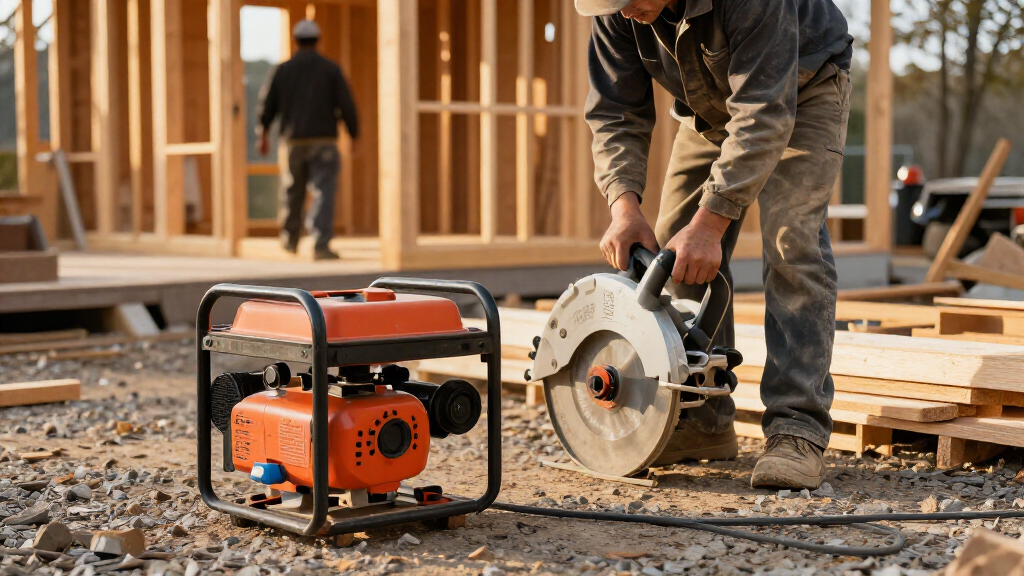
I ranked these portable generators for job sites by how well their stated power class, fuel options, and outlet configuration fit common work demands—not by wattage alone. I weighed the gap between starting and running power, the usefulness of gas, propane, diesel, or tri-fuel capability, and whether an inverter design could be a better fit for crews that prioritize quieter operation and power quality. I also considered practical handling: a high-output generator may run more equipment, but weight, footprint, and refueling needs can make it harder to move between work areas.
The ranking favors jobsite versatility and a clear use case. The DuroMax XP11000iH leads because it combines substantial output, dual-fuel flexibility, and inverter design. The Firman T09275 ranks highly for fuel choice, while the Generac XD5000E earns a distinct place for diesel buyers. Smaller inverter models make more sense for lighter tool loads and easier transport; large conventional units rank better for heavier demand, but their capacity is not an automatic advantage if a crew cannot move or safely place them. Product names and stated specifications inform this editorial comparison; buyers should verify current manuals, outlet details, and local jobsite requirements before purchase.
| portable generators for job site | Fuel |
|---|---|
| DuroMax XP11000iH 11,000-Watt | Gasoline and propane |
| Cummins Onan P9500df Dual-Fuel | Gasoline and propane |
| Firman T09275 Tri-Fuel Portabl | Gasoline, propane, and natural gas |
| All Power America 3300W Portab | Gasoline |
| Genkins 4500W Gas Inverter Gen | Gasoline |
| WEN GN5600 5600-Watt Portable | Gasoline |
| WEN 5,600-Watt Dual-Fuel Porta | — |
| PowerSmart 4300-Watt Portable | Gasoline |
| Westinghouse WGen9500DF Dual F | Gasoline or propane |
| Oxseryn 4400-Watt Gasoline Inv | Gasoline |
| AMERISUN 4500W Open-Frame Gas | Gasoline |
| Generac XD5000E 5,500-Watt Die | Diesel |
| Honda EB6500 6500-Watt Portabl | Gasoline |
| Honda EB10000 10,000-Watt Port | Gasoline |
| DuroMax XP13000EH 13,000-Watt | Gasoline or propane |
Factors to Consider When Choosing Portable Generators For Job Sites
Choosing a generator for a jobsite starts with the work pattern, not the biggest wattage printed on the housing. I’d map the tools that may run at the same time, how often the crew relocates, and which fuels are reliably available. These broader checks can prevent a mismatch that a product comparison alone cannot solve.
Match Running Loads and Motor Startup
List each tool’s running watts and startup demand, then estimate which tools might operate together during the busiest part of the workday. Motors in compressors, saws, and pumps can draw more power when starting than while running, so a generator that covers only the combined steady load may still trip or stall. Avoid adding every tool’s maximum label value without checking whether the crew will actually use them at once; that can push you into a heavier class than the job needs. At the same time, do not size so tightly that one startup forces workers to unplug equipment. Leave room for realistic load changes, and check the generator manual for limits on continuous output. If loads vary widely, separate essential tools from occasional ones and plan which can run in sequence.
Check Voltage, Outlets, and Distribution
Wattage does not tell you whether a generator can connect safely and conveniently to the tools on your site. Check each tool’s voltage and plug type, then compare those needs with the generator’s receptacles and available circuits. A 120/240-volt outlet can matter for compatible equipment, but it does not mean every outlet can deliver the generator’s full rated output at once. Long extension-cord runs add voltage drop and can create hazards when the cord is undersized or damaged. Use cords rated for the load and distance, and follow the tool and generator instructions. If multiple workers need power, plan the distribution layout before buying rather than relying on improvised adapters.
Choose Fuel Around the Work Schedule
Fuel flexibility has value only when the crew can store, transport, and access the fuel safely. Gasoline is widely available, while propane can be easier to store for some operations; diesel may fit a fleet that already uses it, and tri-fuel systems widen the available choices. Dual- and tri-fuel models may have different output depending on the fuel, so compare the ratings for the fuel you expect to use rather than assuming the headline wattage applies to every option. Think through refueling frequency, fuel-container rules, and where fuel will be kept between shifts. A generator that accepts a preferred fuel can still be a poor fit if the worksite lacks an approved supply plan. Match the fuel system to the crew’s actual logistics, not a hypothetical backup scenario.
Balance Portability Against Capacity
Portable does not mean easy for one person to load, roll across rough ground, or move through a confined site. Larger generators can support more demanding loads, but their bulk may require a vehicle, lifting equipment, or a fixed staging area. Smaller inverter models can be easier to reposition, yet may not cover the simultaneous startup needs of heavy tools. Consider how often the unit moves, the terrain, vehicle access, and whether a crew member can handle the generator safely. Wheels and handles help, but they do not remove the need to check the unit’s weight and lifting guidance. For a stationary project, capacity may matter more; for a mobile crew, a manageable footprint can save time every day.
Plan Placement, Noise, and Exhaust Safety
A generator needs a safe outdoor location with room for exhaust to disperse, away from doors, windows, and air intakes. Never run one indoors, in a garage, or in another enclosed or partly enclosed space, even if a door is open. Carbon-monoxide sensors are a useful safety feature, but they do not make unsafe placement acceptable or replace proper monitoring and site procedures. Noise can also affect communication, nearby trades, and work in occupied areas; an inverter design may be worth the tradeoff if lower noise and cleaner power matter more than maximum output. Check applicable workplace rules and the manufacturer’s clearance guidance before setting up. Include exhaust direction and worker access in the site plan rather than treating placement as an afterthought.
Account for Duty Cycle and Upkeep
Jobsite use can involve long operating days, changing loads, dust, and repeated transport, so maintenance and operating limits affect the real value of a generator. Compare the service intervals and procedures in each manual, including oil checks, air-filter care, and storage steps. A model with electric start can reduce starting effort, but the battery still needs care and the generator may require a backup starting plan. Look for clear access to routine service points and confirm that parts and service support are practical for your location. Do not assume that a larger tank or a single runtime figure guarantees a full shift; runtime changes with load and fuel. Build maintenance time into the work routine so a neglected unit does not become a jobsite bottleneck.
Frequently Asked Questions
How much generator capacity do I need to run a compressor and saw on the same jobsite?
I would not size the generator by adding only the tools’ running watts. Check each tool’s startup demand and determine whether the compressor and saw will actually start or run at the same time; motor startup can create a brief load spike. Compare that combined demand with the generator’s running and peak ratings, and confirm the applicable outlet and circuit limits in the manual. If the numbers are close, stagger starts or choose a unit with more headroom rather than relying on ideal conditions. A short load plan based on the crew’s real work sequence is more useful than a single guess at total wattage.
Is an inverter generator a good choice for a construction site?
An inverter generator can suit a jobsite when the crew values a quieter operating profile, portability, or power for sensitive electronics alongside tools. The tradeoff is that compact inverter models in this lineup generally occupy lower output classes than the largest conventional generators. Check whether the model can handle tool startup loads, not just lights, chargers, and steady-running equipment. For a crew running several high-demand tools at once, a larger conventional generator may be a better fit even if it is bulkier and noisier. The decision depends on load and work conditions, not the inverter label by itself.
Should I choose dual-fuel or tri-fuel for a mobile crew?
Choose fuel flexibility based on what the crew can reliably obtain and transport, along with the generator’s output on each fuel. The Firman T09275 offers three fuel choices, while models such as the DuroMax XP11000iH and Westinghouse WGen9500DF are dual-fuel options. More fuel types can provide alternatives when one supply is unavailable, but they can also add setup decisions and do not guarantee equal output across fuels. Verify connection requirements, fuel-specific ratings, and safe storage procedures before relying on a backup fuel. A simpler single-fuel arrangement may be more practical if the crew already has a dependable supply plan.
Does a carbon-monoxide sensor make a generator safe to use near a building?
No. A carbon-monoxide sensor can add a safety layer, but it does not make indoor, enclosed, or poorly placed operation safe. Run the generator outdoors in a location that follows the manufacturer’s clearance guidance and keeps exhaust away from doors, windows, and air intakes. Follow workplace procedures and local requirements, and do not rely on an automatic shutoff as a substitute for safe placement. This matters even on an active jobsite, where temporary walls, trailers, or changing wind can affect where exhaust travels. Review the manual before each new site setup.
Is a 10,000-watt generator always a better buy than a 5,000-watt model for a contractor?
No. A higher-output model can support more simultaneous demand, but it may also be heavier, harder to move, and more generator than a small crew needs. A 5,000-watt-class unit may be the better match for lighter tools, intermittent work, or a crew that relocates often, provided its starting capacity and outlets fit the load. Compare the tools’ real usage pattern, transport method, and site layout before choosing by headline wattage. If the larger unit will spend most of the day underused, its capacity may not offset the handling burden. If heavy tools start together, though, extra headroom can prevent interruptions.
Conclusion
For a broad mix of demanding jobsite tasks, I’d choose the DuroMax XP11000iH as the best overall because it combines substantial output with dual-fuel flexibility and inverter design. The WEN GN5600 is my best value-style pick for crews whose loads fit a more moderate gas-generator class and who do not need the largest units’ capacity. For a premium, higher-capacity choice, the Honda EB10000 suits crews that need a substantial output class and can manage a larger generator. Beginners should start by matching their tool list to the PowerSmart 4300W inverter or another appropriately sized inverter model, then verify outlet and startup requirements before buying. For specific needs, pick the Firman T09275 for tri-fuel flexibility or the Generac XD5000E if diesel is central to the crew’s fuel plan. The right choice is the one that meets the actual load while remaining practical to fuel, place, and move.
Black Friday Picks

Vitamix 5200 Blender with 64 oz. Container, Black
As an affiliate, we earn on qualifying purchases.