The best tree stump removal tools depend on whether you need to pull a small sapling, cut through exposed roots, or speed up decay in a stump you can leave in place. My best overall pick is the HATJICB Heavy-Duty Tree Puller Tool for buyers who want a dedicated manual puller; the Root Slayer Garden Shovel stands out for hands-on root cutting, while Bonide Stump-Out Granules suit patient buyers who do not need immediate removal. The main tradeoff is between physical effort and time: pullers and cutting tools work directly but need safe access and leverage, while granules take longer and do not extract the stump. Read on for the full breakdown of all 11 options and how to match a tool to the job.

Get business pricing on tools and workshop supplies
- Business-only prices and quantity discounts
- Tax-exempt purchasing
- Multiple users, one account, clear invoices
Complete the kit



Key Takeaways
- Pullers are for small woody growth, not every stump: The lineup’s several manual pullers are aimed at saplings and shrubs; stem-size limits and root spread matter more than the tool’s heavy-duty label.
- Handle length changes leverage, not capability alone: The 60-inch manual puller offers more reach than shorter designs, but extra length cannot overcome a large, deeply rooted stump or unsuitable soil.
- Root cutting fills a different role from pulling: The Root Slayer and Leriton cutting tool are better suited to severing accessible roots, while a puller tries to lift the plant and its root mass.
- Bonide is the slow, low-labor alternative: Stump-Out granules are for treating a stump left in place, not for lifting it from the ground or providing quick clearance.
- The grinder wheel has the narrowest fit: SchuhRia’s angle-grinder wheel may help with accessible wood, but it calls for tool compatibility and careful control rather than replacing a stump grinder.
- Build and fit separate the pullers: Steel construction, grip and stated stem capacity help distinguish these options, but buyers still need to match the jaws and working range to the actual plant.
| HATJICB Heavy-Duty Tree Puller Tool |  | Best for Back-Sparing Leverage | Material: Steel | Weight: 22.7 pounds | Dimensions: 44.5 × 10.2 × 5 inches | VIEW LATEST PRICE | See Our Full Breakdown |
| VITAINTE Heavy-Duty Sapling and Tree Puller |  | Best for Compact Storage | Brand: VITAINTE | Model: WJ0001 | Stem capacity: ¼–1⅜ inches | VIEW LATEST PRICE | See Our Full Breakdown |
| Solid Steel Invasive Sapling Tree Puller |  | Best for Root-and-Stump Removal | Material: Solid steel | Extended length: 57 inches | Folded length: 31.5 inches | VIEW LATEST PRICE | See Our Full Breakdown |
| Heavy-Duty Sapling Puller Tool, 54-Inch Handle |  | Best for Simple, Long-Handle Pulling | Stem capacity: ¼–2 inches | Handle length: 54 inches | Material: Steel | VIEW LATEST PRICE | See Our Full Breakdown |
| Manual Tree and Sapling Puller, 60-Inch Handle, for 0.5–2.2-Inch Stems |  | Best for Thicker Small Stems | Stem diameter range: 0.5–2.2 inches | Handle length: 60 inches | Material: Steel | VIEW LATEST PRICE | See Our Full Breakdown |
| Root Slayer 22011 Garden Shovel with Serrated Blade |  | Best for Hands-On Root Cutting | Brand: Root Slayer | Model: 22011 | Blade material: Alloy steel | VIEW LATEST PRICE | See Our Full Breakdown |
| SchuhRia 4-Inch Chainsaw Grinder Wheel for Angle Grinders |  | Best Powered Stump-Shaping Attachment | Brand: SchuhRia | Model: GRD-4IN22TE | Diameter: 4 inches | VIEW LATEST PRICE | See Our Full Breakdown |
| Tahoe Dreams Heavy-Duty Root Puller for Trees and Shrubs, 48 in., Red |  | Best for Small Woody Stems Without Digging | Model: TP01 | Length: 48 inches | Stem diameter capacity: ¼–2.17 inches | VIEW LATEST PRICE | See Our Full Breakdown |
| Bonide Stump-Out Granules, 1 lb |  | Best for Slow, Low-Equipment Stump Breakdown | Brand: Bonide | Model number: 272 | Item form: Granules | VIEW LATEST PRICE | See Our Full Breakdown |
| Heavy-Duty Tree and Sapling Puller for 1/4- to 2-Inch Woody Stems |  | Best Foldable Long-Lever Puller | Stem capacity: ¼–2 inches | Lever length: 62 inches | Stabilizer base width: 5.5 inches | VIEW LATEST PRICE | See Our Full Breakdown |
| Leriton 55-Inch Retractable Root Cutting Tool |  | Best for Cutting Through Tough Roots | Brand: Leriton | Model: XEI-Leriton-0955 | Power source: Manual | VIEW LATEST PRICE | See Our Full Breakdown |
| tree stump removal tool | Material | Model |
|---|---|---|
| HATJICB Heavy-Duty Tree Puller | Steel | — |
| VITAINTE Heavy-Duty Sapling an | — | WJ0001 |
| Solid Steel Invasive Sapling T | Solid steel | TP1 |
| Heavy-Duty Sapling Puller Tool | Steel | — |
| Manual Tree and Sapling Puller | Steel | — |
| Root Slayer 22011 Garden Shove | — | 22011 |
| SchuhRia 4-Inch Chainsaw Grind | Steel | GRD-4IN22TE |
| Tahoe Dreams Heavy-Duty Root P | Reinforced steel | TP01 |
| Bonide Stump-Out Granules | — | — |
| Heavy-Duty Tree and Sapling Pu | — | — |
| Leriton 55-Inch Retractable Ro | — | XEI-Leriton-0955 |
More Details on Our Top Picks
HATJICB Heavy-Duty Tree Puller Tool
The HATJICB stands out for combining a foot pedal with a lever mechanism, letting the user apply body weight instead of relying on repeated digging and bending. Its stated 0.25–2-inch range covers small roots, brush, and saplings, while the anti-slip handles add control during a pull. Compared with the VITAINTE Heavy-Duty Sapling and Tree Puller, it accepts larger stems at the upper end of the listed range, but it does not have VITAINTE’s fold-flat handle for compact storage. At 22.7 pounds, it is also the heaviest of these five options, a meaningful drawback when moving it around a large property. I’d choose it for routine small-plant removal where reduced bending matters more than portability; it is not a substitute for equipment meant for large stumps.
Pros:- Foot pedal and lever mechanism help use body weight for pulling.
- Anti-slip handles provide a more secure grip.
- Fume-free, quiet manual operation.
- Handles roots and saplings across a stated 0.25–2-inch diameter range.
Cons:- The 22.7-pound weight makes it less convenient to transport than the lighter pullers in this group.
- Limited to roots and stems about 2 inches in diameter or smaller.
Best for: Gardeners and property owners clearing small saplings, brush, and roots who want a foot pedal and leverage to reduce bending.
Not ideal for: Buyers removing large, established stumps or carrying a tool over long distances; its capacity tops out at 2 inches and it weighs 22.7 pounds.
- Material:Steel
- Weight:22.7 pounds
- Dimensions:44.5 × 10.2 × 5 inches
- Root diameter range:0.25–2 inches
- Operation features:Foot pedal and lever mechanism
- Handle feature:Anti-slip handles
Our verdict“Choose the HATJICB if reducing bending is your priority and you can accept a heavier tool for small-root and sapling work.”
VITAINTE Heavy-Duty Sapling and Tree Puller
The VITAINTE is the practical pick for buyers who need a manual puller but have limited shed or vehicle space. Its detachable, fold-flat handle makes it easier to store and transport than the long, fixed-format Heavy-Duty Sapling Puller Tool with 54-Inch Handle. A 43.5-inch handle and wide foot pedal provide leverage for woody stems, while the jaws fit a narrower ¼–1⅜-inch range than several alternatives here. That range suits young saplings, but rules it out for thicker stems the HATJICB or Partnix puller is designed to handle. Assembly is required, although the included wrench addresses that task. I’d put this ahead of bulkier pullers for occasional clearing and compact storage, not for a property where larger woody growth is a regular job.
Pros:- Detachable, fold-flat handle is convenient for storage and transport.
- Wide foot pedal and lever system use body weight to assist pulling.
- 43.5-inch handle provides leverage without the length of some competing tools.
- Assembly wrench is included.
Cons:- Jaw capacity stops at 1⅜ inches, below the upper limits of the HATJICB and Partnix models.
- Requires assembly before use.
Best for: Homeowners with limited garage or shed space who remove young woody stems no thicker than 1⅜ inches.
Not ideal for: Landowners regularly pulling thicker saplings or buyers who want a ready-to-use tool without assembly.
- Brand:VITAINTE
- Model:WJ0001
- Stem capacity:¼–1⅜ inches
- Handle length:43.5 inches
- Handle design:Detachable and foldable
- Handle material:Rubber
- Dimensions:4 inches wide × 13 inches high
- Included accessory:Assembly wrench
Our verdict“Pick the VITAINTE for compact storage and young sapling removal, but choose a wider-capacity puller for thicker stems.”
Solid Steel Invasive Sapling Tree Puller
For buyers trying to limit regrowth, this VMTW puller is distinguished by its stated aim of removing invasive saplings with their roots and stumps, rather than simply cutting stems down. Its 57-inch length supplies leverage, and it folds to 31.5 inches for storage—an unusual blend of reach and stowability compared with the fixed-length Heavy-Duty Sapling Puller Tool, 54-Inch Handle. The maker lists a range from small plants such as thistles to trunks up to 2 inches, though actual removal still depends on the plant and ground conditions. One specific limitation is water-soaked soil: the foot may need a piece of wood beneath it for support. I’d choose this for invasive growth where pulling out roots matters, while buyers focused on easier transport may prefer the lighter Partnix model, whose supplied data includes a weight.
Pros:- Designed to remove saplings with their roots and stumps to help reduce regrowth.
- 57-inch length provides leverage.
- Folds to 31.5 inches for storage.
- Listed for plants ranging from thistles to trunks up to 2 inches in diameter.
Cons:- On water-soaked ground, the foot may need a piece of wood underneath for support.
- The supplied product data does not state the tool’s weight.
Best for: Property owners clearing invasive saplings who want to pull roots and stumps to help limit regrowth, and who value a folding long-handle design.
Not ideal for: People working on water-soaked ground without a stable support surface, or buyers seeking a tool with a stated weight for transport planning.
- Material:Solid steel
- Extended length:57 inches
- Folded length:31.5 inches
- Product dimensions:36 × 16 × 6 inches
- Maximum trunk diameter:2 inches
- Model:TP1
- Manufacturer:VMTW
Our verdict“Choose this puller when removing roots to limit regrowth matters more than having a stated tool weight or use on saturated ground.”
Heavy-Duty Sapling Puller Tool, 54-Inch Handle
This steel puller favors a straightforward setup: a 54-inch handle supplies leverage, while a claw-ring grip is designed to hold roots as you pull. Its ¼–2-inch stem capacity gives it a broader stated range than the VITAINTE, making it a more flexible choice when sapling size varies. Unlike the Solid Steel Invasive Sapling Tree Puller, the product data does not describe a folding design or give a root-and-stump removal claim, so I’d favor it for direct manual pulling rather than compact storage or a specific regrowth-control goal. The one-piece steel construction has a protective coating, but the tool still relies on user effort and firm footing; it has no powered assistance. At 14.66 pounds, it is lighter than the HATJICB, though its long overall form may still take up storage space.
Pros:- 54-inch handle provides leverage for manual pulling.
- Claw-ring grip is designed to hold roots securely.
- One-piece steel construction has a protective coating.
- Stated capacity covers stems from ¼ to 2 inches.
Cons:- Manual operation requires physical effort and stable footing.
- The long form may be less convenient to store than the folding VMTW or VITAINTE models.
- Stem capacity is limited to 2 inches.
Best for: Gardeners, landscapers, and small-farm owners who want a steel manual puller for varied saplings up to 2 inches.
Not ideal for: Buyers who need powered extraction, a foldable design, or a tool specifically described as removing roots and stumps to limit regrowth.
- Stem capacity:¼–2 inches
- Handle length:54 inches
- Material:Steel
- Color:Orange
- Product dimensions:61.02 × 7.87 × 5.12 inches
- Item weight:14.66 pounds
- Grip design:Claw-ring root grip
Our verdict“Choose this model for a simple, broad-capacity manual puller if folding storage and powered assistance are not priorities.”
Manual Tree and Sapling Puller, 60-Inch Handle, for 0.5–2.2-Inch Stems
The Partnix puller has the widest stated upper capacity in this group: its jaws are intended for stems up to 2.2 inches, edging past the 2-inch limit listed for the HATJICB and 54-inch steel puller. A 60-inch handle, foot pedal, and gripping jaws that tighten under pulling pressure are intended to help extract small plants with roots, but this remains a manual tool—not a solution for large, established stumps. Its minimum stated stem size is 0.5 inch, so it may not suit the thinnest growth the VITAINTE can grip. The foldable design helps with storage, though it weighs 16.09 pounds and still calls for physical effort and secure footing. I’d choose it when stems approach the upper end of the listed range and extra handle length is useful.
Pros:- Stated stem capacity reaches 2.2 inches, the highest upper limit among these five pullers.
- 60-inch handle and foot pedal provide leverage for manual extraction.
- Gripping jaws tighten as pulling pressure increases.
- Foldable design supports storage.
Cons:- Minimum stated stem diameter is 0.5 inch, so finer growth may not fit.
- Manual pulling requires physical effort and firm footing.
- At 16.09 pounds, it is not the lightest option for repeated transport.
Best for: Landowners removing woody saplings and shrubs near 2 inches thick who want a long handle, foot pedal, and foldable storage.
Not ideal for: Buyers tackling very thin stems under 0.5 inch, large established stumps, or jobs where firm footing and manual effort are impractical.
- Stem diameter range:0.5–2.2 inches
- Handle length:60 inches
- Material:Steel
- Operation:Manual leverage
- Storage:Foldable
- Dimensions:16 × 6 × 33 inches
- Item weight:16.09 pounds
- Manufacturer and model:Partnix BSMJ02
Our verdict“Choose the Partnix when you need the greatest stated stem capacity in this group and can manage a heavier manual tool.”
Root Slayer 22011 Garden Shovel with Serrated Blade
The Root Slayer 22011 is the most direct digging option here: its V-shaped tip and serrated blade are made to slice through roots and packed soil as you work around a stump. That makes it a better fit for exposing and severing smaller roots than the Tahoe Dreams Heavy-Duty Root Puller, which grabs woody stems above ground instead of cutting below it. Its 45-inch resin-encased steel shaft and ergonomic grip give you reach and control for digging, planting, and follow-up garden work. The tradeoff is that this remains a manual shovel, so larger stumps can demand substantial effort and repeated digging. It is also not designed for prying or excessive leverage; choose a puller for stems within its capacity, or a powered approach for extensive stump work.
Pros:- Serrated blade and sharpened V-shaped tip target roots and compact soil.
- Long shaft and ergonomic grip support controlled digging.
- Powder-coated alloy-steel blade helps resist rust.
- Can also handle planting, transplanting, and general garden work.
Cons:- Manual root cutting can be slow and tiring around a large or deeply rooted stump.
- Not intended for prying or excessive leverage.
Best for: Gardeners who want one sturdy hand tool to expose and cut roots around a small stump while also handling routine digging and transplanting.
Not ideal for: Anyone trying to uproot a large stump quickly or planning to use the shovel as a pry bar; its intended use is digging and cutting, not heavy leverage.
- Brand:Root Slayer
- Model:22011
- Blade material:Alloy steel
- Blade length:13 inches
- Shaft:Resin-encased steel
- Dimensions:45 × 10.5 × 3.8 inches
- Weight:5 pounds
- Grip:Ergonomic
- Warranty:Lifetime guarantee
Our verdict“Choose the Root Slayer if you want a versatile digging tool for cutting accessible roots, not a shortcut for removing a large stump.”
SchuhRia 4-Inch Chainsaw Grinder Wheel for Angle Grinders
For buyers who already own a compatible angle grinder, the SchuhRia 4-inch chainsaw wheel offers a powered way to cut and shape stump wood. Its four reinforced rivets hold the chain between the discs, simplifying installation compared with a loose-disc setup, while the stated 14,000-rpm maximum speed sets a clear operating limit. Unlike the Root Slayer 22011, which is suited to digging and severing exposed roots, this attachment works on accessible wood; it does not pull a stump or remove its underground root system. The convenience comes with a serious setup and safety tradeoff: you need a compatible 4- or 4.5-inch grinder, a separately installed guard, and cut-resistant gloves. I would favor it for controlled carving or cutting tasks, not as a stand-alone stump-removal solution.
Pros:- Four reinforced rivets secure the chain between the discs.
- Designed for simpler installation than separate-disc models.
- Can be used for stump shaping, wood carving, and cutting soft materials.
Cons:- Requires a compatible angle grinder, which is not included.
- A separate guard and cut-resistant gloves are needed for operation.
- Cuts accessible wood but does not extract underground roots.
Best for: Experienced DIYers who own a compatible angle grinder and need an attachment for shaping or cutting accessible stump wood.
Not ideal for: Beginners without a compatible grinder, guard, and suitable protective gear, or anyone expecting a single attachment to extract the stump and roots.
- Brand:SchuhRia
- Model:GRD-4IN22TE
- Diameter:4 inches
- Arbor:5/8 inch
- Compatible grinders:4-inch or 4.5-inch angle grinders
- Maximum rotational speed:14,000 rpm
- Grit:Fine, 120
- Material:Steel
- Unit count:1
Our verdict“Pick this attachment for powered shaping of exposed stump wood if you already have the right grinder and safety equipment.”
Tahoe Dreams Heavy-Duty Root Puller for Trees and Shrubs, 48 in., Red
The Tahoe Dreams root puller targets saplings and other woody growth that can be gripped above ground, rather than mature stumps with broad root systems. Its reinforced jaws, foot pedal, and leverage mechanism are designed to pull stems without first digging around them, a different job from the Root Slayer 22011’s root-cutting approach. It arrives pre-assembled and has anti-slip handles, which may make it a more straightforward choice for clearing brush, vines, and young trees. The firm limit is its ¼- to 2.17-inch stem capacity: thicker growth falls outside the stated range, and pulling a stem is not the same as removing a large stump. At 18 pounds, it also takes some effort to carry around a larger property. For a wider base and foldable storage, compare it with the 62-inch Heavy-Duty Tree and Sapling Puller.
Pros:- Pre-assembled for use without a build step.
- Foot pedal and leverage mechanism reduce the need to bend or dig.
- Reinforced steel jaws and gussets are designed for pulling loads.
- Removes woody growth without gas, oil, or chemicals.
Cons:- Limited to stems no larger than 2.17 inches in diameter.
- At 18 pounds, it may be cumbersome to carry across a large property.
- Designed for pulling stems, not extracting a large established stump.
Best for: Property owners clearing saplings, brush, vines, or woody weeds with stems within the stated ¼- to 2.17-inch range.
Not ideal for: Buyers facing mature stumps or stems wider than 2.17 inches, or anyone who needs a lighter tool for frequent long-distance carrying.
- Model:TP01
- Length:48 inches
- Stem diameter capacity:¼–2.17 inches
- Material:Reinforced steel
- Weight:18 pounds
- Dimensions:48 × 10.5 × 5.5 inches
- Features:Pre-assembled; foot pedal; leverage mechanism; anti-slip handles
- Color:Red
Our verdict“Choose this puller for above-ground woody growth within its diameter limit, but use another method for a mature stump.”
Bonide Stump-Out Granules, 1 lb
Bonide Stump-Out suits buyers willing to let a seasoned stump break down over time rather than cut or pull it out by hand. The granules are intended to accelerate decomposition so the stump is easier to burn out or chop out, with a stated 4–6-week working period when applied as directed. That makes it a slower, lower-equipment alternative to the SchuhRia grinder wheel, which works on accessible wood, and to the Tahoe Dreams puller, which is limited to smaller stems. The key qualification is age: the product is described as most effective on stumps cut at least 18 months earlier. It does not mechanically remove the stump, and it requires waiting before follow-up work. I’d choose it for a seasoned stump when patience matters more than immediate clearance, not for a fresh stump or a fast result.
Pros:- Accelerates decomposition to make a seasoned stump easier to remove.
- Can help prepare stump wood for burning or chopping.
- Granule format avoids using a powered cutting attachment.
Cons:- Takes 4–6 weeks to work when applied as directed.
- Most effective on stumps cut at least 18 months earlier.
- Does not physically extract the stump or its roots.
Best for: Homeowners with a seasoned stump who can wait several weeks before chopping or burning out the softened wood.
Not ideal for: Anyone needing immediate stump removal or working with a stump cut less than 18 months ago, where the product is described as less effective.
- Brand:Bonide
- Model number:272
- Item form:Granules
- Net weight:16 ounces (1 lb)
- Active ingredient:Sodium metabisulfite
- Target use:Decomposition of seasoned tree stumps
- Time to work:4–6 weeks when applied as directed
- Most effective on:Stumps cut at least 18 months earlier
Our verdict“Choose Bonide if the stump is seasoned and you can wait for decomposition before doing the final removal work.”
Heavy-Duty Tree and Sapling Puller for 1/4- to 2-Inch Woody Stems
This puller’s 62-inch lever is its clearest advantage over the 48-inch Tahoe Dreams model: the longer handle is designed to give more leverage and support upright operation. Its 5.5-inch stabilizer base is intended to resist sinking in soft ground, while the tool-free folding buckle reduces storage length to 34.2 inches. Those details favor buyers who need to move and store a puller between jobs, though the tool still weighs 18 pounds. Its stem capacity is narrower than Tahoe Dreams’ stated upper limit, topping out at 2 inches rather than 2.17 inches. The description also recommends damp soil or pulling after rain, so dry, hard ground may slow removal. Like other stem pullers, it is for saplings, shrubs, and thorny bushes—not a direct substitute for tools that cut or break down a large stump.
Pros:- 62-inch lever is designed to reduce effort and support upright operation.
- Widened 5.5-inch base helps resist sinking into soft or loose soil.
- Folds without tools to a stated length of 34.2 inches.
- Carbon-steel frame and non-slip grips support sturdy handling.
Cons:- At 18 pounds, it can be heavy to carry between work areas.
- Stem capacity stops at 2 inches, slightly below the Tahoe Dreams model’s 2.17-inch limit.
- The description recommends damp soil or pulling after rain for smoother uprooting.
Best for: Property owners who regularly clear saplings up to 2 inches wide and want a long-lever tool that folds for transport or storage.
Not ideal for: People who need to pull stems wider than 2 inches, want a lightweight tool, or often work in dry, hard soil.
- Stem capacity:¼–2 inches
- Lever length:62 inches
- Stabilizer base width:5.5 inches
- Folded length:34.2 inches
- Product dimensions:36 × 7 × 6 inches
- Weight:18 pounds
- Frame material:Carbon steel
- Folding:Tool-free folding buckle
Our verdict“Choose this model over the Tahoe Dreams puller if foldable storage and a longer lever matter more than the slightly larger stem capacity.”
Leriton 55-Inch Retractable Root Cutting Tool
The Leriton Retractable Root Cutting Tool suits stump jobs where the main obstacle is buried roots, compacted soil, or rocky ground—not pulling out a small sapling. Its gravity-assisted sliding bar adds force to the blade, giving it a different role from pullers such as the HATJICB Heavy-Duty Tree Puller Tool, which is meant to grip and extract stems. Carbon steel construction and reinforced welds are intended for demanding clearing work, but the tool is manual, so progress depends on your effort and the ground conditions.
Compared with the Root Slayer 22011 Garden Shovel, this is the more specialized, heavy-duty option; that specialization also makes it a poor fit for routine light gardening. The listing mentions roots up to five inches thick, but supplies no independent performance details, so I would not treat that as a guaranteed cutting capacity. It also arrives as a bare tool, with no listed accessories.
Pros:- Sliding, gravity-assisted action adds force during root cutting.
- Designed to work through roots, compacted soil, and rocky ground.
- Carbon steel blade and handle with reinforced welds are intended for demanding work.
Cons:- Heavy, specialized construction is cumbersome for everyday garden tasks.
- The claimed ability to cut roots up to five inches thick lacks independent performance details.
- Manual operation can make extensive root removal physically demanding.
Best for: Property owners tackling stubborn exposed roots and compacted or rocky ground during manual stump-clearing work.
Not ideal for: Gardeners who mainly need a light tool for routine beds, or anyone seeking to extract whole saplings rather than cut through roots.
- Brand:Leriton
- Model:XEI-Leriton-0955
- Power source:Manual
- Length:50.39 in
- Blade material:Carbon steel
- Handle material:Carbon steel
- Blade shape:Rectangular
- Special features:Telescopic design; gravity-leveraged cutting
- Included components:Bare tool
Our verdict“Choose the Leriton when cutting tough roots is the priority; choose a puller such as the HATJICB for extracting saplings instead.”
How We Picked
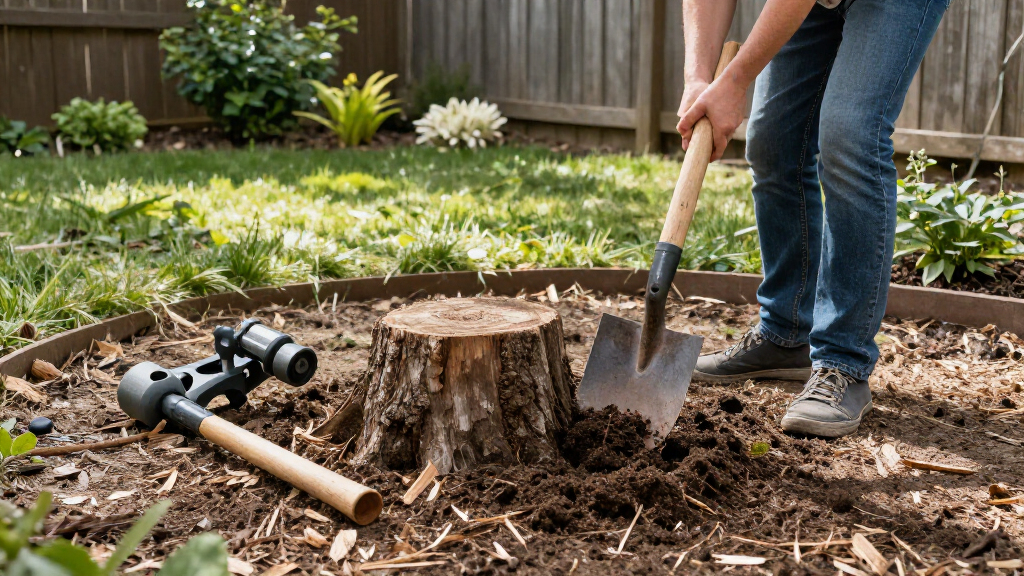
I compared these 11 options by the job they can plausibly handle: pulling small woody plants, cutting roots, grinding accessible wood, or treating a stump that will remain in place. I prioritized clear use cases, stated stem ranges, handle length and material, plus whether the tool’s operating method suits a typical yard task. A dedicated puller ranks ahead of a general-purpose cutting accessory when the goal is removing a small sapling; a chemical treatment ranks lower for immediate removal because it does not extract the stump.
The order reflects usefulness across common stump-and-root jobs, not a claim that one tool fits every site. I gave more weight to direct removal, practical control and a defined application, while accounting for physical effort, fit limits, compatibility and the time required. Similar pullers are separated by their stated capacity and handle design; specialized options sit lower when their use is narrower or needs more preparation. The right choice still depends on stump size, access, soil and whether you need the stump gone now.
| tree stump removal tool | Material |
|---|---|
| HATJICB Heavy-Duty Tree Puller | Steel |
| VITAINTE Heavy-Duty Sapling an | — |
| Solid Steel Invasive Sapling T | Solid steel |
| Heavy-Duty Sapling Puller Tool | Steel |
| Manual Tree and Sapling Puller | Steel |
| Root Slayer 22011 Garden Shove | — |
| SchuhRia 4-Inch Chainsaw Grind | Steel |
| Tahoe Dreams Heavy-Duty Root P | Reinforced steel |
| Bonide Stump-Out Granules | — |
| Heavy-Duty Tree and Sapling Pu | — |
| Leriton 55-Inch Retractable Ro | — |
Factors to Consider When Choosing Best Tree Stump Removal Tools
Before choosing a tool, identify whether you are removing a living sapling, a cut stump, or roots that are already exposed. Those jobs can look similar from above ground but call for different methods. I would use the following checks to avoid buying a tool that is strong but wrong for the task.
Match the Tool to the Stage of Removal
A living sapling can sometimes be pulled with its root system, while a mature cut stump may need roots cut and wood removed in stages. A puller is most useful when the stem can be gripped and the plant is small enough to lift with leverage. Root-cutting tools suit accessible roots or tight spaces where lifting the whole plant is impractical. Granules address a different goal: treating wood that will remain in the ground while it decays. A common mistake is buying a puller for a stump with no usable stem, or expecting a treatment product to create an empty planting space quickly. Decide whether you need extraction, cutting, grinding or gradual decay before comparing tool features.
Measure the Stem and Think About the Root Ball
Measure the woody stem near the point where the tool will grip it, then compare that measurement with the tool’s stated range. A listed maximum is a fit limit, not a promise that the tool can remove every plant at that diameter. Root spread, soil moisture, species and how long the plant has been established can change the force required. If a stem is near the upper limit, leave room for irregular shape and bark that may prevent a secure grip. Avoid forcing an oversized stem into a puller’s jaws; poor seating can make the tool slip under load. For a large stump, a purpose-built stump grinder or professional service may be a better match than any hand tool in this roundup.
Choose Leverage You Can Control
Long handles can increase leverage and keep hands farther from the ground, but they also need clear space to swing and stable footing. A shorter tool can be easier to position around fences, beds and nearby plants, even if it asks for more effort. Pullers rely on a stable contact point and a secure grip; uneven or loose ground can make the setup less predictable. With a cutting tool, consider whether you can reach the root without striking stones, buried utilities or other objects. Do not treat more leverage as a substitute for controlled movement, and stop if the tool shifts or the plant resists unexpectedly. Protective eyewear, gloves and a clear work area matter for both pulling and cutting.
Account for Soil, Access and Nearby Features
Soil conditions can decide whether a manual pull is reasonable: recently loosened or moist soil may release roots more easily than compacted, dry ground, though muddy footing creates its own hazard. Check the area for irrigation lines, cables, edging and shallow utility runs before digging or cutting. Tight access can rule out a wide puller or a grinder attachment even when the tool itself fits the stem. If the stump is close to a structure or desirable plant, cutting roots in stages may offer more control than trying to yank the whole root ball. The tradeoff is time: careful work around obstacles usually takes longer than open-ground removal. When utility locations are uncertain, locate them before any excavation or powered cutting.
Compare Effort, Waiting Time and Follow-Up
Manual extraction trades equipment complexity for physical work, and it may still leave roots that need trimming or removal. Cutting tools can reduce a root’s resistance but may require repeated cuts and cleanup of chips or debris. An angle-grinder accessory adds a separate compatibility and operating-safety check, and it should not be treated as equivalent to a dedicated stump grinder. Stump treatment avoids immediate digging but asks for patience and follow-up; it will not deliver a level, clear planting area on demand. Before buying, decide how soon the ground must be usable and who will do the remaining cleanup. Paying more makes sense when a tool’s fit, leverage or build addresses a repeated task, not simply because a job is difficult.
Frequently Asked Questions
Can a manual tree puller remove a mature stump?
Manual pullers in this lineup are described for saplings, shrubs or woody stems within stated diameter ranges, not as universal tools for mature stumps. A cut stump may offer no stem for the jaws to grip, and a broad, established root system can exceed what hand leverage can lift. You may be able to expose and sever roots first, but that turns removal into a separate digging and cutting job. For a large stump that must come out, compare powered stump grinding or professional removal rather than forcing a small-plant puller beyond its intended use. Match the tool to both the stem and the root mass.
Should I pull a sapling or cut its roots first?
Pulling makes sense when the stem is small enough for a secure grip, the ground is accessible and there is space to work. Cutting roots first can help when the plant resists, when roots are exposed, or when nearby features make a full lift risky. Cutting every root blindly can also remove useful support before you have control of the plant, so work in stages and watch how it shifts. If the plant is large or near a structure, a controlled cutting plan may be safer than relying on leverage alone. The best sequence depends on access, root spread and how securely the tool holds the stem.
Will stump-removal granules make a stump disappear quickly?
No. Bonide Stump-Out Granules are a treatment option for wood left in place, not a tool for extracting a stump from the ground. This approach suits buyers who can wait and do not need the area cleared promptly for planting, construction or lawn work. Follow the product label for application, handling and any limits on use; do not assume treatment removes underground roots. If you need immediate clearance, choose a mechanical removal method or arrange a service. The tradeoff is less immediate physical work in exchange for a longer timeline.
Is an angle-grinder wheel a substitute for a stump grinder?
No. The SchuhRia wheel is an accessory for an angle grinder and is intended for grinding work, but it does not turn a handheld grinder into a dedicated stump grinder. Check that the wheel matches your grinder’s specifications and follow the accessory and tool instructions before use. Grinding near soil can bring the wheel into contact with stones or hidden objects, so the work area and protective equipment need careful attention. It may suit limited, accessible wood removal, but it is not the same choice as equipment built for clearing a large stump below grade. For substantial stumps, a dedicated machine or professional help is usually the more appropriate route.
What should I do if the stump is close to a fence, pipe or valuable plant?
First identify what is buried or growing nearby; do not start levering, digging or powered cutting until utility lines and irrigation are located. A large pull can disturb more soil and roots than expected, while a cutting tool can damage an adjacent root or structure if access is poor. In a tight spot, careful hand excavation and selective root cutting may offer more control than trying to lift everything at once. If the stump is near a foundation, buried service or important tree, get a qualified professional to assess the safest method. The tool that works fastest in open ground may be the wrong tool for a confined site.
Conclusion
For most buyers removing small woody growth, I would start with the HATJICB Heavy-Duty Tree Puller Tool as the best overall choice because it is a dedicated manual puller. For best value, the Heavy-Duty Sapling Puller Tool with a 54-inch handle is a practical option for buyers who want straightforward leverage and whose stems fit its intended range. The best premium pick for added reach is the Manual Tree and Sapling Puller with a 60-inch handle, though extra length is only useful when there is room to work. For beginners handling roots by hand, the Root Slayer Garden Shovel offers a more familiar cutting approach than a specialized puller. Choose the Bonide Stump-Out Granules for gradual treatment when the stump can stay in place, or the SchuhRia grinder wheel only for compatible, controlled grinding tasks. If you are dealing with a large established stump, these hand tools and accessories may not be the right category; consider dedicated grinding or professional removal instead.