Woodworking dust collectors range from portable units for individual tools to hanging air cleaners that capture fine dust already circulating in a shop. My best overall pick is the JET DC-1100VX, which pairs a vortex cone with a 2-micron canister for a more capable central collection setup. For smaller shops, the WEN DC3401 offers a portable 12-gallon format, while the WEN DC1300 suits buyers who need higher stated airflow for a larger collection system. The main tradeoffs are airflow and coverage versus portability, filtration, and the cost of building ducts or adding air filtration. Read on for the full breakdown of which option fits each shop and dust-control need.

Get business pricing on tools and workshop supplies
- Business-only prices and quantity discounts
- Tax-exempt purchasing
- Multiple users, one account, clear invoices
Complete the kit


Key Takeaways
- The JET DC-1100VX leads the collector-focused picks with its vortex cone and 2-micron canister; it is a stronger fit for a central shop setup than a portable, single-tool unit.
- WEN’s lineup covers distinct shop sizes: the DC3401 favors portability, the DC3474 adds a 15-gallon capacity, and the DC1300 is the higher-airflow choice.
- Air filtration systems are not substitutes for tool collection. The ALORAIR, WEN 3410, and PuriCare models address airborne dust after it escapes a machine hood.
- Wall, hanging, and tabletop formats solve different space problems. The VEVOR wall-mount saves floor space, hanging filters serve room air, and Abestorm is a localized tabletop option.
- Product labels point to different jobs, not a single ranking ladder. Extractors, bag-style collectors, and air cleaners should be compared by connection needs, filtration role, and shop layout.
| WEN 12-Gallon Woodworking Dust Collector (DC3401) |  | Best Compact Chip Collector | Motor: 5.7-amp brushed | Impeller: 6-inch nylon | Airflow: Up to 660 CFM | VIEW LATEST PRICE | See Our Full Breakdown |
| JET DC-1100VX Woodworking Dust Collector with Vortex Cone and 2-Micron Canister |  | Best for a Stationary, Multi-Machine Shop | Motor: 1-1/2 HP continuous-duty, totally enclosed fan-cooled | Airflow: 1,100 CFM | Static pressure: 10-1/2 inches | VIEW LATEST PRICE | See Our Full Breakdown |
| Ecawei 9-Gallon Woodworking Dust Extractor with Auto-Start Outlet |  | Best for Tool-Synchronized Cleanup | Model: YKW-1400A | Capacity: 9 gallons | Power: 1,400 W | VIEW LATEST PRICE | See Our Full Breakdown |
| DYNAVEX 12-Gallon Woodworking Dust Extractor with HEPA Filter |  | Best Portable Fine-Dust Extractor | Motor: 1.5 HP | Airflow: 142 CFM | Tank: 12-gallon steel | VIEW LATEST PRICE | See Our Full Breakdown |
| ALORAIR Purecare 780IG 2-Stage Woodworking Air Filtration System with Ionizer and Remote |  | Best Supplemental Air Cleaner | Airflow: 580/780 CFM | Intake: 270 degrees | Filter: MERV-11 | VIEW LATEST PRICE | See Our Full Breakdown |
| ALORAIR Purecare 1350 360-Degree Air Filtration System |  | Best for Broad Shop Air Circulation | Airflow: 1,050/1,350 CFM | Filter: MERV 11 | Particle capture: 90% of 3–10 µm particles; 85% of 1 µm particles | VIEW LATEST PRICE | See Our Full Breakdown |
| ALORAIR Purecare 1080IG Hanging Air Filtration System with Ionizer and Remote |  | Best for Mid-Sized Shops | Airflow: 780/1,080 CFM | Intake: 270° | Filter: MERV-11 | VIEW LATEST PRICE | See Our Full Breakdown |
| WEN DC1300 1,300 CFM 14-Amp Woodworking Dust Collector |  | Best for Two-Tool Collection | Airflow: Up to 1,300 CFM | Motor: 14 A | Inlets: Two 4-inch inlets | VIEW LATEST PRICE | See Our Full Breakdown |
| Abestorm Tabletop Dust Collector with Timer |  | Best Compact Bench-Side Air Cleaner | Airflow: 580 and 780 CFM | Filter: MERV-13 | Power: 100 W | VIEW LATEST PRICE | See Our Full Breakdown |
| WEN 15-Gallon Woodworking Dust Collector, 7.4-Amp Motor (DC3474) |  | Best for Small Shops and Wall Mounting | Airflow: Up to 600 CFM | Motor: 7.4 A induction motor | Impeller: 9 inches | VIEW LATEST PRICE | See Our Full Breakdown |
| VEVOR Wall-Mount Dust Collector, 1 HP, 560 CFM |  | Best Wall-Mount Collector | Airflow: 560 CFM | Motor: 1 HP induction motor | Filtration: 2.5 microns | VIEW LATEST PRICE | See Our Full Breakdown |
| WEN 3410 3-Speed Remote-Controlled Air Filtration System, 300/350/400 CFM, Black | 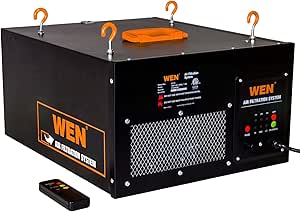 | Best for Post-Work Air Cleanup | Airflow settings: 300, 350, and 400 CFM | Filters: 5-micron pre-filter and 1-micron filter | Coverage area: Up to 400 sq ft | VIEW LATEST PRICE | See Our Full Breakdown |
| POWERTEC 1 HP Dust Collector with 1-Micron Filtration and Mobile Base |  | Best Mobile Collector | Air suction capacity: 800 CFM | Motor power: 1 HP | Filtration: 1 micron | VIEW LATEST PRICE | See Our Full Breakdown |
| Purisystems PuriCare 1100 3-Speed Remote Air Filtration System |  | Best for Larger-Shop Air Filtration | Airflow: 1100 CFM | Coverage area: 1100 sq ft | Filtration: Two-stage mechanical filtration | VIEW LATEST PRICE | See Our Full Breakdown |
| woodworking dust collector | Airflow | Weight | Motor | Dimensions |
|---|---|---|---|---|
| WEN 12-Gallon Woodworking Dust | Up to 660 CFM | 17 pounds | 5.7-amp brushed | 34.25 × 13 × 14.2 inches |
| JET DC-1100VX Woodworking Dust | 1,100 CFM | — | 1-1/2 HP continuous-duty, totally enclosed fan-cooled | Approximately 37 × 28 × 79 inches |
| Ecawei 9-Gallon Woodworking Du | — | — | — | — |
| DYNAVEX 12-Gallon Woodworking | 142 CFM | 29.5 pounds | 1.5 HP | 15.75 × 15.75 × 24.4 inches |
| ALORAIR Purecare 780IG 2-Stage | 580/780 CFM | — | — | — |
| ALORAIR Purecare 1350 360-Degr | 1,050/1,350 CFM | — | — | — |
| ALORAIR Purecare 1080IG Hangin | 780/1,080 CFM | — | — | — |
| WEN DC1300 1,300 CFM 14-Amp Wo | Up to 1,300 CFM | — | 14 A | — |
| Abestorm Tabletop Dust Collect | 580 and 780 CFM | 19.96 lb | — | 14.57 × 9.45 × 11.87 in. |
| WEN 15-Gallon Woodworking Dust | Up to 600 CFM | 41.1 lb | 7.4 A induction motor | 43.3 × 17.7 × 20.1 in. |
| VEVOR Wall-Mount Dust Collecto | 560 CFM | 24 lb | 1 HP induction motor | 40.94 × 13.78 × 15.75 in |
| WEN 3410 3-Speed Remote-Contro | — | 31 lb | 1/6 HP | 17 × 20.5 × 10 in |
| POWERTEC 1 HP Dust Collector w | — | 55 lb | — | — |
| Purisystems PuriCare 1100 3-Sp | 1100 CFM | 40.9 lb | — | — |
More Details on Our Top Picks
WEN 12-Gallon Woodworking Dust Collector (DC3401)
The WEN DC3401 is a space-conscious choice for a small shop that needs to collect chips at a machine without dedicating a large footprint to dust collection. Its listed airflow reaches 660 CFM, and the 12-gallon bag keeps the unit lighter and easier to position than the JET DC-1100VX, whose larger capacity and 1,100 CFM suit more demanding stationary setups. Lockable casters make it practical to move between tools, while optional wall mounting can free up floor space.
The tradeoff is capacity and connection flexibility: the bag will need attention sooner than the JET’s 39.6-gallon collector, and the WEN has a single 4-inch port. I’d choose it for one-tool-at-a-time chip collection, not as a substitute for fine-dust air filtration or a larger multi-machine system.
Pros:- Up to 660 CFM airflow in a compact, 17-pound unit.
- Lockable swivel casters and optional wall mounting allow flexible placement.
- Carrying handle makes storage and transport easier.
- Easy-access carbon brush caps simplify routine motor maintenance.
Cons:- The 12-gallon collection bag fills sooner than the JET DC-1100VX’s larger collector.
- Requires a standard 4-inch hose and offers no alternate inlet arrangement.
Best for: Small-shop woodworkers who want a mobile collector for one 4-inch-port machine and have limited floor space.
Not ideal for: Shops running several machines or seeking longer intervals between emptying; the 12-gallon bag and single 4-inch port are limiting.
- Motor:5.7-amp brushed
- Impeller:6-inch nylon
- Airflow:Up to 660 CFM
- Dust port:4 inches
- Collection bag:12 gallons; 5-micron zippered bag
- Dimensions:34.25 × 13 × 14.2 inches
- Weight:17 pounds
- Mounting:Four lockable swivel casters; optional wall mount
- Warranty:2 years
Our verdict“Choose the WEN DC3401 for compact, movable chip collection at a single 4-inch woodworking machine.”
JET DC-1100VX Woodworking Dust Collector with Vortex Cone and 2-Micron Canister
Among these five picks, the JET DC-1100VX is the strongest fit for a shop that needs a full-size collector for larger machines. Its 1,100 CFM airflow, 1-1/2 HP motor, and choice of one 6-inch inlet or two 4-inch inlets offer more capacity and hookup flexibility than the compact WEN DC3401. The Vortex Cone separates much of the chip load before it reaches the canister, while the rotating-handle cleaning mechanism lets you clear the pleated filter without taking it off.
That capacity calls for room, power, and a suitable setup: the unit is about 79 inches tall, and 115V operation requires a 20A circuit. Its 2-micron canister targets shop dust, but this is not a portable extractor for tool-side fine-dust work like the DYNAVEX. I’d shortlist it for fixed machines and skip it for a cramped shop or mixed-material cleanup.
Pros:- 1,100 CFM airflow and multiple inlet configurations suit larger or more varied machine hookups.
- Vortex Cone separates chips ahead of the filter to support airflow and bag packing.
- Canister filter cleans with a rotating handle without removal.
- Clear collector bags make fill level easy to see.
Cons:- Large footprint and roughly 79-inch height make placement difficult in compact shops.
- 115V operation requires a 20A circuit.
- Remote control is sold separately, and the unit is intended for wood dust and chips only.
Best for: Woodworkers with a dedicated shop, larger stationary machines, and a 20A circuit who want a high-capacity chip-and-dust collector.
Not ideal for: Small or mobile workspaces, or shops needing a portable extractor for fine dust at handheld tools.
- Motor:1-1/2 HP continuous-duty, totally enclosed fan-cooled
- Airflow:1,100 CFM
- Static pressure:10-1/2 inches
- Filter:Pleated 2-micron canister; captures 98% of 2-micron and 86% of 1-micron particles
- Inlets:One 6-inch inlet or two 4-inch inlets
- Voltage and current:115/230V, single phase; 11A at 115V or 5.5A at 230V
- Capacity:39.6 gallons
- Dimensions:Approximately 37 × 28 × 79 inches
- Warranty:5 years
Our verdict“Pick the JET DC-1100VX for a dedicated shop where its airflow and inlet options justify the space and circuit requirements.”
Ecawei 9-Gallon Woodworking Dust Extractor with Auto-Start Outlet
The Ecawei YKW-1400A is better understood as a shop-vac-style extractor than as a high-volume machine collector like the JET DC-1100VX. Its auto-start outlet can switch the extractor on with a compatible corded tool, making it convenient for localized cleanup and chip pickup as work proceeds. Variable suction provides some control across tasks, while dual-cyclone pre-separation helps keep larger debris away from the filters. Wet-and-dry pickup also gives it a broader cleanup role than the WEN DC3401.
The key limitation is the product’s stated dust range: it is not suitable for fine dust from sanding, grinding, drywall, or concrete work. That makes it a poor choice as a primary fine-dust control system, despite its listed HEPA filter. Its 9-gallon capacity is also smaller than the DYNAVEX’s 12-gallon steel tank. I’d choose it for tool-triggered debris pickup, not airborne dust management.
Pros:- Auto-start outlet can coordinate extraction with a compatible power tool.
- Variable suction control adapts to different cleanup tasks.
- Dual-cyclone pre-separation helps reduce debris reaching the main filter.
- Wet-and-dry pickup adds general workshop cleanup versatility.
Cons:- Not suitable for fine dust from sanding, grinding, drywall, or concrete work.
- 9-gallon capacity is smaller than the DYNAVEX’s 12-gallon tank.
- Corded operation requires access to a power outlet.
Best for: DIY woodworkers who want a corded extractor that starts with a compatible tool and handles chips, shavings, and general wet-or-dry cleanup.
Not ideal for: Woodworkers sanding or grinding who need fine-dust extraction, or anyone needing a cordless setup.
- Model:YKW-1400A
- Capacity:9 gallons
- Power:1,400 W
- Voltage and current:110 V; 12 A
- Maximum suction:214 cm
- Hose length:7 feet
- Filtration:Cartridge, HEPA, and pre-motor filters; dual-cyclone filtration
- Pickup:Wet and dry
- Noise level:80 dB
Our verdict“Choose the Ecawei for tool-synchronized pickup of chips and general debris, but not for fine-dust extraction.”
DYNAVEX 12-Gallon Woodworking Dust Extractor with HEPA Filter
The DYNAVEX 12-Gallon Extractor stands out for tool-side collection where fine-particle filtration matters more than the high airflow of a stationary collector. Its 0.5-micron HEPA filter and 142 CFM rating make it a different kind of choice from the JET DC-1100VX: the JET moves far more air for larger machines, while this model is built around a portable steel tank, hose, and adapters for connecting at a tool. A 12-gallon tank also offers more collection room than the Ecawei’s 9-gallon capacity.
The auto-start socket is useful only within its limits: connected tools must be rated up to 550 watts, and continuous use is limited to one hour. That makes it less flexible for higher-powered tools than a collector without this restriction. Wheel fittings are included, but installation requires setup. I’d favor it for compatible tool-based work, not for replacing a high-CFM collector on a table saw.
Pros:- 0.5-micron HEPA filtration targets fine particles at the extractor.
- 12-gallon steel tank holds more than the Ecawei’s 9-gallon capacity.
- Auto-start socket synchronizes extraction with compatible tools.
- Includes a hose, adapters, clamps, and replacement paper filters.
Cons:- Auto-start socket is limited to tools rated up to 550 watts.
- Connected-tool continuous use is limited to one hour.
- At 142 CFM, it is not a replacement for the JET DC-1100VX on high-volume machine collection.
Best for: Woodworkers using compatible lower-wattage tools who want portable collection with a 0.5-micron HEPA filter and a larger tank.
Not ideal for: Owners of tools above 550 watts or shops seeking high airflow for large stationary machines.
- Motor:1.5 HP
- Airflow:142 CFM
- Tank:12-gallon steel
- Filtration:0.5-micron HEPA filter
- Electrical:120 V; 10 A; 1,200 W
- Auto-start tool limit:550 W maximum; connected-tool continuous use up to 1 hour
- Weight:29.5 pounds
- Dimensions:15.75 × 15.75 × 24.4 inches
- Included hose:4 inches × 6.5 feet
Our verdict“Pick the DYNAVEX for portable, HEPA-filtered extraction with compatible tools, rather than for high-volume stationary collection.”
ALORAIR Purecare 780IG 2-Stage Woodworking Air Filtration System with Ionizer and Remote
The ALORAIR Purecare 780IG addresses airborne dust, not the chips a collector pulls from a machine. Its 270-degree intake and two-speed airflow of up to 780 CFM make it a useful supplement to source collection such as the WEN DC3401 or JET DC-1100VX. The remote and 1–9 hour timer let a woodworker run it during a session or after cleanup, while ceiling hanging or workbench placement accommodates different shop layouts.
Its MERV-11 filter is listed to capture 90% of 3–10-micron particles and 85% of 1-micron particles, but this system does not replace a hose-connected dust collector or the DYNAVEX’s tool-side HEPA filtration. The unit is also unavailable for shipment to California. I’d choose it to circulate and filter workshop air alongside machine collection, and skip it if the goal is direct extraction at a saw or sander.
Pros:- 270-degree intake and up to 780 CFM support workshop air circulation.
- MERV-11 filter is rated to capture 85% of 1-micron particles.
- Remote and 1–9 hour timer allow convenient operation after woodworking.
- Can hang from the ceiling or sit on a workbench.
Cons:- Air filtration does not capture chips at the machine like the WEN DC3401 or JET DC-1100VX.
- MERV-11 filtration is not equivalent to the DYNAVEX’s 0.5-micron HEPA filter.
- Cannot be shipped to California.
Best for: Woodworkers who already collect dust at their machines and want a remote-controlled air filtration unit for a workshop up to 800 square feet.
Not ideal for: Buyers seeking direct tool hookup, or California residents who cannot receive this model.
- Airflow:580/780 CFM
- Intake:270 degrees
- Filter:MERV-11
- Particle capture:90% of 3–10 µm particles; 85% of 1 µm particles
- Room coverage:Up to 800 square feet
- Electrical requirements:115 V, 60 Hz, 0.6 A; 62 W
- Noise level:Below 50 dBA
- Controls:IR remote; 1–9 hour timer
- Mounting:Ceiling hanging or workbench placement
Our verdict“Choose the Purecare 780IG as a supplemental shop-air cleaner, not as your primary woodworking dust collector.”
ALORAIR Purecare 1350 360-Degree Air Filtration System
The Purecare 1350 is an ambient air filtration unit, not a replacement for a dust collector connected to a tool. Its 360-degree intake and airflow up to 1,350 CFM make it the stronger choice over the Purecare 1080IG when a larger shop needs air circulated from all sides; the listed coverage reaches 1,700 square feet rather than 1,100. The MERV 11 filter has stated capture rates for particles down to 1 micron, while the timer and remote make it easier to run after a dusty task. It can hang overhead or sit on a bench, though its 27-pound body needs suitable support when mounted. The tradeoffs are a listed noise range of 60–69 dB and a California shipping restriction. Choose it for room-wide cleanup, not direct extraction at a saw.
Pros:- 360-degree intake supports air circulation from every side.
- Airflow reaches 1,350 CFM, with listed coverage up to 1,700 square feet.
- MERV 11 filter has stated capture rates for 3–10 µm and 1 µm particles.
- Includes remote, 1–9-hour timer, and hanging or bench placement options.
Cons:- Does not replace source collection at a machine’s dust port.
- Noise is listed as high as 69 dB.
- Product information says it cannot be shipped to California.
Best for: Woodworkers with a large garage or shop who want overhead or bench-mounted ambient filtration to supplement tool-connected collection.
Not ideal for: California buyers, noise-sensitive shops, or anyone seeking a collector that connects directly to a machine and captures chips at the source.
- Airflow:1,050/1,350 CFM
- Filter:MERV 11
- Particle capture:90% of 3–10 µm particles; 85% of 1 µm particles
- Coverage:Up to 1,700 sq. ft.
- Fan speeds:2
- Timer:1–9 hours
- Dimensions and weight:20.5 × 20.5 × 9.8 in.; 27 lb
- Electrical:115 V, 60 Hz, 1.5 A
- Noise:60–69 dB
Our verdict“Choose the Purecare 1350 for broad ambient filtration in a large shop, but pair it with source collection and skip it if noise or California availability is a concern.”
ALORAIR Purecare 1080IG Hanging Air Filtration System with Ionizer and Remote
The Purecare 1080IG suits a mid-sized shop where overhead air cleaning matters more than collecting chips directly from a tool. Its 270-degree intake and airflow up to 1,080 CFM are a step down from the Purecare 1350’s 360-degree intake and larger stated coverage, but this unit is lighter at 22 pounds and is specified for spaces up to 1,100 square feet. A MERV-11 filter has stated fine-particle capture rates, and the included chain, remote, and timer make ceiling placement practical. Compared with the Abestorm tabletop unit, this ALORAIR model is aimed at circulating shop air rather than sitting near a bench for localized use. The compromises are its smaller coverage, plastic construction, California shipping restriction, and noise that may still be noticeable in a quiet room.
Pros:- 270-degree intake and up to 1,080 CFM support room-air circulation.
- MERV-11 filter has stated capture rates for fine particles.
- Includes hook and chain, infrared remote, and 1–9-hour timer.
- At 22 pounds, it is lighter than the Purecare 1350.
Cons:- Coverage is listed at up to 1,100 square feet, below the Purecare 1350.
- Plastic construction may not suit buyers seeking a metal-bodied unit.
- Product text restricts shipment to California, and its noise may be noticeable in quiet shops.
Best for: Owners of mid-sized woodworking shops who want a hanging air filtration unit with remote operation and a timed run cycle.
Not ideal for: Large-shop owners who need the Purecare 1350’s broader intake and coverage, California buyers, or anyone needing direct tool-port collection.
- Airflow:780/1,080 CFM
- Intake:270°
- Filter:MERV-11
- Particle capture:90% of 3–10 µm particles; 85% of 1 µm particles
- Coverage:Up to 1,100 sq. ft.
- Fan speeds and timer:2 speeds; 1–9 hours
- Noise:Below 60 dBA
- Dimensions and weight:19.4 × 19.4 × 9.6 in.; 22 lb
- Electrical:115 V, 60 Hz, 1.5 A, 151 W
Our verdict“Pick the Purecare 1080IG for remote-controlled ambient filtration in a mid-sized shop; choose the Purecare 1350 instead when broader coverage is the priority.”
WEN DC1300 1,300 CFM 14-Amp Woodworking Dust Collector
Unlike the ALORAIR Purecare air cleaners, the WEN DC1300 is designed to connect to woodworking tools and collect dust and chips at the source. Its two 4-inch inlets can serve two machines, making it a better fit than the smaller WEN DC3474 for a shop that wants to leave multiple tools connected. Airflow reaches 1,300 CFM, and the 50-gallon bag means less frequent emptying during heavier shop work. A steel impeller and four swivel casters add practical durability and mobility. The main compromise is filtration: the supplied bag is listed at 5 microns, so it is less suited to capturing fine airborne dust than a dedicated air filtration unit such as the Purecare 1350. It also has one speed and is intended for indoor use. I’d favor it for chip collection capacity, not as a complete airborne-dust solution.
Pros:- Two 4-inch inlets allow connections to two tools.
- Up to 1,300 CFM and a 50-gallon bag suit higher-volume chip collection.
- 10-inch steel impeller is rated up to 3,450 RPM.
- Four swivel casters make it easier to reposition around a shop.
Cons:- The 5-micron filtration is less suited to fine airborne dust than the Purecare 1350’s MERV 11 filter.
- Single-speed operation offers less airflow control.
- Designed for indoor use.
Best for: Woodworkers with multiple stationary machines who want a mobile collector with two 4-inch connections and a large collection bag.
Not ideal for: Small shops that need a compact unit, users prioritizing fine-particle air filtration, or anyone who needs multiple airflow settings.
- Airflow:Up to 1,300 CFM
- Motor:14 A
- Inlets:Two 4-inch inlets
- Collection bag:50 gallons
- Impeller:10-inch steel; up to 3,450 RPM
- Mobility:Mobile base with four swivel casters
- Speeds:1
- Power source:AC
- Warranty:2 years
Our verdict“Choose the DC1300 when two-tool connections and a large bag matter more than fine-particle filtration or adjustable speeds.”
Abestorm Tabletop Dust Collector with Timer
The Abestorm tabletop collector takes a different approach from the wheeled WEN DC1300: it is a portable air-cleaning unit for a bench or work area, not a high-capacity collector connected to machine ports. Its MERV-13 filter and two airflow settings—580 or 780 CFM—make it a useful localized option for a small shop or dusty bench, while the 120-minute timer can run it for a set period after work stops. A metal housing, handle, cord wrap, and circuit breaker add practical touches for moving and operating it. Compared with the Purecare 1080IG, it is easier to place at bench level, but it lacks that unit’s hanging hardware and room-coverage specification. Its nearly 20-pound weight and corded design also limit how freely it can be positioned.
Pros:- MERV-13 filter offers a higher stated filter grade than the MERV-11 ALORAIR units.
- Two airflow settings and a timer of up to 120 minutes support flexible use.
- Metal housing, handle, and cord wrap aid handling and storage.
- Safety circuit breaker cuts power if current exceeds the safe range.
Cons:- It is an air cleaner, not a tool-connected collector for chips at the source.
- Corded operation requires access to an outlet and limits placement.
- The filter is listed to last up to 6 months and may need replacement.
Best for: Woodworkers who need a movable, bench-side air cleaner for a focused work area and value MERV-13 filtration with timed operation.
Not ideal for: Shops needing high-volume source collection, broad room coverage, or a unit that can be mounted overhead without a nearby outlet.
- Airflow:580 and 780 CFM
- Filter:MERV-13
- Power:100 W
- Electrical:115 V, 0.9 A
- Timer:Up to 120 minutes
- Cord length:11.5 ft
- Dimensions:14.57 × 9.45 × 11.87 in.
- Weight:19.96 lb
- Filter life:Up to 6 months
Our verdict“Choose the Abestorm for portable, localized bench-area filtration, but look to the WEN DC1300 for machine-connected collection and larger debris loads.”
WEN 15-Gallon Woodworking Dust Collector, 7.4-Amp Motor (DC3474)
The WEN DC3474 is a smaller, more space-conscious source collector than the WEN DC1300. Its 600 CFM airflow, single 4-inch port, and 15-gallon bag suit one machine at a time, while the DC1300 offers higher airflow, dual inlets, and a much larger bag for busier setups. Four swivel casters and a carrying handle make this unit movable, and its optional wall mount gives a small shop another way to reclaim floor space. The catch is that wall mounting requires removing the wheels, so it is not a quick switch between mobile and fixed use. Its 5-micron bag also prioritizes chips and coarser dust over the finer filtration offered by the Abestorm tabletop unit. Choose it for compact source collection, not whole-room air cleaning.
Pros:- Up to 600 CFM suits a single machine connection.
- 15-gallon zippered bag provides a practical capacity for a smaller shop.
- Four swivel casters and a carrying handle support moving it around.
- Optional wall mounting can free floor space.
Cons:- One 4-inch port is less flexible than the WEN DC1300’s dual inlets.
- The 5-micron bag is not designed for fine-particle air cleaning.
- Wall mounting requires removing the wheels.
Best for: Small-shop owners who need a mobile collector for one 4-inch machine connection, with the option to mount it on a wall.
Not ideal for: Woodworkers running multiple machines at once, shops needing a large collection capacity, or buyers focused on fine airborne-dust filtration.
- Airflow:Up to 600 CFM
- Motor:7.4 A induction motor
- Impeller:9 inches
- Dust port:4 inches
- Collection bag:15 gallons; 5-micron; zippered
- Dimensions:43.3 × 17.7 × 20.1 in.
- Weight:41.1 lb
- Mobility:Four 2-inch swivel casters and carrying handle
- Warranty:2 years
Our verdict“Pick the DC3474 for compact, single-tool collection and possible wall mounting; choose the DC1300 if you need more airflow, capacity, or tool connections.”
VEVOR Wall-Mount Dust Collector, 1 HP, 560 CFM
For a small shop where floor space is scarce, the VEVOR wall-mount collector keeps the unit off the floor while offering 560 CFM for capturing sawdust and sanding dust at a machine. Its 21-gallon bag holds more debris than a compact extractor, so frequent emptying is less likely during routine projects; the bottom zipper also makes disposal easier without removing the bag. Compared with the mobile POWERTEC 1 HP Dust Collector, this one trades casters and flexible placement for a fixed, space-saving installation. The 2.5-micron filtration is suited to shop debris, but buyers prioritizing finer filtration may prefer POWERTEC’s 1-micron bag. Noise can reach 90 dB, and the listing positions it for small and medium projects rather than demanding, multi-machine collection.
Pros:- Wall mounting frees floor space in a compact workshop.
- 560 CFM airflow suits sawdust and sanding-dust collection for small and medium projects.
- 21-gallon bag reduces how often routine jobs require emptying.
- Bottom zipper allows bag emptying without detaching it.
Cons:- Up to 90 dB of operating noise may be intrusive in a small shop.
- 2.5-micron filtration is less fine than the POWERTEC’s 1-micron filter bag.
- Fixed wall mounting limits repositioning between machines.
Best for: Small-shop woodworkers who want a fixed collector with a roomy bag and need to preserve floor space.
Not ideal for: Woodworkers who need to move the collector between machines, want finer-than-2.5-micron filtration, or run several machines at once.
- Airflow:560 CFM
- Motor:1 HP induction motor
- Filtration:2.5 microns
- Collection bag:21 gallons (80 L)
- Noise level:Up to 90 dB
- Mounting:Wall mount
- Dimensions:40.94 × 13.78 × 15.75 in
- Weight:24 lb
Our verdict“Choose the VEVOR if you want a space-saving, fixed collector for a small shop and can accept its noise and 2.5-micron filtration.”
WEN 3410 3-Speed Remote-Controlled Air Filtration System, 300/350/400 CFM, Black
The WEN 3410 addresses airborne dust left after collection at the saw; it is an air filtration system, not a machine-connected collector. Its three settings move 300, 350, or 400 CFM through a 5-micron pre-filter and 1-micron filter, with coverage specified for rooms up to 400 square feet. That makes it a useful complement to a bag collector such as the VEVOR wall-mount model, rather than a substitute for capturing chips at the source. A remote that works through obstructions and a programmable shutoff timer let users adjust or schedule cleanup without reaching the unit. Compared with the larger-coverage Purisystems PuriCare 1100, the WEN is intended for a more modest shop. Its 400-square-foot coverage limit and 50–60 dB operating noise narrow its appeal.
Pros:- Three airflow settings let users choose between 300, 350, and 400 CFM.
- Two replaceable filters include a 1-micron final filter.
- RF remote works up to 26 feet, including without direct line of sight.
- Programmable shutoff timer supports scheduled post-work air circulation.
Cons:- Coverage is limited to rooms up to 400 square feet.
- It filters airborne dust but does not collect debris directly from a woodworking machine.
- Noise ranges from 50 to 60 dB.
Best for: Woodworkers with an enclosed shop of up to 400 square feet who already collect dust at their machines and want help filtering lingering airborne particles.
Not ideal for: Owners of larger workshops or anyone seeking a machine-connected collector to capture chips and dust at the source.
- Airflow settings:300, 350, and 400 CFM
- Filters:5-micron pre-filter and 1-micron filter
- Coverage area:Up to 400 sq ft
- Noise level:50–60 dB
- Motor:1/6 HP
- Remote range:Up to 26 ft
- Dimensions:17 × 20.5 × 10 in
- Weight:31 lb
Our verdict“Pick the WEN 3410 to filter airborne dust in a smaller shop after source collection, not as a replacement for a dust collector.”
POWERTEC 1 HP Dust Collector with 1-Micron Filtration and Mobile Base
The POWERTEC is the most flexible choice here for woodworkers who move dust collection from one machine to another. Its four-caster base, handle, and 55-pound weight make it portable around a level shop, while the 800 CFM rating and 4-inch intake suit connection to compatible woodworking equipment. A 1-micron filter bag gives it a filtration advantage over the VEVOR’s 2.5-micron bag, and quick-release clamps simplify emptying. Unlike the VEVOR wall-mount collector, it does not claim a larger 21-gallon bag or save floor space, so placement and collection capacity may matter more to the buyer. The 4-inch port can require adapters or compatible ducting, and a 55-pound unit is not an easy choice for stairs. Its single speed also offers no airflow adjustment.
Pros:- Four casters and a handle make it movable between work areas.
- 800 CFM capacity supports collection from compatible woodworking machines.
- 1-micron filter bag captures finer dust than the VEVOR’s 2.5-micron bag.
- Quick-release clamps make collection-bag removal easier.
Cons:- The 4-inch intake may require compatible ducting or adapters.
- At 55 lb, it is awkward to carry over stairs or uneven ground.
- Single-speed operation offers no airflow adjustment.
Best for: Woodworkers who need to roll a collector between machines in a single-level shop and can connect their tools to a 4-inch intake.
Not ideal for: Buyers with limited floor space, frequent stair moves, incompatible tool ports, or a need to adjust airflow across multiple operating modes.
- Air suction capacity:800 CFM
- Motor power:1 HP
- Filtration:1 micron
- Intake port:4 in
- Motor speed:3450 RPM
- Speeds:1
- Voltage:120/240 V
- Weight:55 lb
Our verdict“Choose the POWERTEC if you want a wheeled, 800 CFM shop collector with 1-micron filtration and have suitable 4-inch connections.”
Purisystems PuriCare 1100 3-Speed Remote Air Filtration System
For shops where fine dust remains suspended after the machines are off, the PuriCare 1100 offers air filtration for spaces up to 1,100 square feet, a larger stated coverage area than the WEN 3410’s 400 square feet. Its 1,100 CFM airflow, three speeds, and two-stage filtration with 1-micron particle retention make it an air-cleaning complement to a source collector—not a substitute for a hose connected to a saw. The 26-foot remote and adjustable one-to-12-hour shutoff timer make it easier to run a cleanup cycle without returning to the unit. Compared with the WEN, it brings broader coverage but is heavier at 40.9 pounds and louder at 66 dB. The product description also says it cannot be shipped to California, which may rule it out regardless of workshop fit.
Pros:- Specified coverage reaches up to 1,100 square feet.
- Three speeds provide airflow choices up to 1,100 CFM.
- Two-stage reusable filtration has a stated 1-micron particle-retention size.
- Remote control and a one-to-12-hour timer support convenient cleanup cycles.
Cons:- The product description says it cannot be shipped to California.
- At 40.9 lb, it may be cumbersome to reposition.
- At 66 dB, it is louder than the WEN 3410’s stated 50–60 dB range.
Best for: Woodworkers with a larger shop who already collect dust at the source and want overhead air filtration with remote operation and a timed run.
Not ideal for: California buyers, people who need a machine-connected collector, or anyone who wants a lighter unit to move frequently between rooms.
- Airflow:1100 CFM
- Coverage area:1100 sq ft
- Filtration:Two-stage mechanical filtration
- Particle retention:1 micron
- Speeds:3
- Remote range:Up to 26 ft
- Timer:1–12 hours
- Noise level:66 dB
- Weight:40.9 lb
Our verdict“Choose the PuriCare 1100 for remote-controlled air cleanup in a larger shop, provided its shipping restriction and weight work for you.”
How We Picked
I compared these 14 options by the job they are built to do: collect dust at a machine, serve as a mobile or fixed shop collector, or filter airborne particles around the room. For collector units, I weighed stated airflow, capacity, filtration claims, portability, and features that affect setup, such as an auto-start outlet or wall-mount design. For air filtration systems, I looked at stated airflow, coverage-oriented design, speed control, remote operation, and whether the unit is intended for overhead or localized placement. I treated advertised specifications as product information, not as a guarantee of performance in a particular duct layout.
The ranking gives priority to versatility and usefulness as a woodworking dust-collection solution, while keeping unlike products in their proper roles. The JET ranks highest among the main collectors because its vortex cone and canister filtration make it a more complete fixed-shop option; portable WEN units follow for accessible, simpler setups, while higher-airflow models suit different scale and layout needs. Extractors and air cleaners remain valuable picks, but they rank for narrower tasks: tool-level collection or cleanup of airborne dust. Buyers should not treat an air cleaner’s CFM as equivalent to airflow at a machine hood.
Factors to Consider When Choosing Woodworking Dust Collectors
Before choosing a unit, I would map the dust path through the workshop: where it starts, how it reaches a collector, and what remains in the air afterward. That distinction helps prevent a common mistake—buying a room air cleaner when the real need is a machine connection, or expecting a portable collector to serve several machines through long, restrictive ductwork.
Match the collector to the machine connection
Start with the machines that create the most chips and dust, then check their port sizes and the connector sizes your collector can accept. A unit’s advertised airflow does not tell the whole story: long hoses, small fittings, bends, and branches all restrict movement of air. A portable extractor with an auto-start outlet can suit a handheld tool or one work area, while a stationary collector makes more sense when machines are arranged around a shared system. Avoid assuming that an adapter alone will make mismatched ports perform well. If you plan to connect several machines, think through which gates will be open and how much ducting the air must travel through. Choose for the real layout, not the largest number on the spec sheet.
Separate source collection from room filtration
Source collection captures dust at a tool hood or port; an air filtration system works on particles that have already entered the room. These jobs complement each other, but one cannot reliably stand in for the other. A ceiling-mounted filter may help circulate workshop air, yet it does not remove the need to connect a collector to a table saw, sander, or planer. Conversely, a machine collector does not capture every fine particle that escapes a poorly fitted hood. Buyers often overspend on room filtration while leaving the biggest dust-producing machines unconnected. Put the first effort into controlling dust at its source, then add room filtration if airborne residue remains a concern.
Read filtration claims in context
Micron or HEPA labels describe filtration claims, but they do not answer every question about workshop exposure. Filter fit, seals, maintenance, and how dust is handled during emptying all affect the result. A finer filter can be useful for reducing fine-particle return, but it may call for more careful cleaning and replacement than a basic collection bag. Check whether the product specifies the filter included with the unit or an optional upgrade. Also look for a practical way to access and clean the filter without spreading collected dust. Compare filtration alongside the collector’s intended use, rather than treating a single label as a complete measure of dust control.
Plan for capacity, emptying, and maintenance
Capacity affects how often you stop work to empty a bag or drum, but a larger container can add bulk and make a unit harder to move or store. Consider the materials and volume you cut: a planer can fill a collector much faster than light sanding, even if both tools connect to the same machine. Check how the collection bag attaches and whether you can remove it without lifting a heavy, awkward load. Filters also need routine attention; a clogged filter can reduce airflow and make a capable collector less useful. Before buying, leave room for access around the unit and keep replacement bags or filters available. Maintenance convenience is part of usable performance, not an afterthought.
Choose a layout that fits the shop
Floor space, outlet locations, and the path between machines can matter as much as motor size in a small workshop. A mobile base lets a collector move between tools, but the hose has to follow it and can become a tripping or handling nuisance. A wall-mounted collector frees floor area, though it may limit where the unit can sit and how hoses reach machines. Hanging air cleaners need suitable overhead placement and clearance; tabletop units address a more local work zone rather than whole-shop collection. Sketching the layout before purchase can reveal whether a fixed or portable approach is more practical. Avoid choosing a mounting style based only on available space at the moment—account for future machine moves too.
Pay for capability your workflow can use
A higher stated airflow or added control feature is only useful when the rest of the setup can support it. Better duct routing, suitable machine ports, and a maintained filter help a collector deliver more of its potential. Remote controls, timers, and auto-start outlets can reduce small workflow interruptions, but they do not compensate for a poorly sealed hood. For a single-tool or beginner shop, a simpler portable unit may be easier to place and maintain than a larger fixed system. A growing shop may justify investing in a collector and ducts that can serve multiple machines. Spend more when the added capacity, filtration, or installation style solves a real limitation in your workshop.
Frequently Asked Questions
Should I buy a dust collector or an air filtration system first?
I would usually prioritize a collector connected to the tools that produce the most dust, since capturing material at the source reduces what reaches the room. Air filtration systems such as the ALORAIR Purecare models, WEN 3410, and PuriSystems PuriCare 1100 serve a different role: they circulate and filter workshop air. If you already have source collection but still notice fine dust lingering, an air cleaner can complement it. A room filter is not a replacement for a machine hood or extractor connection. Base the order on the biggest gap in your current setup.
Is a higher CFM rating enough to choose between woodworking dust collectors?
No. A stated CFM figure is useful for comparing products, but it does not reveal how much airflow reaches your tool through your specific hose and duct arrangement. Narrow connections, long runs, sharp turns, and multiple open branches can reduce airflow at the collection point. Also check whether the unit is meant for a single tool, a ducted system, or room-air filtration; those uses are not directly interchangeable. Compare connection size, filtration, layout, and maintenance alongside the airflow claim. A well-matched setup can be more useful than a larger rating paired with restrictive ducting.
Can a portable dust collector serve several machines?
It can, if you move it between machines or connect it to a carefully planned duct system, but portability does not automatically make it a good central collector. The hose length and fittings needed for multiple stations can restrict airflow, and a portable unit may be inconvenient to relocate during a busy session. For occasional use with one machine at a time, a mobile collector can be practical. If several machines need fixed connections, compare the unit’s stated airflow and connection setup against the complete duct layout. Avoid leaving multiple gates open unless the system is designed to handle that demand.
Does a HEPA or 2-micron filter mean the workshop air is fully protected?
No filter label alone guarantees clean air throughout a workshop. Results depend on how well dust is captured at the tool, whether the filter and bag are properly fitted, and how the unit is maintained and emptied. The DYNAVEX extractor’s HEPA claim and the JET DC-1100VX’s 2-micron canister describe different filtration approaches, but they do not remove the need for sound source control. Room airflow, leaks, and the type of work also affect how much dust remains airborne. Treat filtration as one part of a broader dust-control plan rather than a standalone promise.
When does it make sense to add a hanging or wall-mounted unit?
A hanging air cleaner makes sense when you want to address airborne dust across a shop and have a safe, suitable overhead mounting position. A wall-mounted collector, such as the VEVOR option, is for source collection and can free floor space when its location works with your machine layout. These formats solve different problems, so choose based on whether you need room-air circulation or a machine connection. Check clearance, mounting support, power access, and filter access before committing to a fixed position. If your workshop layout changes often, a mobile unit may offer more flexibility.
Conclusion
For a broadly capable fixed-shop collector, I would start with the JET DC-1100VX; it is my best overall pick for buyers who value its vortex cone and 2-micron canister. The WEN DC3401 is my best value and beginner-friendly choice for a smaller shop that needs a portable, straightforward collector, while the WEN DC1300 is the better match for buyers prioritizing higher stated airflow. For a premium air-filtration setup, consider the ALORAIR Purecare 780IG or 1080IG for their two-stage or ionizer-equipped designs and remote control, recognizing that neither replaces tool-connected collection. Choose the Ecawei for an extractor with an auto-start outlet, the DYNAVEX when its HEPA-filtered extractor format fits your needs, or the VEVOR when wall mounting and floor-space savings matter. If your main concern is airborne dust rather than chips at a machine, compare the ALORAIR, WEN, Abestorm, and PuriSystems air-cleaning options by placement and controls. The right pick is the one that addresses your shop’s biggest dust source and fits the way you work.