
TL;DR
Open a free Amazon Business account
Business pricing, bulk buying and tax-exempt orders.
Create a free accountAs an affiliate, we earn on qualifying purchases.
Battery mower decks are smaller mainly because of battery size, weight, and power constraints. For mowing an acre, larger decks with more battery capacity can save time, but technology is steadily improving, making battery options more viable for bigger properties.
Ever notice that battery-powered mowers seem to have smaller cutting decks than their gas counterparts? It’s not just a design choice — it’s a technical reality. The size of the deck directly impacts how much area you can cut in one pass, and with current battery tech, bigger decks mean heavier, more expensive machines that can be harder to handle.
In this guide, you’ll see why battery mowers are limited in deck size, what that means for mowing an acre, and how recent innovations are changing the game. If you own a large yard or are considering switching from gas, this info can help you make smarter choices without sacrificing efficiency or breaking the bank.
Battery mower decks are smaller mainly due to current battery size, weight, and energy density limits.
Advances in battery tech, like interchangeables and larger packs, are gradually enabling bigger decks for battery mowers.
For mowing an acre, choose a model with a larger deck and higher-capacity batteries, or plan for multiple charging sessions.
Weight and runtime are the key tradeoffs: bigger decks mean more power but also more weight and cost.
Assess your priorities: time saved, budget, and eco-impact, before choosing between small or large deck mowers.
Why Battery Mower Decks Are Smaller Than Gas — The Real Reasons
Battery mowers typically feature decks of 20-30 inches, whereas gas mowers often hit 30-50 inches. The main reason? Batteries. They’re heavy, bulky, and still can’t pack enough energy into a small space to power a large deck for long.
Imagine trying to fit a marathon runner’s energy supply into a backpack. It’s a balancing act: more battery capacity means more weight, which makes the mower harder to push and maneuver. This weight not only affects ease of use but also influences safety and precision, especially for those who prefer a lightweight mower for tight spaces or uneven terrain.
Plus, larger batteries significantly increase the cost, which can price out consumers seeking a budget-friendly option. The tradeoff is clear: larger decks require bigger batteries, but current tech limits how small or lightweight these batteries can be while still providing enough power.
For example, a 20-inch battery mower might weigh around 50 pounds, making it manageable for most users. In contrast, a 50-inch gas mower can weigh 70-80 pounds but offers longer runtime and more power. This difference highlights the core challenge: balancing deck size, weight, runtime, and cost, which all hinge on battery energy density and current technological limits.
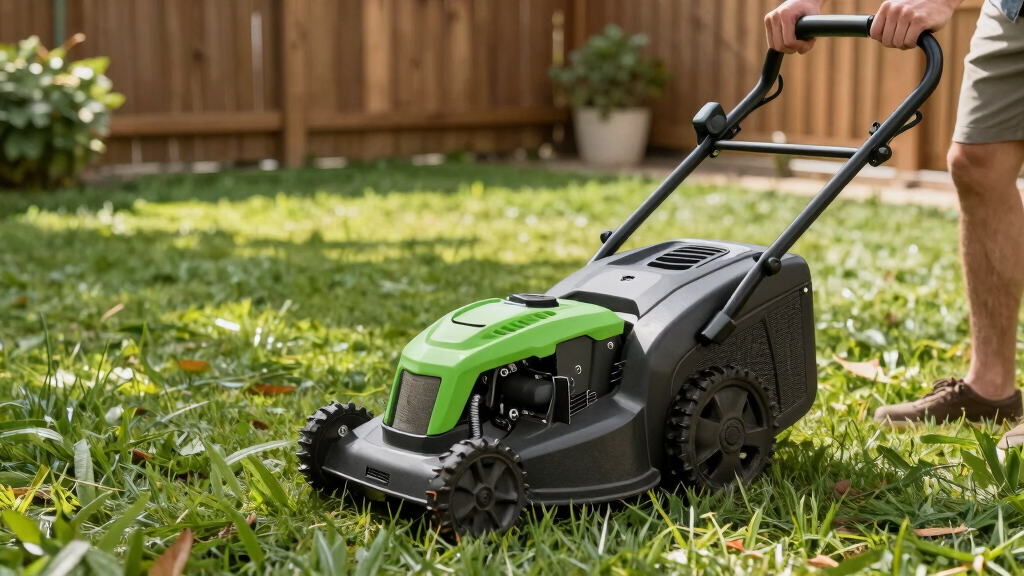
battery powered lawn mower with large deck
As an affiliate, we earn on qualifying purchases.
As an affiliate, we earn on qualifying purchases.
How Battery Tech Is Holding Back Big Decks (And What’s Changing)
Current lithium-ion batteries have an energy density of about 250 Wh/kg, which means they can store a limited amount of energy relative to their weight. To power a large deck mower effectively, you need a bigger battery, but this translates directly into increased weight and cost. This creates a fundamental tradeoff: larger decks demand more energy, but the heavier batteries diminish maneuverability and increase expense, limiting the practicality of big battery decks today.
However, recent breakthroughs like solid-state batteries and modular battery packs are changing this landscape. Solid-state batteries promise higher energy densities and improved safety, potentially enabling larger decks without the weight penalty. Modular packs allow users to swap out depleted batteries for charged ones mid-mow, effectively extending runtime without adding significant weight to the mower itself. This innovation reduces the barrier to larger decks by addressing the core issue of battery weight versus capacity.
For example, some newer commercial-grade battery mowers now feature interchangeable batteries and decks up to 42 inches, with runtimes of 2-3 hours. These models demonstrate how technological advancements are making larger, more efficient battery-powered mowers feasible and practical for larger properties, although they often come with a higher initial investment. The key is that these innovations are gradually shifting the tradeoffs, allowing property owners to consider bigger decks without sacrificing convenience or efficiency.
As an affiliate, we earn on qualifying purchases.
The Tradeoffs: Smaller Decks & Less Runtime vs. Gas Power
Battery mowers with smaller decks are lighter, easier to steer, and produce no emissions, making them ideal for quick, eco-friendly mowing sessions. However, the smaller deck size inherently limits the mowing area per pass, meaning you’ll need more time and effort to cover large lawns. For instance, a 20-inch battery mower might take around 2 hours to mow a full acre, whereas a 50-inch gas mower can complete the same area in less than an hour due to its larger deck and more powerful engine.
This difference in efficiency impacts how you plan your mowing schedule. Smaller decks necessitate multiple passes or longer mowing sessions, which can be inconvenient and time-consuming, especially for larger properties. The tradeoff becomes apparent: you gain ease of use, lower weight, and eco-friendliness at the expense of longer mowing times.
Here’s a detailed comparison to illustrate this:
| Mower Type | Deck Size | Runtime | Mowing Speed | Cost |
|---|---|---|---|---|
| Battery (small deck) | 20-30 inches | 1-2 hours | Slow to moderate | Lower initial, higher long-term |
| Gas (large deck) | 40-50 inches | 1 tank (~1 hour) | Fast | Higher initial, lower long-term |
For large acreages, this time difference can significantly influence your choice. If saving time is crucial, a larger gas mower might justify its higher upfront cost. Conversely, if you prioritize eco-friendliness and lower maintenance, a smaller battery mower could still be suitable, provided you’re willing to spend more time mowing or invest in multiple batteries for longer sessions.
large capacity battery for electric lawn mower
As an affiliate, we earn on qualifying purchases.
As an affiliate, we earn on qualifying purchases.
Are Larger Battery Mowers Coming Soon? The Progress You Should Know
Yes, battery technology is advancing rapidly, and these improvements are directly impacting mower design and capabilities. Manufacturers are developing models with larger decks, longer runtimes, and quick-swap batteries that address the previous limitations. This progress is driven by the need for more efficient, eco-friendly options for larger properties, and the market demand is pushing innovation forward.
For example, recent models now feature decks of 38 inches or more, equipped with larger or interchangeable batteries. These allow homeowners and professionals to mow larger areas with fewer stops, reducing overall mowing time. Some commercial models boast runtimes of 2-3 hours, making them viable alternatives to traditional gas mowers for acreage maintenance.
While these advancements are promising, they often come with a higher price tag, reflecting the increased complexity and capacity of the technology. The key takeaway is that the gap between gas and battery mowers for large lawns is narrowing, and ongoing innovations will continue to improve practicality and affordability for property owners seeking efficient, eco-conscious solutions.
As an affiliate, we earn on qualifying purchases.
When Size Matters: Deciding If a Small or Large Deck Is Right for Your Acre
Choosing between a small or large deck depends on your specific lawn size, mowing frequency, and personal priorities. For small to medium lawns, a smaller deck with quick recharge options can be sufficient, offering the benefits of lighter weight, easier handling, and lower initial costs. But for a full acre or larger, the decision involves understanding the tradeoffs between time, cost, and convenience.
If your goal is to minimize mowing time and you’re willing to invest in higher-capacity batteries, a larger deck mower can significantly reduce the number of passes needed, saving you hours over the season. This is especially true if you have a large, flat lawn that can be efficiently covered with a bigger deck. On the other hand, if your budget is tight or you prefer a lighter, more maneuverable machine, a smaller deck with multiple batteries or frequent recharging might be more practical.
For example, a homeowner with a half-acre lot might find a 30-inch battery mower ideal—compact, affordable, and sufficient for regular upkeep. Conversely, someone with a full acre or more might consider a 42-inch commercial-grade model or prepare for multiple charging sessions, balancing upfront costs with long-term efficiency. The key is to weigh your time, budget, and lawn characteristics to choose the best fit.
Frequently Asked Questions
Can a battery mower handle an acre efficiently?
It can, but it depends on the battery capacity and deck size. Larger batteries and decks reduce mowing time, especially with models designed for extended use. Planning for multiple batteries or quick swaps helps cover larger areas without long pauses.Are bigger deck battery mowers available now?
Yes. Some brands now offer models with decks of 38-42 inches, equipped with larger or interchangeable batteries. These are especially suited for larger lawns and help close the gap with gas-powered mowers.How long does it take to mow a full acre with a battery mower?
It varies. Smaller, 20-30 inch battery mowers might take 1.5-2 hours, while larger, commercial-grade models with bigger decks and longer batteries aim for under an hour or two, especially if batteries are swapped or multiple packs are used.Is a battery mower worth it for a large lawn?
Absolutely, if you choose models with large decks and high-capacity batteries. They offer quiet operation, no emissions, and less maintenance. Just be prepared for a higher initial cost or plan for multiple batteries.Why do gas mowers still dominate large lawns?
Gas mowers generally run longer without needing a recharge, have larger decks, and are more powerful for extended use. They remain the go-to for full-acre mowing unless you’re ready for high-end battery models or commercial equipment.Conclusion
Battery mower decks are smaller today because of tech limits, but that’s changing fast. If you own a full acre, invest in models with larger decks and higher-capacity batteries, or be ready to swap batteries mid-mow. The future belongs to smarter, bigger battery-powered mowers that cut more and weigh less.
Remember, the right mower depends on your lawn size and how much time you want to spend. Stay informed, and don’t settle for less than what your property demands.
College move-in / dorm season Picks
dorm essentials
As an affiliate, we earn on qualifying purchases.