TL;DR

Get business pricing on tools and workshop supplies
- Business-only prices and quantity discounts
- Tax-exempt purchasing
- Multiple users, one account, clear invoices
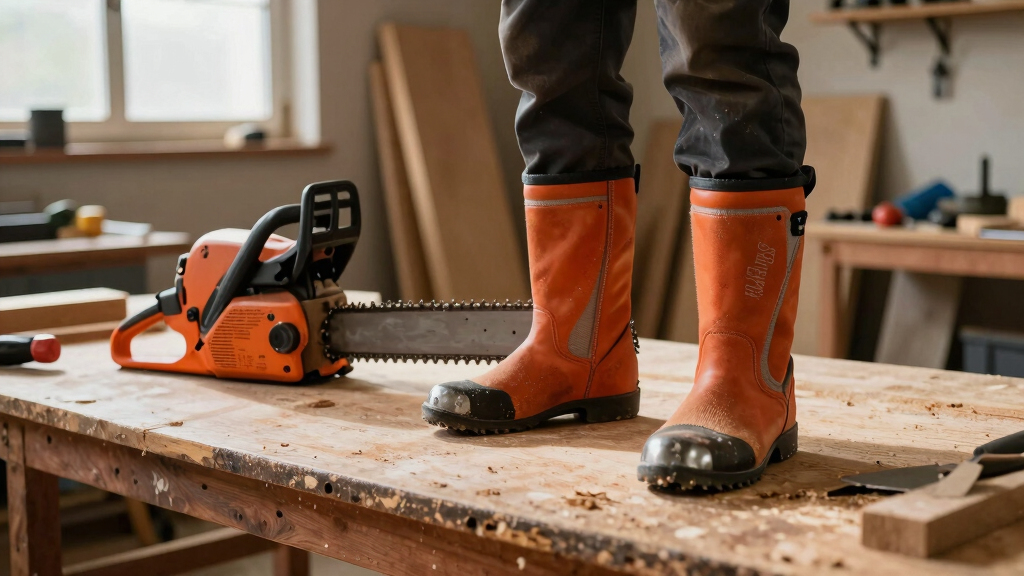
Class 1 chainsaw boots are rated to withstand chainsaws running up to 20 m/s, making them suitable for light to moderate use. Knowing the protection class helps you select the right PPE and stay safe on the job.
Imagine the crack of a chainsaw ripping through wood, the sharp scent of fresh-cut pine filling the air. Now, picture your feet shielded by rugged, specially designed boots — tough enough to stop a rogue chain from turning your workday into a nightmare. That’s the real power of understanding what Class 1 protection means in chainsaw boots.
Choosing the right PPE isn’t just about comfort or brand names; it’s about knowing what level of safety your boots offer. This guide clears up what Class 1 protection entails, how it stacks up against heavier-duty options, and why it matters for your safety and peace of mind on the job.
Class 1 chainsaw boots are rated to withstand chainsaws operating at speeds up to 20 m/s, suitable for casual and semi-professional use.
They use high-strength fabrics like Kevlar combined with impact-resistant soles to block chainsaw contact.
Always check certification labels to confirm compliance with EN 381-5 standards and protection class.
For heavy-duty logging or professional work, move up to Class 2 or higher for better protection.
PPE is a layered system—boots, chaps, helmets, and gloves must work together for real safety.
Chainsaw Boots Explained: What Class 1 Protection Actually Means
Class 1 chainsaw boots are tested against a chain speed of 20 metres per second. That makes them a practical match for many light-to-moderate tasks—but the rating is a test threshold, not a promise of invulnerability.
Key insight: match the protection class to the saw, the task and the risk—not simply to the boot brand or price.
What Class 1 tells you—and what it does not
The class describes performance under a controlled chainsaw-cut test. It helps compare protection levels, but real outcomes also depend on contact angle, chain condition, boot construction, wear, fit and the precise accident scenario.
Tested at 20 m/s
Class 1 corresponds to a test chain speed of 20 metres per second. It is commonly considered for casual, estate, landscaping and semi-professional work where the risk assessment supports it.
Resistance, not armour
Protective layers are designed to resist, slow or obstruct chain contact. No chainsaw boot can make the wearer immune to injury, and the class should never justify riskier technique.
The task sets the class
Compare the boot rating with your equipment, work frequency and operating environment. Higher-risk forestry or logging work may call for Class 2 or above.
A test rating is not a guarantee. A faster chain, damaged protective layers, poor fit, worn soles or an unusual contact can exceed the protection demonstrated in certification testing.
Protection works in layers
A rated boot combines cut-resistant components with structural and workplace protection. Exact materials vary by manufacturer, so the certification label and product documentation matter more than any single fibre name.
More speed means a tougher test
Moving up a class increases the chain speed used for the protective test. It can also add bulk, stiffness, cost or heat, so the right answer is the class required by a competent risk assessment—not automatically the highest number.
| Protection class | Test chain speed | Approx. mph | Typical context | Heavy-duty logging? |
|---|---|---|---|---|
| Class 0 | 16 m/s | ≈36 mph | ~Lower-risk, occasional tasks where permitted | ✗Generally unsuitable |
| Class 1 | 20 m/s | ≈45 mph | ✓Light-to-moderate or semi-professional use | ~Usually step up after assessment |
| Class 2 | 28 m/s | ≈63 mph | ✓Higher-risk professional and forestry work | ✓Stronger test threshold |
Use categories are indicative only. Employer rules, local law, equipment specifications and the task-specific risk assessment take priority.
Four ways protection can be undermined
A correct rating is only the start. Chainsaw PPE must remain intact, fit correctly and be used inside its intended conditions throughout the job.
The saw exceeds the class
Professional equipment or particular operating conditions may produce chain speeds beyond the 20 m/s Class 1 test level.
The barrier is compromised
Cuts, torn seams, exposed layers, sole separation or damaged fastenings can reduce the boot’s protective performance.
Control and coverage suffer
Loose, unstable or incorrectly sized footwear can impair footing and may leave protection sitting in the wrong position.
Traction and materials degrade
Mud, moisture, fuel, heat and debris can affect grip or accelerate deterioration. Follow the maker’s cleaning and care instructions.
Traceability / PPE is a connected safety chain
A four-step selection check
Start with the actual work rather than a product shortlist. Then verify that the exact pair—not merely the product family—carries the required marking and remains suitable for use.
Know the saw
Check chain speed, power, bar setup and the manufacturer’s operating information.
Rate the task
Consider frequency, terrain, weather, working position and professional requirements.
Read the label
Confirm the standard, protection class, size, manufacturer and certification marking.
Inspect every time
Look for cuts, tears, worn tread, failed seams, sole damage and insecure fastenings.
m/s
The bottom line: Class 1 is a defined protective test level suited to many light-to-moderate chainsaw tasks. It is most effective when correctly selected, properly fitted, regularly inspected and combined with safe technique and a complete PPE system.
What Does Class 1 Protection Actually Mean in Chainsaw Boots?
Class 1 protection indicates that the boots have been rigorously tested against chainsaws operating at speeds up to 20 meters per second (m/s). This measurement isn’t arbitrary; it directly relates to the kinetic energy of the chainsaw chain during operation. The faster the chain moves, the more energy it carries, and the greater the potential for injury if contact occurs. By testing boots at this specific speed, manufacturers ensure that their footwear can withstand accidental contact at typical operating speeds encountered in light to moderate work environments.
Understanding this threshold is crucial because it helps you gauge the level of risk your boots are designed to mitigate. For instance, if your chainsaw rarely exceeds 20 m/s, these boots provide a reasonable safety margin. However, if you’re working with high-powered professional equipment that can operate at higher speeds, relying solely on Class 1 protection might leave you vulnerable. Therefore, knowing the protection class informs your decision-making process, balancing safety, comfort, and the nature of your work.
It’s also important to recognize that the speed rating reflects a standardized test condition, not a guarantee that your boots will be invulnerable in every scenario. Factors like wear and tear, material fatigue, and improper fit can affect performance. As such, understanding what Class 1 protection offers helps you make more informed choices and encourages proper maintenance and inspection routines to ensure ongoing safety.
As an affiliate, we earn on qualifying purchases.
How Do Chainsaw Boots Meet Class 1 Standards? The Materials and Testing Process
To achieve a Class 1 rating, chainsaw boots undergo a comprehensive testing regimen based on the EN 381-5 standard, which specifies the methods for evaluating chainsaw protective clothing. These tests simulate real-world scenarios by running chainsaws at controlled speeds across fabric samples and entire boots. The primary goal is to assess the material’s ability to resist cuts, punctures, and impacts caused by chainsaw teeth.
The materials used in these boots, such as Kevlar, high-strength synthetics, and impact-resistant soles, are selected for their combination of durability and flexibility. During testing, the chainsaw is operated at the maximum specified speed—20 m/s—and repeatedly passed over the fabric or boot surface. If the chain cannot cut through or cause significant damage after multiple passes, the boots earn their Class 1 certification.
This rigorous process not only verifies the material’s resistance but also highlights the importance of construction quality. Well-designed boots with reinforced stitching, layered fabrics, and protective linings are more likely to withstand accidental contact. The testing process pushes these materials to their limits, providing confidence that the boots will perform reliably in real-world accidental encounters, especially when maintained properly. Advances in material science have also enabled manufacturers to create lighter, more comfortable boots without sacrificing safety, which is crucial for prolonged use in demanding environments.
As an affiliate, we earn on qualifying purchases.
Compare Class 1 to Other Chainsaw Protection Classes — What’s the Difference?
| Protection Class | Maximum Chainsaw Speed | Best For |
|---|---|---|
| Class 0 | 16 m/s (~36 mph) | DIY projects, occasional use |
| Class 1 | 20 m/s (~45 mph) | Light to moderate use, semi-professional |
| Class 2 | 28 m/s (~63 mph) | Heavy-duty logging, professional work |
Understanding these differences is essential because it helps you match your safety gear to the specific demands of your work. For example, choosing Class 0 boots for occasional DIY tasks might be sufficient, but underestimating your needs could be dangerous if you encounter higher-powered equipment or unexpected chainsaw speeds. Conversely, selecting a higher protection class than necessary can lead to unnecessary weight, cost, and reduced comfort, which might discourage consistent use or cause fatigue.
Tradeoffs also exist in terms of flexibility and weight. Higher-rated boots often incorporate thicker, more layered materials, which can be heavier and less comfortable for prolonged wear. Therefore, understanding the specific protection levels and their implications allows you to make balanced choices—maximizing safety without sacrificing comfort or mobility.
As an affiliate, we earn on qualifying purchases.
What Are the Limits of Class 1 Chainsaw Boots?
Class 1 boots provide a significant safety margin for casual and semi-professional users, but they are not designed for the highest speeds or most demanding environments. Chainsaws used in professional logging or heavy-duty forestry often operate at speeds exceeding 20 m/s, where the energy transferred during a contact can surpass what these boots are rated to handle. Relying on Class 1 gear in such scenarios can lead to serious injuries, as the protective barriers may be inadequate against higher-velocity chains.
It’s crucial to understand that the protective capabilities of boots are directly linked to their certification standards. Using boots rated for lower speeds in high-risk environments creates a false sense of security, which can be dangerous. Moreover, environmental factors such as wet conditions, dirt, or debris can degrade the materials over time, reducing their effectiveness. Regular inspection and proper maintenance are essential to ensure ongoing protection. Small tears, worn soles, or compromised linings can significantly diminish the protective barrier, increasing the risk of injury during an accident. Properly maintained boots, used within their rated safety parameters, are vital for minimizing risk in demanding work scenarios.
As an affiliate, we earn on qualifying purchases.
How to Pick the Right Chainsaw Boots for Your Job
- Assess your chainsaw’s typical speed and power. Is it a small homeowner saw or a heavy-duty professional machine? Understanding your equipment’s capabilities helps determine the necessary protection level, ensuring you don’t underprotect or overburden yourself with unnecessary weight.
- Match your work frequency and risk level to the protection class. For occasional DIY projects, Class 0 or 1 may be sufficient, but for regular or high-risk tasks, consider Class 2 or higher to ensure maximum safety margins. This decision can be a matter of balancing comfort, mobility, and safety.
- Check certification labels carefully. Look for EN 381-5 compliance and the specific protection class, which verify that the boots meet recognized safety standards. Don’t rely solely on brand reputation; always verify certification to ensure performance in real-world scenarios.
- Prioritize fit and comfort. Ill-fitting boots can cause fatigue, blisters, or distraction, all of which increase the risk of accidents. Properly fitted PPE ensures that protective features remain effective during prolonged use, and comfortable boots are more likely to be worn consistently and correctly.
For example, a homeowner tackling a few trees annually might opt for Class 1 boots, appreciating their balance of protection and comfort. Conversely, a professional logger working daily with high-powered chainsaws should invest in higher-rated boots, recognizing that safety and durability are paramount in demanding environments. Matching PPE to your actual work conditions minimizes risk and enhances confidence in your safety gear.
What Else Should You Wear Alongside Chainsaw Boots?
Chainsaw boots are a vital component of a layered safety system, but they shouldn’t be your only protection. For comprehensive safety, you should wear:
- Chainsaw chaps or pants — made from cut-resistant fabric, these protect your legs from chainsaw teeth and splinters, significantly reducing injury severity in the event of contact. They act as an additional barrier, often absorbing or deflecting impacts that could otherwise cause serious injury.
- Helmet with face shield — head injuries and flying debris are common hazards. A helmet combined with a face shield or goggles prevents fractures, lacerations, and eye injuries. Proper head protection can mean the difference between minor cuts and life-altering trauma.
- Gloves — provide grip and impact protection, helping you control the saw and reduce vibration-related fatigue. Well-fitted gloves also improve safety by preventing slips and offering some abrasion resistance.
- Ear protection — chainsaws produce noise levels that can cause permanent hearing loss. Ear muffs or plugs are essential for prolonged use, protecting your hearing health and reducing fatigue caused by noise exposure.
Think of PPE as an integrated system: each piece plays a crucial role, and their combined use ensures comprehensive safety. Neglecting one element can compromise the entire protection strategy, so always gear up fully before starting work. Properly combining these elements maximizes your safety margins and helps you work more confidently and efficiently.
How Often Should You Check or Replace Your Chainsaw Boots?
Regular inspection of your chainsaw boots is critical to maintaining their protective integrity. Before each use, examine them thoroughly for cuts, tears, worn soles, or any signs of deterioration. Small damages might seem insignificant but can quickly compromise the barrier they provide, especially during high-stress or prolonged work sessions.
If you notice any damage, replace the boots immediately. Worn-out or damaged boots lose their ability to absorb impacts and resist chainsaw contact, drastically increasing your risk of injury. Additionally, ensure that the boots fit snugly—loose-fitting footwear can cause slips or missteps, especially on uneven terrain.
Remember, PPE is an investment in your safety. Regular maintenance and timely replacement are essential to ensure that your protective gear functions as intended when it matters most. Incorporate routine checks into your safety protocol, and don’t delay replacing gear that shows signs of wear to keep your protection at peak performance.
Frequently Asked Questions
Can I use Class 1 chainsaw boots for professional logging?
Class 1 boots are designed for chainsaws operating up to 20 m/s, suitable for light to moderate work. For heavy-duty logging, Class 2 or higher-rated boots are recommended to ensure proper protection against faster chainsaw speeds.How do I verify my chainsaw boots meet safety standards?
Look for certification labels indicating compliance with EN 381-5 standards, specifically listing the protection class. Always buy from reputable suppliers who provide certification info.What happens if my boots get a cut or tear?
Any damage can compromise the protective layers, making your boots less effective. Inspect your boots regularly and replace them if you notice cuts, tears, or worn soles.Is it better to get lightweight or heavy-duty chainsaw boots?
It depends on your work. Lightweight boots with Class 1 protection are great for occasional or light projects. Heavy-duty, higher-rated boots are essential for frequent, professional, or high-risk tasks.Should I wear other PPE with chainsaw boots?
Absolutely. Full safety comes from layered PPE—chainsaw chaps, helmet with face shield, gloves, and ear protection all work together to shield you from different hazards.Conclusion
Knowing what Class 1 protection actually offers saves you from under- or overestimating your safety gear. When choosing chainsaw boots, match the protection class to your work’s speed and intensity — don’t just settle for the cheapest or lightest pair.
Think of PPE as your armor. Invest in the right gear, inspect it regularly, and respect its limits. That way, you stay safe, confident, and ready to handle anything the job throws your way.
Fall yard work Picks
leaf blowers
As an affiliate, we earn on qualifying purchases.